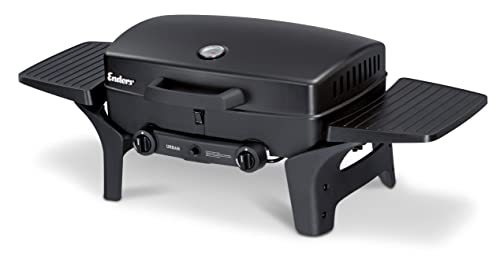
The URBAN is a gas tabletop grill from Enders with two burners, a two-part cast iron grate and pot supports for cooking. On Amazon it is listed at approx. €191 (Amazon page on 21.10.2026: €190.70). Enders’ recommended retail price is €199.00.
Item 2095: the first Urban
Enders Colsman from Werdohl, a company with roots going back to 1883, sells the grill under item number 2095. The product page shows three versions of the first Urban generation side by side: this tabletop grill, the Urban Trolley (2081, RRP €299.00) and the Urban Pro Trolley (2080, RRP €349.00). There is now a successor, the Urban II, which we cover further down.
There is no direct link from Enders to the Amazon listing. The claim that the tabletop model is sold under ASIN B0144KSXVO rests on the addition #2095 in the Amazon title and the part number 2095 in the catalogue.
In our gas grill category, the URBAN sits at the small end. It has no legs in the proper sense, but two plastic frames with a carrying handle, so it needs a surface to stand on.
Body, hood, burners: what is built in
The body is made of powder-coated cast aluminium. The cooking hood is powder-coated steel, and the thermometer sits in it. In the product photo, the hood is rectangular with strongly rounded edges, the round thermometer sits at the top centre, below it is a wide cross handle, and ventilation slots can be seen on the right side of the hood.
Under the grate are two stainless steel burners of 2.2 kW each, 4.4 kW together. At the front of the control panel are two control knobs with a separate ignition button between them. Ignition is by piezo, as follows: open the hood, turn both knobs to Off, open the bottle valve, press one knob and turn it to the highest setting, then press the piezo igniter. Once one burner has lit, according to the instructions the second lights automatically as soon as the first control knob is at full power.
The grate is a solid, enamelled cast iron grate with integrated flame covers, supplied as two halves for left and right. Enders gives the grilling area as 48 x 32 cm, which is 1,536 cm². Underneath, two removable grease trays catch what drips through.
On dimensions: assembled, the URBAN is 94 cm wide, 42 cm deep and 34 cm high. The two plastic side shelves can be removed and stored to save space, which leaves a width of 70 cm. Enders gives the weight as 13 kg and the working height as 23 cm. Amazon’s catalogue lists dimensions of approx. 37 x 20 x 13 cm, which match none of these figures; we do not use them.
The grill does not come out of the box fully assembled. You attach the hood handle, the two frames (with four screws from above), cast iron grates, side shelves, grease trays and thermometer yourself. When unpacking, Enders advises wearing safety gloves because individual parts can have sharp edges, and requires you to remove all protective films before assembly. Before the first grilling, the burners run for 15 minutes without food so that preservative residues burn off; the colour of the hood and combustion chamber may change in the process.
In detail: two burners, three operating modes
Two separately adjustable burners mean two zones. For direct grilling, you cook over the burning flame. For indirect grilling, according to the instructions you place the food over the switched-off burner, leave the other one running and close the hood. The hot air under the lid then cooks the food without the flame hitting it from below. Our guide to direct and indirect heat explains when each zone makes sense.
With a grate width of 48 cm and two halves, each zone has roughly 24 x 32 cm. That is our reading of the design.
One figure that lets you compare gas grills with each other is output per area. For the URBAN, that is 4.4 kW over 1,536 cm², around 2.9 W per cm². According to Weber, the Weber Q 1200N manages around 2.3 W per cm² with 2.93 kW over 1,290 cm², and the Spirit II E-310 around 3.0 with 7.0 kW over 2,314 cm² of main grate. More output per area generally means the grate recovers its temperature faster after cold food is put on. This figure does not tell you how hot it gets under the hood at most. According to Enders, preheating takes approx. 10 to 15 minutes at full power, depending on outside temperature and wind.
For the cooking function, you remove the grill grate and place the pot on the chrome-plated pot supports. The instructions recommend diameters of approx. 16 to 20 cm and say they should not exceed 20 cm. A saucepan fits, a 24 cm frying pan does not. Steaks on the left and a side dish in a pot on the right at the same time: the instructions do not describe it that way. Since the grate consists of two halves, we think it is plausible that one side can be removed on its own, but this is not documented.
Baking is done over the indirect zone, always with the hood closed. Enders names pizza, flammkuchen (Alsatian-style thin tarte) and bread. You preheat the pizza stone, offered in the accessories as a ceramic stone with a diameter of 32 cm (item no. 8791), for approx. 10 to 15 minutes at approx. 180 to 200 °C. At 32 cm, it matches the depth of the grilling area exactly.
How long does a gas bottle last on the URBAN?
By our calculation, an 11 kg bottle lasts a good 34 hours with both burners at full load, an 8 kg bottle a little under 25 hours and a 5 kg bottle a good 15 hours. Throttled back or with only one burner, it lasts longer.
The basis is the nominal heat input on the rating plate in the instructions: ΣQn Hs 4.4 kW at 321 g/h. The sum sign shows that the 4.4 kW applies to both burners together, and if you convert this output into grams per hour using the calorific value of liquefied gas, you land almost exactly on 321 g.
The URBAN is designed for propane (G31) and butane (G30), appliance category I3B/P(50) for Germany and Austria, 50 mbar, nozzle 0.65 mm. It is approved to DIN EN 498:2012 and DIN EN 484:2015 (German editions of European standards), product identification number 0085CQ0040. For bottle operation, hose and pressure regulator are supplied: a 50 mbar regulator to DIN EN 16129, type 694, and union nuts to DIN EN 16436-2. Enders recommends a hose length of 0.8 m, and the bottle stands next to the grill.
For the screw-in cartridge you need a different regulator, type 794 to DIN EN 16129, suitable for cartridges of approx. 450 g and a 7/16 inch thread. The regulator comes in the cartridge holder set, which according to the Amazon listing, with item no. 2092, is not included. Which bottle size suits which grilling habits is covered in our guide Gas bottle for the grill.
What else is worth considering?
| Model | The difference | Price | Our rating | Choose this one if |
|---|---|---|---|---|
| Enders URBAN tabletop grill (this one) | 2 burners of 2.2 kW each, pot supports, 48 x 32 cm | approx. €191 | 8.1 | you want to grill at the table and occasionally put a small pot on |
| Enders Urban II tabletop grill | Successor with reversible grate, 49 x 32 cm, 12 kg | approx. €169.90 | 8.2 | you want the same idea in the newer version |
| Weber Q 1200N | 1 burner of 2.93 kW, cartridge operation | approx. €249 | 8.3 | you cannot store a gas bottle and one heat zone is enough |
| Weber Spirit II E-310 | Grill trolley, 3 burners, 7.0 kW, 2,314 cm² main grate | approx. €459.99 | 9.2 | you have a garden and often grill for larger groups |
The prices are guide values from our price boxes and change constantly. The rating is our editorial assessment based on the data comparison; we have not grilled on any of the four units.
When the URBAN fits and when another one does
What speaks against it most right now is its own successor. The Urban II is listed in our price box at approx. €170 against approx. €191 for the URBAN, even though Enders sets the same RRP of €199.00 for both. According to Enders, it has a cooking hood of powder-coated steel like the URBAN, the same output and a 49 x 32 cm grate. On top of that comes a reversible function: according to the instructions, the grate is turned over to give a frying surface. At 12 kg it is one kilo lighter. As long as the gap stays like this, we would go for the Urban II.
Then there is the placement. With a working height of 23 cm, the URBAN belongs on a table, a wall or a base. On a 75 cm high garden table, the grate would sit at around 98 cm. The table must have at least 70 x 42 cm free, or 94 cm in width with the shelves attached. Enders names the balcony as a place of use in the product description. The instructions, however, require outdoor operation and clearances that are quoted verbatim below, and the clearance above is quickly too tight under a balcony ceiling. Whether gas is allowed on your balcony is governed by your tenancy agreement and house rules; more in the guide Grilling on a balcony.
No room for a bottle? Then the question works out differently. The Weber Q 1200N runs on cartridges to DIN EN 417 (German edition of the European standard) and costs approx. €249 according to the price box against approx. €191 for the URBAN. If the cartridge holder set at the RRP of €34.90 is added for the URBAN, the gap narrows. The Weber then has one burner with electronic ignition and a weight of 11.0 kg, while the URBAN has two zones.
Enders does not say how many people the area can feed. Our assessment: 48 x 32 cm suits two to four people. If you regularly grill for eight, you are better served by a grill trolley such as the Weber Spirit II E-310, which however is listed at approx. €460 in the price box and weighs 44.50 kg according to the Weber product page.
You can carry the URBAN by the carrying handles of the frames, though 13 kg is no lightweight. Before every move the bottle comes off, as the instructions require.
Setting up, connecting, cleaning: the wording of the instructions
The German instructions for item no. 2095 have several pages of safety notes. Here the points on setup, operation, connection and cleaning are given as Enders words them. Grease fires, bottle storage and maintenance intervals are answered in the questions below.
Setup: Use the gas grill outdoors only and make sure it stands sheltered from wind; the design of the body does protect the burners against wind, but that changes nothing about this. Keep it away from moisture and splashing water and place it on a level, stable surface. The distance to flammable and heat-sensitive materials must not be less than 30 cm. There must be no objects or parts of buildings above the grill below a height of 150 cm. The ventilation openings stay clear. Do not smoke while handling the gas system, and the bottle must not stand near open fire.
Operation: While in operation, the unit is not moved and not left unattended. You check the hose and pressure regulator for cracks before every use; if the pressure regulator, hose or bottle is defective or leaking, the grill stays off. The bottle valve is open only while the grill is running. After use and before every change of location: grill off, valve closed, bottle removed, so that regulator and hose are protected. The grilling surface must not be covered completely with aluminium foil or similar, otherwise there is a risk of overheating. Enamelled cast iron grates must not come into contact with strongly acidic foods. If gas escapes or there is a fault, you close the bottle valve immediately. You protect the bottle from strong sun; it must not get warmer than 40 °C.
Connection: The grill may only be operated with a pressure regulator; the supplied one is set at the factory for liquefied gas, and its own installation instructions apply in addition. When connecting or changing the bottle, there are no ignition sources nearby. The union nuts have a left-hand thread. On the pressure regulator you tighten the hose nut with a spanner, and on the bottle valve you tighten the regulator by hand only, without tools, so that the seal stays intact. On the grill you screw on the hose after removing the protective cap and hold against it with a second spanner on the flats. The hose must not be kinked or chafe and must be accessible along its whole length. Then you spray all connection points with leak detection spray or brush them with soapy water (1 part soap, 3 parts water) and open the valve. If bubbles appear, close the valve, retighten and check again. A leak test with an open flame is strictly prohibited. Finally, you clean the spots with water. Hose and regulator must be replaced at regular intervals, and also when national regulations or the validity period of the hose assembly require it.
Cleaning: Only once the grill has cooled down sufficiently, and before every use and after every use. Flammable, abrasive and chlorine-containing cleaning agents are excluded. You pull out the grease trays and dispose of the fat in an environmentally responsible way. After every grilling session you remove residues from the inside of the hood and the cast iron grates with a mild agent, rinse and dry. The burners get a soft brush, not a metal brush. You wipe the inside of the body with warm soapy water. You clean plastic parts with warm water, without solvent-based cleaners, stainless steel cleaners or scouring agents. Painted surfaces take a mild cleaner and warm water, followed by a soft cloth; oven and stainless steel cleaners do not belong on them. Enders recommends its grill grate cleaner and its grill cleaner. Everything must be completely dry before the next use. The grill is stored frost-free and dry, with the hood closed and covered. General tips on the process are collected in our guide Cleaning a gas grill.
Accessories and what Enders leaves open
On the URBAN product page, Enders lists a cast iron reversible plate 1/2 for €45.90, a stainless steel grill pan for €64.90, the pizza stone with holder for €34.90 and a stainless steel wok for €29.95. If you miss the frying function of the Urban II, you get it through the reversible plate. The cartridge holder set is listed there as an accessory for the Urban and Explorer Next series. The instructions also mention a base for the stand version. Enders runs its own shop for spare parts.
The cover is where it gets unclear: the only cover on the page is the Premium weather protection cover for the Urban II and Explorer II series at €19.99, and Enders does not say whether it fits the first generation properly.
According to the product page and the instructions, these points also remain open: the maximum temperature under the hood, the measuring range and accuracy of the thermometer, the grade of stainless steel in the burners, the material of the grease trays and of the pot supports beyond “chrome-plated”, the country of manufacture, the year of market launch, the item number of the base and a number of people for the grilling area.
Who is it for?
The instructions define the target group themselves: the grill may only be used outdoors, it is not intended for use by children and people with a reduced ability to operate appliances, accessible parts can get very hot, so you warn bystanders and keep children away, and you wear protective gloves when handling hot components.
The URBAN is the wrong choice for anyone who wants to cook with large pots. At 20 cm that is the limit; a paella pan or a pasta pot for six belongs on a cooker with a larger stand.
We find it suitable for a small household with an outdoor table that wants to switch between grilled food and a side dish and does not want to set up a second stove. Whether a tabletop unit or a grill trolley suits you better is something you can work through in the Grill Finder.