What the San Francisco 3+1 is
El Fuego sells the San Francisco as a gas grill trolley with three main burners and one side burner, model number AY5632. Among our gas grills, it is one of the three-burner models at around €200: on Amazon on 21.10.2026, no Amazon warehouse offered it, only marketplace sellers; the cheapest new price was approx. €200 (€199.99). Two siblings from our catalogue are almost level: the Royal Gourmet 3+1 at approx. €199.99 and the TAINO Red 4+1 at approx. €199.90.
Where the information comes from belongs at the start for this grill. The El Fuego website was not accessible during our research. What we have is the Amazon catalogue entry with the manufacturer’s details and three manufacturer documents that the DIY store toom provides for the item: a dimensional drawing, a parts list with an exploded drawing on which AY5632 appears, and an instruction manual. However, this manual belongs to the larger 4+1 version AY5631 from the same series. Its texts on safety, gas and care are written for the series in general, which is why we quote them, always as the series manual. We do not carry its technical data over to the 3+1.
The series manual names ARTE Living GmbH in Hilpoltstein as the party placing it on the market. According to the same document, the grill is intended only for private use, only for preparing food and exclusively for outdoor operation.
Burners, grate and housing
The three main burners are stainless steel and, according to the manufacturer, 3 kW each, so 9 kW together. The side burner adds 2.5 kW, which gives the 11.5 kW total output on the data sheet. For the cooking chamber only the 9 kW count, because the side burner sits outside the lid and heats a pot or pan.
According to the manufacturer, the grate is made of 100% solid cast iron and measures 48 x 42 cm. That works out at 2,016 cm²; we calculated this area ourselves from the two edge lengths. In the parts list, the main grate consists of two cast pieces (position 30), plus a warming rack (position 31) that is part of the delivery. The dimensional drawing confirms 48 cm as the width of the grilling chamber.
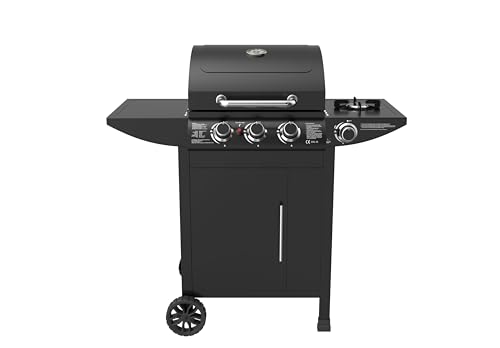
For the housing, El Fuego speaks of a steel construction in black. The product photo shows a domed lid with a thermometer, and beneath it the control panel with three dials for the main burners and a fourth dial at the far right for the side burner, which is set into the right-hand shelf. According to the dimensional drawing, the left side shelf measures 31 x 43 cm, and its top edge is 83 cm above the ground. Beneath the grilling chamber is a closed base cabinet with a door. It rolls on two wheels on the left side, and on the right the trolley stands on feet.
Assembled, it measures 110 x 104.5 x 57 cm (width, height, depth). That is what the Amazon catalogue says, and the dimensional drawing arrives at the same values. The box contains a gas hose and a pressure regulator. For assembly, the parts list shows a screwdriver and an open-end spanner. The series manual advises assembling it with two people and only tightening the screws hand-tight during assembly, and warns of sharp edges that may be present on the components despite care.
In detail: what 9 kW on 2,016 cm² means
A kW figure on a gas grill describes how much gas the burners can burn, converted into output. How much of that reaches the grate depends on things no data sheet quantifies: how tightly the lid closes, how the flame tamers above the burners are shaped, and how much heat passes through the walls. The figure only becomes comparable when you relate it to the area.
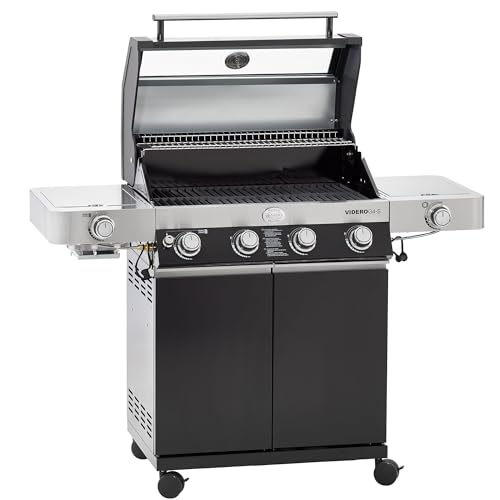
On the San Francisco, 9 kW falls on 2,016 cm², which is around 4.5 kW per 1,000 cm². The Royal Gourmet 3+1 has the same 9 kW on a grate of 46 x 41.5 cm, by our calculation around 4.7 kW per 1,000 cm². The TAINO Red 4+1 spreads 4 x 2.5 kW over approx. 61 x 42 cm, which gives around 3.9. The Weber Spirit II E-310 comes in at 7.0 kW on 2,314 cm², around 3.0, although Weber explicitly gives the 7.0 kW for propane. A higher figure means more gas per area with the dials fully open. It does not follow that the grate is hotter or more even.
The split matters more for use. Three equally strong burners side by side allow an indirect zone. The usual approach is to leave one outer burner off, place the food above it and cook with the heat of the other two with the lid closed. On a chamber width of 48 cm, each burner works out at a lane of about 16 cm. Such a lane is narrow for a large roast, but in our assessment it is enough for chicken legs or thick bratwursts.
The thermometer in the lid measures the air under the lid. That applies to every lid thermometer: temperatures at the grate, and even more so inside the food, are different, so for core temperature you need a probe thermometer.
On the cast iron: a solid cast grate has a lot of mass. It takes longer to get hot, but when cold food is placed on it, it gives up its stored heat at the contact surface instead of cooling down immediately like a thin wire grate. Bare cast iron rusts without an oil film, enamelled cast iron does not. The catalogue leaves open which of the two finishes El Fuego uses; “100% solid cast iron” describes the material, not the surface.
Where can the grill stand?
Only outdoors and with plenty of air around it. The series manual requires a level, fireproof surface and at least 1 m clearance from flammable materials. The gas bottle stands to the right of the grill, not in the base cabinet. On most balconies, this cannot be met in our reading.
The series manual lists in one place what must be met for the setup location. The grill must stand so that children and pets cannot come into contact with it; not in or directly beside corridors, paths and busy areas; without excessive weather exposure, with strong winds and snow named; without a risk of tripping or falling in the immediate surroundings; on a non-combustible, level, firm, stable and non-slip surface; with no structures nearby, with the addition “radius approx. 3 metres”; so that you can monitor it precisely at all times during operation; and so that the gas hose is not twisted. On the last point, it adds that the gas connection is on the right side of the unit and the bottle should therefore also stand to the right of the unit.
A second sentence in the manual concerns the base cabinet directly: placing or storing the gas bottle inside the grill, for example in the base cabinet, is not permitted. On other grill trolleys, the cabinet is there for exactly this. The Weber Spirit II E-310, for instance, takes bottles of up to 13 kg in the base cabinet according to the Weber manual.
A balcony in an apartment building has a house wall, a parapet and usually another balcony above, all much closer than the stated radius. On top of that come the tenancy agreement and house rules, which El Fuego naturally does not regulate. What is usually allowed there is covered in our guide Grilling on a balcony.
For operation itself, the series manual provides for grill or kitchen gloves to DIN EN 407 (a standard that applies in Germany), no loose clothing, a fire extinguisher and first-aid kit kept at hand, and the rule of neither leaving the grill unattended nor moving it during operation. After each use, you turn off the gas supply at the bottle. You should not store the bottle above 50 °C and keep it away from fire or flammable materials.
Connecting the gas and checking for leaks
According to the series manual, you may only put the grill into operation if three conditions are met: a faultless gas pressure regulator certified to EN 16129:2013 is fitted; a faultless, unworn flexible gas hose of no more than 150 cm with a G 1/4“ connection is fitted; and the hose is routed without kinks and without contact with other components. If one of these points is missing, you must refrain from operating it. According to the manual, you can get pressure regulators and hoses from specialist retailers or from the gas supplier. You must replace the hose if national regulations or the validity period stated on it require it, and worn hoses in every case.
Before connecting, you check six things: the bottle valve is closed, the correct external thread is present, all burners are off, the valve connection and regulator are free of damage and dirt, the hose has no damage or blockages, and there is no ignition source nearby, including when changing the bottle. You screw the pressure regulator onto the valve with the union nut anticlockwise, by hand, because hard tools can easily damage the nut. The retaining clips must engage fully.
The leak test is mandatory before first use, then at regular intervals and whenever you smell gas. It takes place outdoors, away from ignition sources such as electrical devices, open flames and flying sparks, with no smoking, with flames out and burners switched off. You mix a light soap solution from soap and lukewarm water, open the bottle valve and apply the solution to every point of the gas line system, from the bottle to the burners. If bubbles form, the connection is leaking: close the valve clockwise and check whether the leak can be fixed. If you hear a whistling sound when opening, you close the valve immediately, because there is most likely damage to the connections, and you call the fire brigade and, if necessary, a gas systems technician. Which bottle size suits you is covered in our guide to the gas bottle for the grill.
Cleaning and care according to the series manual
The series manual recommends cleaning the grill after every use, saying it considerably extends its service life. Beforehand, you let the grill cool down completely. Chemical cleaners are ruled out because the product comes into contact with food.
You remove coarse dirt from the grates with a suitable brush and then rinse them with a brush or sponge and plenty of water, with a little washing-up liquid in the water for stubborn dirt. As preparation, you can wrap the grate in wet newspaper, which loosens the dirt beforehand. You wipe the other surfaces with a damp cloth and clean water; optionally, you apply a thin layer of cooking oil with kitchen paper. As a general rule for bare cast iron, it must dry thoroughly after washing before rust sets in.
For the burners, the manual describes this procedure: shut off the gas supply, remove the gas distributor if necessary, and look inside the burners with a torch. Then clear the openings at the burner ends and the valve nozzles with a wire and clean the outside of the burners with a steel brush. The reason is given right alongside: clogged or blocked burners worsen gas flow and combustion, increase gas consumption and can increase wear.
Spiders are mentioned separately. According to the manual, they nest mainly around the burner tube and disturb or block the gas flow there. Gas can then escape by an unwanted route, above all from the burner air openings, and cause a fire behind the control panel. More on the procedure for gas grills in general is in the guide Cleaning a gas grill.
What the manufacturer does not state
For the 3+1, it is precisely the gas figures that are missing. Gas consumption in grams per hour, gas pressure, gas category, nozzle sizes and the approved gas type are not documented anywhere for the AY5632, nor is the outlet pressure of the supplied pressure regulator or the length of the hose. That also makes it impossible to calculate how long a bottle lasts. It also remains open how the ignition works: the series manual shows a separate ignition button on the 4+1 control panel, but does not say whether it is piezo or electronic.
For the rest of the construction, the following are missing: the material of the lid, combustion chamber and housing in detail (only the steel construction is documented), whether the lid is double-walled, what material the flame tamers are made of, how the grease collection is built, whether the wheels have a brake, the measuring range and accuracy of the thermometer, maximum temperature and heat-up time, the surface of the cast iron grate, a weight from the manufacturer (the Amazon catalogue gives approx. 27.0 kg), a number of people for the grilling area, a matching cover with a model number, and the country of origin.
What else is worth considering?
| Model | The difference | Price | Our rating | Choose this one if |
|---|---|---|---|---|
| El Fuego San Francisco 3+1 (AY5632) (this one) | Cast iron grate 48 x 42 cm, side burner, hose and pressure regulator included | approx. €200 (marketplace sellers) | 7.9 | you want a side burner and the bottle can stand next to the grill |
| Royal Gourmet 3+1 | same burner output, pull-out grease tray, hooks for tongs and gloves | approx. €199.99 | 7.8 | a pull-out grease tray matters more to you than a cast iron grate |
| TAINO Red 4+1 | four main burners, piezo ignition in every dial, enamelled grates, no gas regulator included | approx. €199.90 | 7.7 | you often grill for larger groups and buy the regulator separately anyway |
| Weber Spirit II E-310 | no side burner, bottle can go in the base cabinet, voluntary Weber warranty | approx. €459.99 | 9.2 | a long warranty and a stowed gas connection matter more to you than a side burner |
The prices are guide values from our price box and change; for the San Francisco it is the marketplace price from 21.10.2026. The ratings are editorial assessments from the respective reviews and not measurement results; the table says nothing about durability after several winters.
When the San Francisco fits and when another grill does
First, the location. If you cannot meet the clearance and the bottle rule from the section on setup, the San Francisco is out, however well the rest fits. If you want to keep the bottle in the grill trolley, the Weber Spirit II E-310 (according to the manual, bottles of up to 13 kg in the base cabinet) and the TAINO Red 4+1 (integrated holder for 5 to 8 kg, according to the manual no taller than 500 mm) are options, but the San Francisco is not. According to the price box, the Weber costs approx. €459.99, has no side burner, and according to the Weber manual a voluntary warranty that covers the grilling chamber for 10 years against rust-through and burn-through.
Then the number of people. The TAINO Red 4+1 has, at approx. 61 x 42 cm, 2,562 cm² of grate by calculation, which is 546 cm² or around a quarter more than the San Francisco, at almost the same price (TAINO approx. €199.90 according to the price box). However, the TAINO comes without a gas regulator, which you add to the price. If you regularly grill for larger groups, we would lean towards the TAINO.
The Royal Gourmet 3+1 is the closest counterpart: the same 3 x 3 kW plus a 2.5 kW side burner, approx. €199.99 according to the price box. It has a pull-out grease tray, a stainless steel warming rack of 42.2 x 12 cm and hooks on the left side. The catalogue does not say what material its main grate is made of. If you specifically want cast iron, the El Fuego is right; if you want more convenient grease collection, the Royal Gourmet.
You only need the side burner if you work with a pot or pan at the same time. If you grill only on the grate, you pay for a component you do not use on all three grills at around €200.
The San Francisco is the wrong choice for three groups. Anyone who wants to grill on the balcony of an apartment building will in all likelihood not be able to meet the setup rules of the series manual there. Anyone who wants to calculate before buying how many grilling hours a gas bottle gives will find no consumption value for the 3+1. And anyone who had planned a place in the base cabinet for the bottle has to put it next to the grill here. If you are unsure which grill type suits your space, the Grill finder helps.