Two lids, three knobs: what the Quattro 900 is
The Cozze Quattro 900 is a tabletop gas unit with two cooking areas side by side, each under its own lid. Cozze calls it a 4-in-1 station and lists four functions: plancha, grill, steak station and pizza oven. In the German manual, the same unit is called more soberly “3B QUATTRO Plancha-Grill”.
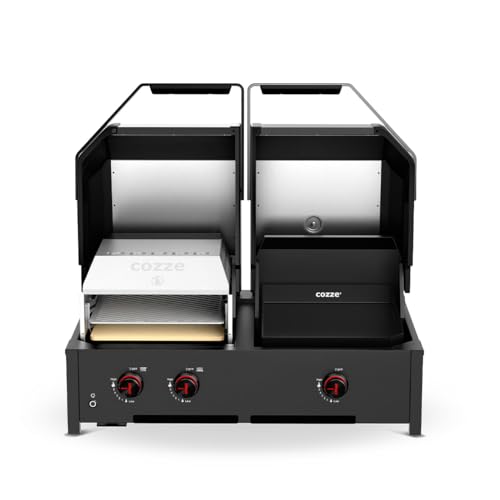
In the product photo, both lids stand open. They are hinged at the back, each has a bar handle on top, and they leave the inside in view. On the left stands a light-coloured box with the Cozze lettering, under which a grate and a light-coloured plate can be seen. On the right sits a black, flat insert, and a round gauge is mounted on the inside of the right lid. Under the left half are two control knobs, under the right one. According to Cozze, the housing is made of galvanised, powder-coated steel in black.
The manual names Millarco International A/S, based in Lystrup, Denmark, as the manufacturer. Where the unit is made is not stated in any source. By its own account, the Cozze brand has existed since March 2021.
We list it in the pizza ovens category. That fits exactly one of its four functions, and it has consequences for the comparison further down: the siblings in the table are pure ovens. Our price box lists approx. €869 for the Quattro (Amazon page on 20 October 2026).
Burners and output: three sources, three ways of counting
How many burners the Quattro has depends on whom you ask. The Amazon listing speaks of three gas burners and two infrared burners. The Cozze product page lists two U-shaped burners made of SS409, “3 kW / 4 kW 30 mbar each”, and next to them an entry for infrared: “each burner 3 kW / 3 kW”. What the two values on either side of the slash stand for, the page does not explain.
The clearest is the ignition guide in the manual. It knows three control knobs: A for the infrared burner, B and C for the stainless steel burners. In the drawing on page 5, A points to two infrared surfaces in the left lid, B to a burner under the pizza oven insert on the left, and C to a U-shaped burner under the right side. That matches the three knobs in the photo. Whether the two infrared surfaces are one burner with two fields or two burners on one valve, the text does not say. The type table lists four nozzle sizes (0.86, 0.86, 0.68 and 0.83 mm), which in our reading points more towards two infrared burners. The “three plus two” count, which also appeared in earlier versions of this page, is in any case not backed by any manufacturer source.
SS409 is a ferritic chromium steel, as is common for gas burners. It is magnetic and less resistant to corrosion than austenitic 304 stainless steel, but cheaper and heat-resistant.
For output there are two figures. The product page states 13.0 kW. The type table in the manual gives a heat input of 13.7 kW, based on the gross calorific value (Hs), and a consumption of 997 g/h. Where the difference comes from, neither source explains. For the gas calculation further down, the consumption value in grams per hour is the more useful number anyway.
Cozze gives the cooking surfaces individually: grill grate 35 × 36 cm, pizza stone 35 × 36 cm, plancha 48 × 36.5 cm. Grate and stone are therefore the same size, and in the photo both lie on top of each other in the left half. The plancha is made of enamelled cast iron. A pizza with a 30 cm diameter leaves 5 cm of space on the narrow side of the stone, which is little room for manoeuvre when launching it with the peel.
The external dimensions differ by millimetres depending on the source: 90.5 × 69.5 × 49.5 cm on the product page, 890 × 695 × 490 mm in the dimensional drawing of the manual (width, depth, height).
In detail: radiation from above, flame from below
An infrared burner works differently from a tube burner. The gas burns on the surface of a porous ceramic plate with a great many fine openings. The plate heats up until it glows and gives off a large part of its energy as thermal radiation. The manual describes the normal state exactly that way: the ceramic plate should heat evenly and glow red. According to Cozze, the Quattro’s infrared burners heat up to 800 °C.
Radiation hits the food directly and needs no hot air as a carrier. That is why an infrared field also works with the lid open, and why it browns a surface faster than a tube burner whose heat first has to arrive via air and grate. According to the drawing, the infrared field sits at the top of the left half; in the photo, the light-coloured box stands there, with the grate underneath. The field therefore radiates down onto the food from above, on the principle of an overhead broiler. Where dripping fat runs to, Cozze does not describe.
The tube burners B and C heat conventionally from below. On the right side, that means: the flame heats the cast plate, and it passes the heat on to the food by contact. Enamelled cast iron stores a lot of heat and therefore stays hot when cold food goes on it. On the left, burner B sits under the pizza oven insert and heats the stone from below.
One detail in the manual stands out. The ignition guide for the infrared burner ends with the sentence that after heating up, you should reduce “the temperature to the right baking level”. That fits a burner that supplies the top heat when baking pizza while the stone gets heat from below. This division of labour is not described like that anywhere, though, and a temperature for the pizza oven is missing entirely.
Can I bake pizza and sear a steak at the same time?
The documents do not allow a definite answer, because the manual does not regulate it explicitly. What is documented: the pizza oven insert and the infrared zone are both on the left under one lid, and it stays open as long as the infrared burner is running. The left and right halves can safely be used in parallel: pizza or steak on the left, plancha on the right.
The rules for this are in the manual under intended use, verbatim:
- “Warning: Do not close the lid when operating the left steak burner.”
- “You can cook on the right grill plate with the lid open or closed.”
- “Make sure the lid is open before you switch on the steak burner (infrared).”
- “Let the grill surface cool down before you close the lid.”
- “When the lid is closed, be aware of the possible build-up of very high heat.”
- “The grease collection tray must be placed under the unit.”
There is also a general rule: “Never light the unit with the lid closed.”
Earlier versions of this page said both lids had their own thermometer. That cannot be confirmed. The Amazon listing mentions a lid thermometer on the right for the plancha, and in the photo as well as in the drawings, a gauge can be seen only there. For the plancha that is sensibly placed, because only on the right may the lid be closed.
How we would use the Quattro: plancha on the right for vegetables, fish or smash burgers, on the left alternating between steak under the infrared field or pizza on the stone. If you want steaks and pizza on the table at the same time for several guests, plan the left side one after the other and let the right side keep running. Recipes and dough handling for the stone are collected in our guide Pizza on the grill.
Gas connection, bottle and where to put it
According to the type table, the German variant is built for category I3 B/P(50), that is for butane, propane and their mixtures at 50 mbar. Cozze confirms 50 mbar for Germany and Austria on the product page, and the manual says the unit is factory-set for a butane/propane mixture regulator at 50 mbar. According to the manual, the regulator should be “certified to BSEN 6129:2013”; that is how it is printed, and in our assessment it means the European regulator standard EN 16129:2013. According to the manufacturer, you should replace it ten years after the date of manufacture at the latest.
Three requirements from the instructions apply to the hose. It should comply with the standard EN 16436, may be at most 1.5 m long, and no part of it may touch the unit. Worn or damaged hoses must be replaced, otherwise at the intervals set by national regulations.
The manual names the permitted bottles by gas type: butane from 4.5 to 15 kg, propane from 3.9 to 13 kg, LPG mixtures from 5 to 13 kg. At full output of all burners and the 997 g/h from the type table, an 11 kg bottle lasts roughly 11 hours on paper, a 5 kg bottle roughly 5 hours. That is the worst case; if you use the infrared field only briefly on the left and sear at a medium setting on the right, you use correspondingly less. Which bottle size suits which use and where to find exchange bottles is explained in our guide Gas bottle for the grill.
On the bottle itself, the manual says: never drop it or handle it roughly, always disconnect it when not in use and then fit the protective cap, store it outdoors, upright and out of the reach of children, never in a place where the temperature can exceed 50 °C, and not near open flames, pilot lights or other ignition sources. Smoking nearby is “strictly forbidden”, and the bottle change must take place away from ignition sources.
Before the first ignition comes the leak test. You mix one part washing-up liquid with three parts water, set all control knobs to OFF and apply the solution to the hose and all connection points. If bubbles form, there is a leak that must be fixed before use; you then repeat the check and finally close the gas supply at the bottle. If a leak cannot be fixed, the manual tells you to contact your gas dealer immediately instead of repairing it yourself. If there is a gas leak, close the gas supply immediately.
The manual is strict about where to put it. The unit is intended exclusively for outdoor use, indoors it is “dangerous and FORBIDDEN”, and you must never use it in covered areas, nor under overhangs such as trees or roofs. Within 1 metre there must be no petroleum products, thinners or other flammable materials. You must not operate it against the wind at more than 3 m/s. The unit and gas bottle must stand level and must not be moved during operation, and safe combustion needs sufficient ventilation. A balcony with another balcony or canopy above it is therefore ruled out; what has to be clarified for open balconies is covered in Grilling on a balcony. After grilling, you close the gas supply at the regulator or the bottle valve.
Cleaning and maintenance according to the manual
The manufacturer makes all cleaning and maintenance work conditional on the unit having cooled down completely. It recommends cleaning the Quattro at least once a month, and after every use a “burn-off” of about 15 minutes against food residues. Oven cleaner is taboo on this unit, in capital letters. On the outside, mild detergent or baking powder in hot water is enough. If the inside of a lid looks like flaking paint, that is baked-on grease and not paint damage, according to the instructions. You free the inside of the base of residues with a brush, scraper or cleaning pad and wash it again with soapy water. Abrasive cleaners, degreasers and concentrated products have no place on plastic parts.
The infrared burner is the most delicate, because its ceramic is porous and can absorb water. The manual advises waiting, ideally several hours or overnight, because cleaning while hot can cause burns or cracks in the ceramic plate. Mild washing-up liquid or grill cleaner goes on a cloth or sponge, never directly on the plate, and no water may stand or run over the surface. You clear blocked openings with a wooden toothpick or a fine, non-metallic tool. Afterwards the burner must air-dry for at least 24, better up to 48 hours. You do not keep using a damaged burner.
The summary of precautions in the instructions reads: never soak the burner or immerse it in water; no steel wool, metal brushes, knives or abrasive powders; only mild or neutral detergents, applied sparingly; wring out cloths and sponges almost completely; let it air-dry thoroughly; clean gently; brush lightly after every use while still warm; a thorough clean every 10 to 15 operating hours, earlier if heat fades or the flame is uneven. The light brushing while warm and the warning against cleaning while hot appear side by side in the manual. We read that as: brush warm and dry yes, clean wet only after it has cooled down.
For the plancha, Cozze specifies eight steps. First, set the heat to the lowest level and wait 5 minutes. Second, close the hole in the plate with the supplied stopper. Third, put half a litre of cold water or ice cubes on the plate and let it simmer for about 5 minutes. Fourth, scrape the residues off with a spatula and push them into the hole. Fifth, remove remnants with a sponge. Sixth, add more water or ice cubes if needed. Seventh, rub the clean plate thinly with cooking oil using kitchen paper or a dry cloth. Eighth, empty the grease collection container.
The grill grate gets mild soapy water and no hard steel brush. You do not open the grease tray while grilling, check it regularly and empty it when it is a third full. According to the manual, you clean the pizza stone by turning it upside down and heating it to maximum temperature; the instructions do not mention water and washing-up liquid for the stone. What you can do if a stone cracks anyway is in our guide Cracked pizza stone.
For burners B and C, the manual provides its own procedure: gas off at the knob, disconnect the bottle, take out the grill grate and plancha, clear blocked openings with a pipe cleaner or stiff wire, inspect the burner for cracks or holes and replace it if damaged. When refitting, the gas valve nozzles must sit correctly in the burner inlet (venturi). Independently of that, a qualified, registered technician should service the gas appliance annually.
What the manufacturer does not state
These details are missing from the product page, the manual and the Amazon listing: the weight of the unit, a total grilling area in square centimetres, the temperature in the pizza oven and on the plancha, a heat-up time, the material of the grill grate, pizza stone, lids and pizza oven insert, the type of ignition beyond the bare “ignition button”, the battery type for the lighting, the manufacturer’s warranty period and conditions, the country of manufacture, a minimum distance from walls, a suitable cover, the year of market launch, and whether hose and pressure regulator are included. Whether the pizza oven and the infrared field may be operated together is likewise not explicitly regulated by the manual.
Two gaps weigh heaviest for a purchase. Without the weight, you do not know whether your table or your wall can carry the Quattro. And without the oven temperature, it is impossible to say which pizza style will work on the stone; Neapolitan pizza needs significantly higher base temperatures than a tray-style pizza.
These three alternatives are worth a look
| Model | The difference | Price | Our rating | Choose this one if |
|---|---|---|---|---|
| Cozze Quattro 900 4-in-1 (this one) | Pizza oven insert and infrared field on the left, cast iron plancha on the right | approx. €869 | 8.9 | you want pizza occasionally and otherwise mainly sear on the plancha |
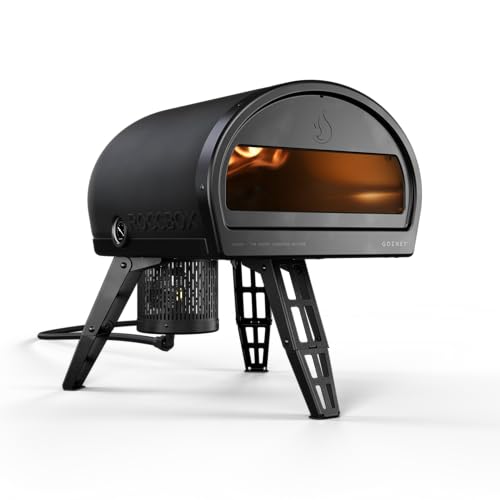
| Gozney Arc XL | pure gas pizza oven for pizzas up to 16 inches, up to 500 °C according to Gozney | approx. €899.99 | 9.1 | for the same money you mainly want to bake large pizzas |
| Cozze 24 inch Black Edition | same brand, cordierite stone 60 × 60 cm for two pizzas according to the Amazon listing | approx. €477 | 8.4 | you bake pizza in series for many guests |
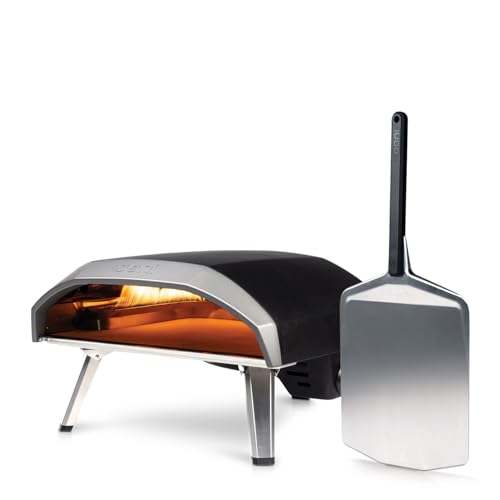
| Ooni Koda 16 | one L-shaped burner, for 40 cm pizzas according to Ooni | approx. €449 | 9.4 | you mainly want pizza and want to spend little |
The prices come from our price boxes as of September 2026 and change. The rating is our editorial assessment from the data comparison; because the Quattro is the only one with a plancha, the table compares it for pizza baking with units built only for that.
When the Quattro 900, when another
If pizza is the main reason for buying, little in our comparison speaks for the Quattro. The Ooni Koda 16 costs approx. €449 in our price box, the Quattro approx. €869, and the Ooni is designed for larger pizzas than the Quattro’s 35 cm stone. The Gozney Arc XL is practically level on price, but is a pure oven.
If you bake many pizzas in a row for parties, the Cozze 24 inch Black Edition from the same brand is the obvious choice. It costs approx. €477 in our price box instead of approx. €869, and according to the listing, two pizzas fit on its stone at the same time.
If you do not need a pizza oven but want a plancha with infrared, take a look at the Cozze Combo 900, which costs approx. €520 in our price box, against approx. €869 for the Quattro.
What speaks for the Quattro is the combination: a cast plate for vegetables, seafood and burgers, next to it an infrared field for steak and a stone for the occasional pizza, all on one bottle. We would pick it if you are planning an outdoor kitchen anyway or have a fixed spot on a terrace or wall and want to avoid two units. Add a gas bottle and a suitable base to the price.
We would not pick it for a covered terrace or for balconies under another balcony, because the manual rules that out. Nor for anyone who wants to rely on having steak and pizza ready at the same time, and for hosts who bake pizza at one-minute intervals for many guests. If you are still undecided between a pizza oven, a plancha and a gas grill, the Grill Finder offers a shortlist.