A gas oven that turns the stone itself
At cozze this oven is called the 17“ Standard Rotate, the German version carries the article number 90427 and, in the manual, the model designation CG-PZ03A-3-BK. It runs on liquefied gas, delivers 6.0 kW and turns a round cordierite pizza stone of Ø 42.5 cm. In our pizza ovens category it costs approx. €399 (Amazon page on 20.10.2026: €399).
According to the manual, the manufacturer is Millarco International A/S from Lystrup in Denmark. cozze introduces itself on its own site as a former subsidiary of this wholesaler and writes that the brand launched in 2021 and at first dealt only with pizza ovens.
One question of identification right up front, because it matters for the purchase. No Amazon ASIN is linked on the cozze pages. That this listing is the Standard Rotate rests on the Amazon part number 90427 and on the key data in the listing title: 6.0 kW, Ø 42.5 cm, 50 mbar, LED and door. Among the 17-inch gas ovens with a rotating stone that cozze offers, only the Standard Rotate has 6.0 kW, the other two have 8.0 kW. Amazon has listed the offer since 31.03.2024 and gives “90427 bundles” in the model field.
The rotation is the argument for this oven. It is not alone in our catalogue in this, though: the Enders PACO Rotate and the WMF Pizzaiolo Pro also turn their stone with a motor.
Three burners, 50 mbar, ignition by AA battery
According to the manual, three burners sit in the oven, two at the sides and one at the back wall. The burner unit is made of stainless steel and may be cleaned with oven cleaner if needed. Together they reach 6.0 kW nominal heat input, based on the gross calorific value (Hs), with an injector size of 1.05 mm. The product page speaks of a “3-part” burner, meaning the same arrangement.
The appliance category is I3 B/P(50). Translated, that means: butane, propane or mixtures of the two, at a connection pressure of 50 mbar. The 50 mbar is the pressure after the regulator, not a type of cylinder. The 90427 version is intended for Austria, Germany, Slovakia, Switzerland and Luxembourg. The 30 mbar that also appears on the product page applies to other countries.
Ignition is electric. A 1.5 V AA battery sits in the ignition button, which you buy yourself, because cozze does not include it. The procedure according to the instructions: press in the control knob, hold it pressed, turn it anticlockwise as far as it will go, press the ignition button. Then you check whether all three burners are lit. The flame can be adjusted continuously between high and low.
On the scope of delivery, the sources contradict each other. The Amazon title promises a regulator and a 1.1 m long gas hose. The parts list in the manual counts four parts, one of each: oven body, pizza stone, door and a rod probe. The regulator and hose are not listed there, and the gas cylinder is explicitly marked “Not included” in an illustration. If you buy anywhere other than in the Amazon bundle, expect to need your own regulator.
For the connection, cozze prescribes only a regulator with CE approval, plus either a hose with a ¼-inch thread or a hose with a nipple and hose clamp. The hose has to comply with the EN 16436 standard, may be at most 1.5 m long, must not be kinked or crushed and must not touch the oven. It is replaced according to the intervals of national regulations. cozze estimates the service life of the regulator at 10 years and recommends replacing it within 10 years of manufacture. The 1.1 m hose from the Amazon listing is within the length limit.
According to the assembly illustration, the oven is assembled by one person, with an Allen key and an open-end spanner.
Stone, opening and door in numbers
The stone measures Ø 42.5 x 1 cm, and cozze also states exactly this diameter as the pizza size. The front opening is 44.5 cm wide and 10.5 cm high, and cozze gives the “working height” as 9.5 cm. On paper, with a pizza the full size of the stone, one centimetre of air is left on each side of the opening. We would therefore plan for pizzas clearly under 42 cm, so that the peel and the crust do not catch on the edge.
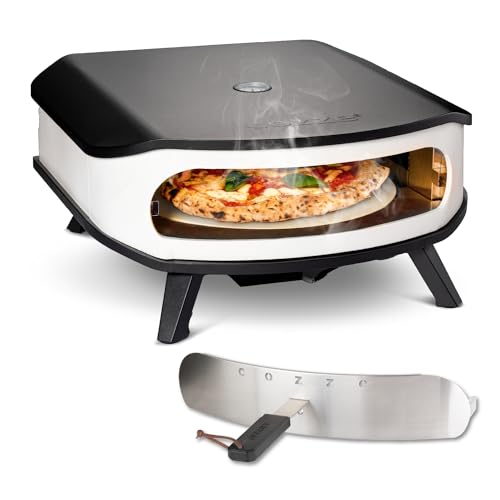
Outside, cozze gives 60.5 x 60.5 x 30.5 cm. The product photo shows a white housing with a black top on splayed legs, with the wide, flat opening at the front. The housing is made of powder-coated galvanised steel, not stainless steel, as an earlier version of this page stated. cozze names white and black as colours, and Amazon lists the offer under black.
According to the product page, a thermometer is included. The manual qualifies this: it shows the temperature in the oven and serves only as a guide. For the temperature of the stone, which is what matters for the base, cozze recommends its own infrared thermometer, sold separately. In the illustration in the manual, the rod probe sits at the side in the door.
The German product page calls the door a “Hitzeschild” (heat shield), the English one a “Pizza door”. Clear rules apply to it in the manual. Fitted during heat-up, it can shorten the heat-up time by 20 to 30 %. When the oven reaches 450 °C, it has to be removed. Between two pizzas you may fit it again, but then the oven must not exceed 450 °C. And during baking you do not put it down on top of the oven.
If we read the illustration correctly, the probe comes out together with the door. In our assessment the infrared thermometer is therefore more a necessity than an optional extra as soon as you want to bake above 450 °C.
In detail: what the turntable changes technically
In a gas oven with a fixed stone, the heat comes from where the flames are, so here from the left, right and rear. At the front is the opening through which heat escapes. The side of the pizza facing the rear wall therefore gets more radiation than the side facing the opening. With ovens that do not rotate, you therefore turn the pizza with the peel, and anyone who does this too late ends up with one dark and one pale edge.
A turntable guides every section of the edge past the burners in turn. cozze promises even cooking with a 360° rotation. Whether the edge actually browns more evenly as a result has not been measured for this appliance by anyone we could cite as a source. The logic behind it holds up, though, and it saves you reaching for the peel in the middle of baking.
Important for expectations: the stone does not turn by itself as soon as the pizza lies on it. You place it in three holders on the rotating base and switch on the rotation motor with one press of the starter. The motor gets its power from a battery box, which also powers the LED light. As we understand it, flat batteries mean: the stone stands still, and you turn by hand again like with any other oven.
The stone is 1 cm thick. For the Ooni Koda 16, the manufacturer states 15 mm. A thinner stone has less mass and stores correspondingly less heat, and it cools down faster under a cold disc of dough. This fits the procedure the instructions prescribe: after sliding the pizza in, turn down to the medium setting so the top does not burn, and before the next pizza set it back to the highest level and wait a few minutes.
How long until the first pizza?
About 20 minutes of heating up according to the manual, after which a pizza bakes in 2 minutes according to cozze. The Amazon text says 20 to 25 minutes. Wind and outside temperature lengthen the time, cozze writes itself.
The manual mentions the 20 minutes twice, once for the oven and once for the stone, which is “hot enough only after at least 20 minutes of heat-up time”. For baking, cozze recommends a very hot oven, ideally around 400 °C.
On the maximum temperature, cozze is not consistent itself. The data block of the product page says “heating up to 550°C”, in the feature list of the same page it is 500 °C. In practice the question is smaller than it looks: the recommended 400 °C is below both values, and above 450 °C the door must not be in the oven anyway.
With several pizzas in a row, allow more than 2 minutes per pizza, because the stone has to reheat in between. How long “a few minutes” is, the instructions leave open. For an evening with several pizzas, we would therefore allow clearly more time than the 2 minutes per pizza suggest.
What cozze leaves open
These details are missing on the product page and in the manual. We have collected them instead of spreading them through the text. cozze gives no weight anywhere; Amazon lists 47.6 pounds, so around 21.6 kg, without saying whether this includes packaging. The Amazon dimensions (64 x 34.5 x 66 cm) also differ from the manufacturer dimensions in the section on stone and door. Also left open are the rotation speed and direction of the stone, the battery life for motor and LED, whether the motor can also run on a power adapter, the type and measuring range of the thermometer, an ignition safety device or a thermocouple, spare parts such as stone, motor and door including prices, a matching cozze cover, the country of manufacture and any statement on balcony use.
What else is worth considering?
| Model | The difference | Price | Our rating | Choose this one if |
|---|---|---|---|---|
| cozze 17 inch Standard Rotate (this one) | Ø 42.5 cm stone with battery motor, three burners with 6.0 kW | approx. €399 | 8.2 | you want to bake large pizzas and not turn them yourself |
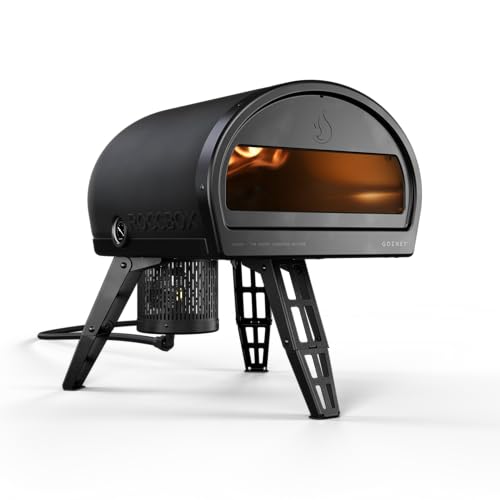
| WMF Pizzaiolo Pro | Ø 40 cm rotating stone, one C-shaped cast burner with 7 kW | approx. €425 | 8.3 | 40 cm is enough for you and you want a cast iron burner |
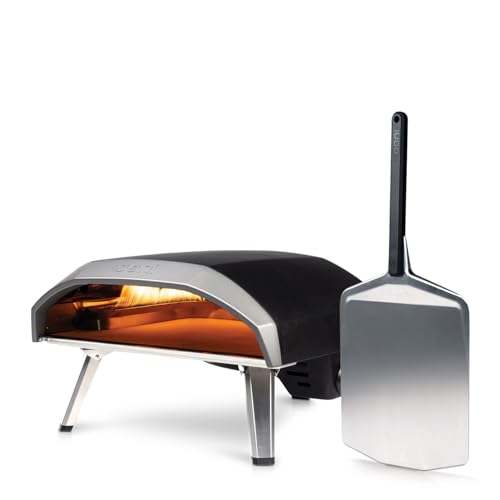
| Ooni Koda 16 | no rotating stone, L-shaped burner with 8.0 kW | approx. €449 | 9.4 | you like turning the pizza yourself with the peel |
| Enders PACO Rotate | Ø 30.5 cm rotating stone, motor on a mains plug, 4 kW | approx. €174 | 8.5 | you bake pizzas of around 30 cm and have an outdoor socket |
The prices are guide values at the time of each lookup, and for the Ooni Koda 16 the price at Santos Grills. The rating is our editorial assessment based on the data sheets, not a measurement result.
When the Standard Rotate fits and when another oven does
The first question is pizza size. At Ø 42.5 cm, the cozze has the largest rotating stone in this round-up. The WMF turns 40 cm, the PACO Rotate 30.5 cm; the Koda 16 has no rotating stone and is built for pizzas up to 40 cm. If you only bake pizzas of around 30 cm anyway, the Enders at approx. €174 is the cheaper choice, as long as there is a socket at the spot where you set it up, because its motor runs on a mains plug. The cozze needs no socket for this, only batteries.
Second question: does turning by hand bother you? If not, the Ooni Koda 16 at Santos Grills for approx. €449 is the oven with the highest rating in this round-up, with 8.0 kW from an L-shaped burner. If you do not want to turn and 40 cm is enough for you, the WMF Pizzaiolo Pro at approx. €425 is only slightly above the cozze.
Third question: where is the oven going to stand? On top of the 60.5 x 60.5 cm footprint come, according to the instructions, 50 cm of clearance at the sides and rear, and nothing may be above the oven, neither a tree nor an overhanging roof. Under a patio roof or a balcony cover it is therefore ruled out. What is generally permitted on a balcony is covered in our guide Grilling on a balcony.
If you travel with a caravan or motorhome, keep looking: according to the manual, the appliance is not intended for use in a caravan or motorhome.
And what is going into the oven? Besides pizza, Amazon also names bread, meat, fish and vegetables. The manual draws a line that is missing there: very fatty meat or similar products are not allowed, because they create a fire hazard.
On top of the approx. €399, the budget includes a gas cylinder, five batteries (one AA for the ignition, four for the battery box) and, if you want to know the stone temperature, an infrared thermometer.
Setting up, connecting, cleaning
The warning appears in capital letters in the manual: “WARNING! FOR SAFETY REASONS USE OUTDOORS ONLY!” Elsewhere it says it is dangerous and prohibited to use the oven in enclosed spaces. During use it has to be kept away from combustible materials, including petroleum products and thinners. Oven and gas cylinder stand on a level surface and are not moved during operation. In wind above 2 m/s, the opening points away from the wind. Before first use you check all connections for leaks with soapy water, and after baking you close the gas cylinder.
According to the manual, children must not stay near the oven unsupervised while it is in use, and must never sit or stand on it or play around it. Loose-fitting clothing and wide sleeves are taboo, because fabric can ignite on burners and hot surfaces. For particularly hot parts, cozze recommends protective gloves.
Cleaning is done only when the oven has cooled down and the gas supply at the cylinder is closed, recommended at least once a month. If you let the oven keep running for 15 minutes after baking, food residues burn off. You clean outer surfaces with a mild detergent or baking powder dissolved in hot water, and for stubborn dirt with non-abrasive scouring powder. For plastic parts, use a soft cloth and hot soapy water, no abrasives, no degreasers and no concentrated grill cleaner. According to the manual, stainless steel parts can be lubricated with Caramba Multispray and a cotton cloth.
You may clean the stone with water, contrary to what it said here earlier. cozze prescribes a mild soapy water solution, if needed non-abrasive scouring powder, then rinsing with water. Elsewhere, the manual names a sponge, hot water and washing-up liquid for the interior and stone. Before the next use, the stone must be completely dry, and drying in the oven is allowed. You never cool the hot stone with water, never put anything frozen on it and do not use it over an open flame. It is sensitive to impact and can break if it falls. What to do about cracks is explained in our guide Cracked pizza stone.
Before storing, you wipe the oven with a damp cloth and mild detergent to remove excess grease. It is stored clean and dry; indoors only if the gas cylinder is disconnected and removed. For longer periods of non-use, it should go in its original packaging, in a dry, dust-free place.
According to the declaration of conformity dated 08.09.2023, the oven complies with the Gas Appliances Regulation (EU) 2016/426 and EN 498:2012, which apply in the EU, and for the stone cozze names LFGB (EC 1935/2004) and DIN 51032, which apply in Germany. The EU type examination was issued by DBI Certification A/S on 20.06.2023 under the number 2531DO-0030.