The WAYNE Jr. is a small gas grill from Burnhard with a single burner, a lid and combustion chamber made of die-cast aluminium, and 3.6 kW output. As delivered, it runs on a screw-on cartridge. In this set, an adapter for gas bottles is included as well. On Amazon it costs approx. €161 (Amazon page on 21 October 2026: €160.65); in Burnhard’s own shop it costs €179.
Number 946830: what is in this set
Behind the brand is Burnhard GmbH from Düsseldorf. In the shop the appliance is called “WAYNE Jr. Balkongrill 1-Brenner inkl. Gasflaschen Adapter” (WAYNE Jr. balcony grill 1 burner incl. gas bottle adapter), article number 946830. Amazon lists the grill under exactly this model number, and there is no second version.
The addition in the name matters. The category page for the WAYNE balcony grills in the manufacturer’s shop lists four offers: this set for €179, the WAYNE Jr. with trolley for €299, the two-burner WAYNE from €269 (as Standard and as Camper Edition) and the two-burner with trolley for €409. The Jr. is therefore the smallest and cheapest appliance there. In our gas grill category it belongs to the tabletop appliances, which need an existing surface and have no base of their own.
According to the product page, the set includes two carry handles, two cast iron grates, the gas bottle adapter for 5, 8 and 11 kg, a removable grease tray and a polyester grill cover that Burnhard describes as UV-resistant, water-repellent and weatherproof. The manual lists the parts in more detail: combustion chamber with frame, lid, lid handle with two spacers, two lid hinges, gas hose with quick-release coupling and cartridge valve, cartridge holder with three discs and three screws, thermometer with wing screw, protective cover for the oil outlet.
Connecting the adapter therefore does not finish the assembly. You attach the cartridge holder with three wing screws, insert the grease tray and protective cover, lay the grates in place and fix the lid.
Ring burner, cast iron grates, die-cast aluminium: the construction
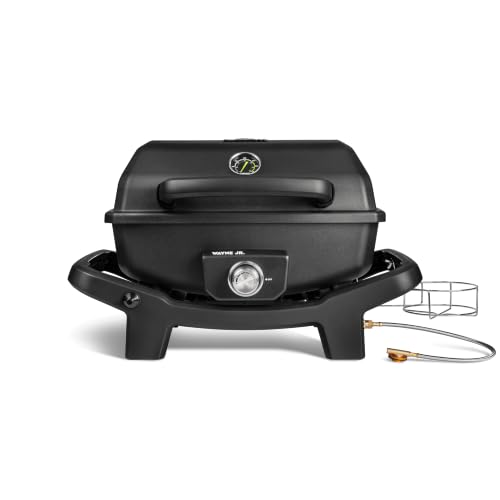
In the product photo, the WAYNE Jr. is a flat, angular box with strongly rounded edges. At the top centre of the lid sits a round thermometer, beneath it a crossbar handle, and at the front centre of the combustion chamber the single control knob. The body stands in a surrounding frame that extends into handles on the left and right; Burnhard speaks of plastic handles. On the right hangs a wire basket, the holder for the cartridge. Also on the right, on the frame, is the piezo ignition button.
On the burner, the manufacturer contradicts itself. The data sheet on the product page names a “stainless steel bar burner”, the description text below it an O-shaped stainless steel burner, and the picture in the manual shows a ring shape. We assume a ring. It has 3.6 kW and is infinitely adjustable. The gas flows through a nozzle with a diameter of 0.3 mm into a venturi tube that has an insect and spider screen. The burner can be removed for cleaning.
According to the data sheet, the combustion chamber is made of die-cast aluminium. For the lid, this is only stated indirectly: the cleaning instructions speak of the “Aludruckgussteilen (Brennkammer & Grilldeckel)” (die-cast aluminium parts, combustion chamber and grill lid). Aluminium does not rust, which is a real advantage over painted steel on a grill that gets rained on on the balcony.
On the combustion chamber lie two enamelled cast iron grates, both reversible. The manual recommends the side with the wider grill stripes for delicate food such as chicken or fish. Underneath, a tray catches the grease; in the data sheet it is powder-coated, in the delivery list on the same page it is enamelled.
The sources do not quite agree on dimensions either. The manual gives 58.4 x 35.6 x 42.6 cm (width, depth, height); the product page gives 35.4 x 58 x 43 cm with the lid closed and 63 x 58 x 52 cm with it open. The difference is in the millimetre range. Burnhard gives the weight as 10.5 kg in both places. Amazon’s catalogue lists approx. 15.3 kg converted, probably including packaging; we stick with the manufacturer.
The main grilling area measures 43 x 32 cm. Further down in the same data sheet it says 42 x 32 cm.
In detail: one burner, one zone
A gas grill with several burners can switch off one half. The food then lies over the cold side, and the hot air under the closed lid cooks it from all sides without a flame hitting it from below. This is how you prepare thick cuts that should not char on the outside before they are done inside. With a single ring burner, this option is gone. You can turn the flame down, but you cannot leave half the grate cold. How the two cooking zones work is explained in our guide to direct and indirect heat.
The only workaround is distance upwards. Burnhard sells a warming rack as an accessory for this. The food sits higher there and further from the flame. In our assessment this is not true indirect cooking, but it is enough for bread rolls or ready-made sausages.
If you work out the 43 x 32 cm, you get around 1,380 cm², or a good 2.6 W per cm². This figure tells you how much burner output falls on each square centimetre of grate. In principle, more of it means the grate heats up again faster after cold steaks are put on. The two-burner WAYNE is almost level (4.4 kW on 46 x 37 cm, around 2.6 W per cm²), the Enders Urban II Pro somewhat higher (4.4 kW on 1,568 cm², around 2.8 W per cm²), the Weber Q 1200N lower (2.93 kW on 1,290 cm², around 2.3 W per cm²). We calculated this from the manufacturers’ figures.
How hot the grill gets appears online in two versions. The product page says “bis zu 380 °C” (up to 380 °C), the manufacturer’s text in the Amazon catalogue 300 °C. The data box on this page shows both values. Whether the 380 °C applies at the grate or under the lid is unclear. For everyday use, the manual gives a different figure anyway: preheat with the lid closed for 10 to 15 minutes, except on the very first use.
Cartridge or gas bottle: what do you need for the WAYNE Jr.?
Both work, and you buy both separately. As delivered, the WAYNE Jr. runs on a screw-on cartridge to EN 417. For gas bottles of 5, 8 or 11 kg, this set includes an adapter with pressure regulator and a 90 cm hose.
For cartridge operation, the manual is precise. Permitted are screw-on cartridges with a maximum of 550 g gas filling and the thread 7/16 x 28 UNEF. The Coleman C300 with a propane-butane mixture is intended; cartridges from other brands must have a 7/16“ screw valve and contain 70% butane to 30% propane. Burnhard explicitly warns: it is dangerous to connect other types of gas cartridge. The cartridge sits in the holder on the right-hand side. When buying, the manual says you should seek advice from a specialist retailer.
The adapter is made of brass and rubber and couples to the grill via a quick-release coupling; in the Amazon text this point is called the WAYNE FitnFire interface. Its own manual describes a fixed-setting pressure regulator to DIN EN 16129 (a standard that applies in Germany) with a maximum of 8.0 kg/h and 1.5 bar operating pressure; the whole thing weighs approx. 370 g with the hose. The grill’s product page, by contrast, says “Druckminderer 2.5 bar” (pressure regulator 2.5 bar). We could not clarify which figure applies; the adapter manual states the 1.5 bar twice.
The reason for this special route is in the technical data. The manual assigns the WAYNE Jr. to the gas category direct gas pressure, so it is built for the pressure from the cartridge. A 50 mbar regulator for grill trolleys, which is usual in Germany, delivers a fraction of that. As we read it, this explains why Burnhard writes: “Daher darfst du auch nur diesen Adapter verwenden.” (So you may only use this adapter.) According to the adapter manual, it is tested and approved only with WAYNE Jr., JONES Jr. or JONES, and any structural modification to it is not permitted.
When connecting, the following applies: the bottle stands securely on the floor or a level surface, protected against tipping over. You tighten the union nut at the end of the hose with a spanner. The hose does not run under the grill and does not touch it; its angle is there so that the grill can be operated safely on the table, on the floor or on the WAYNE trolley. When the grill is off, the bottle is disconnected and the protective cap is fitted. Switching off follows this order: first close the control knob, then the bottle valve.
And how long does the gas last? The manual gives the connection value: 262 g/h with butane, 257 g/h with propane. A 550 g cartridge is therefore empty in around two hours at full output. A 5 kg propane bottle lasts about 19.5 hours, an 8 kg bottle a good 31 and an 11 kg bottle just under 43 hours. These are our calculations for full load; on a low flame each container lasts longer. More on bottle sizes is in the guide gas bottle for the grill.
These three alternatives are worth a look
| Model | The difference | Price | Our rating | Choose this one if |
|---|---|---|---|---|
| BURNHARD WAYNE Jr. (this one) | 1 ring burner with 3.6 kW, cartridge or bottle via adapter | approx. €161 | 8.0 | you grill for two or three and do not need an appliance with side tables |
| Burnhard Wayne 2-Brenner Balkongrill | 2 burners with a combined 4.4 kW, 46 x 37 cm grate | approx. €239 | 8.0 | you want to switch off one half and cook indirectly |
| Weber Q 1200N | 1 burner with 2.93 kW, two side tables, 105 cm wide | approx. €249 | 8.3 | you need a shelf right at the grill and have the width for it |
| Enders Urban II Pro Tischgrill | 2 burners with 2.2 kW each, pot supports for cooking | approx. €179 | 8.1 | you want two zones and a cooking spot |
The prices are guide values from our price boxes and change. The rating is our editorial assessment from the data comparison; we have not grilled on any of the four.
When the WAYNE Jr. fits and when another one does
First the space, because this is where a balcony grill is decided. The manual requires a minimum distance to objects of any kind of 100 cm to the rear, 100 cm to the side and 100 cm above. To all combustible materials it is 1.5 m, to flammable liquids 7.5 m. If you include the 100 cm on both sides, with an appliance width of 58.4 cm you need a free width of a good 2.5 m, and a metre of air above the lid up to the balcony ceiling above. As we understand it, a fabric awning or a wooden shelf has to keep to the 1.5 m. If you cannot manage that on your balcony, this grill is the wrong advice for you.
The surface counts just as much. The manual requires a level, stable and fireproof surface, and in another place a straight, non-combustible one. The product page expressly allows a stable, heat-resistant table. In our opinion a wooden decking floor does not meet that; the grill then belongs on a table or on the trolley. Whether gas is allowed on your balcony at all is governed by your tenancy agreement and house rules; more on this in the guide grilling on a balcony.
On the number of people, Burnhard states up to 4. We would rather plan the Jr. for two to three people, because with four portions at once there is no room to move food aside and a cooler zone is missing. If you often grill for four or more or want to cook roasts indirectly, take the Wayne 2-Brenner: according to our price box it costs approx. €239, the Jr. approx. €161.
For approx. €179 according to the price box, there is the Enders Urban II Pro with two burners and pot supports. In return it is designed for the gas bottle; for cartridges you need accessories from Enders. With the WAYNE Jr. it is the other way round: cartridge as delivered, bottle via the adapter in the set. If you mainly want to grill with a cartridge, for example because you do not want a bottle on the balcony, the Jr. is the better fit.
The WAYNE Jr. has no shelf space. If you want to put plates and tongs down right at the grill, look at the Weber Q 1200N (approx. €249 according to the price box), though it is much wider at 105 cm.
And the budget: on top of the approx. €161 come gas and, if no suitable table is available, a base. The WAYNE trolley costs €159 on its own in the manufacturer’s shop, the set of Jr. and trolley €299. Whether the bottle adapter is also in this set, we have not checked. If you are still undecided between types, the Grill Finder helps.
Setting up, connecting, cleaning: the wording of the manual
The distances are in the section before. Here are the remaining rules, as Burnhard words them. For fire, gas smell, storage and replacement of hose and regulator, you will find the details in the questions below.
Setting up: use outdoors only. Make sure the gas grill is sheltered from the wind, and keep it away from moisture, splashing water and electrical cables. The grill radiates heat; never place it directly against glass fronts, walls or plants. Protect the gas cartridge from strong sunlight.
Operation: the appliance is not moved during operation and is kept away from combustible materials. Never leave it unattended. Do not light the gas flame with an open flame, use the piezo ignition. Never lean over the open grill when lighting or operating it. The ventilation openings of the housing must on no account be covered. You always wear protective gloves as soon as the hot components exceed ambient temperature by 50 °C. Charcoal, briquettes and lava stones have no place in a gas grill, and neither does natural gas. The bottle valve of the cartridge is only open while grilling, and before every change of location the grill is switched off and the cartridge unscrewed. After use you unscrew it if possible. The same applies in the event of a fault or gas leak.
Before every use you check the hose and pressure regulator for cracks and damage, the gas connections for breaks, cracks or wear, and the burners for dirt. If the hose or cartridge is defective or leaking, the grill stays off. The gas hose must not come into contact with hot surfaces, must not run along sharp edges, must not be dripped on by hot fat and must not be twisted or kinked at any point.
Connecting the cartridge: before assembly the gas valves must be fully closed. The sealing ring must be intact and seated correctly. You tighten the gas valve hand-tight, because excessive force can damage the cartridge valve and gas line. Never remove the cartridge during operation. Then comes the leak test: spray all sealing points with commercially available leak detection spray or brush them with soapy water (1 part soap to 3 parts water), open the valve and watch for bubbles. If any appear, you check the seal on the cartridge valve and repeat the process; if bubbles still rise, you unscrew the cartridge and go to a specialist dealer. You repeat the test after every cartridge change, never with an open flame and never while smoking.
Cleaning: let it cool down first, set the control knobs to “OFF” and remove the cartridge. Flammable cleaning agents are taboo. Cleaning is done after every use, first by burning off for 15 to 30 minutes until no more smoke rises. Burnhard considers brass brushes rather unsuitable for cast iron and stainless steel grates because they are very soft. You remove coarse dirt from the die-cast aluminium combustion chamber and lid with a scraper; the recommended exposure time of a cleaner must not be exceeded, and for the outer surfaces you do not use a microfibre cloth. Before you remove the burner, you detach the gas hose from the grill and unscrew the cartridge. To clear the burner openings, never use wooden toothpicks; they can break off and block the opening. A thorough clean is due every 3 to 4 months and after a long period of standing. General care is covered in the guide cleaning a gas grill.
Accessories, warranty and the open points
In its manufacturer’s shop, Burnhard sells four matching parts: the warming rack for €24.90, the gas bottle adapter on its own, also for €24.90, the trolley for €159 and a reversible cast iron griddle plate for €39.90. The plate measures 21.5 x 32 cm at 0.7 cm thick, exactly half the main grilling area. We read this as meaning it replaces one of the two grates and you have grill stripes on the left and a smooth surface on the right. The shop also has a spare parts section; we did not review individual prices for burners or grates there.
After the product page, category page, grill manual and adapter manual, several things remain open: an ignition safety device or flame monitoring, the time to maximum temperature, a burn time per cartridge (our figures above are calculated), the scale and measuring range of the lid thermometer, the grilling area in square centimetres, country of manufacture and market year, a manufacturer’s guarantee beyond the statutory warranty, and a statement on the balcony beyond “outdoors only” and the distances. In addition there are the contradictions on burner design, grease tray, grilling area, maximum temperature and pressure regulator, each of which appears above in its place.
Who is it suitable for?
The manual limits the intended use in four sentences. This gas grill may only be used outdoors and in a well-ventilated place. Never operate it in a building, a garage or any other enclosed area. It is not intended for installation in or on recreational vehicles and boats. Parts sealed by the manufacturer must not be altered.
Under the general hazards there are three further points: the appliance is not intended for use by children and by people with a limited ability to operate appliances. Accessible parts can become very hot; keep children away. And any modification to the appliance can lead to accidents and to loss of the warranty claim.
The WAYNE Jr. is therefore the wrong choice for anyone who wants to build it permanently into a camper van or boat, and for snack stands, clubs or catering: according to the manual it is not intended for commercial use.
We find it suitable for two to three people with a balcony or terrace where the distances can be kept, who would rather store a cartridge than a gas bottle and can do without a second heat zone. If you later switch to the bottle after all, you already have the adapter in the box, and at 10.5 kg and with two handles the grill can also be carried indoors once it has cooled down.