A tabletop grill that Weber itself no longer sells
The Q2000, article number 53010079, is a liquid gas grill with one stainless steel burner, built for a table or a separate cart. It is one of the small models in our overview of gas grills. It costs approx. €421 (Amazon page on 20 October 2026: €420.68).
One thing up front, because it changes the buying decision: Weber has removed the model from its German shop. On 21 October 2026 the product page only returns “page not found”, and the Q category lists the Q 1100N, Q 1200N, Q 2100N and Q 2200N instead. All manufacturer information on the Q2000 in this text therefore comes from the archived product page (as of 20 May 2026) and from operating manual no. 57760 from July 2013, which applies jointly to the Q 1000, Q 1200, Q 2000 and Q 2200. The archived product page showed a recommended retail price of €429.00.
The design has a history that Weber names in the manual itself: the designs and features of the Q grills originally go back to Robert DeMars of Original Ideas, Inc.
Body, grate and frame according to Weber
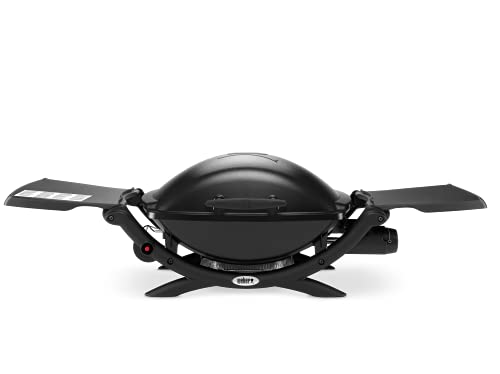
The lid and cooking chamber are made of painted cast aluminium. The product photo shows a flat, rounded lid with a handle set across it, below it a black frame with X-shaped splayed legs, and a folded-out side table on each of the left and right. The Amazon catalogue text describes the frame as glass-fibre-reinforced nylon, and Weber names the same material in its feature list.
The grate is made of porcelain-enamelled cast iron. According to the Amazon text it is in two parts and has flavour bars. What the manual describes is somewhat more concrete: cast iron bars on the grate guide dripping grease away from the burner tube into a pull-out tray holding a disposable drip pan. The grease therefore does not land on the burner, which reduces the risk of flare-ups. Weber itself justifies the cast grate with even heat distribution and heat retention.
Ignition is by push button, and the burner valve is infinitely adjustable. The burner’s air openings are covered with a stainless steel mesh against spiders and insects.
On weight and dimensions: 18 kg according to Weber. With the side tables folded out, the grill is 130.6 cm wide, and with the lid closed it is 36.9 cm high and 49.6 cm deep. Open, it grows to 66.1 cm in height and 61.8 cm in depth. Weber gives the cooking area as a “primary cooking area” of 54 x 39 cm.
In detail: one burner means one heat zone
A gas grill with two or more burners can have one side hot and the other off. Food on the cold side then cooks indirectly, with hot air under a closed lid rather than with radiant heat from below. The Q2000 has no such separation. A single burner tube sits under the grate, and the one control knob turns the whole area up or down together.
For sausages, steaks, vegetables and fish, in our assessment this is no drawback as long as everything cooks at a similar heat. For a roast that is meant to sit for an hour beside the flame, the cold zone is missing. We would not buy a single-burner grill for that.
There are two figures for output. The archived product page gives 3.52 kW for the main burner, while the consumption table in the manual gives at most 3.7 kW at 264 g/h for operation on the gas cylinder. Weber does not explain where the difference comes from. For comparison, the successor Q 2100N has 4.10 kW according to Weber.
The manual also specifies how to grill with the appliance: always with the lid closed, so the heat distributes evenly. Preheating on the START/HIGH setting with the lid closed takes approx. 10 to 15 minutes, depending on air temperature and wind. On a new grill, slightly higher temperatures can occur during the first few uses. The Q2000 has no lid thermometer you could use to read when it is ready; the exploded diagram in the manual only shows one on the Q 2200.
How much space does the Q2000 need on a balcony or terrace?
Allow for 130.6 cm of width and a good 60 cm of depth with the lid open, plus, according to the manual, at least 1.5 m clearance from all combustible materials. On a narrow wooden balcony this often cannot be met.
According to the manual, combustible materials include, for example but not exclusively, wood, treated wooden floors, wooden decking and wooden porches. For flammable liquids, Weber requires a safety distance of 7.5 m. The remaining siting rules in the manual, close to the wording:
- only outdoors in a well-ventilated place
- not in garages, buildings, passageways, garden houses or sheds, or in any other enclosed places
- not under an unprotected combustible roof or canopy
- not on glass or combustible surfaces, because heat can be conducted through the legs of portable grills
- on level, stable ground, with no combustible materials in the immediate vicinity
- do not slide into or install in a structure
Whether your tenancy agreement or house rules allow a gas grill on the balcony is not covered in any Weber document, so check that with your landlord. For more, see the guide Grilling on a balcony. According to the manual, you only fold the side tables in once the grill has cooled down. They are not intended as chopping boards.
Gas, pressure regulator and consumption
In Germany and Austria, according to the manual, the Q2000 runs on liquid gas of category I3B/P at 50 mbar. Gas cylinders with a filling weight of at least 2.5 kg and at most 13 kg are approved. The cylinder is not part of the delivery.
The connection accessories are unclear. In the exploded diagram of the Q 2000, a note at the valve says hose and regulator “may not be included”. At the same time, the manual requires you to use only the pressure regulator supplied with the grill, and permits only officially approved hoses and regulators. Replacement regulators and hoses must match the components Weber specifies. Ask the retailer what is in the box before you buy gas.
For the hose: at most 1.5 m long, not kinked, and check before each use for kinks, cracks, wear and cuts. Weber recommends replacing the hose assembly every five years; if a country prescribes shorter intervals, those take precedence. You fit the regulator so that its vent opening points downwards. The cylinder always stands upright, when fitting, transporting and storing. The grill must never be connected to the natural gas network; valves and nozzles are designed for liquid gas only.
The manual describes the leak test precisely. You need a spray bottle, a brush or a cloth, and a solution of 20 parts liquid soap to 80 parts water. The burner stays off during this. Three points are checked: valve to regulator hose, regulator hose to regulator, and regulator to cylinder. If bubbles form or a bubble grows, there is a leak there; then close the gas supply and do not operate the grill. Because the solution can be slightly corrosive, you rinse all connections with water afterwards. The check is due before first use, after every disconnection and reconnection, and after every service, partly because, according to the manual, a connection can come loose during shipping.
A rough calculation of consumption, from the 264 g/h in the consumption table: a 5 kg cylinder lasts just under 19 hours with the burner fully open, an 11 kg cylinder just under 42 hours. If you grill on a medium setting, it lasts longer; how much longer cannot be put in figures without a manufacturer value. For what else matters when buying a cylinder, see the guide Gas bottle for the grill.
Cleaning, care and safety according to the manual
Before each use, look into the drip tray and remove excess grease with a plastic scraper. Wash the tray with warm soapy water and rinse with clean water. Do not line the cooking chamber, drip tray or disposable drip pan with aluminium foil.
For the rest, in the order of the manual:
- clean the exterior only when the grill is off and cooled down, with warm soapy water, then rinse with clean water
- no cleaners containing acid, white spirit or xylene
- never oven cleaner, abrasives (scouring cleaner), cleaners containing citrus components, or scouring pads
- clean the grates first with the scraper, then with the brush, not in a self-cleaning oven
- check grill brushes regularly for loose bristles and wear; Weber recommends buying a new stainless steel brush for every grilling season
- brush deposits off the burner tube, and never widen the burner openings while doing so
- clean the inside of the cooking chamber with warm soapy water and rinse with clean water
Whether the grates may go in the dishwasher, Weber leaves open for the Q2000. On the Q 2100N, the product page says “dishwasher safe”, which cannot be transferred to the older model. According to Weber, the insect screen and burner tube should be checked and cleaned at least once a year; removing the burner tube takes a 3/8 inch socket wrench. You do not clean the screen with hard or pointed objects. If the burner still refuses to work, the guide Gas grill will not light helps.
If you smell gas, the manual gives four steps: close the gas supply, put out all open flames, open the lid. If you still smell gas, keep away and inform the gas supplier or fire brigade immediately.
From the warnings, which are much longer in the manual than here, these are the points that apply while grilling itself: children must not operate the grill, and you keep small children, elderly people and pets away while it is running. The grill is never left unattended. Charcoal, briquettes and lava rocks do not belong in it. You do not lean over the open grill, you do not touch the front edge of the cooking chamber when it is hot or the lid is open, and a cover only goes on once the grill is cold. According to the manual, the Q2000 is intended neither for commercial use nor as a heater.
Accessories, warranty and open points
On the archived product page, Weber listed as accessories the Premium cover with article number 7111 for €39.99, replacement drip pans (art. 6415) for €5.99, and a cart called “Q 2000 Gas Series Cart” (art. 6525) with no price. In Switzerland, Weber still sells the Q 2000 as a variant with a stand (art. 53010375), which weighs 21.4 kg. According to the manual, new disposable drip pans and grates are available from the retailer or via weber.com, and replacement hoses, pressure regulators and valve assemblies from the retailer.
Warranty according to the product page and manual: cooking chamber and lid assembly five years against rust-through and burn-through, the paint finish two years (fading and discolouration excluded). Stainless steel burner tubes and cast iron grates likewise five years against rust-through and burn-through, plastic parts five years without fading and discolouration, all other parts two years. According to the manual, exclusions include damage from salty air and chlorine (for example at a pool), from insects and rodents such as martens, and from harsh weather such as hail or storms; near the coast or a pool, regular washing is part of maintenance.
What we did not find in any Weber source, gathered in one place: a maximum temperature, a cooking area in square centimetres, a heat-up time to a specific temperature, which ignition your unit has (the manual lists a red push button and an electronic ignition with an AAA battery), how long spare parts are available after discontinuation, the country of manufacture, the year it came to market, and the packed dimensions. The Amazon catalogue also gives a weight converted to approx. 8.7 kg; we stick with Weber’s 18 kg.
These three alternatives are worth a look
| Model | The difference | Price | Our rating | Choose this if |
|---|---|---|---|---|
| Weber Q2000 (this one) | 1 burner with 3.52 kW, no lid thermometer, tabletop unit at 18 kg | approx. €421 | 8.3 | you want a tabletop grill with one heat zone and are happy to get spare parts through the retailer |
| Weber Q2100N | 4.10 kW, lid thermometer, 13.5 kg according to Weber | approx. €400 | 8.4 | you want the current model with a thermometer and carry the grill often |
| Weber Q 2200N | with compact stand and lid thermometer, 21.5 kg according to Weber | approx. €428 | 8.6 | you have no table to put the grill on |
| Burnhard Wayne 2-Brenner | 2 burners with 2.2 kW each, grate 46 x 37 cm, lid thermometer | approx. €239 | 8.0 | you also want to cook indirectly on the balcony and can manage with less area |
The prices are guide values from our price boxes and fluctuate in the shops. The rating is our editorial assessment of the manufacturer data.
When the Q2000 suits, and when another grill does
If you grill for two or three, have a fixed, non-combustible spot outdoors, and mostly put quick-cooking food on the grate, one burner is enough. In our assessment the Q2000 is then a sensible choice, particularly as Weber gives long terms against rust-through for the cooking chamber, lid, burner and grate.
If you want to read the temperature under the lid, that speaks against it. The Q 2100N has a thermometer, more output and, according to Weber, weighs less, and it costs approx. €400 against approx. €421 for the Q2000. It is also the model Weber currently sells, which can tip the balance on spare parts in a few years.
Without a table or wall to put the grill on, with the Q2000 you have to add a cart, whose price we do not know. The Q 2200N comes with a compact stand and costs approx. €428, against approx. €421 for the Q2000.
If you also want to cook indirectly on the balcony, you need two burners. The Burnhard Wayne has them and costs approx. €239, but its grate is smaller at 46 x 37 cm according to Burnhard.
The Q2000 is the wrong choice for anyone who regularly wants to cook roasts, whole chickens or ribs that need to cook for a long time beside the flame. And for anyone whose balcony is made of wood: with the mandatory 1.5 m clearance from combustible material, there is rarely a spot there that the manual allows. The Grill finder also helps with choosing between the series.