Which Go-Anywhere we mean here
The Go-Anywhere Gas is Weber’s portable gas grill with a single burner. In Germany and Austria it is sold under article number 1141079, and the Amazon catalogue lists the same number as the model number. It burns liquid gas from a disposable cartridge that is bought separately. Weber only sells it in black.
It shares its name with the Go-Anywhere for charcoal, which Weber lists under article number 1131004. That one is in our price box at approx. €95, while the gas version costs approx. €145 (Amazon page on 21.10.2026: €144.89). Weber itself asks €179.99 in its own shop (as of 21.10.2026). On our site it is listed under gas grills, in a category with grill carts that cost many times as much.
We did not have the grill in front of us and did not cook anything on it. Our sources are Weber’s German product page, the operating manual for the Go-Anywhere liquid gas grill (German version, dated 04/01/18, marking CE 0845) and the Amazon catalogue. Where these three contradict each other, we say so at the relevant point.
Bowl, grate, burner: what it is made of
The bowl and lid are made of porcelain enamel. According to Weber, the coating protects against rust-through, cracking and flaking and withstands high grilling temperatures. The cooking grate is made of porcelain-enamelled steel, not cast iron as this page used to say. Underneath works a stainless steel burner with a rated output of 2.1 kW, controlled by an infinitely adjustable burner valve.
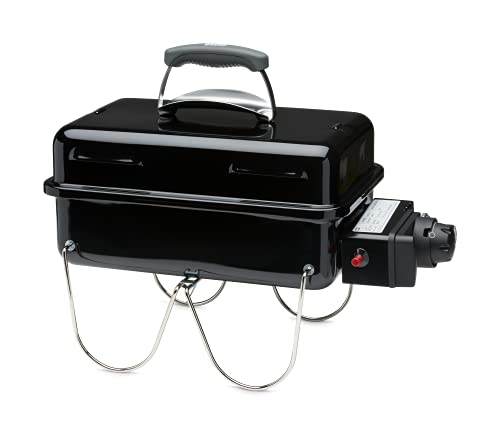
The product photo shows a flat, rectangular box. On the right of the bowl hangs a small housing with the red ignition button, a bail handle sits on top of the lid, and wire legs made of coated steel stand underneath. The legs are the core of the transport idea: folded over, they hold the lid shut, and the lid itself becomes the carry handle. According to the data sheet, this handle is made of glass-fibre-reinforced nylon.
With the lid closed, the grill measures 36.9 cm in height, 53.4 cm in width and 31 cm in depth. Weber states 7.22 kg. The Amazon catalogue says 11.5 pounds, which converts to approx. 5.2 kg. We stick to the manufacturer’s figure.
Weber gives the primary cooking area as “42 x 26”, with no unit. With a body that is 53.4 cm wide, in our reading only centimetres make sense. Even so, an area in square centimetres appears nowhere on the product page, and we do not calculate one from two numbers without a unit.
Ignition is by push button. According to the manual, you open the lid, switch on the gas supply at the regulator, turn the burner control knob to START/HIGH (the lightning symbol) and press the red ignition button several times so that it clicks each time. As a second way, the manual describes a match. In that case you keep your face and body at least 30 cm away from the lighting hole.
What Weber leaves open, collected in one place: a lid thermometer appears neither on the product page nor in the manual. Also missing are a number of people (the 2 to 4 people come from the Amazon text alone), the material of the heat shield and the valve and regulator assembly, the type of coating on the legs, the country of manufacture, details on spare parts and their prices, assembly effort and set-up time, the time to reach maximum temperature, and minimum clearances to the back and sides in centimetres.
In detail: one burner, one lid, two vents
On a gas grill with several burners, grilling indirectly means: one burner stays off, the food sits above it, and the other burners heat the space under the closed lid. The heat then reaches the meat as hot air, not as radiation directly from below. That way a roast cooks through without burning on the outside.
With a single burner and a single control knob, this cannot be divided up in the same way. For indirect grilling, Weber therefore describes something different: close the lid and regulate the airflow via the two integrated vents. That is more like cooking in a closed box with controlled air supply than a true indirect zone, because the burner still sits under the whole grate. Whether the edge stays measurably cooler than the centre, nobody has published anything we could cite. Our assessment: sausages, burgers, vegetables and flat steaks suit this principle. A pork neck that is meant to cook slowly at low temperature for hours belongs on a different appliance.
According to the manual, you always preheat and grill with the lid closed. Preheating runs on START/HIGH and takes approx. 5 to 10 minutes depending on air temperature and wind. The product page promises high grilling temperatures of up to 300 °C.
Two more sentences from the manual help put this in context. A new gas grill may reach somewhat higher temperatures during the first few grilling sessions. And the cooking times in Weber’s recipes apply to an outside temperature of 21 °C with light wind or no wind, so on a cold, windy day at the lake it takes longer.
Which gas cartridge do I need?
A butane-propane disposable cartridge with a screw valve to EN 417 and a fill weight of no more than 550 g.
As an example, the manual shows Weber’s own cartridges for the Baby Q and PERFORMER. Besides the WEBER Q cartridges, the product page also allows other cartridges approved to DIN EN 417, provided they are marked 80 % butane and 20 % propane. The manual words it a little differently and requires the marking “PROPANGAS” or “PROPAN-BUTAN-GEMISCH” (propane gas or propane-butane mixture). In the shop, we would look for both: a valve to EN 417 and one of these markings.
The cartridge is connected directly to the regulator: push it in, turn it to the right, only hand-tight according to the manual. The pressure regulator lets the gas flow from the cartridge at an even pressure. For Germany and Austria, the manual gives gas type I3B/P at 50 mbar and a valve nozzle of 0.61 mm.
A large cylinder of 5 or 11 kg is not provided for in Weber’s documents. We found no adapter for it in either of the two Weber sources, and without Weber’s approval we would not screw one on. The grill must never be connected to the natural gas mains: valves and nozzles are designed exclusively for liquid gas, and according to the manual a conversion to natural gas is dangerous and voids the warranty.
On consumption, the manual becomes specific. At the highest setting, the main burner uses 153 g of gas per hour. We calculated the run time per cartridge from that ourselves: with the maximum permitted 550 g, you get roughly 3.6 hours at full load. A smaller cartridge is empty correspondingly sooner, and turned down, each one lasts longer.
The cartridge itself has its own rules. It must not be stored or transported above 51 °C, and the manual gives the hot car as an example. You disconnect it from the grill when it is empty, when the grill is stored in a garage or other enclosed space, and when the grill is transported. A removed cartridge is not kept in a garage or building. Spare cartridges are not stored under or near the grill, changes are made only outdoors and at a safe distance from ignition sources, and children are kept away from the cartridges.
Where it may be used: park, balcony, campsite
The product page names camping, the park around the corner and the balcony as places of use, and the Amazon text adds motorhomes. The manual draws the limits more tightly. The grill is operated exclusively outdoors in a well-ventilated place, explicitly not in a garage, building, covered walkway, shed or hut, and not under an unprotected combustible roof or overhang.
It is equally clear on vehicles. No use in a car boot, estate car, mini-van, minibus, SUV or caravan, and no mounting in or on caravans and boats. You are best off reading the Amazon sentence “ideal for motorhomes” as a transport note: the grill travels along in the motorhome, and you grill outside next to it. We would treat a fabric awning like a combustible overhang.
For flammable liquids, the manual requires a clearance of at least 7.5 m. For combustible material it says “at least ,61 m”; the digit before the comma is missing in the print. 0.61 m is the obvious reading, but it is not confirmed; if in doubt, ask Weber customer service. As combustible materials, the manual gives examples such as wood, treated wooden floors, wooden decks and wooden porches. For a balcony with wooden decking, that is the most important line in the whole manual.
Then there are the rules for operation. The grill always stands on a safe, level and stable surface, no flammable gases or liquids such as fuel or alcohol are kept on the cooking surface, and it is neither pushed into nor built into a structure. It never runs unattended and is not moved during use. The entire cooking chamber gets hot. You keep your hands away from the front edge of the cooking chamber while the grill is hot or the lid is open, and you never lean over the open grill. Children do not operate it; according to the manual, small children, elderly people and pets should keep their distance.
Whether gas is allowed on your balcony at all is decided by your tenancy agreement and house rules, not by Weber. What is typically regulated there is covered in the guide Grilling on a balcony.
Leak test, smell of gas, grease fire
The manual requires a leak test before first use, whenever a connection has been disconnected and reconnected, so at every cartridge change, and at every routine maintenance. This also applies if the retailer assembled the grill. For the control knob cover you need an 11/16“ spanner. You mix the test solution yourself from 1 part liquid soap and 4 parts water. The burner stays off during the test, and you never look for a leak with a flame.
Two points are checked: the connection between regulator and cartridge, and the connection between valve and regulator. If bubbles form or a bubble grows, there is a leak. If it leaks at the cartridge, you remove it and do not use the grill; the manual advises trying a different cartridge and otherwise contacting the retailer. If it leaks between valve and regulator, you close the gas supply, leave the grill off and contact the retailer. Afterwards you rinse all connections with water, because some leak detection solutions can be slightly corrosive.
If you smell gas, the manual gives a fixed order: shut off the gas supply to the appliance, extinguish all open flames, open the lid. If the smell is still there, you keep away from the appliance and immediately inform your gas supplier or the fire brigade. Liquid gas is heavier than air and can collect in lower-lying places instead of dispersing.
In a grease fire, you set the burner to position 0 (OFF) and keep the lid closed until the fire is out. You never extinguish flames on a gas grill with water, and certainly not an oil or grease fire. In the case of uncontrolled flare-ups, you take the food out of the flames until they die down. If more than the grease is burning, you keep your distance and call the fire brigade.
Cleaning and warranty
According to the manual, the underside of the cooking chamber must be cleaned before each lighting: excess grease is removed from there and from the grate with a plastic scraper. You work on the grate itself with a scraper and a stainless steel brush; it does not belong in a self-cleaning oven. Weber recommends buying a new stainless steel grill brush at the start of each grilling season and checking the old one for loose bristles.
Inside, the cooking chamber is cleaned with warm soapy water and rinsed with clear water, and outside warm soapy water is likewise enough. According to the manual, oven cleaner, abrasive cleaners (kitchen scouring cleaner), cleaners containing citrus and scouring pads are off limits. When cleaning the valve or burner, you do not widen valve nozzles or burner openings. Repairs to parts that carry or burn gas are not intended without consulting Weber customer service.
The warranty tiers are worded identically on the product page and in the manual. Weber covers the cooking chamber and lid assembly for 10 years each against rust-through and burn-through, plastic components for 5 years (excluding fading and discolouration), and all other parts for 2 years. The two-year statutory warranty in the EU remains unaffected by this. Among the exclusions, the manual lists misuse, lack of care, damage from insects and rodents, salty air and chlorine sources such as swimming pools and hot tubs, and harsh weather. If you grill on the coast or next to the pool, you would do better to read the terms once in full.
Three alternatives from our catalogue
| Model | The difference | Price | Our rating | Choose this one if |
|---|---|---|---|---|
| Weber Go-Anywhere Gas (this one) | Suitcase design, legs as lid lock, EN417 screw cartridge | approx. €145 | 7.7 | you carry the grill often and can manage with cartridges |
| Weber Q 1200N | 2.93 kW, 1290 cm² cast iron grate, but 11.0 kg | approx. €249 | 8.3 | the grill mostly stays in the same spot on a balcony or terrace |
| Campingaz Tour & Grill CV Plus | runs on Campingaz CV 470 PLUS instead of EN417 screw cartridges | approx. €182 | 8.1 | you already have CV cartridges with you for a stove or lamp |
| Broil King Regal 590 | stationary grill cart, 16 kW main burner, side burner and rear burner | approx. €1,649 | 9.4 | you grill for large gatherings in the garden and never transport it |
The prices are guide values from our price boxes and change. The rating is our editorial assessment based on the manufacturer’s specifications; we did not measure anything on any of the four grills.
When the Go-Anywhere Gas fits and when it does not
The first question is how often you carry it. If the grill stays on the same balcony all season, the suitcase principle hardly pays off. In that case we would rather reach for the Weber Q 1200N, which is in our price box at approx. €249 (this one: approx. €145) and in return has more grate and more output. If the grill goes along in the car every weekend, on the other hand, weight and lid lock are exactly the points you are paying for here.
The second question concerns the gas. If you already carry Campingaz CV cartridges for a stove or lamp, the Tour & Grill saves you a second cartridge system, at approx. €182 (this one: approx. €145). If you have had nothing to do with cartridges so far, you will find EN 417 screw cartridges from several manufacturers. And if you actually wanted to carry on using an 11 kg cylinder from the gas grill in the garden, this is not the one for you, see above.
On the number of people, there is only the range from the Amazon text, 2 to 4 people. We would not ask more of the grate, and with four people, in our assessment, you grill in rounds.
On the budget side, cartridges come on top, and if you carry the grill often, take a look at the premium carry bag that Weber lists in its own shop under article number 7160 for €39.99. A matching cover is available there with 10 % off when you buy the grill. What else you need for your first camping trip is covered in the guide Buying a camping grill. If you cannot decide between very different designs, try the Grill Finder.
If you want charcoal, take the sister model from the first section. And if you are looking for a family grill for the terrace with a thermometer in the lid and two zones, so that steak and vegetables each get their own heat at the same time, the Go-Anywhere Gas is the wrong appliance.