What the Tour & Grill CV Plus is
Campingaz lists the grill under article number 2201110, and the same number appears in the Amazon catalogue as the model number. The manufacturer calls it a “3-in-1 appliance: table grill, freestanding grill or compact grill”. In its own Tour & Grill collection, Campingaz lists only this one model, with no variants.
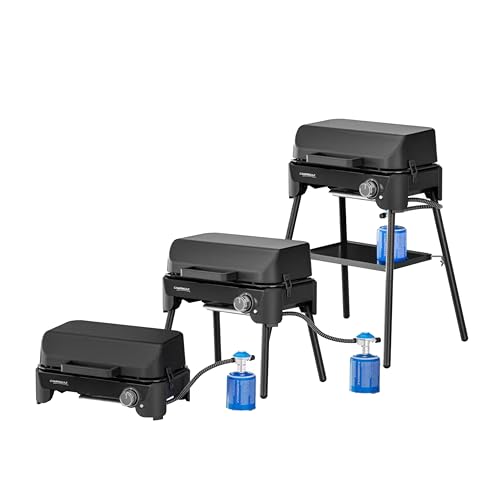
The product photo shows all three forms side by side. At the front, the grill lies flat on the ground: a box-shaped black body with a rectangular lid, the control knob at the front right, and next to it a blue cartridge on the hose. In the middle, the same box stands on four short legs. At the back, it has long legs and a lower shelf on which the cartridge stands.
Campingaz names camping, balcony and park as places of use. In our overview of gas grills, that puts it among the transportable single-burner models for the car boot, not among the trolley grills for the patio. On Amazon it costs approx. €182 (Amazon page on 20.10.2026: €182.37), and in our data comparison it scores 8.1 out of 10 points.
Burner, grate and housing
Under the lid sits a single burner, according to Campingaz a “stainless steel Blue Flame burner” with 2.4 kW. It is lit by piezo igniter. A control knob steers the gas flow, and the instructions describe temperature control simply as the path from the full-flow position to the reduced-flow position.
Campingaz gives the grilling area as 1,200 cm² and adds the edge lengths 47 x 26 cm. The grate is made of enamelled steel, the lid of steel. According to the data table, the grill has no warming rack.
On weight, manufacturer and Amazon agree: 10 kg. Set up, the grill measures 59 x 52 x 103 cm according to Campingaz (width, depth, height); the height matches the freestanding set-up with the lid open. Underneath are non-slip silicone feet, and at the sides are integrated handles. Campingaz describes the grease tray as dishwasher-safe. The Amazon catalogue also lists a steel shelf for spices and the CV cartridge; in the photo, this is the lower shelf of the freestanding grill.
Collected here is what we found in no source: a maximum temperature at the grate, a heat-up time to a given temperature, a lid thermometer, the material of the grill bowl and a coating of the housing, the material of the shelf on the manufacturer’s site, the fill quantity of the cartridge in grams, the packed size in the compact set-up, the working height as a freestanding grill, the country of manufacture, the year of market launch, and a cover or bag that Campingaz assigns to this model. We did not derive the grilling area from the outer dimensions; both figures appear as such on the product page.
In detail: butane, cool evenings and a single zone
According to the instructions, the CV 470 PLUS is 80 % filled with liquid butane. For the burner to get gas, this liquid has to evaporate, and how well that works depends, according to Campingaz, on the outside temperature and on the amount left in the cartridge. The instructions draw a clear limit from this: “Avoid using your appliance at outside temperatures below 15°C. If this is the case, please insert a full cartridge into the appliance.”
An evening in May or September easily falls below this threshold. The physics behind it is common knowledge. Butane boils just below 0 °C, so less evaporates in cool air, and because the cartridge itself loses heat as it evaporates, it cools further during long operation. Propane boils only at about minus 42 °C, which is why grills on a propane bottle hardly know this effect. Our assessment: if you grill a lot in the shoulder season, you should take this limit more seriously than the square centimetres.
Campingaz states the consumption identically on the product page and in the instructions, 175 g/h, in the instructions with the addition “Nozzle N° 75”. The gas category given there is “direct pressure - butane gas”, and the product page lists an operating pressure of 50 mbar.
One burner under the whole grate means there is no side you can switch off. Indirect grilling, where a roast cooks next to the flame instead of above it, generally requires two separately adjustable burners on gas grills. With one knob for the whole area, all you can do is turn the flame down. This principle works for sausages and flat pieces, but for a whole chicken we would choose a different grill.
Does a normal gas bottle fit the Tour & Grill?
No. The instructions state: “This appliance may only be used with Campingaz ® CV 470 PLUS cartridges and with the supplied hose and regulator. Using other gas containers can be dangerous.” An adapter to a propane bottle is therefore not intended, even if the 50 mbar on the product page sounds like bottle operation.
Connection is made via the Easy Clic Plus system. Beforehand, you close the control valve by turning the knob on the regulator from + to -, and the control knob on the grill clockwise as far as it goes. Then you press the regulator onto the cartridge and turn until you hear it click into place, according to the instructions “at about one sixth of a turn anticlockwise”. You should not turn further, otherwise you risk damaging the system. You make the connection in an open, very well ventilated place, never near flames, sparks or another heat source, and away from people or combustible materials.
In the freestanding set-up, the cartridge locks into a stamped shape in the lower shelf, on the right, with the hose best placed behind the right rear pole. In the two low set-ups, it stands upright on the ground. The hose must be neither twisted nor under tension and must not touch hot parts.
For running costs, the cartridges matter most, since you keep buying them as long as you use the grill. None of our sources contains a cartridge price, so we leave out a calculation per grilling hour.
The spare part prices in the Campingaz shop are documented: enamelled grate (art. 2203889) €31.99, lid with handle and hinges (2203974) €65.99, legs with lower shelf (2208819) €58.99, grease drawer (2203890) €14.99, piezo igniter (2203973) and control knob (2203972) €9.99 each. For the lid hinge, the exploded drawing lists a set of two axles and two pins (2232011). According to Campingaz, this drawing applies equally to the Tour & Grill CV and the CV Plus.
Three set-ups, one box: assembly and transport
The instructions number the variants. Option 1 is the freestanding grill: you screw the four upper poles together with the plastic threaded part into the corners of the grill, insert the four lower poles, screw in the wing screws partway leaving 3 or 4 mm free, lay the lower shelf on and tighten the screws. Option 2 uses only the upper poles, into which you push plastic feet. Option 3 manages entirely without legs. In all three cases, you then insert the grease tray and the grate.
Here two sources contradict each other slightly. The product page promises that legs and shelf can be “simply clicked in”. In the instructions, the upper poles are screwed in and the shelf is fixed with wing screws. We would stick to the instructions.
Before first use, you also fit the lid axles and fix them with a pin. For transport, you lock the lid with the silicone fasteners at the sides; Amazon calls them “extra clips on the lid”. You carry it only once the appliance has cooled down, and never by the lid handle but holding it at the sides.
Option 3 has a catch that the instructions name explicitly. The surface underneath can “heat up considerably” during use, so the grill must not go on a combustible surface such as plastic or a tablecloth. A heat-resistant or fireproof surface (concrete, stone, brick, directly on the ground) or a heat-resistant layer between appliance and combustible surface is recommended. A plastic folding table at the campsite is therefore ruled out for the compact set-up unless something is placed in between.
What else comes into question
| Model | The difference | Price | Our rating | Pick this one if |
|---|---|---|---|---|
| Campingaz Tour & Grill CV Plus (this one) | 1 burner, CV 470 PLUS cartridge only, three set-up variants | approx. €182 | 8.1 | you want to switch between ground, table and freestanding grill |
| Enders Explorer II Pro | according to Enders 2 burners of 2.2 kW each, gas bottle or screw-on cartridge | approx. €158 | 8.1 | you want to connect a gas bottle |
| Weber Q 1200N | according to Weber grate of porcelain-enamelled cast iron, 1290 cm² | approx. €249 | 8.3 | a cast-iron grate is worth the extra cost to you |
| Weber Spirit II E-310 | according to Weber 3 burners with a combined 7.0 kW, 2,314 cm² main grilling area | approx. €460 | 9.2 | the grill stays permanently in the garden |
The prices come from our price boxes and change constantly. The rating is our editorial assessment from the data comparison; we measured nothing.
The Enders is the closest. It costs approx. €160, the Campingaz approx. €182, the Enders has two burners and therefore two zones, and Enders states 1,568 cm² of grilling area. The Weber Q 1200N costs approx. €249; Weber gives one burner with 2.93 kW for it. The Spirit costs approx. €460, and at 44.50 kg according to Weber it is not a grill to take along.
When the Tour & Grill fits and when another one does
Start with the number of people. Campingaz calls the grill ideal for 2 to 4 people. For a couple with two children at a campsite, that fits. If you grill for six, you load in stages or take a grill with more area, in our selection the Enders or, if the grill does not need to travel, the Spirit.
On the balcony, the product page says yes, while the instructions set conditions. Verbatim: “The appliance must be set up or used at a minimum distance of 25 cm from the wall or a combustible object and a minimum distance of 1 m from the ceiling.” And: “Do not use the appliance in caravans, vehicles, tents, shelters, huts and small enclosed areas.” Where your balcony does not allow these distances, it is ruled out. Whether house rules and tenancy agreement allow gas at all is covered by our guide grilling on a balcony.
If a gas bottle is already standing in the shed, the Tour & Grill is the wrong choice, see above. The Enders Explorer II Pro is then the obvious replacement. For motorhome travellers, the ban inside the vehicle applies; you grill outside next to the vehicle.
For the time of year, the butane limit from the technical section decides. If you mainly grill on summer holidays, you will notice little of it. If you are on the Baltic coast in October, you plan for full cartridges or choose a bottle-fed grill.
On budget, the cartridges come on top of the approx. €182. If you want to spend more for a cast-iron grate and a maximum temperature stated by the manufacturer, look at the Weber Q 1200N, for which Weber states 316 °C. If you are still undecided between gas, charcoal and electric for on the go, you will find the criteria in our camping grill buying guide or you can let the grill finder give you a selection.
Safety, cleaning and care according to the instructions
The front page has two sentences that frame everything else: “Read the instructions before use.” and “Use outdoors only.” An excerpt verbatim from the safety precautions in section A: “All products powered by gas combustion consume oxygen and release combustion residues. Some of these combustion residues may contain carbon monoxide (CO).” Also: “Do not leave in operation while sleeping, do not leave unattended.” The grill belongs on a stable, horizontal surface and is not moved during use, and the cartridge must stand upright. The complete list is supplied with the appliance.
It is never lit with the lid closed. You open it, check that the control knob is at OFF, press it and turn it anticlockwise to maximum flow, wait 2 to 3 seconds and press the piezo switch several times. If the piezo does not ignite, the instructions describe lighting by hand with a match with the grate removed. Typical causes when nothing lights at all are collected in our guide gas grill will not light.
Before each use, according to section G, you make sure there are no leaks, that the burner tube is not blocked (by cobwebs etc.), that the hose does not touch any parts that can get hot, and that the grease tray is inserted correctly and as far as it goes. Finally, you fit the grate properly.
You always check for leaks outdoors, away from combustible materials and with no smoking. The control knob is at OFF, and the regulator is on the cartridge. Then you apply leak-detection spray to the connections (bottle, pressure regulator, hose, appliance) and open the regulator valve while the control knob stays at OFF. If soap bubbles form, a spot is leaking. Afterwards you close the valve on the cartridge regulator. The grill is used only once all connections are perfectly tight; if gas escapes, you disconnect the regulator from the cartridge and contact customer service. “Never use a flame to check the appliance for gas leaks.” According to the instructions, the check is mandatory “at least once a year and every time the gas cartridge is changed”.
You clean after every use, but only once the appliance has cooled down completely. According to the instructions, you clean the burner with a damp sponge soaked in water and washing-up liquid; before the next use, all burner openings must be clear and dry, and you remove a blockage with a wire brush if necessary. Campingaz calls it normal for the burner to oxidise; according to the instructions, regular cleaning prevents premature oxidation from acid residues. You wipe the control panel with a sponge dampened with water and washing-up liquid, and the underside of the grill bowl after each use with a damp sponge.
For the grease tray, the instructions recommend cleaning after each use and a trick: put some sand in to absorb the fat, then dispose of it. The grate is enamelled. Campingaz recommends its own grill cleaning spray and suitable grill brushes for it, and the grate may go in the dishwasher once you have scraped off adhering residues with a sponge or a metal brush. To take it out, you slide a finger into the holes provided. General tips on fat and grate can be found in our guide cleaning a gas grill.
You check the hose regularly and have it replaced through customer service if it is worn or cracked. According to the instructions, the printed date is the production date, not an expiry date: the hose can be used without time limit as long as it is not damaged. After every use, you close the valve of the cartridge regulator.
Who is it suitable for?
For a small group that travels by car, grills in summer and finds at the destination sometimes a table, sometimes only a meadow. The three set-ups are made for that.
The wrong choice is the Tour & Grill for anyone who wants to use it professionally, for example at a market or for catering. The instructions are clear on this: “This product was designed for ordinary private use. It is not intended for commercial use.”