What Enders sells under number 2108
The Explorer II Pro is a small two-burner gas grill that Enders lists under item number 2108. The box contains two sets of legs, four short and four long, both of which are plugged in. According to the manual, with the short ones alone it is a table grill, with the long ones a stand unit.
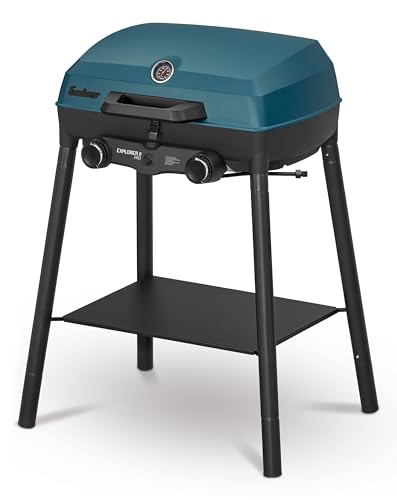
The product photo shows the stand version: a box-shaped lid with rounded corners and the thermometer in the middle, two control knobs at the front, and underneath four slim legs with a shelf tray between them. The grill has no side tables. According to the manual, you place the gas bottle next to the unit, not underneath it.
On Amazon it costs approx. €158 (Amazon page on 21 October 2026: €157.95). The manufacturer’s site shows an RRP of €199.00 (retrieved on 21 October 2026). The manufacturer is Enders Colsman AG, based in Werdohl, which according to its own statement has existed since 1883 and develops its grills there; Enders does not say where the Explorer II Pro is produced. Where the Explorer II Pro sits among the other units is shown in the overview of all gas grills.
Burners, grate, lid and dimensions
Under the lid are two stainless steel burners at 2.2 kW each, 4.4 kW in total. Each has its own control knob; Enders speaks of two independently adjustable burners. Ignition is by piezo. The grill burns propane (G31) or butane (G30). For Germany and Austria, the technical data in the manual gives gas category I3B/P with 50 mbar connection pressure and nozzles of 0.65 mm diameter. The unit is tested and approved to DIN EN 498:2012 and DIN EN 484:2020 (German and European standards that apply in Germany and the EU), and the product ID is 0085CQ0040.
According to Enders, the grilling area measures 49 x 32 cm, so 1,568 cm². On it sits a two-piece stainless steel grate with integrated flame covers. We read this as follows: the plates that on many gas grills sit as a separate part above the burners and deflect dripping fat are built into the grate here. Underneath are removable stainless steel pot rests. They explain why Enders speaks of three cooking functions, grilling, cooking and baking: if you remove the grill grate, a pot sits directly above the flame.
The housing and lid are made of powder-coated cast aluminium. Enders describes the lid as large-volume, without giving a volume or an interior height. The thermometer sits in the lid. Fat runs into a removable drip tray.
As a stand grill, the Explorer II Pro has a 67 cm working height, as a table grill 27 cm. Assembled, it measures W 60 x D 48 x H 81 cm in stand mode, and W 60 x D 42 x H 39 cm on the table. Enders states 10 kg. The Amazon catalogue gives approx. 10.9 kg converted; we stick with the manufacturer.
According to the parts list in the manual, the contents are the fire box and grease drip tray, four long and four short legs, handle pieces 1 to 4, left and right grill grate, the thermometer, the hose line with pressure regulator, the shelf tray with four brackets, four leg adapters, as well as 2 screws, 4 M5 screws and 6 washers.
What is missing from the documents
Some values you would expect for a gas grill appear neither in the manual nor on the product page: the temperature that can be reached under the lid, the measuring range of the thermometer, the steel grade and material thickness of the grate, pot rests and grease tray, the wall thickness of the cast aluminium, the country of production and the year of market launch (the manual carries version number 241031, presumably dating from October 2024). Equally open are a number of people for the grilling area, a burn time per cartridge or bottle, material and dimensions of the shelf tray, and the packed size and shipping weight. The word balcony does not appear in the manual’s setup rules.
In detail: two zones on 49 by 32 centimetres
Two separately adjustable burners mainly mean this: you can switch one side off. Indirect grilling, which Enders describes in the manual, builds on that. The food sits above the switched-off burner, the other one runs, and the lid stays closed. The heat then arrives not as radiation from below but as hot air circulating under the lid. For thick cuts, that is the point: the surface does not burn before the inside is done. How the method works in principle and which zone suits what is explained in our guide to direct and indirect heat.
4.4 kW on 1,568 cm² works out at roughly 2.8 W per square centimetre. On its own, the figure says little. It becomes useful when compared with the closest relatives: according to Enders, the Explorer II and the Urban II Pro have the same burners on the same area, and so the same value. What sets these three apart is the grate, lid and frame, not the output.
For preheating, Enders gives approx. 10 to 15 minutes at full power, depending on external influences such as temperature and wind. Enders writes that the housing design protects the burners against wind, but still advises a wind-sheltered spot. What temperature the grill reaches afterwards remains open, and we would plan around that: the thermometer in the lid shows it to you, but you have no manufacturer figure to compare it with.
For pizza, Enders recommends a pizza stone. It is preheated for approx. 10 to 15 minutes at approx. 180 to 200 °C, and baking is always done with the lid closed. Based on these details, we would not buy the Explorer II Pro as a pizza oven, but as a grill on which pizza also works.
How long does a cartridge last?
With both burners at full power, by calculation just under an hour and a half. The manual gives a consumption of approx. 321 g per hour, and the matching cartridge holds approx. 450 g. That gives roughly 1.4 hours or 84 minutes.
This is our calculation; Enders itself gives no burn time. It describes the worst case: on a low flame or with only one burner, the cartridge lasts longer, but how much longer cannot be derived from the documents. Preheating alone costs 54 to 80 g by the same calculation. With a bottle the picture changes: 5 kg lasts, by calculation, a good 15 hours at full load, 8 kg just under 25 and 11 kg a good 34 hours. On the manufacturer’s site, the 450 g Enders screw-in cartridge costs €7.99, which at full load comes to roughly €5.70 per hour.
Before you plan around cartridges, it is worth looking at what is in the box. According to the manufacturer’s site, an 80 cm hose and a gas pressure regulator are included for gas bottle operation; according to the manual, a pressure regulator to DIN EN 16129, type 694, and a hose to DIN EN 16436-2. For the cartridge, the manual requires a different regulator, type 794 under the same standard. The cartridge must comply with DIN EN 417:2012 and have a 7/16 inch screw thread, and Enders points to its own gas cartridge with item number 6322. A cartridge holder set (item number 2071) is available as an accessory.
The Amazon text puts it more briefly: can be operated with either a gas bottle or a screw-in cartridge, hose and regulator included. According to the manufacturer’s documents, the “included” applies only to the bottle. We could not confirm whether the cartridge holder set contains the type 794 regulator.
Bottles of 5, 8 or 11 kg are approved, standing next to the grill. The manual gives their dimensions: 11 kg approx. 59 cm tall at 30 cm diameter, 8 kg approx. 46 cm at 30 cm, 5 kg approx. 47 cm at 23.5 cm. A hose length of 0.8 m is recommended. If the table grill sits on a garden table and the bottle on the ground next to it, that can get tight, because according to the manual the hose must not be kinked or chafe. We would measure before buying. Which bottle size suits which purpose is covered in our guide to the gas bottle for the grill.
What else is worth considering?
| Model | The difference | Price | Our score | Choose this one if |
|---|---|---|---|---|
| Enders Explorer II Pro (this one) | Cast aluminium lid, table and stand legs, two burners | approx. €158 | 8.1 | you want to switch between table and ground |
| Enders Explorer II | Same chassis, lid made of powder-coated steel | approx. €122 | 8.0 | your budget is tight and the grill mostly stands dry |
| Enders Urban II Pro table grill | Enamelled cast iron grate, side shelves, no stand legs | approx. €179 | 8.1 | the grill always stands on a table |
| Weber Q 1200N | One 2.93 kW burner, cast iron grate, side tables | approx. €249 | 8.3 | shelf space matters more to you than two zones |
The prices are guide values from our price box and change. The score is our editorial assessment based on the manufacturer’s data; we have not measured anything on any of the four grills.
When the Explorer II Pro fits and when another one does
The Explorer II costs approx. €122 against approx. €158 for the Pro. According to Enders, burners, grilling area and working heights are the same. The difference lies in the lid: on the Explorer II it is powder-coated steel, on the Pro cast aluminium. In addition, according to Enders the Explorer II weighs 9 instead of 10 kg and is 78 instead of 81 cm tall when assembled. Aluminium does not form iron rust, while with steel the protection depends on the coating. If you often leave the grill outside or transport it in the boot, where the coating can get scuffed, we would pay the extra. If you put it away dry after every use, you can save it.
If your grill always stands on a table anyway, the Urban II Pro table grill at approx. €179 is the alternative (the Explorer II Pro stands at approx. €158). According to Enders it has the same burners and the same area, but an enamelled cast iron grate, side shelves and no stand legs. With the shelves it is 94 cm wide, the working height is 23 cm, and the weight 12 kg. Cast iron stores more heat than a stainless steel grate and releases it to the food when it is placed on, hence the more pronounced grill marks.
At approx. €249 in our price box, the Weber Q 1200N sits above the Explorer II Pro at approx. €158. It has a single burner of 2.93 kW, a cast iron grate and side tables. With one burner, the two-zone split described above falls away. If you mainly grill sausages and steaks directly and want space to put things down, you will manage with it; if you also want to let a roast cook indirectly, in our assessment you are better off with the Explorer II Pro.
The area is not intended for larger groups. If you regularly grill for many people, you will find units with three or more burners in the category overview above.
For the balcony, the manual’s setup rules apply: outdoors only, sheltered from wind, on a level and stable surface. You keep at least 0.5 m distance from flammable and heat-sensitive materials, and 1 m must remain free above the highest point of the open lid, without objects or parts of buildings. An awning or your neighbour’s balcony above is quickly within that metre. Whether gas is allowed on your balcony at all is governed by your tenancy agreement and house rules; what matters here is summarised in our guide to grilling on a balcony.
For camping, the 10 kg and the plug-in legs, which you pull off for the journey, count. As a stand grill, the Explorer II Pro needs no table at the pitch. The working height of 67 cm is, however, well below a kitchen worktop, so if you are tall you will be stooping. More on size, weight and fuel on the road is in the camping grill buying guide.
Gas connection, operation and cleaning according to the manual
When connecting the bottle, the union nuts have a left-hand thread. The manual proceeds like this: screw the hose’s union nut onto the pressure regulator and tighten firmly with a spanner. Tighten the pressure regulator onto the gas bottle by hand only, without tools, so that the seal is not damaged. Place the bottle next to the unit. On the grill, remove the protective cap, tighten the hose with a spanner while holding against it with a second spanner on the unit’s flats. Finally, check for leaks: brush the connections with leak detection spray or soapy water (1 part soap to 3 parts water) and open the bottle valve; where bubbles form, it leaks, so retighten and repeat. Afterwards you clean the spots with water. According to the manual, a leak test with an open flame is strictly prohibited. With the cartridge, you screw the regulator on by hand with the valve on the regulator closed, and you tighten the hose on the grill with two spanners as well.
On gas, Enders also writes: the grill may only be operated with a pressure regulator, and the one included is factory-set for liquefied gas. Hose and regulator must be replaced at regular intervals, and the hose also whenever national regulations or its period of validity require it. When buying or renting the bottle, you take advice from a specialist retailer. When connecting and changing, there must be no ignition sources or open fire nearby. The hose must not be kinked or chafe and must be accessible along its entire length.
The manual summarises intended use like this: the grill may only be used outdoors. It is not intended for children and for people with a limited ability to operate appliances. Accessible parts can get very hot, so you warn bystanders and keep children away. When handling hot parts, you wear protective gloves.
For operation, the following also applies: do not smoke when handling the gas system and do not place the bottle near open fire. Set the grill up sheltered from wind, on a level and stable surface and away from moisture and splash water. In operation, it is not moved and not left unattended. You check the hose and pressure regulator for cracks and damage before every use; if anything is defective, the grill stays off. The bottle valve is open only while the grill is in operation. After use and before every change of location, you switch off, close the valve and disconnect the bottle. You never cover the grilling area completely with aluminium foil or similar, otherwise there is a risk of overheating. The ventilation openings stay free, and the distances from the balcony paragraph apply everywhere. If gas escapes or there is a fault, you immediately close the bottle valve. You protect the bottle from strong sun; it must not exceed 40 °C, and a cartridge 50 °C.
Ignition is with the lid open: all control knobs to off, bottle valve open, press a knob and turn it anticlockwise to the highest setting, then press the piezo igniter. According to the manual, the second burner alternatively ignites automatically as soon as the first control knob is at full power. To switch off, you close the bottle valve and turn all knobs to off.
On grease fires, Enders warns that highly heated fats and oils can ignite spontaneously. You dab excess fat and marinade off the food beforehand and remove grease deposits regularly, especially inside the burn chamber and in the grease tray. Burning, hot or smoking fat is never extinguished with water. If it burns seriously, you get people to safety, close the bottle valve if possible and cool the bottle with water; the manual warns of an explosive reignition. Anyone who inhales gas in high concentration can suffocate: get fresh air and call a doctor.
Cleaning is done only once the grill has cooled down enough. The manual requires cleaning before every use and after every use, without flammable, abrasive or chlorine-containing cleaning agents. You pull out the grease tray and dispose of the fat in an environmentally responsible way. After every grilling session, you remove residues from the inside of the lid and the stainless steel grates with a mild cleaning agent, rinse and dry. You remove food residues on the burners with a soft brush, not a wire brush. You wipe the inside of the housing with warm soapy water, plastic parts with warm water, painted surfaces with a mild cleaner, without solvents, oven cleaner or stainless steel cleaner. Before the next use, you let everything dry completely. Repairs and maintenance on gas-carrying parts are reserved for authorised specialist personnel, sealed components must not be tampered with, and you never oil stiff valves or knobs.
Accessories, spare parts and warranty
The manual lists six accessories with item numbers: cast plate (2072), stainless steel pan and bowl set (2074), pizza stone (2110), weather cover (2073), cast iron grate (2107) and cartridge holder set (2071). On the manufacturer’s site, the cartridge holder set, pizza stone, half cast plate and cast iron grate cost €34.95 each, and the premium weather cover for the Urban II and Explorer II series €19.99. With the cast iron grate, the difference from the Urban II Pro can therefore be partly retrofitted. If you add the cover and cartridge holder set to the grill, according to the manufacturer’s site that comes to an extra €54.94, not counting the gas bottle.
In case something breaks, the manual contains a spare parts list with Enders numbers, for example body 130004120, lid 130004122, grill grate 130004124, grease drip tray 130004106 and thermometer 130004144. No prices are given there.
The warranty is a voluntary manufacturer’s warranty for first buyers and supplements the statutory warranty rights. The manual gives 10 years against rust-through or burn-through for the cooking lid and burn chamber, 3 years for the grease tray, stainless steel burners and grill grate, likewise 3 years for plastic parts and 2 years for the remaining parts such as the ignition bridge, screws and thermometer. You secure the extended warranty by registering the grill on the Enders website within three months of purchase.