A small grill trolley with an infrared burner
TAINO calls the Wabaya 3+0 a “compact city model”. It is a gas grill on a narrow trolley with three control knobs. Two of them control steel main burners, the third an infrared ceramic burner, which TAINO calls a sear zone. Each of the three has 2.5 kW.
On the Amazon page, the grill was at €139.99 on 21.10.2026, so approx. €140. In the TAINO shop it was at €139.99 on 21.10.2026 instead of the regular €229.99, but was marked there as currently unavailable.
Behind the brand is Clic-Trade GmbH from Cologne, which also imports the grill. According to the instructions, it is manufactured in the People’s Republic of China, and designed in Germany according to TAINO. The Wabaya has been listed in the shop since March 2024, and the German instructions carry model number 93513 and the revision date 01/2025.
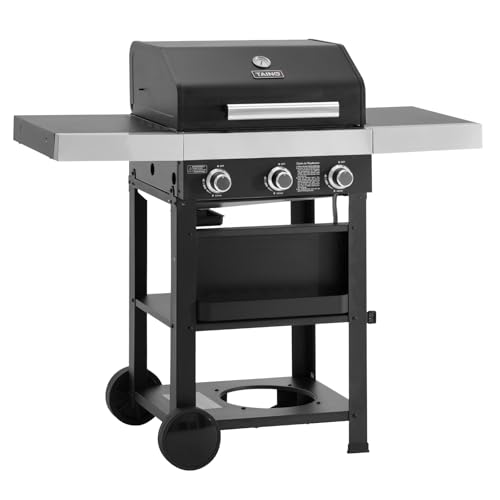
The product photo shows a box-shaped lid with a TAINO logo and a silver handle bar on the firebox. The side tables hang left and right, and beneath stands an open frame with a lower shelf and a base plate with a round cut-out. The two wheels are on the left, and on the right the frame stands on two feet. In our overview of gas grills, it sits among other three- and four-burner trolleys that cost about the same.
Burners, grates and dimensions according to TAINO
The two main burners are made of steel and sit under enamelled burner covers. The parts list in the instructions lists two such covers for three burners. By our reading, the ceramic of the infrared burner is therefore exposed under the grate. According to the technical data in the instructions, the grill together reaches 7.5 kW of heat input and uses 546 g of gas per hour at full power. The nozzles of the main burners are 0.68 mm. Ignition is by piezo, and each burner has its own control with the positions OFF, HI and LO.
TAINO gives the cooking area as approx. 47 x 37 cm, which is around 1,739 cm². It is split across two grates of approx. 23.5 x 37 cm each. Above hangs an enamelled warming rack of approx. 44.5 x 17.5 cm, so just under 780 cm². The inside of the firebox is enamelled, the body is made of powder-coated steel in matt black, and the handle of stainless steel. The lid holds a thermometer with a scale in °C and °F.
Grease runs via a drip plate into a galvanised, removable collecting tray with a grease pan.
Outside, the Wabaya measures approx. 112 x 53 x 103 cm (width, depth, height). The two side tables, each approx. 31 x 44 cm, can be folded down, which reduces the width to 64.5 cm. The working height is approx. 82.5 cm, and the weight is approx. 20.5 kg. There is also a holder for 5 kg gas bottles and a spice and sauce holder. The two plastic wheels are approx. 15 cm in diameter and 4 cm wide.
What TAINO does not state
The following are missing from the product page and the 44-page instructions:
- the material of the two grates
- wall thickness of the lid and whether it is double-walled
- a maximum temperature, either for the cooking chamber or for the sear zone
- the heat-up time
- the gas consumption of the individual burners
- the construction and material of the ceramic plate in the infrared burner
- instructions for indirect grilling
- an explicit statement about balconies
- prices and a list of spare parts
- assembly time and tools required
In detail: what the infrared burner does differently
An ordinary gas burner is a tube with a row of small openings. Its flames mainly heat the air and the cover above, and from there the heat rises to the grate. With an infrared ceramic burner, the gas burns on the surface of a finely perforated ceramic plate. The plate glows, and a large part of the heat reaches the food as radiation, without a detour through the air. This is the basis of sear zones: a lot of heat on a small area, so that a steak gets a crust in a short time.
What stands out with the Wabaya is the power figure. At 2.5 kW, the infrared burner has exactly as much as each main burner. So there is no more energy in this zone, it is just transferred differently. TAINO does not quantify how hot the grate above the ceramic gets. The only temperature in the instructions belongs to the burn-in, and all burners run together then.
One figure helps put this in context. 7.5 kW over around 1,739 cm² gives about 4.3 W per cm². According to Weber, the Weber Spirit II E-310 has 7.0 kW over 2,314 cm² of main grate, which is a good 3.0 W per cm². On paper, the small Wabaya therefore has more power per area. What arrives at the grate also depends on the lid, wind and outside temperature.
For indirect grilling, you leave one burner off and place the food over it with the lid closed. That is our own deduction from three separately adjustable burners, and TAINO itself nowhere describes the method for the Wabaya. There is not much room for it: across 47 cm of width, each burner arithmetically gets just under 16 cm. And the lid thermometer shows the air temperature under the hood, not the heat directly above the ceramic.
What do you need to do before the first steak?
Three things: assemble the grill, get a suitable pressure regulator with hose and connect it, and burn the grill in. The instructions make the burn-in mandatory, and it takes 40 to 45 minutes.
You choose the regulator according to the gas category. In Germany, that is I3B/P(50), meaning butane, propane or LPG mixture at 50 mbar. The instructions require a low-pressure regulator to EN 16129 in its current version and permit only hoses with a screw connection. According to the instructions, the same category applies in Austria, Switzerland, the Czech Republic, Slovakia and Luxembourg.
Because of the risk of explosion, you connect it only outdoors and with the grill cooled down. The steps according to the instructions: bottle valve closed, protective caps off, screw on the union nut at the grill and carefully tighten it with a spanner. Then the bottle goes into the trolley, the hose is screwed onto the regulator and tightened, and finally you screw the regulator onto the bottle by hand. For this last step you use no tool, otherwise the seal suffers.
Before first use, TAINO recommends a leak test, with the grill fully assembled and a full bottle. You mix a soapy solution of one third soap and two thirds water, set the controls to OFF, open the bottle valve and brush the solution with a brush or cloth onto all connections and hoses. Bubbles indicate a leak. Then close the valve, tighten the leaking fitting and test again from the start until no more bubbles form, and finally close the bottle valve. Smoking and open flames are taboo while doing this. The grill is not operated with a leak.
For the burn-in, you first clean the surfaces with a soft cloth and soapy water and dry them. They are pre-treated with vegetable oil at the factory. As oil, the instructions name heat-resistant types, ideally rapeseed or sunflower oil. Then you light all burners one after another on the lowest setting, and after about 10 minutes all run on the highest. The lid stays closed and is opened briefly every 4 to 5 minutes. At approx. 220 to 250 °C, the burners stay on full for 20 to 25 minutes, then are turned down for about 15 minutes. Production residues burn off during this, and you should avoid standing in this smoke if possible.
Light it always with the lid open and your face not above the grill. Push the control in and hold it for 3 to 5 seconds so that gas flows, turn it anticlockwise to HIGH and, after the ignition spark, keep it pressed for another two seconds. At HIGH the flame should be about 12 to 20 mm long. If a burner does not light, you turn it to OFF and wait 5 minutes before the next attempt. How to use the hot side for searing is covered in our guide to grilling steak.
What else comes into question?
| Model | The difference | Price | Our rating | Choose this one if |
|---|---|---|---|---|
| TAINO Wabaya 3+0 (this one) | Infrared burner alongside two steel burners, grate approx. 47 x 37 cm | approx. €140 | 7.5 | you want a hot zone for searing and have little floor space |
| Costway gas grill 3 burners 7 kW | three identical burners, grate 1,608 cm², 16 kg | approx. €150 | 7.9 | you do not need a sear zone and want a lighter trolley to push |
| TAINO Brando 4+1 | four stainless steel burners plus side burner, grate approx. 60 x 34 cm | approx. €160 | 7.5 | you want to put a pot for side dishes on the flame while you grill |
| Weber Spirit II E-310 | enamelled cast iron grates, main grate 2,314 cm², 7.0 kW | approx. €459.99 | 9.2 | you often grill for larger groups and can spend considerably more |
The prices are guide values from our price boxes and change constantly in the shops. The rating is our editorial assessment based on the manufacturers’ data, and we have not measured anything on any of these grills.
When the Wabaya fits and when another one does
Start with the spot where it will stand. The instructions require 60 cm of clearance from combustible materials behind the back panel, 50 cm at the sides and 100 cm above. With the tables unfolded, you therefore need a free area of around 212 cm in width and 113 cm in depth, with space for you added at the front. With the tables folded down, it is still 164.5 cm in width. For a small terrace, that is in our assessment the real advantage of the Wabaya. For comparison: the Brando 4+1 measures approx. 124.5 cm in width even before the clearances.
With a balcony, it gets tighter. The instructions do not explicitly regulate it. They do, however, prohibit operation on wooden decks and under combustible surfaces or roofs, and require the area above the grill to stay clear. A balcony with a wooden floor is therefore ruled out, and by our reading so is one with another balcony directly above. Whether gas is allowed at all is governed by your tenancy agreement and house rules. You will find more in the guide Grilling on a balcony.
Then the area. TAINO does not say how many people it is enough for, and we do not derive a number from it. A comparison helps more: the main grate of the Weber Spirit II E-310 is around 33 percent larger, and the approx. 60 x 34 cm of the Brando 4+1 is around 17 percent more. The Costway, at 1,608 cm², is even just under 8 percent below the Wabaya. If you already grill in several rounds today, in our assessment none of the three inexpensive trolleys changes much about that.
The sear zone is the point on which the choice turns. If you mainly grill sausages, vegetables and chicken legs, you do not need it. Then the Costway costs approx. €150 (the Wabaya approx. €140), is ahead of the Wabaya in our rating with 7.9, and according to Costway weighs 16 kg, so 4.5 kg less. If you want to sear steaks hard and finish cooking them gently alongside, the Wabaya is the only one in our table for which the manufacturer states an infrared zone.
Finally, work out the whole budget. On top of the grill at approx. €140 come a 50 mbar regulator with hose and a gas bottle, and a cover if you want one. The Weber Spirit II E-310 is well above that at approx. €459.99, but according to Weber it has grates made of porcelain-enamelled cast iron. If you are still undecided whether you want gas at all, you can work through the questions in the grill finder.
Accessories and running costs
TAINO lists two covers for the Wabaya. Cover 98879, made of Oxford polyester with hook-and-loop fasteners, measures approx. 117 x 52 x 99 cm and costs €23.99 according to the TAINO shop. It is wider than the grill with the tables unfolded. Cover 98881 is advertised for COMPACT 3+0 and WABAYA 3.0, measures approx. 76 x 50 x 94.5 cm and costs €24.99. By the numbers, it fits only over the grill with the tables folded down. In the TAINO range, apart from these two covers, only the grill itself and a set carry the name Wabaya.
Gas can be calculated. At 546 g per hour with all three burners on full, a 5 kg bottle lasts a good nine hours arithmetically (5,000 g divided by 546 g). With a smaller flame it lasts correspondingly longer. We deliberately do not include a gas price here, because it varies greatly depending on the dealer and the filling. What to look for when buying a bottle is explained in the guide Gas bottle for the grill.
According to the instructions, you check the regulator and hoses before every use and replace them if they are excessively worn before you use the grill again.
Cleaning, care and safety according to the instructions
Cleaning is done only with the grill cooled down and the gas supply turned off at the bottle, without harsh or aggressive cleaning agents. After every use you remove all grease residues to avoid fires, and let each burner run for another approx. 15 to 20 minutes without food. You empty the grease tray after every use once it has cooled down, and it always belongs at the bottom of the grill. The grill should be serviced every 90 days, but at least once a year.
For the individual parts, the instructions say:
- Grate and inside: brush, scraper or pad and mild soapy water, for stubborn stains wire brush, steel wool or scouring sponge.
- Grate and grease collector: mild soapy water solution, soak if needed, rinse, dry.
- Inside of the lid: remove flaking carbon with hot soapy water. “Never use oven cleaner!”
- Outer surfaces: mild detergent or baking powder with hot water.
- Burners: clear blocked openings with pipe cleaner or wire, inspect for cracks and holes, and replace damaged burners.
One sentence in the instructions does not fit the device: it warns that the stainless steel surface of the grill can discolour due to high temperatures. According to the product page, the body is made of powder-coated steel, and the sentence apparently comes from a template for other grills. It therefore does not help you with caring for the body.
For positioning, the instructions require: outdoors only and in well-ventilated places. The grill is prohibited in enclosed and inhabitable spaces, such as houses, tents, caravans, motorhomes and boats, and because of carbon monoxide also for cooling down. In addition: protection from weather and moisture, nothing flammable nearby, a stable and heat-resistant surface on which nothing wobbles, and a place where children and animals cannot reach the grill. Before use, you check the local regulations. Clearances and the ban on wooden decks and combustible roofs are covered above in the decision guide.
After grilling, you close the bottle valve, remove the connection and put the protective cap on. The bottle is stored upright, outdoors, well ventilated, separate from the grill and out of reach of children. After a longer break, you check the grill for gas leaks and blockages in the burner, with insects given as an example in the instructions. During operation you do not undo any gas connection, and smoking is prohibited during use. You do not touch the dark area of the handle during operation, as it gets hot. The grill is moved only when cooled down and never with the bottle connected. More background is in the guide Cleaning a gas grill.
Who is it suitable for?
For people with little space on stone or tiles who mainly grill quickly seared meat and want a hot zone for it. At approx. 20.5 kg on two wheels, the Wabaya can be pulled across a level terrace. Amazon describes two lockable castors. The parts list shows two wheels on one axle and two floor protectors, and in the photo the right side stands on feet. By our reading, the grill stands firmly as soon as the foot side is on the ground.
It is the wrong choice for anyone who wants to use it commercially or in a club: according to the instructions, it is suitable exclusively for private use. And for families where the children are meant to do the grilling themselves. The instructions state clearly that children must not operate the device.