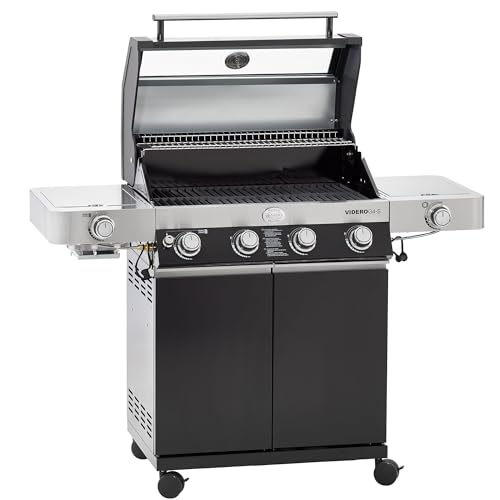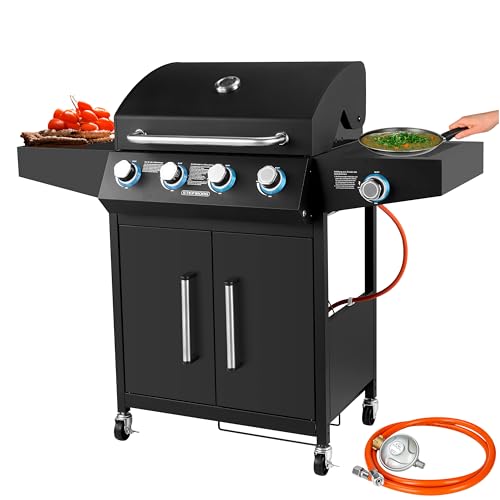
A gas grill cart from a household goods shop
Steinborg is not a grill manufacturer in the strict sense but a house brand of Enstore GmbH. Under this name the retailer sells mainly household appliances in its own shop, plus a handful of grills: two folding grills (SB-8160 and SB-8161), a charcoal grill (SB-8220), an electric stand grill and exactly one gas grill. That is this one, the SB-8180 with the nickname “Chef de Cuisine”.
On Amazon it costs approx. €400 (Amazon page on 21.10.2026: €399.90), and in the Enstore shop it was at the same price when we looked on 21.10.2026. That puts it in the lower range of four-burner carts with a side burner in our overview of gas grills.
You should know where the information below comes from. There are exactly two sources: the product page at Enstore and the Amazon catalogue, and their texts are word for word identical over long stretches. We did not find a downloadable data sheet or operating manual even on the second research pass. A few safety notes could still be read, because they are printed on the control panel and visible on one of the shop photos.
What Enstore states about burners, grate and frame
Under the hood there are four main burners, with a side burner added on the far right. Enstore gives it a clear job: it is “ideal for preparing sauces and side dishes”. In the product photo, a pan of vegetables sits on it.
The grate consists of three parts made of enamelled stainless steel. Enstore gives the grilling area as 62.5 x 41.5 cm (width x depth), which is just under 2,600 cm². According to the delivery list, a “small grill grate shelf” is also included, presumably a warming rack above the main grate; no dimensions are given for it. There is a thermometer in the lid, visible in the photo as a round display centred above the handle. Ignition is by piezo at the push of a button.
The frame is black. Two side shelves extend to the left and right, and a rail for grill tools hangs on the side. At the bottom is a base cabinet with two doors on four castors, which according to Enstore have brakes. This base cabinet has room for an 8 kg gas bottle. Fat runs into a removable drip tray.
The outer dimensions are where it starts to go wrong. Enstore and Amazon both state 133 x 113 x 54 cm in the order height, width, depth. On the dimension drawing in the shop’s image gallery, however, the height is labelled as 113 cm. One of the two figures is wrong, and which one cannot be settled from the outside. The 113 cm width is in any case an overall dimension that includes both side shelves; no figure tells you how wide the combustion chamber alone is. We are not adopting the weight in the Amazon catalogue (converted, around 8 kg). For a grill cart with a base cabinet and lid, that value is not plausible.
In detail: stainless steel under enamel and four knobs side by side
Enamel is a glass-like layer fired onto metal at high temperature. On grill grates it is usually applied to cast iron or plain steel, because both rust without protection. It is rarer on stainless steel, because stainless steel does not actually need this rust protection. Whether Enstore really means a rust-free core by “enamelled stainless steel” is something we cannot verify. If so, it would have one advantage: if enamel chips off in one spot, there is no iron underneath that starts to rust.
When searing, something else counts, namely mass. A thick cast grate absorbs a lot of heat and passes it on to the meat placed on it without cooling down much itself. That is where the dark grill marks come from. Stainless steel conducts heat less well than cast iron, and thin bars store little. How thick the bars on the Steinborg are and what one grate part weighs is unknown. If mainly you want strong branding on steaks, cast grates are in our assessment the better choice, see the Nexgrill in the table further below.
The four knobs on the front panel theoretically open up what distinguishes a four-burner from a two-burner: one side hot, the other off. On the hot side you sear, and on the cool side a roast or a whole chicken keeps cooking with the lid closed, without fat dripping into the flame. How to divide the zones and which temperatures are usual is covered in the guide to direct and indirect heat.
Individual control is not explicitly promised anywhere. Four knobs for four burners do speak for it, though. More interesting is the printed lighting instruction (in full further below): it has you light the middle burners first and then the left or right one. Read that way, the outer burners get their flame from the middle ones. For indirect grilling with a cool centre, that means you still light the middle burners first and then turn them down.
Are the illuminated knobs worth it?
Our assessment: as a nice extra yes, as a reason to buy rather not. The light helps you read the position of the knobs in the evening. It changes nothing about the burners, grate or heat, and it needs four AA batteries.
In the product photo, the knobs are surrounded by blue rings. Enstore justifies the lighting with “easy operation even in poor lighting conditions”. That is true as far as reading the knobs goes. The light does not show whether a burner is actually burning; for that you still have to look at the flame.
We would bear two practical points in mind. First, the batteries: how long a set lasts is unknown, and battery compartments on an appliance that stands outdoors get exposed to moisture. Take the cells out before winter, before they leak. Second, the feature is not exclusive in this price class. The Flammenwerk Profi in the table below also has illuminated knobs and a side burner.
Ignition and safety: what the control panel says
Because there is no downloadable manual, the print on the control panel is the only piece of safety text we could read before buying. We read it from a shop photo. It carries five notices: “For outdoor use only.” “Read the operating manual first before using the appliance.” “Warning: use an oven cloth/oven glove when using the grill.” “Accessible parts can be very hot.” “Please keep small children away.”
Below that, under the heading “Instructions for lighting” (in the German original a literal translation of the English “lighting”, meaning igniting), is a lighting instruction. The six steps read:
- The lid must be open before lighting.
- Set all knobs to “OFF”.
- Open the gas bottle valve according to the operating instructions.
- Push in the middle burner knobs and turn them anticlockwise until they reach the igniter (on the print this is followed by a note about a clicking sound).
- Then press the left or right control knob and turn it in the same direction until the burner lights.
- If the burner does not light, turn all knobs to “Off” and repeat steps 4 and 5 after 5 minutes.
The waiting time in step 6 has a reason. If gas flows out without burning, it collects under the hood. If you click again straight away, you ignite this mixture all at once. That is also why step 1 exists: an open lid lets the gas escape. Our guide Gas grill will not light sorts out what can be behind repeated failed ignitions.
Everything else is a general rule for gas grills and expressly not Enstore’s wording: after every bottle change you check the connections with leak detection spray, and if bubbles rise, the valve stays closed. The hose must not kink or touch hot parts. You do not place the grill under roof overhangs or next to a hedge.
What is in the box and what you need to add
Enstore lists: the grill, three enamelled grates, the small grill grate shelf, the lockable compartment, the drip tray, the hanging rail, an operating and assembly manual and a weatherproof cover hood. The hood is also listed in the Amazon catalogue as a grill cover. Amazon also lists two gas parts, more on that in the questions below.
The lockable compartment appears in the list as a separate part. In the photo we can see two doors with handle bars on the base cabinet, but no lock. So whether the compartment is a separate box to screw on or belongs to the cabinet doors cannot be read from the image or the text.
You have to add the gas bottle. It is not included in any variant. Which bottle types exist, what separates exchange and owned bottles, and what to look for with the regulator is covered in the guide Gas bottle for the grill. We cannot put a figure on the running costs of the gas, because output and consumption are missing; a calculation per bottle would be a guess. A small item on the side: the AA batteries for the lighting.
On care, only one sentence is online: the removable drip tray makes cleaning easier. For enamelled grates, the general rule is that a brass brush protects the layer, while coarse steel wire brushes can scratch it. How to get the combustion chamber, burner tubes and grease tray clean one after another is explained in the guide Cleaning a gas grill.
What Enstore leaves open
The gaps are collected here. Open are: the output in kW, in total and per burner, including the side burner; gas type, connection pressure and appliance category; the gas consumption in grams per hour; material and construction of the burners; the material of the hood, housing, base cabinet and side shelves; dimensions and material of the pot support on the side burner and of the small grate shelf; a reliable weight; maximum temperature, heat-up time and the scale of the lid thermometer; minimum clearances, balcony rules, leak testing, cleaning instructions and intended use, so everything that would be in a manual; warranty terms; spare parts; a CE identification number or standard reference; the country of production and the year of release; whether the lighting switches itself off and how long the batteries last; how many people the grilling area is meant for.
In our assessment the missing gas data weighs heaviest. With kW and consumption you can compare grills in this class against each other, and without an appliance category you do not know before buying whether the nozzles are designed for propane, butane or both. The EU Gas Appliances Regulation (EU) 2016/426, which applies in the EU, requires that instructions and safety information in the national language accompany a gas appliance. The Enstore delivery list mentions an operating manual in the box. We have not read it.
What else comes into question?
| Model | The difference | Price | Our rating | Choose this one if |
|---|---|---|---|---|
| Steinborg Gas Grill 4 Burner Chef de Cuisine (this one) | 4+1 burners, illuminated knobs, cover hood included, no kW or gas figures | approx. €400 | 7.9 | you want the hood in the package and can only read the output data off the appliance |
| Flammenwerk Profi Gas Grill 4+1 | 17 kW stated, stainless steel hood, also illuminated knobs and side burner | approx. €450 | 8.7 | you want a stated output and a hood made of a stated material |
| Nexgrill Gourmet Pro 4-Burner | porcelain-enamelled cast grates plus a cast plate, manual with 16.5 kW, 50 mbar and consumption | approx. €449 | 8.3 | you want to see gas pressure, consumption and clearances in black and white before buying |
| Broil King Regal 590 | 16 kW across five main burners, side burner 2.7 kW, rear burner 4.4 kW with rotisserie | approx. €1,649 | 9.4 | you often grill for large groups and have a budget well above €1,000 |
The prices are guide values from our price boxes and change constantly. The rating is our editorial assessment based on the published manufacturer data; we have not measured any of these grills.
The Flammenwerk and the Nexgrill are almost level. In our price box the Flammenwerk costs approx. €450, the Nexgrill approx. €449, the Steinborg approx. €400. With the Flammenwerk you get a stated stainless steel #430 hood and an output figure; what the Steinborg’s hood is made of, Enstore does not say. With the Nexgrill you get cast grates and a manual that puts numbers on pressure and consumption. You should count the cover hood that comes with the Steinborg against both before you compare the prices.
The Broil King Regal 590 costs approx. €1,649. It is in the table because it shows what the Steinborg lacks: output figures for every burner type and a rear burner for the rotisserie.
Who the Steinborg suits and when another grill is better
Our assessment: the Steinborg suits people who want a gas grill cart with a side burner and cover hood in one package for approx. €400 and are prepared to get the technical data off the rating plate only after unpacking.
Number of people: Enstore gives no figure. Just under 2,600 cm² of main grate is, in our assessment, enough for a family if not everything has to be ready at the same time. For garden parties where twenty sausages and eight steaks are meant to go on in one go, a larger grate such as the Broil King’s is the better choice.
Placement: at 113 cm wide and 54 cm deep, the grill belongs on a terrace or in the garden. On a narrow balcony it gets tight, especially as you need air behind it to open the hood.
Side burner: if you cook outdoors with a pot and pan anyway, it is a reason for this model. If you only grill meat and vegetables on the grate, you pay for the fifth burner without needing it.
The Steinborg is the wrong choice if you only buy a gas grill after you have read pressure, output and safety clearances. Then the Nexgrill at approx. €449 is the more direct route in our comparison, because its manual contains these figures.