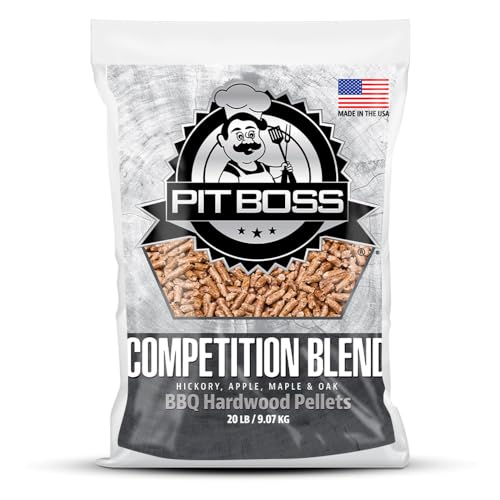
The Pit Boss Competition Blend is a bag of hardwood pellets for wood pellet grills. The German manufacturer site and the Amazon title say “Competition Mix”, the bag itself “Competition Blend”; the same item with the number 55235 is meant. According to the print, the bag weighs 20 lb, which is 9.07 kg, and on Amazon on 12.10.2026 it cost from approx. €31 from marketplace sellers. In the Fuel category it sits alongside pellets from other brands and charcoal briquettes.
There is neither a data sheet nor a manual for this bag, and the German product page consists of two paragraphs. We therefore rely on the brand’s German and US sites (for the US site also on the image descriptions), the FAQ pages, the German warranty document, the front and back of the bag as images on the manufacturer’s site, and the Amazon catalogue. We have not opened a bag or grilled anything with it. We infer that the Amazon number B0863JGY15 belongs to this item from the model number 55235 and the weight, because the manufacturer site has no buy button.
Which woods are in the bag?
In the running text of the product pages, Pit Boss names no woods for this blend, only an image caption line: the image description of the 20 lb bag photo on the US site reads hickory, apple, maple and oak, and the same line appears on the Amazon photo. The back of the bag instead contains a reservation in the German text block: the exact composition of the blends, including the base blend, may change without prior notice for seasonal, regional and availability reasons.
We read the line as a direction that Pit Boss does not commit to, because the US pages contradict each other: for the 40 lb bag (item number 55435), the image description of the bag photo reads hickory, cherry, maple and oak, while the 20 lb bag has apple instead of cherry.
The US pellet page stays general: each blend contains its own combination of wood species, including oak, hickory and apple. Traeger also names hickory, maple and cherry for its Signature Blend.
Competition blend: just a name
The front of the bag says “Competition Blend”, and below it in German “Wettkampfmischung” and “Echtholzgeschmack” (real wood flavour). We find no statement in any of the manufacturer sources we checked that the recipe was developed for BBQ competitions or has proven itself there, and we do not adopt it. The US product page advertises impressing the judges in your own backyard, and the US pellet page lists its own Competition Series with the blends PitMaster, Trophy and Griller’s Reserve.
The German product page calls the Competition Mix a complex and at the same time exquisite blend, versatile and suited to everything.
Only the US page for the same item number is more concrete. The US page shows a graphic with the scale Light, Medium, Heavy, in which “Medium Smoke” is highlighted, and the US pellet page also divides its pellets into these three smoke levels. We read Medium as the middle of three manufacturer levels.
As for food, the US page says the blend suits every dish and is a good choice for low-and-slow beef or pork, that is, for meat that cooks for many hours at low temperature. The Amazon catalogue names meat, fish and vegetables.
Raw material and binding, ash and moisture
Pit Boss Germany describes the contents as 100% natural hardwood pellets without artificial flavours, sprayed-on scents, adhesives or chemicals. The US pellet page says for the brand’s pellets in general that Pit Boss uses no flavour oils, fillers or binders; the statement applies to the whole brand. According to the German site, the pellets are bound by the natural wood sap when the sawdust is pressed under high pressure. Technically, with wood pellets this is usually the wood’s own lignin, which softens under pressure and heat and sets again as it cools.
The US product page describes ash and moisture only with adjectives: low to no ash for easy cleaning and a low moisture content for clean, even smoke. The Amazon catalogue speaks of even heat development.
In detail: why pellets must stay dry
A pellet grill has a hopper, an auger and a fire pot. The auger pushes pellets into the fire pot, and the controller regulates the temperature mainly through the amount fed in; on most grills a fan also blows air into the fire pot. The principle is similar across pellet grills, only the controllers differ. The pellet itself is the sensitive part, because it consists of pressed sawdust.
Pit Boss describes what happens with moisture. If pellets in the auger tube absorb enough of it, they disintegrate and clump together again into a solid mass that blocks the auger (German FAQ). The auger then has to be removed and cleaned. Even before that, according to the same FAQ, damp pellets burn less efficiently, and the US FAQ adds that the grill does not reach temperature or the flame goes out.
Pit Boss therefore advises airtight storage. The bag carries the note “store dry” in five languages. The hopper is not storage either: it should be emptied after every cook, and leftover pellets belong in a sealed container, because pellets rot outdoors and can jam the auger (US pellet page).
If the grill will not start despite having pellets, the guide Pellet grill will not start helps with the usual causes, damp pellets included.
Does the bag work in every pellet grill?
According to Pit Boss’s US product page, yes: it calls the Competition Blend compatible with all wood pellet grills and smokers. Which pellets your grill tolerates is, however, set by its manual.
For its own grills, Pit Boss itself recommends pellets from the brands Pit Boss or Louisiana Grills where performance is concerned; other brands are usable if they are hardwood pellets for wood pellet grills (US FAQ).
The warranty is thinner. The German warranty terms apply to Pit Boss wood pellet grills from Dansons and state five years on all parts and five years on electrical parts, from the purchase date, for the first owner and with proof of purchase. The exclusions section says there is no written or implied performance guarantee, as the manufacturer has no control over installation, operation, cleaning, maintenance or the type of fuel burned. The warranty does not apply if the appliance was not installed, operated, cleaned and maintained in strict accordance with the instruction manual.
For grills from other manufacturers, their terms apply. Traeger, for example, states the Signature Blend as compatible only with its own pellet grills; how Traeger treats third-party pellets in its warranty terms is summarised in our review of the Traeger Signature Blend pellets.
What else comes into question?
| Model | The difference | Price | Our rating | Choose this one if |
|---|---|---|---|---|
| Pit Boss Competition Blend 9 kg (this one) | Hardwood blend, proportions unknown; according to the US site for all wood pellet grills | approx. €31 | 8.7 | you have a wood pellet grill whose manual allows third-party pellets and you do not need a fixed wood blend |
| Traeger Signature Blend 9 kg | Hickory, maple and cherry named by the manufacturer, compatibility stated only for Traeger pellet grills | approx. €27 | 8.9 | you have a Traeger pellet grill and want named woods |
| PINI hardwood pellets | Beech and oak, 6 mm, 10 kg according to the Amazon catalogue | approx. €19 | 8.2 | you want to read up on wood species and diameter in the catalogue beforehand and your appliance tolerates 6 mm pellets |
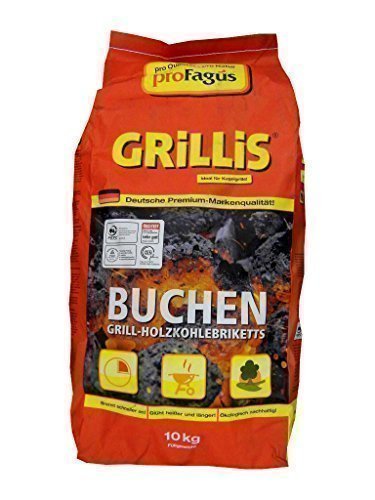
| proFagus GRiLLiS briquettes 10 kg | Charcoal briquettes, not pellets | approx. €30 | 9.4 | you have a charcoal or kettle grill and no pellet grill |
The prices are guide values from our data sheets, not current to the day; what Amazon charges changes without warning. The ratings are our editorial assessment based on manufacturer information and price, not measurement results.
At approx. €19 for 10 kg, the PINI bag costs approx. €1.90 per kilo, the Pit Boss at approx. €31 for 9.07 kg approx. €3.41. The difference is around €1.51 per kilo: ten kilos of Pit Boss calculate to approx. €34, the PINI bag to approx. €19. The title of the PINI offer names pizza ovens, grills, smokers, smoker boxes and smoke tubes.
The proFagus briquettes are in the table because they have the highest rating in our category. They are a different fuel, intended for charcoal and kettle grills, and no substitute for pellets in a pellet grill.
Safety: storage indoors and the warning on the bag
On the US pellet page, Pit Boss describes wood pellets as extremely flammable. It advises not storing them near heat or flames; as examples it names a car and a water heater in the garage. Even an unopened bag could ignite under extreme heat or flame.
The warning on the back of the bag is in five languages. In German its core reads “Nicht zum Heizen oder Kochen in Innenräumen ohne ausreichende Belüftung verwenden” (do not use for heating or cooking indoors without adequate ventilation), giving as the reason fumes that can accumulate. In addition, the contents are not suitable for consumption by people or animals. We have not checked whether the delivered bag carries the German notices: the product photo we have from the Amazon offer shows only the front with English labelling, and the catalogue lists Italian and English as languages.
The US product page additionally carries the mandatory California warning under Proposition 65: use may produce wood dust and carbon monoxide, which are considered carcinogenic and harmful to reproduction respectively in California. That is a US-specific mandatory notice.
Our assessment: carbon monoxide is produced in every combustion, which is why a pellet grill belongs outdoors.
What Pit Boss does not state
On the manufacturer sites, the bag and in the Amazon catalogue, there was no information at the start of October 2026 on:
- Proportions of the individual wood species
- Pellet diameter and pellet length
- Calorific value in kWh per kg, and ash and moisture content as a percentage
- Burn time per bag, consumption per grilling hour, temperature range and cooking times (hour figures from retailers or other manufacturers apply to other pellets and grills and are therefore not given here)
- Best-before date, batch information and certificates such as FSC, PEFC, ENplus or DINplus
- Packaging material (the bag shows only a recycling symbol with the number 4 and a request to recycle it)
- Price or recommended retail price on the German manufacturer site
- Warranty on the pellets themselves
When this bag suits and when another fuel is better
First the grill: a wood pellet grill is the normal case for these pellets. If you are still considering whether a pellet grill suits you at all, first read the guide Pellet grill for beginners. If you mainly grill on a charcoal or kettle grill, a bag of pellets is in our assessment the wrong main fuel, and the proFagus briquettes (approx. €30, rating 9.4) suit better.
With the woods, what counts is how precise you need to be. If you want to repeat a flavour reliably, the Pit Boss caption line works only as a direction: depending on bag size it names apple or cherry. With a Traeger pellet grill, the Traeger Signature Blend (approx. €27) comes into question, which Traeger describes with hickory, maple and cherry; without such a grill, the PINI with beech and oak remains among our alternatives, provided your grill tolerates 6 mm pellets. The Traeger Hickory (approx. €29, rating 8.8) carries the flavour in its name and, like the Signature Blend, is stated as compatible only with Traeger pellet grills.
With money, more than the bag counts: factor in an airtight container. Between the Pit Boss and the Traeger Signature Blend (approx. €27) there are around €4 per bag, around €40 over ten bags. If you have no dry place for the container, you should not stockpile pellets, whatever the brand.
More fuels are in the fuel ranking.
We would use up the first bag on a wood pellet grill with the manual beside us and note how long it lasts.