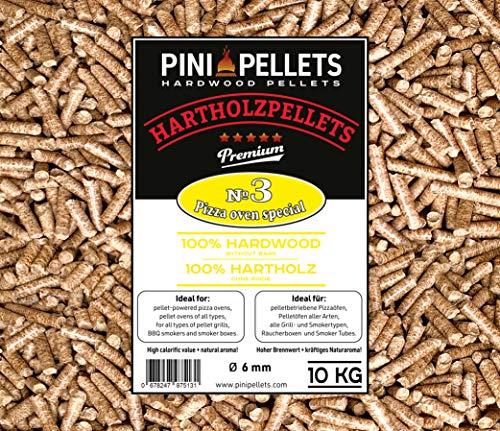
PINI numbers its hardwood pellets. No. 3 carries the addition “Pizza oven special”, is said by the manufacturer’s shop to consist of beech and oak, and comes in a 10 kg bag. In the fuels category it is the only product with a pizza oven in its name; the other pellets there come from Traeger and Pit Boss and are described for pellet grills and smokers.
Our sources: the shop pinistore.com, to which the address pinipellets.com printed on the bag redirected on 14.10.2026, the Amazon catalogue and the photo of the bag in the Amazon listing. According to the About page, the shop is run by Semanex e.K. from Bochum, and the dispatch warehouse is in Hannover. We have not lit a single pellet. What follows below on calorific value, ash and smoke is either a manufacturer claim or marked as our own inference.
Beech, oak, bark, binders: what is in the bag
On Amazon, the bullet point says “100% single-variety beech and oak wood”. The manufacturer’s shop, by contrast, lists the same product as a mixture: wood type beech + oak, field “Mixture”: yes. The manufacturer content on Amazon speaks of a hardwood mix. PINI does not state the proportions of beech and oak anywhere. Our reading: “single-variety” here means hardwood without foreign components, not a single wood species. In the pellet trade, hardwood means broadleaf wood such as beech, oak, maple or hickory; pine and spruce count as softwood.
The photo of the bag says “100% hardwood without bark”, in German and English. Bark contains more minerals than the wood beneath it and therefore usually raises the ash content. This holds for wood pellets in general; nobody has measured it on this bag.
On additives, the shop writes that the pellets consist of 100% natural, untreated wood without any binders and are free of resin and pesticides. A pellet holds together without glue because of pressing: under pressure and heat, the wood’s own lignin softens and bonds the shavings. Resin comes mainly from softwood, and beech and oak contain hardly any. The claim is therefore plausible.
In detail: calorific value, ash and residual moisture
For calorific value, PINI gives three figures: approx. 5.50 kWh/kg in the text of the shop product page, “over 5.7 kWh/kg” on the product image in the shop and approx. 5.7 kWh/kg on Amazon. The photo of the bag in the Amazon listing carries no figure at all, only “High calorific value + strong natural aroma!”. The gap of 0.2 kWh/kg is just under 4 percent and, in our assessment, decides no purchase. Calculated for the whole bag, that is 55 to 57 kWh, and this is the theoretical upper limit: the calorific value includes the heat of evaporation of the water in the flue gas, which an oven without condensation cannot use. Less is usable than the figure suggests.
Residual moisture is also given three times: in the shop “usually below 8%”, in the manufacturer content on Amazon below 7%, in the Amazon description below 10%. The figures do not rule each other out, because anything below 7% is also below 8 and below 10%. Under technical properties the shop says “below 8%” and in the running text “usually below 8%”. We would take 8% as the figure PINI commits to on its own product page. Moisture costs energy: the more water in the pellet, the more heat is lost in evaporation before the oven gets any of it.
The shop puts the ash at below 0.8%. Alongside it are qualitative promises without a figure: high energy content with efficient, long-lasting combustion, even and constant heat output, high temperatures in a few minutes in a pizza oven. The Amazon description says the pellets burn slowly. These are claims from which you can read nothing off as long as minutes, degrees and hours are missing.
For use as a heating pellet, PINI claims up to 30% more effectiveness compared with other wood pellets, with pellets made of pine wood as the shop’s example; PINI gives no measured value. The figure explicitly applies to heating. For a pizza oven and grill it does not help.
Does a 6 mm pellet fit my appliance?
That depends on your appliance, not on PINI: the pellets have a 6 mm diameter, and PINI names pellet ovens, pellet grills, pellet-fired pizza ovens and smokers as uses, but gives no brand and no approval from an appliance manufacturer. Your appliance’s manual is what counts.
The lists of uses differ depending on where you look. The shop lists pellet grills, pellet ovens, pellet-fired pizza ovens, pellet systems and pellet heating systems, for grilling and smoking. The bag lists pizza ovens, pellet ovens of all kinds, all grill and smoker types, smoker boxes and smoker tubes. On Amazon the entries are grill, smoker, pellet grill, pizza oven, other pellet-fired fireplaces, smoker boxes and smoking tubes. Heating systems appear only in the shop, smoker tubes only on the bag and on Amazon. On gas or charcoal grills without a feed, a pellet usually burns in a smoker box or a smoker tube, as named on the bag.
Why the diameter matters: in pellet grills, an auger feeds the pellets from the hopper into the fire pot, as our guide Pellet grill for beginners describes. In other pellet ovens, the pellet runs through a chute. Both are designed for a specific diameter, and how far 6 mm may deviate from that is stated in the appliance’s manual.
Smoke and aroma: No. 3, BBQ Classic and Oregano
The shop lists twelve numbered varieties. According to the shop, No. 1 is called “BBQ Classic” and is intended for grilling, smoking and smoke cooking. It has the same wood type (beech + oak), the same description text, the same technical values and the same price as No. 3. The shop describes a difference only in the name: Pizza Oven Special here, BBQ Classic there. We do not claim that both bags have the same contents; all that is documented is that the shop names no difference.
The case is different with No. 4, in the shop “Pizza Oven Oregano”. It lists oregano as an additional wood type, has otherwise identical technical values and according to the shop costs €21.95 per 10 kg, so €3 more per bag. Other varieties are No. 7 with basil, No. 8 with cherry, No. 9 with apple and No. 11 with alder. If you want a single wood species, the shop also has varieties of beech only or oak only.
On smoke, the statements point in different directions. The shop writes that the smoke aroma permeates the dishes without masking their own flavour. The photo of the bag says “strong natural aroma”. The Amazon description speaks of intense smoke and recommends the pellets, besides pizza, especially for pork, poultry and lamb. So PINI does not advertise No. 3 as smoke-neutral or aroma-neutral.
How much of this reaches the pizza depends on the time in the smoke. Our inference from the technology: the longer a dish sits in smoke, the more aroma it takes up. A brisket sits for hours in the smoker, a pizza only briefly in the oven. How much smoke a pellet gives off also depends on the appliance and the air supply.
What 10 kg costs
In our price box, No. 3 is listed at approx. €19 on Amazon, which works out at €1.90 per kilo. The buy box of the Amazon page showed no price on 14.10.2026; we therefore cannot reconfirm the €19 for that day. In the manufacturer’s shop, the bag cost €18.95 on the same day, likewise €1.90 per kilo.
The other pellets in our category serve as a yardstick, each calculated at 9 kg as stated in the product names: Traeger Signature Blend comes to approx. €3.00 per kilo, Traeger Hickory to approx. €3.17 and Pit Boss Competition Blend to approx. €3.44. No. 3 is therefore the cheapest of the four per kilo. The price per kilo says nothing about burning or smoke behaviour, because wood blend and intended use differ for each.
A single price gives a reference point on the low side: on the Amazon page on 14.10.2026 there was a retailer offer for heating pellets (ENplus A1, 15 kg) at €18.99, approx. €1.27 per kilo. That is not a market average, and a heating pellet belongs only in an appliance whose manufacturer allows it.
How many pizza evenings a bag lasts depends on the oven. How to estimate consumption from your oven’s output figure is explained in the FAQ below.
Storing, portioning, disposing of ash
On storage, PINI writes one sentence: wood pellets are to be stored dry. On Amazon it says “Store dry!”, nothing more. Pressed wood draws moisture from the air, swells and then crumbles into sawdust, which can clog an auger or a chute. We therefore advise a closed container in a dry room.
According to the Amazon bullet point, the scoop is part of the delivery, and the shop image shows it as “FREE scoop included”. It is meant to make clean portioning easier. The Amazon photo shows only the bag. If you want to use the scoop as a measuring cup, weigh one scoopful yourself once.
Apart from the storage note, the manufacturer’s page contains no safety information. In general, with any wood firing: ash and embers go into the bin only once they have cooled completely, and in a container made of non-combustible material. Wood fires produce carbon monoxide and therefore do not belong in closed rooms without extraction. For installation and operation, your appliance’s manual is what counts.
What else comes into question?
| Model | The difference | Price | Our rating | Choose this one if |
|---|---|---|---|---|
| PINI Hartholz Pellets No. 3 Pizza Oven Special (this one) | Beech + oak without stated proportions, 6 mm, 10 kg, €1.90/kg by calculation | approx. €19 | 8.2 | your appliance’s manual allows 6 mm hardwood pellets and you want beech and oak without added herbs |
| Traeger Signature Blend 9 kg | Blend of hickory, maple and cherry, according to Traeger for Traeger pellet grills | approx. €26.98 | 8.9 | you have a Traeger pellet grill and want an aroma blend |
| Traeger Hickory 9 kg | Hickory variety, according to Traeger with a strong, full-bodied aroma | approx. €28.56 | 8.8 | you smoke beef or ribs in a pellet grill and want a strong hickory aroma |
| Pit Boss Competition Blend 9 kg | Blend of hickory, apple, maple and oak according to the print on the Amazon photo, proportions open | approx. €30.96 | 8.7 | you have a wood pellet grill or smoker and want a blend instead of beech and oak |
The prices are guide values from our data sheets and change without notice. The ratings are our editorial assessment based on manufacturer information and price, not measurement results. The three comparison products are pellets for pellet grills and smokers; none of them names a pizza oven in its product name.
What PINI does not state
On pinistore.com, pinipellets.com and in the Amazon catalogue, we found no information on these points on 14.10.2026:
- Operating manual, data sheet, safety data sheet
- Proportions of beech and oak, recipe difference between No. 3 and the BBQ Classic variety
- Origin of the wood, country and place of production, packer, whether PINI presses the pellets itself or buys them in
- Certification marks such as ENplus, DINplus, FSC or PEFC
- Calorific value in MJ/kg, bulk density, abrasion, ash melting point, test method for ash and residual moisture
- Consumption per hour of operation or per pizza evening, burn time in hours, oven temperature reached, heat-up time
- Smoke intensity as a level or figure
- List of suitable pizza ovens, pellet grills and smokers, approval by appliance manufacturers
- Manufacturer warranty or quality guarantee
- Bag material, bag dimensions, dimensions and capacity of the scoop
- Year the brand was founded, market launch of No. 3
For a fuel, notes on installation, operation and cleaning belong in the appliance’s manual, not the pellet’s.
When No. 3 fits and when another fuel is better
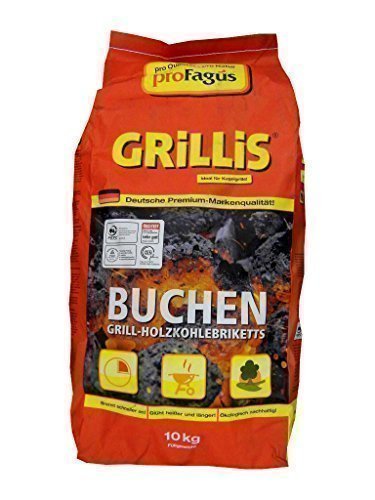
On charcoal, kettle and gas grills without a pellet feed, No. 3 is limited to the smoker box and smoker tube; it does not heat the grill itself there. For charcoal and briquettes, the ranking Fuels helps, and in our category the proFagus briquette has the highest overall rating at 9.4. If you want to bake pizza on a gas, kettle or kamado grill, you need no pellets at all; how that works is explained in the guide Pizza on the grill. If you do not have an appliance yet, the Grill finder narrows it down.
With a pellet grill or pellet oven still under warranty, it is worth asking the appliance manufacturer before buying whether third-party pellets are permitted. If only the manufacturer’s own bag is allowed, the appliance manufacturer’s bag is the choice, not PINI.
On aroma, it depends on what you want. For ribs or brisket with strong hickory, Traeger Hickory from the table is the clearer choice, because according to the shop No. 3 consists of beech and oak. If you like herbs or fruitwood, look at PINI’s own varieties with oregano, basil, cherry or apple. If you need a documented certification mark, No. 3 is the wrong address.
No. 3 is available individually only as a 10 kg bag. If you fire rarely, you need a dry storage place for 10 kg; if you fire often, order in multiple quantities in the shop on a sliding scale.
If your appliance’s manual allows 6 mm hardwood pellets and the price per kilo matters to you, No. 3 is the cheapest pellet option in our table. If one of the two conditions is missing, choose another fuel.