The Traeger Hickory 9 kg is a bag of wood pellets for pellet grills, where according to Traeger the pellets are the heat source inside the grill. The Amazon listing calls it “Hickory 100% Naturholzpellets” and gives its weight as 20 pounds, which is approx. 9.07 kg. In our data sheet it is listed at approx. €29. In the fuels category, it sits alongside other pellets and charcoal briquettes.
We have not opened a bag or grilled anything with it. The information comes from the pages of Traeger Germany and Traeger USA (retrieved on 6 October 2026), from the Amazon listing and from the photo of the bag. Statements that Traeger makes about its pellets in general are marked as such in the text.
Which bag arrives from Amazon?
By model number and UPC, it is the US item PEL319 in the 20 lb bag. Traeger Germany lists hickory only as an FSC version under number PEL345, and that is a different item.
The match is made via these numbers, because Traeger’s pages do not link to Amazon. Amazon gives PEL319 as the model and 634868919831 as the UPC, plus a second number. The same SKU and the same UPC appear on Traeger’s US product page, there for a “20lb Bag”. On the German pages, Hickory Holzpellets FSC® is listed with 9 kg of content for €19.90. On 6 October 2026, the bag was not in stock according to the page data (stock 0). The “9 kg Beutel” in the Amazon title is a rounding of the 20 pounds.
Whether the delivered bag is the FSC version cannot be read from the listing: neither the title nor the bullet points mention FSC, and Traeger Germany writes for its own FSC pellets that the packaging may vary.
The listing comes from a third-party seller: dispatch and sale were with meingartencenter24 when it was retrieved.
Two details in the listing contradict each other. The catalogue page gives Germany as the country of origin, while a bullet point says “Hergestellt in den USA” (made in the USA). There is also a “Pellet plus Rub Option” in the listing text. Only hickory could be selected on the page. Traeger itself gives the USA and says all its pellet mills are located there.
Is this really pure hickory?
That cannot be confirmed. The Amazon title says “Hickory 100% Naturholzpellets”; the 100% may refer to the variety or to natural wood in general.
At Traeger, three statements stand side by side. The hickory page, German and American alike, speaks of a balanced blend of hardwoods. The guide to pellets for brisket calls the same pellets pure hickory; on the pages we checked, it is the only place with that description. The two statements contradict each other. About the brand’s premium wood pellets, Traeger Germany writes that they consist of 100% natural, food-safe hardwood (said for the brand, not expressly for this bag).
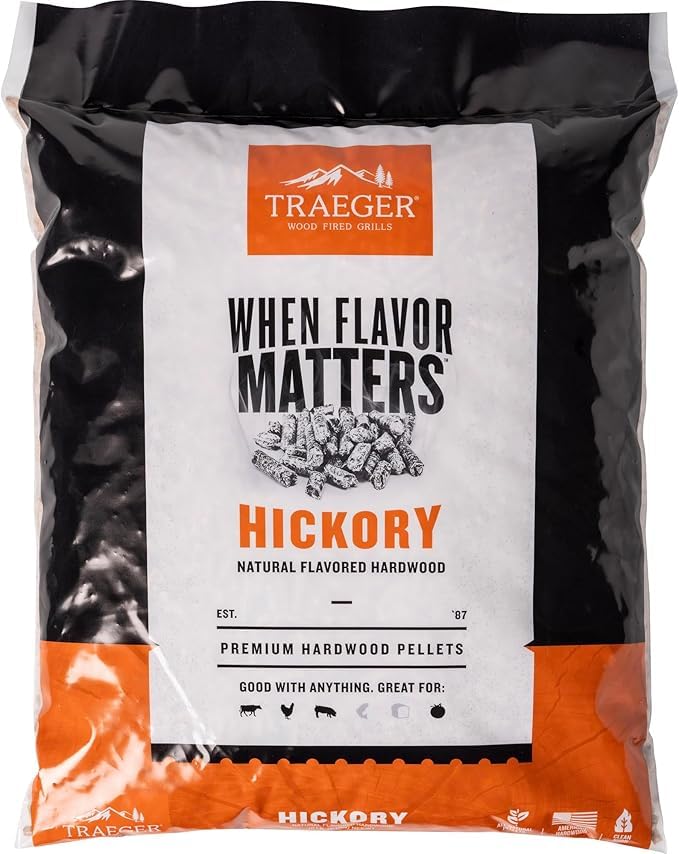
On the photo, the label carries the line Natural Flavored Hardwood under the word Hickory, and below that Premium Hardwood Pellets. This applies to the bag shown: according to the Amazon text, the picture shows the new packaging, and an old one may be delivered.
On the hickory page, the statements “Keine Bindemittel” (no binders) and “Niedriger Aschegehalt” (low ash content) appear. Traeger Germany describes the production of its pellets like this: clean, green hardwood is dried in a rotating drum and an oven, crushed in the hammer mill, pressed and cooled before packing. Where possible, Traeger uses sawdust from clean, green hardwood for this.
Hickory next to oak, apple, cherry and mesquite
Traeger describes its varieties in words. Even so, a rough order can be read from the guides. It is our compilation from several pages. At the mild end are fruitwoods such as apple, to which the brisket guide attributes a mild smoke. According to the hardwood guide, oak is somewhat stronger than apple or cherry and somewhat lighter than hickory. Hickory gives off a strong flavour and, according to the same guide, suits most kinds of meat. The brisket guide calls mesquite a very strongly flavoured wood.
The pitmaster Aaron Franklin is quoted in the Traeger guide as saying that hickory is somewhat stronger than oak: strong, smoky, with a hint of sweetness, best for heavy meats such as beef.
The German hickory page describes the taste as full-bodied and strong and names beef, poultry, pork and vegetables as particularly good matches. For brisket, hickory is the first choice according to the brisket guide, with a strong smoke flavour. In the same brand’s pairing guide, brisket is matched with pecan, with a subtly nutty note. Traeger recommends different things depending on the page. Our guide Beef Brisket explains the cut itself. For pork ribs, Traeger writes that hickory hits hard without overpowering the meat, and recommends it for baby back ribs using the 3-2-1 method. The guide 3-2-1 Method for Spare Ribs shows the process.
According to the hardwood guide, some people find hickory a little too strong. They mix it with a milder pellet such as oak or apple. Traeger classifies cherry ambiguously: the hardwood guide counts it among the stronger-flavoured pellets, the brisket guide among the fruitwoods with a mild smoke. For changing varieties, Traeger describes this route for the Pro series and newer grills: open the clean-out flap on the hopper and tip the pellets into a container. Hickory comes already mixed in the Traeger Signature Blend, which Traeger puts together from hickory, maple and cherry.
Range and cost per grilling hour
In its US guide to wood pellets, Traeger writes that a bag of 18 to 20 pounds lasts between 6 and 20 hours: when grilling at higher temperatures it is empty after about 6 hours, and when smoking at low ones it lasts up to 20. Converted to the weight of the bag, that is around 0.45 kg per hour at 20 hours and around 1.5 kg at 6 hours (our calculation). We infer why the range is so wide from the design: at a high target temperature the auger feeds more pellets than at a low one.
Our data sheet lists the bag at approx. €29, which is around €3.20 per kilo. Calculated at this price, one hour of fuel costs between approx. €1.45 (20 hours per bag) and approx. €4.83 (6 hours); the grill’s electricity is not included. A third-party seller carries the bag, so the price on Amazon may differ from our guide price.
The FSC version from Traeger Germany (PEL345, see above) comes to around €2.21 per kilo at €19.90. At Traeger Germany, all six FSC varieties cost the same, including the Signature Blend. In our data sheets, the hickory bag at approx. €29 costs around €2 more than the Signature Blend (approx. €27).
Storage, handling and warnings
Traeger Germany recommends storing pellets indoors in an airtight container and advises against keeping them outdoors. The US storage guide describes the consequences of damp pellets: crumbly pellets can clog the auger and may not ignite. The US page “Why wood pellets” gives 5% as the ideal moisture content for wood pellets. According to Traeger, with damper pellets the grill does not reach enough heat, while drier ones lead to a sour taste. If you pause grilling for a longer time, Traeger advises taking the pellets out of the hopper because of moisture. For storage, Traeger sells the StayDRY pellet container.
Health-related notices appear in two places. Under “Produktsicherheit” (product safety), Amazon shows the sentence “Kann die Atemwege reizen” (may irritate the respiratory tract). On Traeger’s US product page there are two warnings under the Californian law Proposition 65: inhaling wood dust is known to the State of California to cause cancer, and carbon monoxide, as a by-product of burning the product, to cause reproductive harm. As a general rule, carbon monoxide can form whenever wood is burned. How to set up the grill and dispose of the ash is in its instruction manual.
Does the bag fit a grill from another brand?
It is confirmed only for Traeger pellet grills: the US product page lists all Traeger pellet grills and the StayDRY pellet container as compatible. Nothing is said there about grills from other brands, and the German page gives no compatibility at all. The Amazon title says “für Smoker und Pelletgrills” (for smokers and pellet grills) in very general terms.
Traeger also writes that its pellets have the ideal size for the augers of its own grills. On its US page for the Competition Blend in the 20 lb bag, Pit Boss writes that it is suitable for all wood pellet grills and smokers. With a pellet grill from another brand, we would first read its manual, because that states which fuel its manufacturer intends.
What else comes into question?
| Model | The difference | Price | Our rating | Choose this one if |
|---|---|---|---|---|
| Traeger Hickory 9 kg (this one) | Hickory, described by Traeger as strong and full-bodied | approx. €29 | 8.8 | you have a Traeger pellet grill and want a strong hickory flavour |
| Traeger Signature Blend 9 kg | Blend of hickory, maple and cherry, described by Traeger as versatile | approx. €27 | 8.9 | your food varies and you want only one bag in the cupboard |
| Pit Boss Competition Blend 9 kg | Pellets from another brand, suitable for all wood pellet grills and smokers according to Pit Boss | approx. €31 | 8.7 | you do not have a Traeger grill |
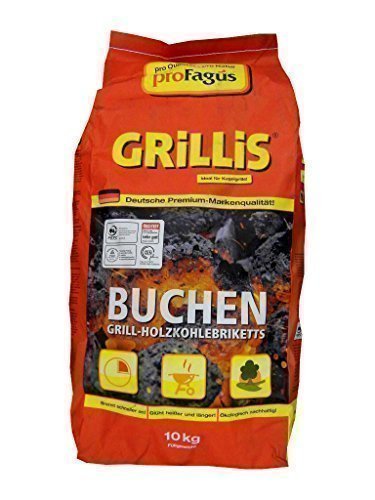
| proFagus GRiLLiS Briquettes 10 kg | Beech charcoal briquettes, bound with starch according to proFagus, not pellets | approx. €30 | 9.4 | you have a charcoal or kettle grill and not a pellet grill |
The prices are guide values from our data sheets and change at the retailer without warning. The ratings are our editorial assessment based on manufacturer information and price; we measured nothing.
What Traeger does not state
On the Traeger pages and in the Amazon listing, there was no information on these points when they were retrieved:
- Hickory share in percent
- Meaning of the label line Natural Flavored Hardwood
- Ingredient list and safety data sheet for the bag
- Ash content and moisture of this bag in percent, calorific value, length and diameter of the pellets in millimetres
- Consumption in kilograms per hour and per grill model
- Origin of the wood (region)
- Mixing ratio when hickory is mixed with oak or apple
- Suitability for fish, lamb and game
- Best-before date and recommended storage time of the sealed bag
- Manufacturer’s warranty for the bag itself (the warranty terms of Traeger Germany cover grills and accessories; the 30-day return period in the Amazon listing is a statement by the seller)
When hickory fits and when another fuel is better
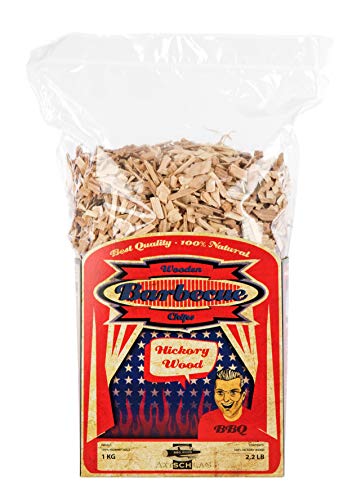
If you need fuel for a charcoal or kettle grill, a bag of pellets as the main fuel is the wrong choice. There, the proFagus briquette from the table fits, which according to the manufacturer is intended for kettle grills and smokers, and hickory smoke comes via smoking chips, for example Axtschlag Hickory at 1 kg for approx. €10.50 (rating 8.9). How smoking works on such grills is in the guide Smoking on the Grill. If you do not yet have a pellet grill, you will find the basics of this design in the guide Pellet Grill for Beginners.
For what to cook, we follow Traeger’s list for this variety. Whether hickory is too strong for you, you only know after the first bag, and for this case Traeger names mixing with oak or apple. If you mostly grill fish, we would not start with hickory.
If FSC is a requirement for you, the German version PEL345 is the choice where Traeger names the certificate (€19.90, not in stock on 6 October 2026).
On 12 October 2026, a bag of Pit Boss cost from approx. €31 at marketplace sellers on Amazon, so around €2 more than the hickory bag at approx. €29. That leaves no price advantage for the other brand.