The Traeger Signature Blend is a pellet blend of hickory, maple and cherry. The Amazon listing gives the bag’s weight as 20 pounds, which is approx. 9.1 kg. On Amazon, the bag cost approx. €27 on 6 October 2026. In the Fuel category, the bag sits alongside pellets from other brands and charcoal briquettes.
We have not opened a bag or grilled anything with it. What is written here comes from the pages of Traeger Germany and Traeger USA (retrieved on 6 October 2026), from the Amazon listing and from the photo of the bag. General statements by Traeger about its own pellets are marked as such in the text.
Is this the same bag as at Traeger Germany?
According to the item numbers, no. The Amazon listing is the US item PEL331 in the 20 lb bag, country of origin according to Amazon: USA. Traeger Germany lists the Signature Blend only as an FSC version under PEL346 and PEL425.
That B079DHNK3H is the US item follows from Traeger’s US product page: for PEL331 it shows the same UPC 634868926440 as Amazon, describes a 20 lb bag, and in Traeger’s US shop it costs US$19.99 (retrieved 6 October 2026). On the German pages the product is called Signature Blend Holzpellets FSC®, the bag holds 9 kg, and Traeger calls the FSC pellets a “brand new series”. The title and bullet points of the Amazon listing do not mention FSC. According to the page data of Traeger Germany, the bag was out of stock on 6 October 2026 (stock 0).
The listing text mentions a “Pellet + Rub Option” selection with Traeger seasoning rubs; on the page we retrieved, the four flavour options were selectable, and according to Amazon one bag of pellets is delivered.
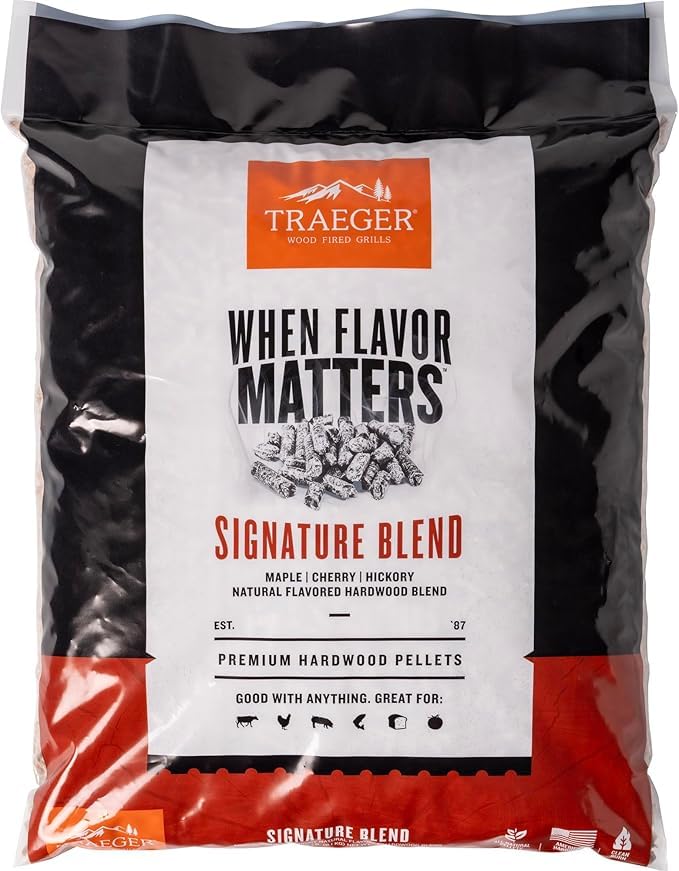
The photo shows a black bag with a white label: Traeger logo, the name Signature Blend, below it Maple, Cherry and Hickory, the line Natural Flavored Hardwood Blend and Premium Hardwood Pellets. Under the line Good with anything. Great for: are six symbols for beef, poultry, pork, fish, bread and a tomato.
Hickory, maple, cherry: three woods, no proportions
The German product page names the three woods and says their flavours combine into a blend that suits almost anything you cook, naming beef, poultry, pork, lamb, seafood, baked goods and vegetables. How much of each is in the bag is not stated anywhere. The order varies: on the page it is hickory, maple, cherry; on the bag it is Maple, Cherry, Hickory.
What Traeger says about the individual woods is in the US guide to single-wood pellets. According to it, hickory gives off a strong flavour and suits most kinds of meat, though some find it a little strong. Maple is mild with a hint of sweetness and suits pork, especially turkey. Cherry is among the stronger-flavoured pellets and is meant for cases where you want robust smoke. From this we read that Traeger describes two of the three components as robust and only one as mild.
On composition, the page description of the German product page says “100% natural hardwoods”; as a feature it also says “no binders”. About its own pellets in general, Traeger says they contain no unnatural additives and no chemicals, and that the hardwood is untreated; the US guide calls them free of artificial fillers. The German product page also lists low ash content and clean burning.
Blend or single wood?
If your food varies and you want only one bag in the cupboard, that is the idea behind the blend. A specific single wood you get as single-wood pellets.
The German range has six FSC varieties: Signature Blend, Competition Blend, oak, apple, hickory and cherry. According to the page data, all cost €19.90 (as of 6 October 2026), so the blend costs no more than hickory.
Traeger mentions blending itself. Some find hickory a little too strong and, according to the US guide, mix it with a milder pellet such as oak or apple. The Signature Blend also mixes hickory at the factory, but with maple and cherry instead of oak or apple: Traeger describes maple as mild and cherry as strongly flavoured. If you want to set the ratio yourself, buy single-wood pellets and mix them. We covered the hickory bag in the review Traeger Hickory Pellets.
In detail: moisture, auger and storage
In a pellet grill, the fuel is both heat source and smoke supplier: without pellets, the grill does not run, according to Traeger. The pellets sit in the hopper, an auger pushes them into the fire pot, and the controller regulates the temperature, among other things, through the amount fed in. This principle applies to every pellet grill.
This explains Traeger’s attention to moisture. Damp, crumbly pellets can clog the auger and may not ignite. As the ideal moisture content for wood pellets, the US page “Why wood pellets” gives 5%: according to Traeger, damper pellets do not reach enough heat, and drier ones lead to a sour taste. The German page says Traeger has been working for years on hardwood pellets with exactly the right moisture content.
For all its pellets, Traeger describes production like this: it begins with clean, green hardwood, which is dried in a rotating drum and an oven. Where possible, Traeger uses sawdust for this that would otherwise end up as waste. In the mills, all of which are in the USA, Traeger regularly carries out burn tests, for consistent pellets in every bag.
For use at home, Traeger describes a snap check: a pellet should break cleanly without crumbling. Some sawdust at the bottom of the bag is normal, but a lot of it or clumped sawdust points to compromised pellets. According to the US guide, poor pellet quality, often the result of unsuitable storage, is the number one cause of temperature problems. Traeger Germany advises against storing pellets outdoors because moisture can make them unusable, and recommends an airtight container indoors. For a longer break from grilling, Traeger’s advice is to take the pellets out of the hopper, because moisture can reach them there.
For changing varieties, Traeger describes this route for the Pro series and newer grills: open the clean-out door on the hopper and empty the pellets into a container. On older models, according to Traeger’s guide, you scoop the pellets out of the hopper with a vessel. If the grill does not ignite despite having pellets, the guide Pellet grill will not start helps.
How long does a 9 kg bag last?
According to Traeger, a bag of 18 to 20 pounds lasts between 6 and 20 hours: when grilling at higher temperatures it is empty after about 6 hours, and when smoking at low temperatures it lasts up to 20 hours.
The range is so wide because the grill feeds in more pellets at high temperature than at low. Converted to the bag here (20 lb is approx. 9.07 kg), that gives around 0.45 kg per hour at 20 hours and around 1.5 kg per hour at 6 hours. That is our calculation from Traeger’s time figures. The time your first bag lasts on your grill is the most useful value for further planning.
According to our data sheet, the bag costs approx. €27, which is approx. €3.00 per kilo (€27 divided by 9 kg). According to the page data, the FSC version from Traeger Germany comes to €19.90 for 9 kg (as of 6 October 2026), which works out at €2.21 per kilo. That is a different item with a different number; the two figures are not suitable as a price comparison.
Third-party pellets and the warranty
Traeger Germany warns: using other wood pellets, wood chips, fuel bricks or heating pellets can lead to damage to the grill.
The warranty terms of Traeger Germany contain a list of cases in which the warranty for the grill lapses. Two of them concern the fuel: fuels other than wood pellets intended for wood pellet grills and grilling appliances were used with the grill, or wood-stove heating pellets were used in the grill. They carry the numbers (v) and (vi) there, so the list is longer; Traeger has it in full. The terms appear under the heading “Limited 10-Year Warranty from Traeger (new Timberline and Ironwood grills)” and therefore apply to those two series; we found no grill warranty for other series on the page.
The terms do not say whether pellets from other brands count as wood pellets intended for pellet grills; before switching to another brand, we would ask Traeger and keep the answer.
The US product page carries two warnings under the Californian law Proposition 65. The first: carbon monoxide, a by-product of burning this product, is known to the State of California to cause birth defects or other reproductive harm. The second: inhaling wood dust is known to the State of California to cause cancer. This is a mandatory Californian warning on the US page, not an EU notice. In general, for any combustion: carbon monoxide is produced, so a pellet grill belongs outdoors, and the setup instructions are in the grill’s manual.
What else is an option?
| Model | The difference | Price | Our rating | Choose this if |
|---|---|---|---|---|
| Traeger Signature Blend 9 kg (this one) | Blend of hickory, maple and cherry | approx. €27 | 8.9 | you have a Traeger pellet grill and want just one bag for varied food |
| Traeger Hickory 9 kg | Single-wood hickory, described by Traeger as a strong flavour | approx. €29 | 8.8 | you want a recognisable hickory flavour and a blend is too broad for that |
| Pit Boss Competition Blend 9 kg | Pellets from another brand; for Traeger grills the warranty question from the section above applies | approx. €31 | 8.7 | you do not have a Traeger grill |
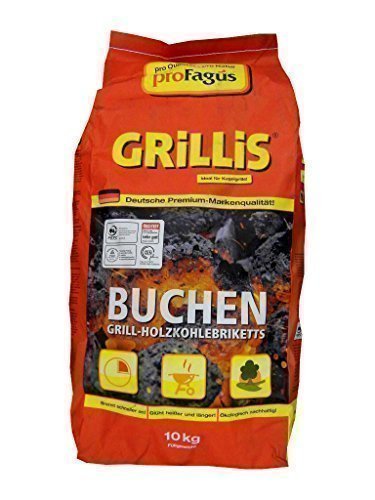
| proFagus GRiLLiS briquettes 10 kg | Beech charcoal briquettes, bound with starch according to proFagus, not pellets | approx. €30 | 9.4 | you have a charcoal or kettle grill and not a pellet grill |
The prices are guide values from our data sheets, not up to the minute; what Amazon charges differs from them and changes without warning. The ratings are our editorial assessment based on manufacturer information and price, not measurement results.
What Traeger does not state
On the Traeger pages and in the Amazon listing, there was no information on these points on 6 October 2026:
- Proportions of hickory, maple and cherry in percent
- Smoke intensity as a level or scale
- Ash content and moisture of this bag in percent, calorific value, length and diameter of the pellets
- Consumption in kilograms per hour and per grill model
- Origin of the wood (region)
- Ingredient and allergen list and safety data sheet
- Best-before date and recommended storage time of the unopened bag
- Warranty or returns rule for the bag itself (the warranty terms concern grills and accessories)
- Year the Signature Blend was introduced and date of the FSC changeover
The Traeger pages do not link to Amazon; they lead to a dealer search instead of a buy button. We have not checked who sells the Amazon listing.
When the Signature Blend fits and when another fuel is better
First, the grill. Traeger calls the Signature Blend compatible with all Traeger pellet grills; for a pellet grill from another brand, its manual applies first. If you need fuel for a charcoal or kettle grill, a bag of pellets is the wrong purchase, and the proFagus briquette from the table (approx. €30, rating 9.4) is the more suitable choice.
Then the warranty. If you have a new Timberline or Ironwood, we would stay with Traeger pellets, because they are the wood pellets Traeger specifies for its pellet grills. For another model, read the warranty terms that apply to your grill before switching.
Then the money. On Amazon on 12 October 2026, a bag of Pit Boss cost from approx. €31 from marketplace sellers, so around €4 more than the Traeger bag at approx. €27. That leaves no price advantage for the other brand.
If FSC is a must for you, use the dealer search of Traeger Germany to find a dealer that stocks the FSC version.
More fuels are in the fuel ranking. If you are still wondering whether a pellet grill suits you at all, first read the guide Pellet grill for beginners.