A gas pizza oven that you turn yourself
In the Amazon catalogue this oven is called “Q Pizza Pizzaofen Gas mit Manuellem 360°-Drehsystem” (Q Pizza gas pizza oven with manual 360° turning system), and DOBADN is entered as the brand and manufacturer. It runs on propane and stands on its own folding legs, so it needs a table or another firm surface. DOBADN itself calls it a countertop oven.
In our pizza oven overview it is one of the gas ovens with a rotating baking surface. It is turned by hand, using a handle on the side, not with a motor. It costs approx. €210 (Amazon page on 20.10.2026: €209.99).
Our rating is 7.9 out of 10, and it has less to do with the oven than with what is known about it. We did not find a manufacturer’s website: dobadn.com and dobadn.de were not reachable, and a search for the brand and model number returned no results. What is written here about the device comes from five paragraphs of manufacturer text and a few data fields in the Amazon catalogue, plus the product photo. We did not have an instruction manual.
What the product image shows
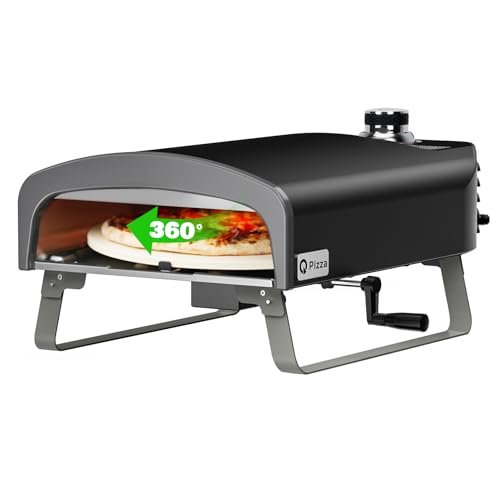
For this oven the photo is more informative than the text. It shows a black, box-shaped body with a front set off in grey, into which a flat, arched opening is cut. Behind it a pizza lies on a round, light-coloured plate, and a green arrow labelled “360°” is superimposed above it. At the top right of the housing there is a single control knob. The manufacturer’s text does not describe its function; on gas pizza ovens such a knob is usually the gas regulator.
On the right, below the opening, a crank with an angled handle protrudes from the housing. DOBADN speaks of a “manual turning handle” that you turn “to achieve even heating”. Our page title says hand crank, and judging by the photo both apply: a turning handle in the shape of a crank. How the crank is connected to the plate and whether it turns in both directions cannot be seen in the picture.
The oven is carried by two grey, U-shaped brackets on the left and right. These are the folding legs from the manufacturer’s text.
Dimensions and weight
The Amazon catalogue lists the oven at 27.17 x 10.63 x 17.72 inches (length, width, height) and 31.44 pounds. Converted, that is approx. 69.0 x 27.0 x 45.0 cm and approx. 14.3 kg. Whether the weight applies with or without packaging is unclear.
The order of the dimensions cannot be right as given. The catalogue field “size” says ⌀33 cm, and a round part with a 33 cm diameter does not fit into a housing 27 cm wide. In the photo the oven is also clearly wider than it is tall. We suspect that 27 cm is the height and that width and depth are split between 45 and 69 cm, with the crank possibly included in the 69 cm. This assignment cannot be proven. For planning, that means: allow for up to 69 cm in the longest direction and measure your table.
The ⌀33 cm is also less clear than it looks. Whether the value refers to the stone, the rotating plate or the largest pizza is not apparent from the field. The data sheet at the top of this page lists it as the pizza stone. That is the obvious reading, but it is not a manufacturer’s statement.
In detail: why a pizza stone has to be turned
In a gas pizza oven the heat does not come evenly from all sides. The burner sits in one place, usually at the back or on the side, the flame draws up under the roof of the cooking chamber, and the roof radiates the heat back onto the toppings. The edge facing the flame therefore browns faster than the edge at the opening. With ovens without a turning function you take the pizza out with the peel, turn it and slide it back in. It is precisely at that moment that, at high heat, a topping likes to slip off or the base tears.
A rotating plate saves you that. The pizza stays where it is, and you bring each side towards the flame in turn. With a motor the plate runs by itself and evenly; the Enders PACO Rotate from our catalogue does this with a switchable electric motor which, according to the instructions, needs 220 to 240 V. With the DOBADN you set the pace, so it is up to you to make sure no side stays at the front too long.
Where the burner sits in the DOBADN and what shape it has is unknown. For turning, that is not a side issue. A burner that runs in an L along two walls, as in the Ooni Koda 16, spreads the heat more widely than a single burner at the back wall, and by Ooni’s own description it manages a 40 cm pizza with a single turn.
Our assessment of operation: if a pizza is done in one minute according to the manufacturer, there is no time to do anything else on the side. You stand at the crank for the whole baking time. With four pizzas for the family that hardly matters. With twelve for a garden party it is a job that someone has to take on for the whole evening.
How hot does the DOBADN get, and how quickly is it ready?
DOBADN states 500 °C and a preheating time of 10 to 15 minutes, after which a pizza is supposed to be baked in one minute. Whether the 500 °C applies in the cooking chamber or on the stone is not stated.
How quickly an oven is back at temperature after the third or fourth pizza is not revealed by the maximum temperature. For that you would need the burner output in kW, and it is missing. For comparison: according to its instructions the Enders PACO Rotate has 4.0 kW and uses 291 g of gas per hour, and the Ooni Koda 16 reaches 8.0 kW. For the DOBADN we cannot put the output into context and cannot calculate any gas consumption. We do not want to estimate it either.
At 10 to 15 minutes the stated preheating time is on a par with the PACO Rotate, for which Enders gives approx. 10 to 15 minutes at full power, depending on outside temperature and wind. Ooni gives 20 minutes to 500 °C for the Koda 16. A thermometer on the DOBADN is neither mentioned in the text nor visible in the photo. To know whether the stone is hot enough, you therefore need an infrared thermometer, which you buy separately.
Gas bottle and where to put it
According to the manufacturer’s text the oven “uses a 20-litre propane gas tank”. It does not follow from this that the bottle is supplied, and we do not assume so. In Germany propane bottles are sold and exchanged by filling weight, with 5 and 11 kg being usual; a figure in litres is unusual in the trade. Which bottle is meant therefore cannot be read from the sentence. Our guess, expressly as such: in North America propane bottles of 20 pounds are the standard for grills, so the figure could come from there. Which size suits an oven that you also take with you now and then is explained in our guide gas bottle for the grill.
As a general rule with any new connection: spray all connections with leak-detection spray or soapy water, and wherever bubbles form, that point is leaking. Never look for leaks with a flame.
On the place of use, the manufacturer’s text contains a sentence that is easily misunderstood. The oven is said to be “designed for both home use and the outdoors”. In product German, “Hausgebrauch” (home use) means private use as opposed to commercial use, not operation inside the house. That is not an approval for indoor spaces, nor a ban, and we found no instructions that would clarify it. For gas appliances with an open flame and no flue gas outlet, the general rule is that they belong outdoors, because carbon monoxide can be produced during combustion. We would only run the DOBADN outdoors, at a distance from the house wall, awning and anything that can burn. On a balcony, your tenancy agreement and house rules come into play; the most important points are in the guide grilling on a balcony.
The only safety instruction in the manufacturer’s text is not to move the oven during use. It appears in a sentence about the “safe and portable design”. The catalogue says nothing about minimum distances, the surface or wind protection.
What DOBADN does not state
These points are missing from the Amazon catalogue, and we did not find any other source from the manufacturer:
- Burner output in kW and gas consumption in grams per hour
- Gas type in detail, appliance category and connection pressure in mbar
- whether a pressure regulator, hose, pizza peel or a cover are part of the scope of delivery
- Material of the pizza stone, housing, interior and burner
- Shape, number and position of the burners
- Ignition (piezo, electric or manual)
- whether a thermometer is built in
- whether the housing is single or double-walled
- what the ⌀33 cm refers to
- cleaning instructions that go beyond “easy to clean”
- Warranty period, warranty terms and spare parts for the stone, burner and turning handle
- a certification under the EU Gas Appliances Regulation 2016/426
- Company headquarters and country of origin
With a gas appliance the last points are not a formality. The connection pressure an oven is built for and the country it is approved for are normally given on the rating plate. We would look for the rating plate after delivery, before connecting the bottle, and send the oven back if there is none.
These three alternatives are worth a look
| Model | The difference | Price | Our rating | Choose this one if |
|---|---|---|---|---|
| DOBADN Q Pizza with hand crank (this one) | Plate turned by hand, ⌀33 cm according to the catalogue, output and scope of delivery open | approx. €210 | 7.9 | you want to turn without electricity and will clear up the open points yourself |
| Royal Gourmet Gas Pizza Oven Compact | also turned by hand, 4 kW, hose and regulator included according to the Amazon title | approx. €160 | 8.0 | you want to turn by hand and know beforehand what is in the box |
| Enders PACO Rotate | Stone turns via a switchable motor, ⌀30.5 cm | approx. €174 | 8.5 | there is a power socket where you set up and you do not want to crank |
| Ooni Koda 16 | 8.0 kW, pizzas up to 40 cm, no rotating plate | approx. €449 | 9.4 | you often bake large pizzas for many people |
The prices are guide values from our price boxes and change constantly. The rating is our editorial assessment based on the manufacturer data.
On price, the DOBADN does poorly in this field. It costs approx. €210, the Royal Gourmet approx. €160 and the Enders PACO Rotate approx. €174. Both state an output of 4 kW, and with both the regulator and hose are in the box. The Ooni Koda 16 costs approx. €449, but with pizzas up to 40 cm it also plays in a different size class.
When the DOBADN fits, and when another oven
If there is no electricity where you set up, for example at a campsite or at the back of the garden, the hand crank is a real advantage over the PACO Rotate, whose motor has a mains plug. Only the Royal Gourmet also turns by hand, and for less money. We would therefore only choose the DOBADN if its price falls below the Royal Gourmet or if that one is not available.
On pizza size, the reading of the catalogue field decides. If the stone is 33 cm, pizzas of around 30 cm are the measure. If you regularly want to bake pizzas of around 40 cm, you cannot avoid a class like the Ooni Koda 16, and you pay the extra mentioned for it.
If you carry the oven often, every kilo counts. The Amazon catalogue gives approx. 14.3 kg for the DOBADN and approx. 13.0 kg for the Royal Gourmet; Enders gives 11 kg for the PACO Rotate, Ooni 18.2 kg unpacked for the Koda 16. DOBADN writes that the oven can be transported and carried easily. With the gas bottle that makes two pieces of luggage, and an 11 kg bottle is the heavier one.
If you are planning your budget, add the gas bottle to the approx. €210 and, as long as nobody confirms it, the regulator and hose too. You need a pizza peel in any case for putting pizzas in and taking them out. If you first want to find out whether gas is the right answer at all, you can narrow it down with our grill finder.
Who is it suitable for?
DOBADN aims the oven at BBQ enthusiasts and campers and describes assembly and operation as simple. It suits camping as long as you have a bottle with you and can put it on a stable surface that it does not need to leave while baking.
It is the wrong choice for anyone who wants clarity on output, scope of delivery and approval before buying; for the Enders and Ooni devices this information is in the instructions. And for anyone who wants to bake indoors: for that only an electric appliance comes into question that the manufacturer explicitly approves for indoor use.