The smallest grill in the FRED Series 4
The FRED Jr. is the model with two main burners in Burnhard’s FRED Series 4, and in the shop it is only available as a Deluxe package. This package includes a side table with an infrared ceramic burner. The other side table carries an acacia wood chopping board with a GN food container underneath.
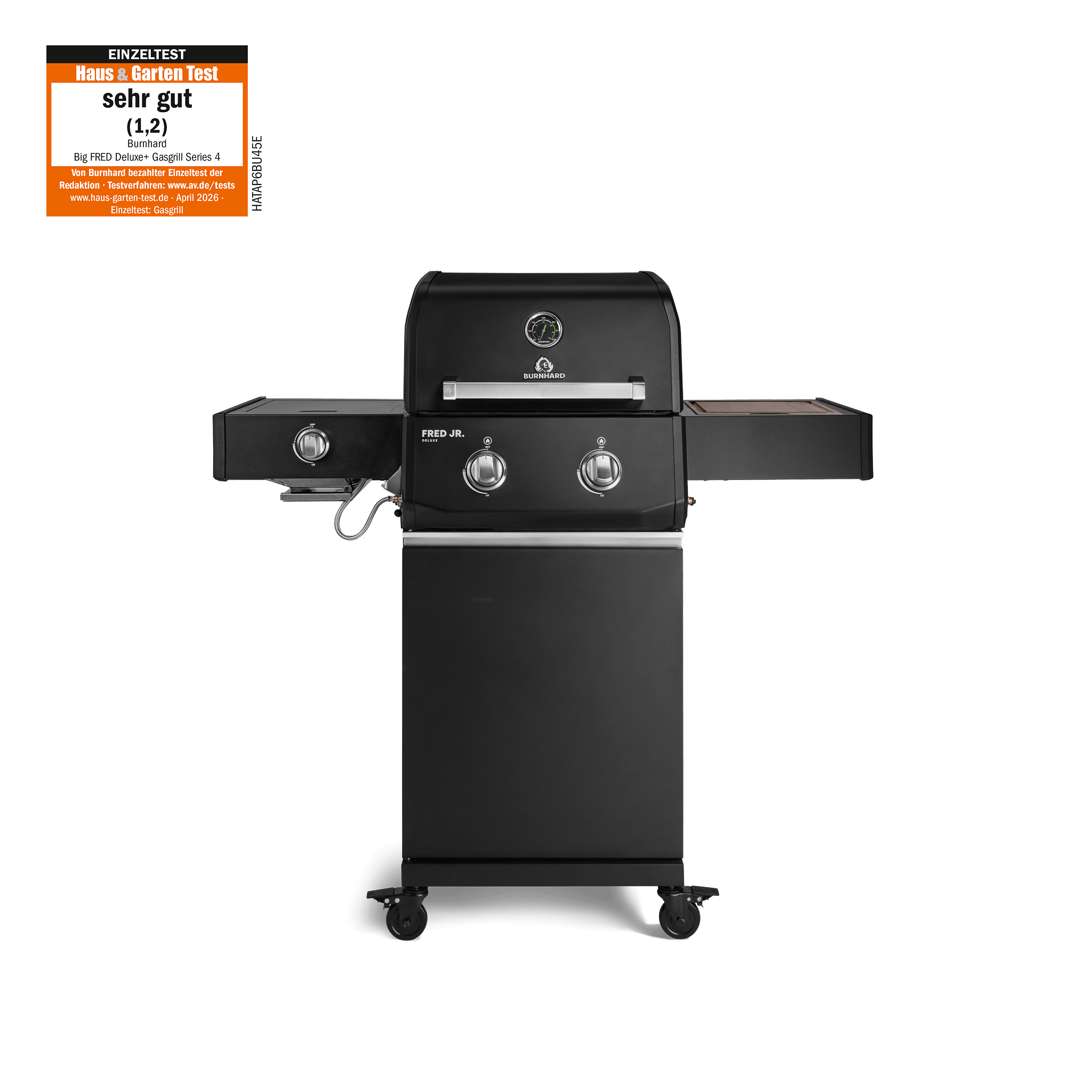
The product photo shows the Black Edition from the front. On the left is the infrared side table with its own control knob, on the right the wooden board sits flush in the shelf. Between them is the burner chamber with a domed lid, thermometer and handle bar, below it two control knobs for the main burners and a closed base cabinet on four castors. Burnhard offers four variants: Black Edition or stainless steel, each with a cast iron or stainless steel grate. In the Burnhard shop, each variant costs approx. €649 with a cast grate and approx. €699 with a stainless steel grate, so the grate change makes a difference of €50 (on 21 October 2026: €649.00 with cast grate). For us, Burnhard is the only way to buy this model.
For our research, we read the product page, the operating manual for the main grill and the side table manual. The manual applies to grill item numbers 946712 and 946713; the infrared side table has its own booklet. For how the FRED Jr. compares with the other carts, see the overview of all gas grills.
Burners, grate and housing
Under the grate are two stainless steel tube burners of 3.75 kW each, 7.5 kW together. This is exactly the value the manual gives as the nominal heat input of the main grill. The 11 kW with which Burnhard advertises the package only come about with the infrared ceramic burner in the side table, which contributes 3.5 kW. Each tube burner is lit individually via the Kickstarter piezo ignition and regulated steplessly between HI and LO. Above them sit two W-shaped stainless steel flame tamers, called W-Shape Flavor Bars by Burnhard, 17.5 cm each. According to the manufacturer, the tube burners are replaceable and can be retrofitted.
The main cooking area measures 46.5 × 41.5 cm, which works out at roughly 1,930 cm². Burnhard designs it for up to 5 people. Above the main grate hangs a stainless steel warming rack of 43 × 13.5 cm, which you fold away as soon as a chicken or a roast needs the full height. For the main grate you choose between thick cast iron grates, which according to the manual are enamelled, and stainless steel grates.
The burner chamber is stainless steel. Its side panels and those of the lid are made of die-cast aluminium, which Burnhard describes as heat-storing. On the Black Edition, the base cabinet and lid are made of cold-rolled steel with a matt powder coating. The manual’s parts list shows a double wall for the burner chamber (two parts); a double-walled lid is not mentioned there. Burnhard mentions an oven band on the lid only in general terms for the Series 4.
In addition there are a thermometer in the lid, a grease drain plate and a removable stainless steel grease tray, two folding side tables with a load capacity of up to 20 kg each, hanging hooks on both side tables, a magnetic bottle opener and four rubberised castors with locking brake. With the lid closed the grill measures 117.8 × 54.2 × 119 cm, with it open 117.8 × 64.5 × 148.5 cm, and with the side tables folded down it is 74.8 cm wide. It weighs 34 kg. The manual’s dimensions table says “498 x 552 x 1190 cm”, evidently printed with the wrong unit; we are using the values from the product page.
What Burnhard does not state
A number of data points that would help with comparisons are missing from all three sources: the cooking area in square centimetres (we calculated the figure above from the edge lengths), the grate size of the infrared module, a maximum temperature of the cooking chamber, a heat-up time to a specific temperature, the material thicknesses of lid, housing and grates, the grade of stainless steel, the country of production and the battery type that the ignition fault table asks about.
In detail: two zones on the grate, a third beside it
Two burners under one grate give two zones, left and right. For sausages and vegetables, both run. For indirect cooking, one runs and the other stays off, and the food sits over the cold burner with the lid closed; the heat then comes from the side and from above out of the hood, not as radiation from below. With a grate width of 46.5 cm, about half of it remains for the indirect side. A three-burner grill can switch off the middle burner and heat from both sides, which evens out the temperature across the surface better.
The lid thermometer measures the temperature in the burner chamber. According to the manual, you grill best between 250 and 370 °C, and at the grate itself it is usually hotter than the display suggests. You should preheat for approx. 20 minutes with the lid closed (except on first use); elsewhere the manual gives approx. 15 minutes of heating up.
The infrared ceramic burner in the side table is a separate hob with its own lid and grate. Burnhard advertises up to 900 °C of direct heat from below. In principle, such a burner works like this: the gas burns on the surface of a perforated ceramic plate, the plate glows and gives off most of its heat as radiation. This is intended for a quick crust on steak or burgers, not for delicate food. We would see it as a searing station, after which the meat finishes on the main grate over a low flame.
Three rules of their own from the side table manual apply to the module: the module’s lid is always open when lighting. Before you put it back on, you let the burner cool down. And you never fold the side table down while the burner is in operation.
Does an 11 kg cylinder fit in the base cabinet?
Yes, as long as it is made of steel. The manual allows three sizes in the base: 5 kg (height 420 mm, diameter 230 mm), 8 kg (505 mm, 300 mm) and 11 kg (600 mm, 300 mm). Plastic composite cylinders are not permitted in the grill because of the risk of melting.
If you use a composite cylinder anyway, you place it next to the grill and run the hose out through the rear panel. In the base cabinet, a heat shield protects the cylinder, as the parts list states. You route the hose so that it does not touch the burner chamber and does not run under the grease tray. If you want to move the grill, you take the cylinder out beforehand, otherwise it can tip over. Before every change of location, the grill is switched off, the cylinder valve is closed and the cylinder is unscrewed from the hose.
One point contradicts the advertising text. The product page says you store your cylinder “directly in the grill”. The manual, by contrast, requires that the cylinder be disconnected when not in use, fitted with a protective cap and stored outside the grill’s base cabinet. We read it like this: it stands in the base cabinet while you are grilling. For storage, the manual specifies a well-ventilated, shaded place protected from the weather and below 50 °C, not in the house, not below ground level such as in a cellar or underground car park, and not in unventilated places.
These three alternatives are worth a look
| Model | The difference | Price | Our rating | Choose this one if |
|---|---|---|---|---|
| BURNHARD FRED Jr. Deluxe (this one) | 2 tube burners with 7.5 kW on 46.5 × 41.5 cm, plus infrared side table with 3.5 kW | approx. €649 | 8.3 | you grill for up to five people and want a separate station for hot searing |
| BURNHARD FRED Base | 3 tube burners with 11.25 kW on 59.0 × 41.5 cm, without infrared and without chopping board | approx. €519.20 | 8.3 | you often grill for larger groups and can do without the infrared burner |
| Weber Spirit II E-310 | 3 burners with 7.0 kW on a 2,314 cm² main grate, no side burner | approx. €459.99 | 9.2 | you have the smallest budget and prefer to grill indirectly with three zones |
| Broil King Regal 590 | 5 main burners with 16 kW on 80 × 48.8 cm, plus rear burner and side hob | approx. €1,649 | 9.4 | you regularly host large groups and want to work with the rotisserie |
The price of the FRED Jr. Deluxe comes from the Burnhard shop (21 October 2026); the others are guide values from our price box and vary by shop, and for the FRED Base the guide value is from Amazon. The rating is our editorial assessment based on the data comparison, not a measured result.
When the FRED Jr. fits and when another grill does
Number of people. Up to 5 people is the manufacturer’s figure for the FRED Jr.; for the FRED Base with the 59 cm wide grate, Burnhard states up to 10. If you mostly grill for two or four, the small grate is enough. If guests regularly join, we would go for the three-burner.
Footprint. With the side tables unfolded, the FRED Jr. needs 117.8 cm of width, the FRED Base 130.4 cm. On top of that come the manual’s minimum distances to objects of any kind: 100 cm to the rear, 100 cm to the side and 200 cm upwards. The grill keeps 1.5 m from all combustible materials and 7.5 m from flammable liquids.
Balcony. Burnhard does not comment explicitly on balconies. The manual requires operation outdoors, never in a building, garage or other enclosed area, plus the clearances above. On a covered balcony with a ceiling less than two metres above the grill, this cannot be met in our reading. Whether your tenancy agreement or house rules allow gas at all is something you clarify beforehand; what to bear in mind is covered in our guide to grilling on a balcony.
Heat zones. The infrared burner is the argument for the FRED Jr. Deluxe over a cheaper three-burner. If you never sear, you pay for it anyway. The FRED Base stands at approx. €519 in our price box, the Weber Spirit II E-310 at approx. €460, the FRED Jr. Deluxe at approx. €649.
Rotisserie. The FRED Jr. has no rear burner, and Burnhard rules out retrofitting because the rear burner is fixed in the burner chamber. If you want to turn chickens on a spit, look at the Broil King Regal 590 or the three-burner FRED Deluxe.
Budget. On top of the grill price come a gas cylinder, which is not included, and a cover, which Burnhard sells separately.
Accessories, upgrades and running costs
According to the product page, the box contains: two W-Shape Flavor Bars, two stainless steel tube burners, acacia wood chopping board and GN food container in the side table, a gas hose with pressure regulator, the magnetic bottle opener, four rubberised castors with locking brakes, cast iron or stainless steel grates, the warming rack, grease drain plate and grease tray in stainless steel, two hook rails and the infrared ceramic burner. The manual adds three cleaning needles in sizes 0.7, 0.8 and 0.9 mm.
According to Burnhard, FRED Series 3 accessories still fit the Series 4; as examples the manufacturer names plancha, rotisserie and built-in shelf. The manual permits operation only with original accessories.
For gas, an upper limit can be calculated. The manual gives a connection value of 2 × 273 g/h for the main burners, 546 g/h together, and the side table manual gives 255 g/h for the infrared burner. At full load, the grill therefore draws up to 801 g/h. An 11 kg cylinder thus lasts, on paper, a good 20 hours with both main burners on HI, and just under 14 hours with the infrared burner switched on as well; a 5 kg cylinder lasts a good 9 hours on the main burners. If you grill on a medium setting or with only one burner, you use less. Exactly how much, nobody has measured. Incidentally, the nozzles are different sizes, 0.83 mm on the main burners and 0.81 mm on the infrared burner.
Cleaning, care and safety according to the manual
Before the first fire comes the leak check, and the manual describes it step by step. You spray all sealing points with standard leak detection spray or brush them with soapy water in the ratio of 1 part soap to 3 parts water. Then you open the cylinder valve; small bubbles appear at leaking points. In that case you close the valve, tighten the nuts and repeat the check. If bubbles keep rising, you close the gas valve and go to a specialist dealer. The check is repeated after every cylinder change. Before every use, you check the hose and pressure regulator for cracks and damage, and the burners for dirt.
You should set the grill up on a level, stable and fireproof surface, sheltered from the wind and away from moisture, splashing water and electrical cables. Before every use you secure it with the locking brakes, it is not moved during operation, and it is never left unattended.
Lighting is done with the lid open and only with the piezo ignition of the relevant burner, never with an open flame. You turn the control knob on, wait 3 seconds and keep turning until it clicks. If the burner does not light, you repeat this 3 to 4 times. If it still does not work, you set the knob to OFF, close the cylinder valve and wait 5 minutes. When lighting and grilling, you never lean over the open grill.
If you smell gas, you close the gas supply, extinguish all open flames and open the lid. In the event of a grease fire, you switch off the burners and close the lid; the manual expressly warns against extinguishing an oil or grease fire with water.
After grilling, according to the manual, you set the main burners to HI and the infrared burner to LO and let them burn for 15 to 30 minutes with the lid closed until no more smoke rises. Then you let the grill cool down, remove the gas cylinder and clean it without flammable cleaning agents, after every use. The flame tamers may also go in the dishwasher, as may the stainless steel grate. The product page describes only the stainless steel grates as dishwasher-safe, not the cast iron grates. According to Burnhard, standard grill cleaners are only partly suitable for the aluminium parts; for those you use a cleaner suitable for aluminium or washing-up liquid. If you rinse the interior, no water may get into the gas nozzles. A blocked nozzle is cleared with a needle or a pipe cleaner.
You empty the grease tray before every use to prevent a grease fire, and neither aluminium foil nor an aluminium tray belongs on the grease drain plate or grease tray. A thorough clean is due every 3 to 4 months or after a long period of disuse, and you also brush clean the insect and spider guard on the venturi tube. The acacia wood chopping board is not dishwasher-safe; you clean it thoroughly after every use, store it dry and care for it with oil. The GN food container and frame may go in the dishwasher. You leave repairs and maintenance on the gas system to authorised specialist staff.
Who is it suitable for?
In our assessment, the FRED Jr. Deluxe suits a household of two to four people who grill on a patio or in the garden and value an infrared burner for searing, without setting up a wide three-burner. At 34 kg and with four castors with brakes, it can be pushed between its spot and a shelter, provided the cylinder is outside beforehand.
It is the wrong choice for people who regularly grill for eight or more guests, for anyone who wants to work with a rear burner and rotisserie, and for catering: according to the manual, the grill is not intended for commercial use. It is also out of the question as a grill that children help operate, because use by children is prohibited according to the manual. People with reduced physical, sensory or mental abilities may only use it under supervision or after instruction in safe use. If you are unsure whether gas or charcoal suits you better, the grill finder offers a preselection.