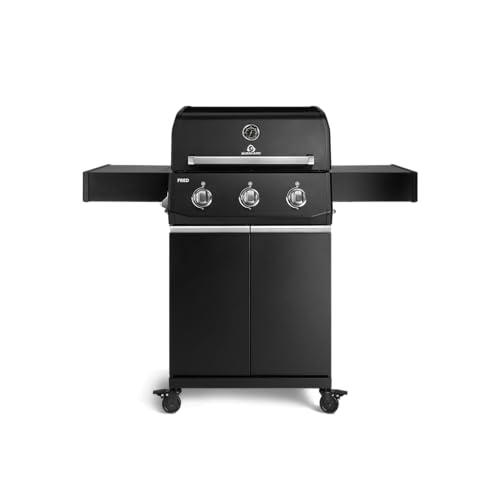
The FRED Base is the simplest trim of Burnhard’s three-burner gas grill FRED Series 4: three stainless steel tube burners, a main cooking area of 59.0 x 41.5 cm, and a base cabinet for the gas bottle. The Amazon ASIN of this page carries model number 947124, and under that number Burnhard sells the Black Edition with cast iron grate, in its own shop for approx. €599 (as of October 2026). At Amazon it is currently cheaper, approx. €519 (Amazon page on 20.10.2026: €519.20).
A correction up front, because the old figure is still in the page title: earlier versions of this page stated 9.6 kW. The product page and manual give three times 3.75 kW, 11.25 kW in total.
What the Base has and what it leaves to the more expensive FRED
The FRED with three burners comes in three trims, and the differences lie almost entirely in additional burners and attachments. The Deluxe gets a rear burner, an infrared ceramic burner that Burnhard advertises as a “900 °C zone”, a side cooktop and a cutting board with GN container. The Deluxe+ adds Longlife cast burners, a cover, a smoker box and a kitchen roll holder. The product page lists these from €799 (Deluxe) and from €929 (Deluxe+).
The Base has none of that. It has the three tube burners and two fold-down side tables as shelf space.
There is no choice of colour for the three-burner in this trim; the Base comes only as the Black Edition. What you can choose is the grate: instead of the cast iron grates of the 947124, there is variant 947125 with a stainless steel grate, according to the product page for a €70 surcharge, so €669.
According to Burnhard, the Series 4 is the fourth generation of a grill that has been under development for almost ten years. Compared with the Series 3, the manufacturer names five changes: side panels in die-cast aluminium on the firebox and lid, side tables with a 20 kg load capacity each, a stainless steel firebox even on the powder-coated Black and Green Editions, a more resistant powder coating and an oven band on the lid. For how the Base is priced against other three-burner grills, see our overview of gas grills.
Firebox, lid, grates: what the grill is made of
The product photo shows a classic box construction. At the top the cooking chamber with a slightly rounded lid and thermometer, at the front three control knobs, below them a base cabinet with two doors, the side tables left and right, and four castors at the bottom.
The firebox is stainless steel, double-walled according to the parts list, and its side panels are die-cast aluminium. The lid and base cabinet are made of cold-rolled steel with a matt powder coating. The lid is also double-walled, has die-cast aluminium at the sides and carries an oven band, in other words a seal. On the burners sit three W-shaped flame tamers made of stainless steel, called “W-Shape Flavor Bars” by Burnhard. Fat runs over a drip tray into a removable grease tray, both also stainless steel.
According to the manual, the three cooking grates of the 947124 are enamelled cast iron. Above them sits a stainless steel warming rack, 54.6 x 13.5 cm, which you can fold down or remove completely.
With the side tables up, the grill is 130.4 cm wide, with them folded down 87.4 cm. With the lid closed it measures 58.4 cm in depth and 119 cm in height; open, it needs 64.5 cm depth and 148.5 cm height. Burnhard states 30.4 kg. The Amazon catalogue, by contrast, lists 98.1 pounds, converted approx. 44.5 kg, and none of the sources makes clear which of the two values includes packaging.
The product page also counts the gas hose with 50 mbar pressure regulator, a magnetic bottle opener, two hook rails and four rubberised castors with parking brake as part of the delivery. In the manual’s parts list, three cleaning needles, two brackets and a heat shield for the gas bottle are added; the only tool provided for assembly is a single Phillips screwdriver. A gas bottle is not included.
In detail: three tube burners, 11.25 kW and two zones
Each of the three tube burners has its own control knob and is started separately via the Kickstarter piezo ignition. According to the manual, any position between HI and LO can be chosen; Burnhard describes the control as infinitely variable. According to Burnhard, the burners themselves are replaceable and can be retrofitted; to change them, you loosen the screw connection at the burner end and lift them out of the firebox.
What 11.25 kW means becomes clearer when you relate it to the area. The main cooking area from the introduction is 2,448.5 cm², which by our calculation gives around 4.6 kW per 1,000 cm². The figure describes, however, how much gas burns, not how hot the grate gets. The double-walled lid, the flame tamers and the wind at the site also count for that. The manual gives two slightly different values for the burners: 11.25 kW output and, in the table, a nominal heat input (Hs) of 11.5 kW. Per main burner it lists a connection value of 273 g/h and a gas nozzle of Ø 0.83 mm.
Amazon lists “direct and indirect grilling” in the bullets. The principle is the same for every gas grill with several burners: for direct grilling, you cook over a burning burner; for indirect, the food sits over a switched-off burner, and the heat of the neighbouring burners passes over it with the lid closed. With three burners you can have one side hot and the other off, or switch off the middle and leave the two outer ones burning. How evenly this works on the FRED, none of us has seen, and Burnhard does not publish a temperature distribution.
According to the manual, the lid thermometer shows the temperature of the cooking chamber. Burnhard recommends 250 to 370 °C as the grilling range. About 15 minutes with the lid closed should be enough for heating up; elsewhere the manual gives 20 minutes of preheating as an energy-saving tip.
The lid must be open when igniting. According to the manual, you wait 3 seconds before lighting the burner; if it does not work at the first attempt, you repeat the step 3 to 4 times. If the burner still does not light, the control goes to OFF, the bottle valve is closed, and you wait 5 minutes. The manual prohibits lighting with an open flame; ignition is always via the piezo ignition of the respective burner.
What Burnhard leaves open
A few questions are answered by neither the product page nor the manual, and we do not estimate there:
- a target temperature for the 15 minutes of heating up and a maximum temperature in the cooking chamber
- gas consumption on an ordinary grilling evening; only the full-load value is documented
- wall thickness and weight of the cast iron grates, and the length of the tube burners
- the country of manufacture; Burnhard writes only “Designed & engineered in Germany”
- how the “up to 10 people” figure comes about
- a manufacturer’s guarantee beyond the statutory warranty
- prices for replacement burners and replacement grates
- delivery method and number of parcels
Two inconsistencies in the manual itself: the item list for the FRED 3-burner gives the numbers 946715, 946717, 946716 and 946718, but not 947124; the technical data nevertheless match the product page. And the dimensions table prints “624 x 552 x 1190 cm”, which is probably a unit error and fits no figure on the product page. We therefore use only the dimensions from the product page.
How long does a gas bottle last on the FRED Base?
With all three burners at full load, the grill consumes 819 g of gas per hour according to the manual. By calculation, a 5 kg bottle lasts a good 6 hours with that, an 8 kg bottle just under 10 hours and an 11 kg bottle around 13.4 hours. Throttled down, each bottle lasts longer.
Exactly these three sizes fit in the base cabinet. The manual gives the dimensions: 5 kg with 420 mm height and 230 mm diameter, 8 kg with 505 mm and 300 mm, 11 kg with 600 mm and 300 mm. The bottle belongs centrally on the braces so that it does not tip over. Composite bottles made of plastic are not permitted in the base cabinet; if you use one, the gas hose has to be routed outside through the rear panel.
Hose and pressure regulator come pre-assembled. According to the manual, it is a CE-approved hose line of at most 1.5 m and a fixed-setting pressure regulator to DIN EN 16129 and DIN EN 16436-1 (German standards that apply in Germany) with a maximum of 1.5 kg/h and 50 mbar operating pressure. You should replace both after 10 years at the latest, even without visible damage, with the gas hose with gas pressure regulator, item no. 947107. The gas system should be routinely inspected at least once a year, and repairs and maintenance on it are reserved for authorised specialist personnel. What else to bear in mind when buying a bottle is in our guide to the gas bottle for the grill.
For the time when you are not grilling, the manual has a list of its own. The bottle belongs out of the reach of children, away from oxidising gases and other combustion-promoting substances, and, because escaping liquefied gas is heavier than air and sinks to the floor, not in the house and not below ground level, such as in a cellar or underground car park. It must be protected from direct sun and other heat sources and stored at less than 50 °C in a well-ventilated, shaded, weather-protected place, upright and secured against tipping over. Spare bottles or bottles that are not connected must not stand under or next to the grill. When the grill is out of service, the bottle is disconnected and the protective cap put on. It is stored outside the base cabinet, and you may only put the grill itself in indoor spaces if the bottle is disconnected and removed. The base cabinet is therefore a place for the bottle during grilling, not a storage place.
These three alternatives are worth a look
| Model | The difference | Price | Our rating | Pick this if |
|---|---|---|---|---|
| BURNHARD FRED Base (this one) | 3 tube burners at 3.75 kW each, no infrared or rear burner | approx. €519 | 8.3 | you grill for up to ten people and want to expand it yourself later |
| Weber Spirit II E-310 | 7.0 kW for 3 burners, voluntary Weber guarantee per component | approx. €459.99 | 9.2 | a long manufacturer’s guarantee matters more to you than rated output |
| Napoleon Freestyle PRO 365 | Infrared sizzle zone from the factory, 15 kW in total | approx. €599 | 9.1 | you want to sear steaks over a very hot zone |
| BURNHARD FRED Deluxe | same area, permanently installed infrared rear burner | approx. €719 | 8.3 | you want a rear burner, which the Base can never get |
The prices are the guide values from our price boxes and change. The rating is our editorial assessment from the data comparison; we did not measure anything on any of the four grills.
Base, Deluxe or another three-burner: which fits when
How many people are you grilling for? Burnhard designs the main cooking area for up to ten people. If more come regularly, the Big FRED Base with four burners is the obvious step up, according to our price box approx. €699.
Do you have the space? Do not just count on 87.4 cm. The manual requires 100 cm clearance at the back, 100 cm at the side and 200 cm above; the grill should never stand directly against glass fronts, walls or plants. With the side tables up and both side clearances, we arrive by calculation at a good 3.30 m of width. No approval for the balcony appears in any of the Burnhard sources; they say only that the grill is to be used exclusively outdoors.
Do you want to sear? The Base has no infrared burner. According to our price box, the Napoleon Freestyle PRO 365 costs approx. €599, the Base at Amazon approx. €519, and it brings its sizzle zone from the factory. For someone who mostly grills steaks, we would lean towards the Napoleon.
Rotisserie, rear burner, side cooktop? According to Burnhard, you cannot retrofit the rear burner on the Base, because it is permanently fitted in the firebox. If you want it, buy the FRED Deluxe straight away, at Amazon approx. €719 instead of approx. €519 for the Base. The side cooktop, by contrast, can be added later as a side table; more on that in the next section.
Is the guarantee more important to you than output? The Weber Spirit II E-310 costs approx. €460, the Base approx. €519. Weber states only 7.0 kW for its three burners, but gives a voluntary guarantee per component. Our assessment: if you want to leave your grill standing for ten years and do not want to tinker, you are better off there. If you like to retrofit, the FRED Base gives you more options.
Accessories and expansion
The side tables hang on quick-release adapters and can be swapped for function tables. In the Burnhard shop, the side table with ceramic burner FRED Series (€129.00), the side table with cooktop FRED Series (€180.07) and the side table with food container and cutting board (€119.00) are listed for this. The shop also carries the FRED Plancha griddle plate at 41.5 x 23.5 x 3.5 cm for €119.00 and the built-in shelf for gas grill FRED for €79.90. Alternatively, Burnhard sells an upgrade set with which the Base is expanded towards the Deluxe; the rear burner is excluded.
According to Burnhard, Series 3 accessories still fit the Series 4; plancha, rotisserie and built-in shelf are named. Whether a rotisserie works sensibly on the Base without a rear burner is left open by the compatibility statement. Two rules from the manual apply to every attachment: the grill may only be used with original accessories, and gas-carrying modules may only be attached or removed when the grill is switched off.
A contradiction on the product page concerns the smoker box. The promotional text speaks of a “supplied smoker box”, but the delivery list of the Base includes none, and according to the category page it belongs to the Deluxe+ or the upgrade set. We go by the delivery list: do not count on a smoker box in the carton with the Base.
Setting up, connecting, cleaning: what the manual prescribes
On siting, the manual gives five points. The grill should stand sheltered from wind, away from moisture, splash water and electrical cables, with 1.5 m minimum distance to all combustible materials and 7.5 m to all flammable liquids, on a level, stable and fireproof surface, and the gas bottle is to be protected from strong sunlight. Before every use, the grill is fixed using the parking brakes of the castors and is not moved during operation. Before every change of position, you switch it off, close the bottle valve, unscrew the bottle from the hose and take it out, otherwise it can tip over. Whether it has slipped, you check before every barbecue.
You check the hose and pressure regulator for cracks and damage before every use. After connecting and after every bottle change comes the leak test, which the manual describes like this: spray all sealing points with standard leak detection spray or brush them with soapy water (1 part soap to 3 parts water). Open the bottle valve; bubbles form at leaking points. Close the valve again, tighten the nuts on both connection sides by hand and repeat the test. If bubbles still rise then, close the valve and go to a specialist dealer.
Before the first barbecue, you let the main burners burn for 20 minutes without food so that preservative residues disappear. According to the manual, discolouration inside through heat oxidation is possible. Aluminium foil or an aluminium tray on the drip tray or grease tray is prohibited, and the tray should be emptied before grilling to prevent a grease fire.
Cleaning is done after every use, with the grill cooled down, without flammable cleaning agents and only after the gas bottle has been removed. You burn off coarse residues beforehand: main burners on HI, lid closed, 15 to 30 minutes until no more smoke rises. The flame tamers may also go in the dishwasher. No water may get into the gas nozzles. According to the manual, standard grill cleaners are only conditionally suitable for the aluminium parts, and no microfibre cloth should be used on the stainless steel surfaces, because it can scratch. Every 3 to 4 months or after longer idle periods, a thorough clean is due. After rest periods you also look into the venturi tube at the end of each main burner, which has an insect and spider guard; for blocked openings, cleaning needles of 0.7 mm, 0.8 mm and 0.9 mm are included. The cast iron grates should be stored as dry as possible in winter; the manual advises taking them indoors to prevent flash rust.
Who is it suitable for?
For catering, hospitality or club events with sales, the FRED Base is the wrong choice: according to the product page and manual, it is not intended for commercial use. For families, the manual also says: children must not play with the grill, and use by children is prohibited.
By our comparison, it suits a household with a garden or large terrace that wants gas in the base cabinet and is looking for a grill it can expand piece by piece. According to the product page, Burnhard ships it in 2 to 4 working days, with a 30-day right of return. The shipping costs are stated contradictorily there: the page header says “freight €29”, the product box “free shipping”; we would check that in the basket before ordering.