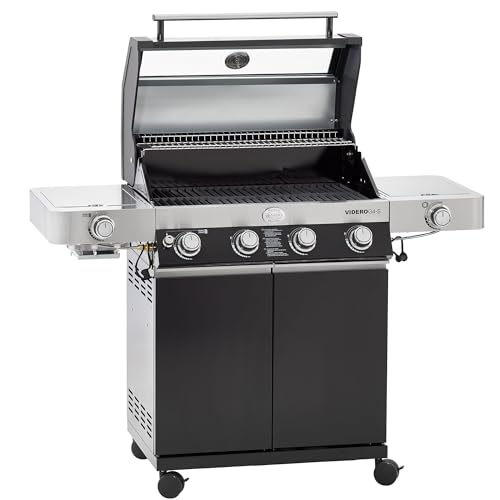
The Freestyle PRO 365 is a gas grill and the smaller of two models in Napoleon’s Freestyle PRO series, model number FP365DSIBPK-1-DE. It has three main burners and is listed in black. The product page names propane gas as the fuel; for Germany the manual also permits butane. What separates it from the Freestyle 365 without PRO is an infrared side burner that Napoleon calls SIZZLE ZONE.
In our price box it is at Santos Grills for approx. €599 (as of September 2026). Napoleon itself gives an RRP of €699 (accessed on 2 October 2026), marks it with “New!” on the series page and sends buyers to the dealer search via “Where to buy?”. There is no natural gas version in Germany.
We have not handled the grill ourselves. What is written here about technology and operation comes from Napoleon’s German product and series pages, the operating instructions N415-0850CE-DE and the assembly instructions N415-0851CE dated 5 May 2026. The manual covers seven Freestyle models; where it attributes something only to “some models”, we do not carry it over to the PRO 365. An earlier version of this page named stainless steel grates, a cooking area of 57 x 46 cm and heating-up and cooking times that came from no Napoleon source. That has been corrected.
Burners, grates, cart and dimensions
The three main burners are made of stainless steel; the maintenance chapter of the manual mentions thick-walled 304 stainless steel. Each has its own control knob. Above them sit stainless steel flame guards, which the manual calls sear plates in some places and flavour bars in others, and on top of those the main grates in porcelain-coated cast iron. Napoleon calls them Iconic WAVE, and the parts list gives them as S83039. Stainless steel main grates (S83043) are listed on the same list only for the Phantom PRO 425. There is also a warming rack in stainless steel.
The product page contradicts itself on the main cooking area: the key features say 51 x 45 cm, the technical data say 52 x 46 cm along with the note “26 burger”. Napoleon gives the total cooking area as 3,775 cm².
Ignition is by JETFIRE, with the lid open. You press a main burner knob, slowly turn it anticlockwise to HIGH until the pilot flame burns, and hold it down until the burner lights. If the pilot flame does not appear, you immediately turn the knob clockwise to OFF and start again. If the pilot flame and burner still have not lit after 5 seconds, the knob also goes to OFF, and you wait 5 minutes so the gas can disperse.
According to Napoleon’s Freestyle overview, the lid contains an ACCU-PROBE thermometer. The parts list gives the lid itself as the black assembly N010-1534-BK, the same as on the Freestyle 365. Its material is not stated on the PRO 365 page. Because of the shared assembly, we assume the same material as on the Freestyle 365, but this is only documented for its variant with a side burner: for that one, Napoleon describes a cast aluminium cooking chamber and a lid with black porcelain enamel.
Below, the cart is closed. According to Napoleon, accessories or the gas bottle go into the base cabinet. On one side there is a folding shelf with tool hooks and a bottle opener, and the product page calls the wheels all-terrain. The function overview in the manual is more specific, though for the model shown there, a Freestyle PRO with an infrared side burner: it shows powder-coated shelves, a retaining ring for the gas bottle and 7-inch wheels, so just under 18 cm.
Assembled, the grill is 124 cm wide, 63.5 cm deep and 116 cm high, 154 cm with the lid open. With the shelf folded down, 100 cm of width remains. The Freestyle 365 without a side burner is just as wide and shrinks to 76 cm with both shelves down, so 24 cm per shelf. We read from this that on the PRO 365 only one side folds and the side with the SIZZLE ZONE stays up. Packed, the grill weighs 52.29 kg, and the carton measures 50.80 x 71.12 x 73.66 cm.
According to the assembly instructions, no tools for assembly are included. They advise taking all parts out of the packaging beforehand, placing the assembly on a firm, level and horizontal surface and using the main carton as a base to prevent scratches. The manual says: assemble exactly according to the assembly instructions and, if a shop assembled it, check against the instructions that everything is correct; do not install in or on recreational vehicles or boats; do the leak test before commissioning; do not modify the grill under any circumstances; use only the pressure regulator and hose supplied with the grill or replacement parts expressly recommended by Napoleon.
In detail: 12 kW under the lid, 3 kW of radiant heat alongside
The 15 kW on the product page is a sum. The output table in the manual breaks it down: 12.0 kW for the three main burners together and 3.0 kW for the SIZZLE ZONE. At full output, according to the same table, the main burners use 873 g of gas per hour and the infrared burner 218 g, 1091 g together. The table has no column for a rear burner for any of the models; it only has total, main, flame side and infrared side.
A total says little about how densely the heat arrives under the grate, because a larger grill has more area to heat. We therefore divided the main burner output by the main cooking area. With the smaller of the two area figures, multiplied out as 2,295 cm², this gives 5.2 W per square centimetre, with the larger one (2,392 cm²) 5.0 W. Calculated the same way from the manufacturer’s figures, the Rösle Videro G4-S Vario+ with 14 kW on 3,150 cm² comes to 4.4 W, and the Broil King Regal 590 with 16 kW on 4,032 cm² to 4.0 W. Napoleon labels the kW column heat input, so it means the energy flowing into the burners as gas. How hot the grate gets also depends on the lid and on wind. The quotient is useful for comparing grills; it does not replace a temperature figure.
To preheat, according to the manual, you run all main burners with the lid closed on the highest setting for about 10 minutes; if the grill does not get hot enough, the troubleshooting section advises 10 to 15 minutes. Fish and vegetables that only cook briefly can sit with the lid open. With the lid closed it gets hotter and the temperature more even; according to the manual, meat cooks more evenly this way, and the cooking time may be shorter. Lean meat such as chicken breast or pork sticks less if you oil the grates before preheating.
Roasts and anything else that takes longer than 30 minutes can be cooked indirectly: the food sits where no flame burns, and the opposite burner runs. Against flare-ups, you trim excess fat or turn the temperature down. If it flares up anyway, you move the food out of the flames, turn the heat down and leave the lid open.
The SIZZLE ZONE works on a different principle. In a ceramic infrared burner, the gas generally burns on a ceramic plate with many fine openings. The plate glows and gives off a large part of its energy as radiant heat directly to the surface of the food, instead of first heating the air under a lid. That Napoleon has fitted such a burner here is shown by the troubleshooting section: if the infrared burner flashes back, you switch it off, let it cool for at least 2 minutes, relight it and let it burn on HIGH for at least 5 minutes or until the ceramic plates glow evenly red.
On the heat of the zone, Napoleon writes that it reaches “extremely high temperatures in seconds”. More tangible is the infrared grilling guide on page 21 of the manual. A steak of 2.54 cm sits there on HIGH for 2 minutes per side and is rare after 4 minutes; for medium and well done, it stays at 2 minutes per side on high heat, after which you turn down to medium, with cooking times of 6 and 8 minutes. Napoleon calls these general guidelines. How to check the core temperature and how long a steak should rest is covered in our steak grilling guide.
The SIZZLE ZONE is lit separately from the main burners. You open the burner cover, press the side burner knob and set it to HIGH with a slow anticlockwise turn. Then you hold down the ignition button with the lightning symbol until the burner lights, or use a match. If it does not light, the control goes clockwise to OFF; after waiting 5 minutes, you repeat the last two steps. For the SIZZLE ZONE the parts list gives its own components: the IR side burner S81004, the IR side burner grate S83009 (stainless steel according to the product page), an igniter S86002, a drip tray and a lid.
On a high setting, according to the manual, the infrared heat provides an even surface for searing. With griddles or pans you cover at most 75 percent of the infrared burner area, because according to page 16 it needs sufficient open area for proper combustion and good heat flow. The danger box on the same page includes these notes: never leave food unattended on burners that are switched on, do not deep-fry on the side burner because cooking with oil can be dangerous, and do not close its lid while it is running or hot.
Do you need the SIZZLE ZONE, or is the Freestyle 365 enough?
You need it if you want to sear steaks hard while vegetables or sausages are already on the main grate. If you sear directly over the main burners, the Freestyle 365 is enough: also three stainless steel main burners with a combined 12 kW, but no side burner, and Napoleon’s RRP is €499, which is €200 lower.
In our price box the gap is smaller. There the Freestyle 365 is at approx. €549, €50 below the PRO 365.
Between them sits a third model, the Freestyle 365 with side cooktop (F365DSBPK-1-DE). According to Napoleon it also reaches 15 kW, but instead of the infrared zone it has a side burner with a cooktop, RRP €599. If you reduce a sauce or cook side dishes in a pot at the grill more often than you sear steaks, you are better served by it in our assessment.
Napoleon’s area figures for the three are revealing. The Freestyle 365 without a side burner comes to 3,194 cm² total cooking area, so 581 cm² less than the two models with a side burner. The difference arises exactly where a side burner is added; it therefore seems likely that Napoleon counts its area. The burgers are also inconsistent: according to its product page, the model with the cooktop has the same main cooking area as the PRO 365 in its technical data, but room for 22 instead of 26 burgers.
Location, gas, leak test: what the manual requires
At the very top of the manual it says in capitals: use only outdoors in a well-ventilated area. If you smell gas, you turn off the gas at the appliance, extinguish any open flame and open the lid. If the smell persists, you keep away from the appliance and call your gas supplier or the fire brigade immediately.
The grill is intended for an outdoor patio or the garden, in a location that keeps all clearances to combustible materials. It belongs in an above-ground, open place with natural ventilation and no stagnant air, where wind and natural convection quickly disperse gas leaks and combustion products. So not in a building, a garage or any other enclosed space, and not in a built-in or slide-in construction, and the ventilation openings in the cylinder housing stay clear. In which kind of shelter it still counts as outdoors, we answer below in the questions.
From combustible materials, according to page 7, you keep 610 mm clearance at the back and 178 mm at the sides; next to vinyl cladding or glass panes, Napoleon additionally recommends 610 mm, and during operation combustibles stay away from the grill. It does not stand under combustible roofing or structures and not where strong wind hits, especially directly from behind. The minimum ambient temperature for safe operation is minus 17.8 °C.
You never cover more than 75 percent of the cooking area. Cold water on the hot grill, whether rain, sprinkler or hose, can make the porcelain chip; what it does to the ceramic is covered below under care. A pressure washer touches no part of the grill. Accessible parts can get very hot, you keep small children away, and hoses do not touch hot surfaces. According to page 7, the connection, including installation of the gas and hose connection, must be carried out by an approved gas installer, and the connection is checked for leaks before operation.
In Germany the PRO 365 runs on liquefied gas of category I3B/P(50), butane or propane at 50 mbar. According to the manual, the nozzles measure 0.84 mm at the main burners and 0.74 mm at the infrared burner. The control panel for 50 mbar carries the number N010-1811-50-BK, the regulator and hose for Germany the number N530-0032. Napoleon requires you to compare the rating plate with the table, and permits only pressure regulators that deliver the stated pressure. If the regulator hums on hot days, according to the troubleshooting section that is normal: internal vibrations produce the noise, and according to Napoleon it does not affect the grill’s performance or safety.
As a bottle, the manual requires propane from 6 kg or butane at 13 kg, built and marked according to national and regional regulations and with enough fuel for operation; if in doubt, ask your gas supplier. Regulator and hose should come from Napoleon, and if they are not included, you use ones that comply with national and regional regulations. A hose of 0.9 m is recommended, it must never be longer than 1.5 m, and it is replaced before the printed expiry date. A bottle must never be filled to more than 80 percent.
You store a spare bottle neither under the grill head nor under the side burners. Page 2 is stricter: a propane bottle that is not connected must not be stored near this or any other appliance at all. The bottle the grill is connected to stands in the base cabinet on the lower shelf, but only if it stays within the maximum width and height; larger bottles stand outside on level ground. Which bottle size makes sense for a garden grill and how to check the fill level is covered in our guide to the gas bottle for the grill. The diagram with the maximum dimensions, to which page 9 refers, is not printed in the manual; whether your bottle fits is therefore something to clarify with the dealer before buying.
Napoleon requires a leak test before first use, once a year, after every bottle change or refill, after replacement, reconnection or servicing of gas parts, and whenever you smell gas or see damage. The procedure: do not smoke, remove all ignition sources, set all burner controls to Off, open the gas supply valve and brush all connections and fittings of the regulator, hose, manifold and valves with a mixture of half liquid soap and half water. Bubbles show a leak. Then you tighten loose connections. If the leak cannot be stopped, you immediately close the gas supply, disconnect the grill and have it checked by a certified installer or dealer; it is not used again until the leak is fixed. You never look for leaks with an open flame.
If the grill stays unused for a longer time, you turn off the gas at the bottle valve, disconnect the hose between bottle and grill and store the bottle outdoors in a well-ventilated place that children cannot reach. It does not go into a building, a garage, a shed or any other enclosed space. If you store the grill itself indoors, you disconnect it from the supply.
Care: seasoning cast iron grates, keeping ceramic dry
When cleaning, according to the manual, you always wear protective gloves and safety glasses. Only a cooled grill is cleaned, so that you do not burn yourself, and Napoleon calls accumulated grease a fire hazard.
Most of the work comes from the cast iron grates. Seasoning is compulsory according to the manual, with a capitalised “MUST”, before first use and then every 3 to 4 uses. For this the grates go back on the grill at 176 to 204 °C and are heated for 30 to 60 minutes; the individual steps are on page 20. As oil, Napoleon recommends one with a high smoke point and names avocado oil, safflower oil, sunflower oil and beef tallow; you should avoid butter and margarine. Cast iron grates are cleaned with a brass wire brush. If rust forms on the cast iron, you remove it with a scouring pad or a brass brush and then season again.
On the SIZZLE ZONE, according to the manual, most drips and food residue burn off immediately in the intense heat. A wire brush has no place on the ceramic surface; it can cause damage. You do not use water or other liquids on the burner either, but let it run for 5 to 10 minutes on the highest setting until the residue has burned off. The reason: sudden temperature changes can make the ceramic plate crack, according to page 27 also when cold water from outside hits the hot burner.
For the ceramic the following also applies: you never extinguish flames and flare-ups with water. If a ceramic burner gets wet before use, steam and pressure build up during later operation, which crack the ceramic, and repeated soaking can expand it until it cracks and crumbles. If you find standing water in the grill, you check the ceramic for moisture and remove the burner if it is wet. Hard objects must not hit the burner, so take care when inserting and removing the grates and with accessories. Damage from failure to observe this is expressly not covered by the grill warranty.
You clean the grease tray every 4 to 5 uses. Only inserts approved by Napoleon go in: no aluminium foil, no sand and no other unapproved material, because that can obstruct the flow of grease. Insect nests or cobwebs are more than a cosmetic flaw, because according to the manual they can make the flame burn yellow or orange and cause fire or flashback at the air shutter under the control panel. Once a year a qualified specialist should inspect and service the grill thoroughly.
Warranty, accessories and what else costs money after purchase
The product page states a limited warranty of 10 years. The manual graduates it in a table for the Freestyle series and the TravelQ 285 by component: 10 years for cast aluminium parts and stainless steel base, for the stainless steel lid and the porcelain-enamelled lid; 5 years plus 10 for the painted steel lid, stainless steel tube burners, stainless steel flame guards, porcelain-enamelled cast iron grates and unprotected ceramic infrared burners; 3 years plus 10 for porcelain flame guards; 2 years for all other parts. Which lid row applies to the PRO 365 depends on the lid material (see above under the lid). “Plus 10” means: after the period expires, you get the spare part for a further 10 years at 50 percent of the current retail price.
The product page lists accessories with RRP (accessed on 2 October 2026), including the rotisserie kit for Freestyle 69302 for €149, a cast iron charcoal insert with smoker basket 67732 for €54.95, a stainless steel smoker box for the flame guards 67013 for €29.95 and the grill mat 68001 in the size 119.5 x 81.5 cm, also for €54.95. Each item carries the note “Only available in store.” The assembly instructions additionally list a cast iron griddle 56425 for all Freestyle models.
Among the wear parts, disposable grease trays are the main item. The manual provides for a change every 2 to 4 weeks, depending on use. The 3-pack 62026 for the Freestyle 365 costs RRP €10.95 according to Napoleon and so lasts, on paper, 6 to 12 weeks; the assembly instructions also mention foil trays in a 5-pack (62007). For the burner tubes there is the JETFIRE maintenance kit 62050 for RRP €8.95. You clear blocked burner ports, according to the manual, with a straightened paper clip or the supplied maintenance drill. You can find spare parts via the parts search in the help section of the product page.
What Napoleon leaves open
The following is not in any of these sources, or the sources contradict each other:
- the net weight; only the packaging weight is given
- the output of the individual main burners, only their sum is documented
- the area of the SIZZLE ZONE, the dimensions of its grate and whether it is height-adjustable (the manual mentions height-adjustable grates only for “some models”)
- the scale range of the lid thermometer, a maximum temperature in the cooking chamber and a temperature figure for the SIZZLE ZONE
- the area of the warming rack and what the total cooking area includes besides the main grate
- the material of the undercarriage and doors
- whether the pressure regulator and hose are in the box: the manual speaks once of the regulator “supplied with this grill”, elsewhere of “if not included”; according to no source is a gas bottle part of the package
- the type and size of the battery that, according to the troubleshooting section, can be empty or inserted wrongly in the case of ignition problems
- how many people the grate is enough for
- assembly time, country of production and market launch
- prices for spare parts
Three alternatives from our catalogue
| Model | The difference | Price | Our rating | Choose this one if |
|---|---|---|---|---|
| Napoleon Freestyle PRO 365 (this one) | 3 main burners plus SIZZLE ZONE infrared side burner with 3.0 kW | approx. €599 | 9.1 | a dedicated, separately lit searing zone is worth €50 extra over the Freestyle 365 to you (price box, as of September 2026) |
| Napoleon Freestyle 365 | same number of main burners, but no side burner | approx. €549 | 8.8 | you sear directly over the main burners and would rather put the money into a cover and gas bottle |
| Rösle Videro G4-S Vario+ | 4 main burners, Primezone infrared with 3.5 kW and in addition a gas cooktop with 3.0 kW | approx. €849 | 9.2 | alongside the searing zone you want to use pots on a cooktop and can accommodate around 138 cm of width |
| Broil King Regal 590 | 5 main burners, rear burner with 4.4 kW, with rotisserie set according to Broil King, no infrared zone | approx. €1,649 | 9.4 | you grill on the spit regularly and need more grate area for large groups |
The prices come from our price box (as of September 2026) and change; on the day of your order the dealer may list a different price. The technical details come from the manufacturer pages and manuals of Napoleon, Rösle and Broil King; the rating is our editorial assessment from the data comparison.
Who the PRO 365 suits, and when another grill
First, space. If you add Napoleon’s minimum clearances to the external dimensions, you arrive at a free footprint of around 1.60 x 1.25 m if combustibles stand at the back and sides, plus headroom for the open lid. Next to vinyl or glass it becomes more.
Then the location. A balcony does not appear in Napoleon’s details for the PRO 365, whereas the Freestyle 365 page explicitly mentions balconies. We would therefore not buy the PRO 365 for a balcony, especially since tenancy agreements and house rules have a say there, as our guide to grilling on a balcony explains.
On a spit, you grill with the PRO 365 only with an additional purchase and over the main burners. If you do this regularly or often grill for large groups, we consider the Broil King Regal 590 the better choice, because according to Broil King, a rear burner and a rotisserie set with an electric motor come with it. In our price box, however, it costs €1,050 more.
On top of the purchase price come a cover and a propane bottle, possibly also a regulator and hose. Before buying, ask whether the two gas parts are in the box and whether the dealer is one of Napoleon’s official authorised dealers; the manufacturer’s warranty depends on this.