A Pizza Oven for the Worktop
The Ariete 909 sits on the kitchen worktop and plugs into a socket. It needs no more infrastructure than that. In Italy it is simply called “Pizza in 4 minuti”, listed as model 0909 in red with the article code 00C090910AR0. Ariete is a De’Longhi brand: the instruction manual names De’Longhi Appliances Srl, Divisione Commerciale Ariete, based in Campi Bisenzio near Florence, as the supplier.
The manufacturer’s page gives four key figures. 1200 watts of power, a maximum of 400 °C, 5 cooking levels and a fireclay plate (Italian pietra refrattaria) 32 cm in diameter, where Ariete expressly includes the metal frame in the measurement. It costs approx. €84 (Amazon page on 20 October 2026: €83.99). In the pizza ovens category, alongside gas and wood-fired ovens for outdoors, we list a handful of electric appliances for indoors.
Design: Round Body, Stone Below, Heat from Above
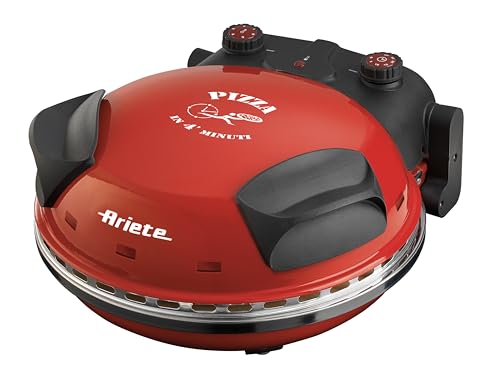
In the product photo the 909 is round and domed like a flat cupola, painted red, with two black handles on the left and right. At the back, two dials sit on a black base. Figure 1 of the manual names the parts: heating element (A), plate of heat-resistant stone (B), housing (C), handles (D), power button and temperature control (E), temperature indicator light (F), timer (G) and spatula (H).
It is operated like a domed waffle iron. You lift the upper part with both hands by the handles, place the pizza on the stone using oven gloves and close it again. The stone therefore sits below in the base, while the heating element sits in the upper part.
Ariete gives the external dimensions as 34 x 30 x 19 cm and the weight as 3.94 kg, or 4.63 kg in the box. Amazon lists the same dimensions. Because the body is round and the handles and control panel protrude at the sides and back, the 34 x 30 cm describe the space needed on the worktop, not the size of the stone.
There are two statements about the accessories that do not match. On its page, Ariete shows two stainless steel spatulas that you use to place the pizza on the hot stone, and the manual lists the spatula as part H. The Amazon title instead mentions a wooden board. A wooden board is not mentioned anywhere by Ariete itself. What is actually in the box is something we would check when unpacking.
In Detail: Fireclay Stone from Below, Heating Element from Above
Fireclay is a fired, refractory ceramic. It absorbs a lot of heat and passes it to the base of the dough through direct contact, considerably more strongly than a baking tray, which cools quickly as soon as cold dough lies on it. The top of the pizza, by contrast, gets its heat as radiation from the heating element in the lid. In such a flat, closed space the path between heating element and topping is short, and the promise of a short baking time rests on exactly that. That is the physics; how hot the stone and air in the 909 actually get has not been measured for us.
The rules that Ariete sets out in the instructions follow from this principle. You should not open the lid during cooking, because otherwise the heat escapes and the cooking time gets longer. The food must not touch the upper heating element, and the appliance must be fully closed during the cooking phase. Heavily loaded pizzas or a thick quiche base therefore hit a limit sooner than in a conventional oven.
Two more points concern the stone itself. Fresh dough must be dusted with flour on the underside, otherwise it sticks to the stone plate. And toppings that fall off (the manual names oil, cheese, tomatoes and mozzarella) should not get onto the plate, because the porous stone soaks them up and smoke and odours can then develop.
To make the stone easier to keep clean, Ariete has treated it with a transparent non-stick coating. According to the manufacturer’s page, it is meant to resist stains and residues. The manual qualifies this: over time the surface treatment can darken and develop stains and small cracks, without operation or baking quality suffering.
How Long Does a Pizza Take Including Preheating?
For the first homemade pizza, allow around 14 minutes: about 10 minutes of preheating on the highest level, then according to Ariete 4 minutes of baking time. A pizza from a baking mix, where you stir the dough yourself, takes 4 to 5 minutes according to the manual.
The process according to the manual is short. Plug in, switch on with button E and choose the temperature. Indicator light F is lit while the oven heats up and goes out “after a few minutes”. With timer G you set the baking time. Once it has run down, the timer sounds a warning tone, and you turn control E to “0” and pull the plug.
At one point the figures seem to contradict each other: the light signals readiness “after a few minutes”, but 10 minutes of preheating are recommended. We would stick to the 10 minutes. The manual does not explain what the light responds to, and a thick stone generally takes longer to heat through than the air above it.
More important than any minute is a sentence that the manual prints in capital letters: “The timer is not used to switch the oven on or off!” After the warning tone the 909 keeps heating until you turn it to “0” yourself. For recipes from a cookbook, according to the manual, simply follow what the recipe says.
Placement and Heat: What the Manual Requires
The German manual has 38 safety notes. For the question of where the oven may stand, these are the decisive ones, quoted here word for word:
- Note 4: “Place the appliance on a level and solid surface during use.”
- Note 26: “Place the oven on a work surface that can withstand a temperature of at least 90°C. Make sure that ventilation is not obstructed by objects.”
- Note 18: “Do not place the appliance on or near heat sources or electrical elements. Do not place it on other appliances.”
- Note 22: “The oven must not be built in or inserted into a piece of furniture.”
- Note 23: “Do not use the appliance near walls or curtains”
- Note 21: “Neither tea towels nor plates may be placed on the appliance.”
- Note 15: “The power cable must not hang over the edge of the table or surface. Avoid contact of the cable with hot surfaces.”
The manual does not state how many centimetres of distance to the wall are meant. The space under a wall cabinet or directly next to the hob is ruled out by notes 18 and 23. Whether your worktop can take the 90 °C is stated in its documentation. With a coated chipboard worktop, we would check before the oven heats up for the first time.
During operation, note 14 applies: “The appliance must not be moved during use.” Note 25 warns that the outer surfaces can become very hot, and note 16 refers to the stone: “Do not touch the baking plate while the oven is switched on and also immediately after switching off, as it stays very hot for a long time.” And note 36 requires: “This appliance must be supervised during operation.”
For households with children, note 8 says: “Keep the product and its supply cable out of the reach of children under 8 years.”
Cleaning the Stone as Ariete Describes It
Cleaning only happens once the plug is pulled and the appliance has cooled down completely. You remove baked-on residue with a scraper. “Avoid the use of abrasive and cleaning agents”, says the manual. You clean the outside of the appliance with a damp cloth, and the stone plate may also be wiped with a damp cloth. For the housing, plug and cable, note 9 applies, in capital letters: never immerse in water or other liquids.
For stubborn stains Ariete recommends baking soda powder, in this order:
- Stone cold, appliance disconnected from the socket.
- Open the upper cover.
- Remove food residue from the stone with a spatula.
- Moisten the stone with a sponge soaked in water.
- Put 1 or 2 large spoonfuls of baking soda powder in the middle of the stone.
- Spread it with the sponge over the stone, especially on the black stains, so that a paste of water and baking soda forms.
- Leave to work for about 5 minutes.
- Rub with the sponge, then remove residue and baking soda from the stone.
- Leave to dry.
Some stains may remain afterwards, which the manual calls normal. It also advises removing dust from the heating element and the base before every heat-up, as dust may have settled during the resting phase, and checking the stone plate for dust before use.
There is a tension in the manual that you should know about. The care section says the baking surface becomes darker after frequent use and shows stains and small cracks, without function or baking quality suffering. In the section on food contact, by contrast, Ariete requires you to check the product regularly for material deterioration, and lists “microcracks, blistering, delamination, shrinkage, stickiness, loss of transparency, corrosion or any other change in the structure or consistency of the material”. Where the normal small crack ends and the worrying change begins, Ariete does not specify. Our assessment: a hairline crack that does not grow is what the care section means. If the stone crumbles or the coating comes off in shreds, we would ask customer service. How to recognise the cause of a crack is covered in the guide Cracked pizza stone.
What Ariete Does Not State
These details are missing from the manual and the manufacturer’s page: the mains voltage (all that is required is that it matches the appliance voltage), the cable length, the material of the housing and lid, whether there is heating under the stone as well as the upper heating element, which temperature belongs to which of the 5 cooking levels, the longest timer time that can be set, the interior height of the cooking chamber and with it the largest pizza that actually fits within the frame, the exact heat-up time to 400 °C, whether the stone and spatula can be ordered individually as spare parts, the country of manufacture and the year of market launch. None of our sources mentions a turntable, so we assume you turn the pizza yourself when needed.
What Else Is Worth Considering?
| Model | The difference | Price | Our rating | Choose this if |
|---|---|---|---|---|
| Ariete Pizza Oven 909 (this one) | 1200 W, up to 400 °C, 5 cooking levels, stone 32 cm including frame, red | approx. €84 | 7.8 | you want a small electric oven for the kitchen and like red |
| Ariete Pizza Oven 917 | technically identical according to Ariete, black housing | approx. €83 | 7.6 | you want the same appliance in black |
| G3 Ferrari G10006 | 1200 W, thermostat up to 400 °C, stone 31 cm, aluminium peel 28 cm included | approx. €78 | 7.7 | you want to buy the pizza peel along with it |
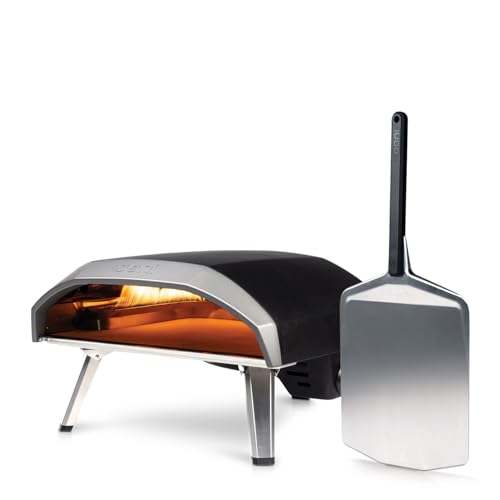
| Ooni Koda 16 | Gas, for outdoors, up to 500 °C, pizzas up to 40 cm | approx. €449 | 9.4 | you have a garden and a gas bottle and want to bake larger pizzas |
The prices are the guide values from our price boxes and change constantly at the retailers. The rating is our editorial classification of the manufacturer data, we have not measured anything on any of the four ovens.
The G3 Ferrari is the closest relative from a different manufacturer. For the G10006 (called Delizia Red in its own shop), G3 Ferrari likewise states 1200 watts and an adjustable thermostat up to 400 °C, plus a fireclay stone 31 cm in diameter, a 5-minute timer with a signal tone, and an aluminium peel 28 cm in diameter and a recipe booklet in the box. Whether the 31 cm includes a frame as with Ariete is not clear from the page, so the two stone sizes cannot be directly compared.
When the 909 Fits and When Another Oven Does
The 909 fits if you want to bake pizza in a flat without a garden and have a free, heat-resistant spot on the worktop, with distance from the wall, curtains and hob. It also fits if you have to put it away after baking: just under 4 kg can be lifted into a cupboard once it is cold.
It does not fit if you bake for four or more people and everyone wants to eat at the same time. Only one small pizza goes on the stone at a time. By our calculation, four pizzas are on the table after 26 minutes at the earliest (10 minutes of preheating, then four times 4 minutes), not counting topping and moving them, and the first one is cold by then. A gas oven such as the Ooni Koda 16, which according to Ooni handles 40 cm pizzas, is built for such gatherings. It costs approx. €449 with us, so €357 more, weighs 18.2 kg unpacked and belongs outdoors.
It also does not fit if you want to do something else in the meantime. Because the timer does not switch off, you have to be at the oven yourself after the warning tone.
That leaves the question of colour. According to Ariete, the black Ariete 917 is the same appliance and is in our price box at approx. €84, and the red 909 likewise at approx. €84. If you have no colour preference, then in our assessment you take whichever costs less on the day you buy. Undecided between an electric appliance and an oven for outdoors? The Grill Finder asks about space and fuel and narrows the choice down.