One cooking chamber, two ways to heat it
Alfonso Forni is based in Pace del Mela in the province of Messina in Sicily. On the German manufacturer page this oven is called “Gas-Holzofen Alfonso für 4 Pizzen (Hybrid)” (gas and wood oven Alfonso for 4 pizzas, hybrid), item number F4P-I-135-01; in the Amazon catalogue it runs under the part number “4 PIZZE IBRIDO”. Hybrid here means that the same cooking chamber is heated either by a gas burner or by wood burning directly in the oven. You choose the burner from the manufacturer as an LPG burner, as a natural gas burner or not at all, in which case it stays a pure wood oven. Alfonso names private use and small commercial businesses as the target group.
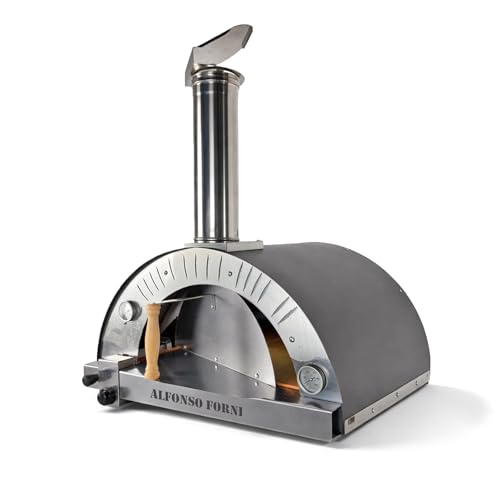
In the Amazon product image the roof is curved and anthracite-coloured, running front to back like a half pipe. An arch of bare stainless steel surrounds the opening, and above it, in the centre, stands the chimney with an angled chimney cap. On the front there are two round gauges, left and right, and below them a control knob on the left. No door is fitted in the photo.
Externally the oven is 82 cm wide and 42 cm high, and the chimney rises about 60 cm above that. On depth, the product page contradicts itself: the table says 90 cm, while the running text, technical drawing and brochure say 92 cm. We would plan with 92 cm, the value from three of four places. According to the manufacturer the oven weighs 100 kg. On Amazon it costs approx. €1,898 (as of October 2026), which puts it well above the three ovens we set beside it further down in our pizza ovens category.
Steel, fireclay, ceramic fibre: what the oven is made of
The load-bearing structure is AISI 304 stainless steel. The product page gives 2 mm thickness for it, the brochure a range of 2 to 4 mm. The other sheets vary between 3 mm and 0.8 mm depending on load; the manufacturer writes this in the Italian notation as 30/10 to 8/10. The outer roof is galvanised steel with an anthracite finish, and a polished stainless steel roof is available for an extra charge. As a second material, Alfonso lists steel with an epoxy powder coating.
The Amazon listing says AISI 430 in the same place. That is more than one digit. AISI 304 is an austenitic chromium-nickel steel with around 18 percent chromium and 8 percent nickel, while AISI 430 is a ferritic chromium steel with no significant nickel content. The second is cheaper, magnetic and more prone to surface rust outdoors. We go with AISI 304 because the manufacturer’s product page and brochure agree. If you want to check, take a magnet: it sticks firmly to 430 and barely at all to 304.
Baking is done on fireclay stones that are 3 cm thick, extra hard and food-safe according to the product page. They are made of Sorrento clay of the Casapulla type. Beneath them lies a 3 cm honeycomb structure of Skamotec, a calcium silicate. Here too there are three figures for one component: the brochure gives a 2 cm standard stone and the extra-hard 3 cm stone as an option, and Amazon says 2.2 cm. Which stone is in the Amazon listing cannot be read from the documents.
The difference matters in practice. A thicker stone stores more heat and releases it more evenly to the dough base when several pizzas go onto the same spot one after another. In return it takes longer to heat through.
At the top, the cooking chamber is insulated twice with ceramic fibre, 3 to 6 cm thick, with a density of 96 kg/m³ according to the construction sheet. Underneath, Skamotec and 3 cm of calcium silicate insulate. Amazon gives 30 mm of fibre at density 96, which corresponds to the lower limit of the manufacturer’s figure.
The cooking chamber itself measures approx. 60 cm in width and approx. 80 cm in depth. The product page gives the height as approx. 24 cm, the brochure as a maximum of 30 cm. With a curved roof this need not be a contradiction, since a maximum height is measured at the crown and another figure may be taken further out; this reading is not confirmed. According to the brochure the opening is 52 cm wide and at most 18 cm high.
In detail: gas burner and wood embers in the same vault
The gas burner sits in a drawer on the left side. According to the product page it is 670 mm long, has a diameter of 51 mm and an output of 30 kW; the brochure gives 678 mm. Further down on the same product page, in the accessories section, there is instead a 9 kW burner with a diameter of 41 mm. Which value applies to the Amazon listing, we cannot clarify. In favour of 30 kW, the brochure gives the same figure.
The burner is fitted with a thermocouple and safety valve. Such an ignition safety works in principle like this: the thermocouple projects into the flame and generates a small voltage that holds a solenoid valve open. If the flame goes out, it cools down, and the valve shuts off the gas supply. That is the general principle; Alfonso itself names only the two components.
To switch, you lift the burner drawer and set it down on its own holder. Its steel cover acts as a flame deflector in wood operation. In gas operation, an element with a valve sits at the flue outlet and closes the flue gas passage. For a wood fire it has to come out, because wood needs draught: the smoke should escape through the chimney with a diameter of 130 mm. A 50 cm flue pipe and the chimney cap are included in delivery.
For the wood fire, the operating manual gives three preparations: check that the flue pipe and chimney cap sit correctly, close the burner drawer, and remove the element with the closing valve from the flue outlet. Then dry wood goes in the middle of the cooking chamber. Once it has burned down to embers, you push the embers to the right, to the left or to the back. To hold them together, Alfonso recommends a flame protection bar.
In both modes you cook directly on a single level. According to the product page, the oven reaches 500 °C in approx. 5 minutes with gas and with wood alike.
Do four pizzas really fit?
On gas, according to the product page, yes: up to four standard pizzas at once. With wood it is fewer, because the fire needs space in the cooking chamber. The brochure from the same manufacturer, however, gives only up to two pizzas on gas.
The hourly output also differs. The product page promises 80 pizzas per hour on gas, the brochure approx. 60. Converted to the respective number of places, that would mean a full round every three minutes with four places, and every two minutes with two places. Both are plausible for 500 °C in the vault, but the two figures do not fit the same oven.
Our calculation, using the 60 × 80 cm footprint and two common pizza sizes: two pizzas of 30 cm diameter fill the width exactly, and two rows need 60 of the 80 cm depth. So four pizzas of this size fit, but rim to rim, with no room for the peel. At 35 cm, the maximum size that the Associazione Verace Pizza Napoletana sets for its pizza, only one fits across the width and two along the depth. Two pizzas is then the realistic number, which matches the brochure. Pizzas go in one at a time anyway, through the 52 cm wide opening.
Connecting the gas, lighting, converting
For LPG, a pre-calibrated pressure regulator is included, along with 1.5 m of blue rubber hose. The pressure the regulator is set to is not stated, and that matters especially for an oven from Italy. In Germany, 50 mbar is usual for outdoor LPG appliances, while other pressure levels are common in Italy. Before buying, we would ask the manufacturer in writing which bottle and which pressure the burner is designed for. What to watch for with bottle size and fill level is covered in our guide to the gas bottle for the grill.
Lighting is by hand. According to the manual, you press in the gas tap, turn it to the left and hold a long-shaft lighter as close as possible to the burner holes. You control the gas flow so that not too much gas escapes. A piezo or electric igniter does not appear in the manual.
Converting from wood to gas starts with cleaning. The manual requires you to clean the cooking chamber thoroughly of the remains of the wood fire, and recommends a vacuum cleaner for that. Twelve steps follow. They include: lift the cover, turn the holder 90 degrees to the right, unscrew the plug for wood operation, push the burner in as far as it will go and screw it down with the securing bracket. Finally you connect the LPG bottle, with a new seal, as the manual states explicitly. This is not something for switching between two pizzas, more for switching between two evenings.
According to the Amazon listing, you can place the oven under a canopy or on a veranda in gas operation, and in the garden in wood operation. Before choosing such a spot, check how much air remains between the chimney cap and the roof surface; the chimney ends about 60 cm above the oven roof.
Cleaning, maintenance and safety according to the manual
The manual for the hybrid ovens exists only in Italian; we have translated the following points.
After wood operation, you should remove the ashes from the cooking chamber regularly and clean the accumulated soot from the steel vault. According to the manual, the cooking chamber cleans itself through the high temperatures. After gas operation, you clean the burner and its surroundings thoroughly after every use and remove food and grease residues from the cooking chamber.
For LPG operation, the manual names five maintenance points. Check the flue pipe and chimney cap regularly for damage. Replace the rubber gas hose every two years. Check the hose and clamps regularly. Check the seal between the bottle and pressure regulator. And remove the soot from the steel vault. If the oven is not used for a longer time, an oven cover should protect it from the weather, and the gas burner belongs in a dry place.
On safety, the manual contains a single general sentence: one should always pay the greatest attention to one’s own safety. What otherwise applies generally to gas and open fire is not a requirement from Alfonso but a general rule: after every bottle change you check the connections with leak-detection spray. Gas and wood fires produce carbon monoxide and therefore do not belong in enclosed spaces. You keep your distance from wood, awnings and house walls, and children do not belong near an oven that reaches 500 °C inside. If your stone cracks, our guide cracked pizza stone helps with the question of whether it is still usable.
Open points before buying
Some details are missing in all the documents we found, that is, on the German and English product pages, in the drawing, construction sheet, brochure and manual: gas consumption in grams per hour and wood consumption; the time until the stone has reached baking temperature (the 5 minutes refer to 500 °C in general); minimum clearances to combustible materials, a statement on balcony, indoor use or outdoor-only operation, a carbon monoxide warning and a section on intended use; instructions for leak-testing the gas connection; a commitment on spare parts supply, even though the burner and options are listed individually as accessories; shipping weight and shipping terms to Germany. In addition, the manufacturer pages do not link to an Amazon listing. The assignment of the Amazon item to this model rests on the dimensions in the catalogue (converted approx. 42 × 90 × 82 cm) and the part number.
What else comes into question?
| Model | The difference | Price | Our score | Choose this one if |
|---|---|---|---|---|
| Alfonso Forni hybrid pizza oven (gas & wood) (this one) | Gas or wood, 60 × 80 cm chamber, 100 kg | approx. €1,898 | 8.5 | you bake regularly for big groups and have a fixed spot |
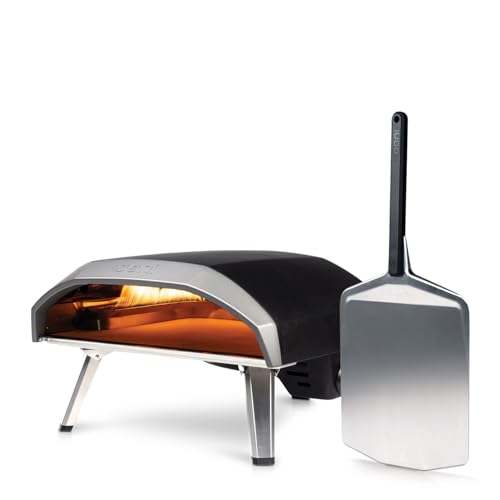
| Ooni Koda 16 | gas only, 16 inch surface for one pizza, 18.2 kg | approx. €449 | 9.4 | you bake one pizza after another and want to put the oven away after the evening |
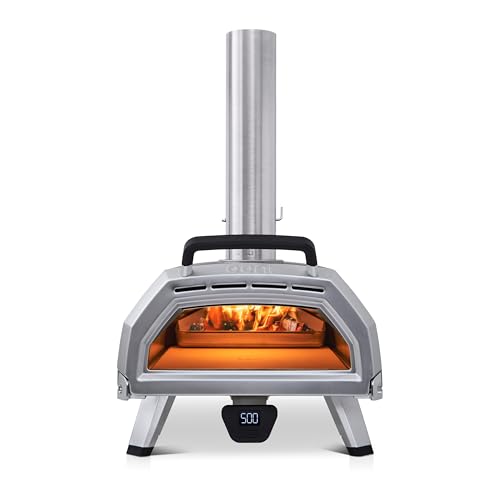
| Ooni Karu 16 | wood and optional gas, 425 mm cooking surface, 28.4 kg | approx. €559 | 9.2 | you want to bake with wood but have no fixed spot for 100 kg |
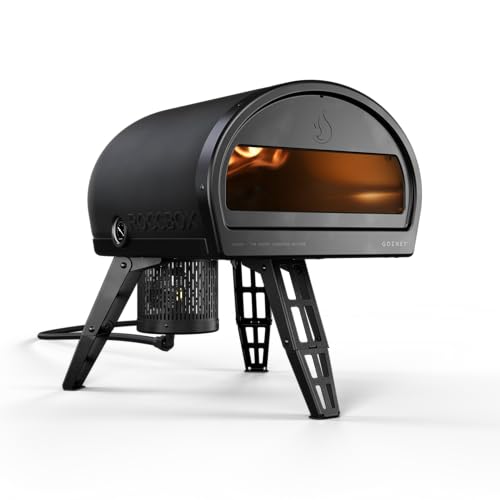
| Cozze 24 inch gas pizza oven Black Edition | gas only, 60 × 60 cm stone, three burners, no chimney | approx. €477 | 8.4 | you want two pizzas at the same time and can do without a wood fire |
The prices are guide values from our price box, and for the Koda 16 the price at Santos Grills; they change constantly. The score is our editorial assessment from data sheets; nobody measured it.
When the Alfonso is worth it, and for whom it is not
The first question is group size. If you bake for four to six people, an oven for one pizza works well, as the wait per pizza is then short. The Alfonso only plays out its surface area when ten or more people regularly sit at the table and you want to slide in two pizzas at the same time. That is our assessment, not a manufacturer figure.
The second question is space. You do not carry 100 kg into the garage after dinner. You need a permanent spot and underneath it a table, a wall or the manufacturer’s rolling trolley. With the chimney, the oven reaches a good metre in height above its base, which gets tight under a low pergola.
Third question: how often do you want to change fuel? If you fire up with wood one evening and want to bake quickly with gas the next, you first have to vacuum out the cooking chamber and fit the burner. If you want almost only gas, the Cozze 24 inch gives you two pizzas of surface without this conversion. The Cozze costs approx. €477, the Alfonso approx. €1,898; for the higher price you get the wood fire and 20 cm more depth with the Alfonso.
The fourth question is budget. On top of the approx. €1,898 come a gas bottle, an oven cover, which the manual provides for longer breaks, a peel and, if needed, a pyrometer and door. If you want to bake with wood but shy away from this sum and the weight, you end up with the Ooni Karu 16, which at 28.4 kg is still portable.
The wrong choice, the Alfonso is for anyone who rents a flat with a balcony, and for couples who bake pizza twice a month. In the first case, the tenancy agreement and house rules govern whether an open wood fire is allowed, and whether a balcony slab can bear 100 kg of oven plus base is something the landlord knows, not the oven manufacturer. In the second case, you are heating a 60 × 80 cm stone floor for two pizzas. If you are still unsure about fuel and oven size, the grill finder helps narrow it down, and how pizza works on a gas, kettle or kamado grill is shown in our guide pizza on the grill.