The larger Pulse, built for the table
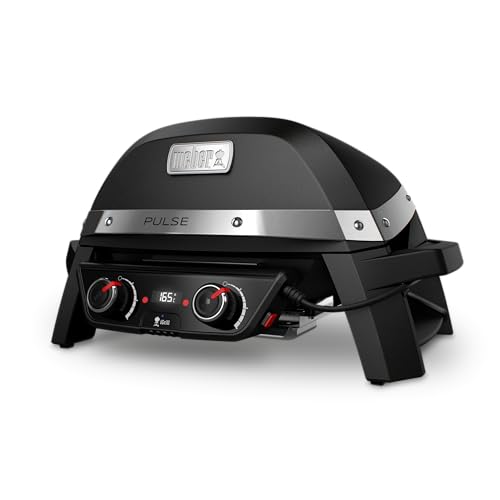
The Pulse 2000 is an electric grill that you put on a table. Under its domed lid are two heating zones, and each has its own control knob at the front of the controller. Weber’s German user manual 59529 from April 2022 covers it together with the smaller Pulse 1000, and it describes grilling in two temperature zones explicitly only for the “2000 series”. In our electric grills category, we put it at approx. €578 (as of September 2026).
The Amazon listing carries Weber article number 82010079. The same number appears in the manual’s declaration of conformity, and in Weber’s range it belongs to the tabletop unit without trolley. Amazon calls the version “Black Edition”; on the Weber pages the colour is simply called black.
You can no longer find the grill on weber.com/DE. Both German product addresses for the Pulse 2000 redirected to the electric grills overview on 25 September 2026, and only the Pulse 1000 remained in the Pulse category. Our technical details therefore come from the manual and from Weber’s Swiss and Irish product pages, which list the same values.
Housing, grate and controller
The lid and housing are cast aluminium, the lid trim is aluminium, and the two handles are glass-fibre-reinforced nylon. In our product image, the grill stands on angled legs; it has no wheels. Closed, it is 39 cm high, 71 cm wide and 60 cm deep; with the lid open it grows to 77 cm in height and 76 cm in depth. According to Weber, it weighs 19.6 kg.
Weber states the power as 2,200 W, and the grill is designed for 220 to 240 V at 50 or 60 Hz. You grill on 49 × 39 cm, which works out at 1,911 cm², and according to Weber up to six steaks fit on it at once. The grates are made of porcelain-enamelled cast iron; the assembly illustration for the two-knob model shows two grate sections. With these grates, Weber distinguishes the Pulse in an article from electric grills that sear the food directly on the element. According to the manual, a whole chicken or a roast fits under the lid.
Under the grates sits the heating element assembly. It is fixed at the front with thumbscrews and can be removed for cleaning, as can the lower cook box liner at the bottom of the grilling chamber. Whatever meat juice and marinade does not evaporate runs into a disposable drip tray. This sits in the grease tray under the chamber, and you pull that out towards the front. According to the parts list, one of each is included, so the two zones share one collection system.
The electronics are in the temperature controller, which you push straight into its holder at the front. It carries the two knobs, an LED display for the grill temperature, red status lights, a blue light for Bluetooth and, on the right, the red on/off button: pushed in means on, protruding means off. A residual-current circuit breaker is also built into the controller. You route the mains cable under the right handle and secure it in the cable clamp on the right leg, from where it runs to the rear. When the grill is not in use, you remove the controller and store it in the supplied box indoors.
In detail: two zones, one display
The knobs have three ranges. According to the manual, LOW covers 93 to 149 °C, MEDIUM 176 to 232 °C and HIGH 260 to 316 °C. Weber’s Swiss page speaks of a digital precision temperature control that measures the temperature inside the grill and adjusts it automatically as needed.
Page 11 contains the sentence that matters most when grilling with two temperatures: the controller shows “the average temperature inside the grill and not the temperature of the individual zones”. If HIGH is running on the left and LOW on the right, then as we understand it the display shows an average that applies to neither side. For the food on the cooler side, the meat probe is then more reliable.
For two foods with different cooking times, Weber specifies a procedure. You turn both knobs to HIGH, preheat to 260 °C and brush the grates with a stainless steel grill brush. Then you set both knobs to the temperature of the food that takes longer and put it on the left. Ten minutes before the second one is added, you set its cooking temperature on the right knob and wait until it is reached. Preheating is always done on the highest setting, even if a recipe calls for MEDIUM or LOW.
You grill indirectly differently on the Pulse than on a gas grill. On a gas grill, one burner stays off for indirect heat and the meat lies over the switched-off side, as our guide to direct and indirect heat explains. Weber’s manual describes a different route for the Pulse: preheat, then reduce the heat by turning the knob or knobs to the middle position, and place large food such as a whole chicken or a roast horizontally in the centre of the grill. Both zones keep heating at a reduced level, and the meat lies in the middle, that is, where they meet.
According to the manual, you grill directly with the lid closed and turn the food only once during cooking. With the lid closed, the grate is hotter, cooking times are shorter and the smoky aroma is stronger; that is also stated there. In one article, Weber describes how the space between heating element, food and lid fills with smoke. According to the manufacturer, the Pulse is therefore not smoke-free either.
Can the Pulse 2000 be controlled via an app?
According to the manual, no. Weber’s iGRILL app, which the manual and the Amazon description mention, shows the core temperature of the food and the grill temperature via Bluetooth, sets timers and provides grilling guides. You set the heat on the two knobs on the controller.
In the app, you create your own grilling guides or choose existing settings, and there you also decide whether the controller displays Celsius or Fahrenheit. Earlier versions of this page mentioned a Weber Connect app; the manual and the Amazon description make no mention of it, and we have corrected that. The declaration of conformity describes the device as an electric grill for outdoor use “with iGRILL-3”.
Two meat probes are included, and the controller has four ports. According to Weber, you can thus monitor up to four pieces of meat at once; for the third and fourth you need additional probes. You route the cables through the side opening on the grill so that the lid can close properly. The probe cable must not be exposed to flames or temperatures above 380 °C, and the probes should also avoid cold below minus 30 °C. The app only shows values between minus 30 and 300 °C; outside that range, the connection to the probe drops. In our assessment, exactly that can happen on HIGH if a probe hangs freely in the cooking chamber next to the meat, because HIGH goes up to 316 °C.
The signal transmits between 2,402 and 2,480 MHz, and Weber describes Bluetooth as a radio signal “for short distances only”. The controller is only ever paired with one mobile device: if the blue light is on continuously instead of flashing, another one is already connected.
Three alternatives from our catalogue
| Model | The difference | Price | Our rating | Choose this one if |
|---|---|---|---|---|
| Weber Pulse 2000 (this one) | two zones with one knob each, 49 × 39 cm, tabletop unit without wheels | approx. €578 | 9.2 | you often cook meat and a side dish at different temperatures at the same time |
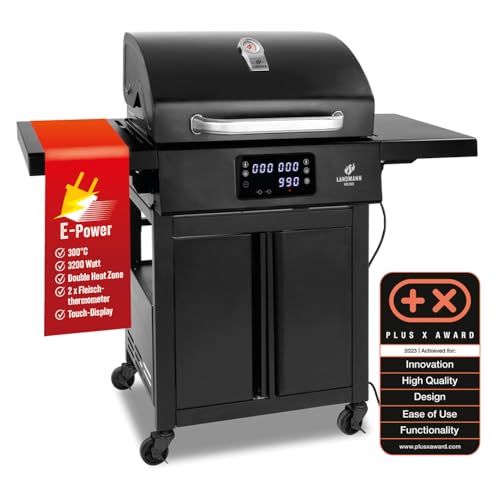
| Landmann EG-II-590 | grill trolley on four lockable castors, 59 × 40.5 cm, 100 to 300 °C per side in 50 °C steps | approx. €550 | 9.4 | you do not want to provide a table as a base and have a good 1.2 m of width free |
| Weber Pulse 1000 | one heating zone with one knob, 41 × 31 cm | approx. €380 | 8.9 | you almost always prepare just one food at one temperature |
| RÖSLE Videro E2-P | rotary knob with digital display and timer, stainless steel grate 39 × 32.5 cm, lid with glass insert | approx. €390 | 8.7 | you rarely grill for more than four people |
The prices are guide values from our price boxes; the respective shop shows the current price. The ratings are editorial assessments from the data comparison and are not based on any measurement; the details on Landmann come from its instructions, those on Rösle from roesle.com, retrieved on 25 September 2026.
When the Pulse 2000 suits you and when another grill does
First, the location. The manual requires a level, heat-resistant surface, and within 61 cm of all outer edges there must be no combustible materials. With the lid closed, that gives a clear zone of roughly 1.93 × 1.82 m; the open lid extends it by 16 cm in depth. By our reading, a wooden table is ruled out, because it would itself stand within those 61 cm. You keep at least 3.05 m away from bodies of water such as a pool or pond. Because sustained wind lowers the temperature in the grill, you position it so that the wind blows against the front.
For the balcony, one warning with the signal word DANGER matters most: “Use the grill only outdoors in a well-ventilated area. Do NOT use the grill in garages, buildings, covered passageways, tents, other enclosed areas or under combustible structures.”
According to a Weber article, the Pulse can also be used where gas and charcoal grills are not allowed, which it says is often the case on city balconies. Whether your tenancy agreement or house rules permit an electric grill is not answered there; the manual merely requires you to observe all locally applicable guidelines and regulations. Our guide to grilling on a balcony summarises what landlords may prohibit.
The electrical requirements are strict. The Pulse belongs on an earthed socket, plug adapters are taboo, and it must be connected via a residual-current device (RCD, in German an FI-Schalter) with a rated residual current of no more than 30 mA. The wattage of the socket must not be exceeded. At 230 V, it draws just under 9.6 A at full load by calculation. On a 16 A circuit, as is usually fused for sockets in flats, that leaves a good 6 A for everything else, so just under 1,500 W. Where you do not know what else is on the circuit, that speaks in favour of the Pulse in our view, because with the Landmann EG-II-590 from the table, at up to 3,200 W, only a good 2 A, just under 500 W, would remain on the same circuit.
Then the question of the second zone. The Weber Pulse 1000 has one zone and one knob. According to Weber, it grills on 41 × 31 cm, roughly 1,271 cm²; the Pulse 2000 has about half as much area again. In our price boxes, the Pulse 2000 is about €198 above the Pulse 1000, and we would only pay that premium if you use the second zone regularly.
The Landmann EG-II-590 costs €28 less than the Pulse 2000 in our price box, has roughly a quarter more cooking surface and stands on its own castors; in return, it is 121.5 cm wide. Rösle designs the RÖSLE Videro E2-P electric grill for one to four people, and it is €188 below the Pulse 2000.
Accessories come on top of the grill price. In the German Weber shop on 25 September 2026, the Premium cover 7140 for the Pulse 2000 was listed at €39.99, though it could not be ordered there, and disposable drip trays (article 6415) at €5.99 for a pack of ten. At the start of each grilling season, Weber also recommends a new stainless steel grill brush.
Cleaning, care and safety according to the manual
According to Weber, the grease collection system should be cleaned every time you grill, to prevent grease fires. You switch off the grill and let it cool down, disconnect the temperature controller and pull it off, pull the grease tray out towards the front, check the disposable drip tray and replace it if necessary, then put everything back in. Before each use, you also check the tray for grease residue and remove excessive build-up. You handle hot grease carefully when removing and disposing of it.
For the grill brush used to brush the grates after preheating, there is a separate warning: Weber requires you to check it regularly for loose bristles and excessive wear, and to replace it as soon as loose bristles appear on the grate or in the brush. No metal brush goes near the heating elements; food residue on them is supposed to burn off during preheating.
A thorough clean is due after every fifth grilling session at the latest, more often with continuous use. Beforehand, you switch off the grill, wait until it has cooled down completely, disconnect it from the power supply and remove the controller. The lower cook box liner is dishwasher safe; warm soapy water works too. Take care not to bend it, and do not operate the grill without it. You also remove the heating elements for cleaning, without bending them. According to Weber, paint-like flakes on the inside of the lid are carbon deposits from vaporised grease and smoke. They are non-toxic but, if cleaning is infrequent, can fall onto the food, and you loosen them with a plastic scraper.
You never immerse the temperature controller, cables, plug, probes or the grill itself in water or other liquids, and you do not spray any liquid into the inside of the grill, both because of the risk of electric shock. A damp microfibre cloth is enough for the cooled controller, without cleaning agents or brushes that scratch the surface; glass cleaner never goes on plastic surfaces, as it damages the surface according to Weber. You clean the probes before first use; after that, you wipe them down once cooled with a damp towel or a wet wipe. They are not dishwasher safe and not waterproof, and they are stored with the controller in its box.
Unsuitable for cleaning the grill are abrasive stainless steel polishes or paints, acidic cleaning agents, white spirit or xylenes, oven cleaner, abrasive cleaning agents (kitchen cleaner) and abrasive cleaning pads. The exterior is made, as applicable, of aluminium, stainless steel and plastic. For stainless steel, Weber names a degreasing cleaner and a microfibre cloth, wiping in the direction of the grain, then rinsing clean and drying; bleach and chlorinated cleaners stay away. Painted surfaces and plastic get a degreasing cleaner, are rinsed and dried.
In a grease fire, you close the lid, switch the on/off button to the OFF position and disconnect the grill from the mains. The lid stays closed until the fire has gone out, and you use no liquids to extinguish it. Why water on burning grease is dangerous is explained in our guide on preventing grease fires.
While preheating and grilling, you never leave the Pulse unattended, because the entire grilling chamber heats up, and it must not be moved while in operation. For handling, Weber requires heat-resistant grill gloves with a contact heat resistance of level 2 or higher according to DIN EN 407 (a standard that applies in Germany and the EU). Charcoal, briquettes, liquid fuel and lava rocks are expressly unsuitable for this grill. When connecting, you first plug the controller into the grill and then the plug into the socket; you pull at the plug, never at the cable.
Spare parts, warranty and what remains open
According to the manual, you can get spare parts through your local retailer or via weber.com. However, the German Weber category “Spare parts for electric grills” listed only heating elements and grates for the Q series on 25 September 2026. Only original spare parts from Weber-Stephen are approved for repair and replacement, otherwise the warranty claim lapses.
Weber describes the warranty as voluntary and free of charge. It applies for five years from the date of purchase for material and workmanship defects, provided you assemble and operate the grill according to the manual, and the Swiss product page relates it to all components. Geographically, it covers Europe, the Middle East and Africa, and personally only the first buyer; it is transferable only in the case of a gift or a promotion. You do not have to register the grill for it, but Weber considers registration on weber.com advantageous.
Excluded is normal wear, which Weber describes as cosmetic or otherwise insignificant deterioration, for example rust on the surface, dents and scratches. Significant defects are covered: certain components rusting through or burning through, and other damage or malfunctions that make safe or proper use impossible. If you live in a coastal region or the grill stands near a pool, regular cleaning and rinsing of the outer surfaces is part of the maintenance that Weber presupposes. The manual lists the causes that void the warranty on page 4 in a separate list, which you should read before setting up. According to Weber, the warranty in no way limits your statutory rights in the event of a defect.
These details are missing from the manual, the Weber pages and the Amazon catalogue:
- how the power is split between the two zones and how many heating elements are fitted
- a heat-up time for MEDIUM and LOW
- the power consumption of a grilling evening in kWh and the length of the mains cable
- ingress protection rating (IPX) and protection class
- the material of the heating elements, cook box liner and grease tray
- the interior height under the lid in centimetres and a number of people
- whether the grill may stand in the rain or be left outside over winter
- Bluetooth range in metres and measurement accuracy of the probes
- how much smoke is produced during operation
- country of origin, assembly time and year of market launch; the manual carries only a copyright notice from 2018
- side tables, since for the tabletop unit Weber describes only the two handles, and a separately available trolley in the German Weber shop
Amazon’s catalogue differs on the dimensions; converted, it lists roughly 39 × 39 × 60 cm and 20.5 kg. On this page, the Weber values apply.
Who Weber intends the Pulse 2000 for
The limits are in the manual, spread across several warnings. The Pulse 2000 is intended exclusively for household use outdoors, not for indoor use or commercial use, and you do not use it as a heater. It is unsuitable for installation in or on caravans or boats, you do not build it into an integrated or slide-in structure, and you do not use it in a vehicle, in a boot or on a loading area.
When it comes to who may use it, Weber is stricter than Landmann. According to the manual, the Pulse must not be used by children or by people with reduced physical, sensory or mental capabilities, whereas the instructions for the Landmann EG-II-590 allow children from 8 years if they are supervised or have been instructed in safe use and understand the hazards. With the Pulse, children must be supervised so that they do not play with it, and because accessible parts can become very hot, you keep children and pets away.
If you rent in a multi-family building, you should know one sentence from the warranty terms. The voluntary warranty applies only to products used privately and not to Weber grills “used commercially, at municipal level or in multi-party buildings, such as by restaurants, hotels, resorts or in rental properties”. How Weber interprets that for a privately used grill on the balcony of a rented flat is not clear from the text. It is best to ask Weber customer service about it before buying.