The Weber Pulse 1000 is an electric grill for the wall socket: 1,800 W, no gas, no charcoal. This page belongs to the Amazon ASIN B07FDC6GZN. Amazon lists part number 81010079 and the edition “Black Edition” for it; the same number appears as the item number on Weber’s own product page. According to the catalogue data, it is therefore the same device that Weber itself sells. The word “deal” in the title refers only to this Amazon listing.
We have not handled the grill and have not grilled anything on it. The details come from Weber’s product, warranty and accessory pages, from the operating instructions for the Pulse 1000 and 2000 (20 pages, which we call the manual) and from the Amazon catalogue. Our own calculations and conclusions are marked as such.
Our catalogue lists the Pulse 1000 a second time, with a different ASIN: Weber Pulse 1000. There Amazon gives part number 81010053. Weber’s declaration of conformity names a shared list of 24 model numbers for all four Pulse models (Pulse 1000, Pulse 1000 with stand, Pulse 2000, Pulse 2000 with cart), including 81010053 and 81010079, without assigning them to a model name. No manufacturer text shows how the two Pulse 1000 listings differ. This listing was approx. €380 on Amazon on 6 October 2026.
Construction and materials
According to Weber, the body and lid are made of cast aluminium and the lid cladding of aluminium; it is meant to keep the temperature in the cooking chamber even. The lid handle is stainless steel, the two carry handles are glass-fibre-reinforced nylon.
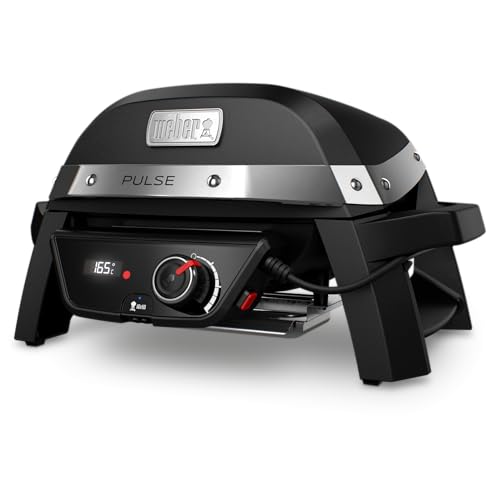
With the lid closed, the grill is 33 cm high, 61 cm wide and 54 cm deep; with the lid open, 68 cm high and 65 cm deep. Converted, the Amazon catalogue dimensions match the values with the lid closed. On weight, the sources differ by around 6 kg: Weber states 13.92 kg, the Amazon catalogue 43.87 pounds, converted around 19.9 kg. The product photo shows the grill on short legs, without a cart; stand and cart are separate versions at Weber with their own assembly instructions and are not in this grill’s parts list.
The grill is operated with a dial with the positions Off, Low, Medium and High and a red on/off button which, according to Weber, has an integrated safety mechanism. The electronic temperature controller sits on the front control panel and can be removed; when not in use, it is meant to be kept indoors in the supplied box. Instead of an analogue thermometer there is an LED display for the grill temperature. You set in the app whether it shows Celsius or Fahrenheit.
The grates are porcelain-enamelled cast iron. Weber lists heat retention and the sear pattern as advantages, and according to the manual the cast iron lets the grill heat back up quickly after the lid is opened. The whole cooking area measures 41 × 31 cm.
In detail: one heating zone, three settings, preheating
The dial has no degree scale, but three ranges. According to the manual (page 11), Low is 93 to 149 °C, Medium 176 to 232 °C and High 260 to 316 °C. Weber gives the maximum temperature three times with a different figure: the product page speaks of an even temperature above 300 °C, the feature description of automatic adjustment up to 315 °C, the manual of up to 316 °C on High.
Before the very first grilling, the manual requires a burn-off: at least 20 minutes with the lid closed on the highest setting. Before every later grilling too, you preheat on High, even if the recipe calls for medium or low heat; otherwise, according to the manual, the food sticks to the grate and the sear pattern is missing. The grill counts as preheated at 260 °C. Depending on ambient conditions, that takes 15 to 20 minutes. Those conditions include wind: sustained wind lowers the temperature in the grill, Weber advises positioning it so the wind blows against the front, and mentions longer cooking times at low temperatures or at higher altitudes. Once the selected temperature is reached, the controller beeps briefly and the status lights stay on; until then a red light flashes.
For direct heat the sequence is: knob to High, preheat to 260 °C, brush the grates, set the temperature for the recipe, put the food on, close the lid. Turn the food only once, and the lid opens only for turning and for a check at the end of the cooking time. For indirect cooking, you proceed like this: also preheat to 260 °C, brush the grates, turn back to the middle position and lay large food such as a whole chicken or a joint flat in the centre. According to the manual, the lid is high enough for this.
The Pulse 1000 has no separately controllable second zone. Two-zone grilling, where one side sears and the other cooks gently, is described in the manual explicitly only for the Pulse 2000; here there is one control knob. If you follow the manual, you also cover at most three quarters of the grate: it advises leaving at least a quarter free and leaving space between the food.
Are 1,800 watts enough for steaks?
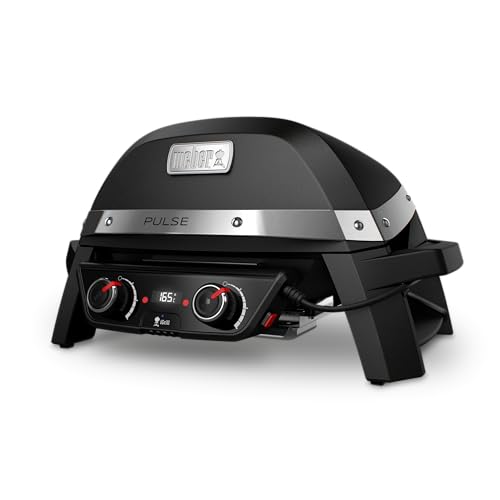
There is no documented answer. Weber describes the grill for up to four steaks and names the High setting at 260 to 316 °C, but neither a grate temperature nor a searing output. Among the three alternatives on this page, the Pulse 1000 has the lowest wattage.
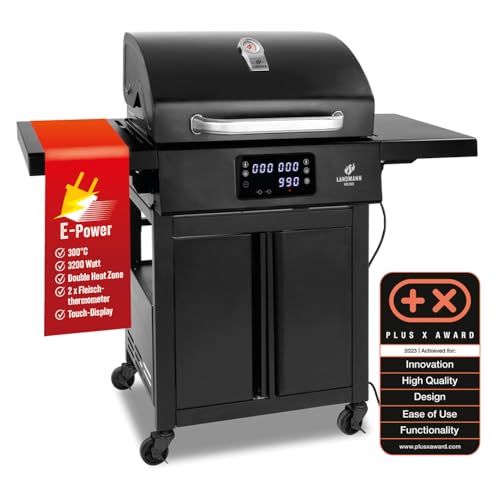
According to the manual, the Pulse 2000 reaches 2,200 W. The Enders eFLOW PRO 2 TURBO has 3,000 W and a TURBO ZONE which, according to Enders, delivers extra-high temperatures for searing at the push of a button. The Landmann EG-II-590 states 100 to 300 °C, measured at the grill grate; it delivers a maximum of 3,200 W and has two independently controlled heating elements.
Watts state how much power the device draws. How hot the grate gets also depends on the body, lid, grate and control. As the lid’s most important job, the manual names keeping air out and heat in: with the lid closed, the grill grate is hotter and cooking times are shorter.
iGrill: probe, app and measuring range
According to Weber, the iGrill technology is integrated into the grill; the probe inputs are on the front of the controller. Two connections are provided, and one meat temperature probe is supplied.
The manual lists these app functions: monitoring several probes at once, setting timers, following the temperature remotely, creating your own grilling guides or choosing existing settings. The grilling guides contain rough cooking times and grill settings. On the product page, Weber writes that the iGrill technology can be controlled via app. The manual describes Bluetooth as a short-range radio signal; as places for remote monitoring, it names the other end of the garden and the kitchen.
According to the instructions, you insert the probe at least 10 mm deep into the centre of the food. For poultry it goes into the thickest part of the thigh or breast, away from the bone; for thick, flat cuts it goes in from the top or the side into the centre. The cable runs through the side feed-through on the grill so the lid can close, and neither probe nor cable may be exposed directly to the hot grate. The app shows values between -30 and 300 °C; below and above that, the connection to the probe drops. The cable must not be exposed to flames or to temperatures above 380 °C. Target core temperatures for poultry, beef and pork are in our core temperature chart.
Setup, power and safety according to the instructions
Here we reproduce the safety section of the manual (page 3, “Safety, installation and operation”) as close as possible to the wording of the instructions, sorted by topic.
- Where to place it: Weber marks two points as DANGER. The grill may only be used outdoors in a well-ventilated area, not in garages, buildings, covered passages, tents, other enclosed areas or under combustible structures. And it is not suitable for charcoal, briquettes, liquid fuel or lava rocks.
- Purpose: The grill is intended exclusively for household use outdoors, not for indoor use, not for commercial use and not as a heater. You should use it only as the manual describes; improper use can lead to fires, electric shocks or injuries, and the manufacturer and specialist retailers are not liable for damage from improper use. It must not run in vehicles, boots or cargo beds (cars, lorries, estate cars, minivans, SUVs, caravans, motorhomes, boats). It is not suitable for installation in or on caravans and boats, and does not belong in a built-in or slide-in structure.
- Clearances and ground: Within 61 cm around the grill, nothing combustible may stand during operation, measured from all outer edges, and within 3.05 m there must be no body of water such as a swimming pool or pond. No flammable gases and liquids (for example petrol or alcohol) and no other flammable materials may be in the grilling area. The ground must be level and heat-resistant.
- Socket: The grill is only connected to an earthed socket, without a plug adapter and not to a damaged socket. It must be on a residual current device (RCD) with a rated residual current of at most 30 mA. The mains voltage must match the value on the device sticker, and the socket’s wattage must not be exceeded. The temperature controller goes onto the grill first, then the plug into the socket; you pull on the plug, never on the cable.
- Extension cable and wiring: An extension cable only if necessary, and only one suitable for outdoor use with a Schuko plug and 1.63 mm conductor diameter on an earthed socket. It should be no longer than 4 m and no longer than absolutely necessary; a damaged extension cable is not used, it must not be a trip hazard, the connections stay dry, and local guidelines and regulations apply. Electrical cables stay away from heated surfaces and are laid so that nobody pulls on them or trips over them. You check cable and plug regularly; if either is damaged, the device is not used.
- Impacts and water: The controller must not be dropped or exposed to strong impacts; if the device has been dropped or does not work properly, it stays off. Controller, cable, plug, probe and grill do not belong in water or other liquids, and nothing is sprayed into the inside of the grill (risk of electric shock).
- Operation: During preheating and grilling, the grill is never left unattended, because the entire cooking chamber heats up, and it is not moved during operation. Accessible parts can be very hot; children and pets stay away, and children are supervised so they do not play with the device. Children and people with reduced physical, sensory or mental capabilities must not use the device (as per the note on the iGRILL technology). Alcohol, medication or drugs can impair the ability to assemble, move, store or operate the grill safely. When handling the grill, you wear heat-resistant grilling gloves with contact heat resistance level 2 or higher under DIN EN 407 (a standard that applies in Germany and the EU).
- Probes: The probes are very sharp (risk of injury). Their coloured markings are not heat insulated and must not be touched with bare hands while grilling; protective gloves are mandatory.
- Grease fire: Close the lid, set the on/off button to OFF, disconnect the grill from the mains and keep the lid closed until the fire has gone out. Do not use liquids to extinguish it.
- Storage and assembly: Before moving, cleaning or storing, the grill cools down. You remove the temperature controller when not in use and store it indoors, and the grill is only covered once it has cooled completely. It is only operated with all parts in place and assembled according to the assembly instructions. Modifications void the warranty claims, parts sealed by the manufacturer are not opened or altered, and no part of the grill is covered with foil, because that can impair performance.
Our reading: if you grill under a balcony ceiling or an awning, you need to clarify whether the spot still counts as well-ventilated outdoors and free of combustible structures above. The manual gives no measurement for the height or depth of an awning; more on balconies is in our guide Grilling on a balcony.
Cleaning, accessories and warranty
Before thorough cleaning, you switch the grill off, let it cool down completely, disconnect it from the power and remove the controller. It should be cleaned thoroughly after every fifth grilling at the latest, and more often if used constantly. You brush the grate with a stainless steel grill brush immediately after preheating, because according to the manual residues act like glue. You check brushes for loose bristles and replace them if you find any; Weber recommends a new stainless steel brush at the start of each season.
The grease management system guides grease away from the food into the disposable drip tray in the removable grease tray and, according to the manual, reduces the risk of flare-ups. It should be cleaned at every grilling. Before each use you check the tray for grease residue and remove excess grease to avoid a grease fire; the disposable drip tray is discarded and replaced if there is grease residue. Take care when removing and disposing of hot grease. More on prevention is in our guide Grease fires on the grill.
The removable cookbox lining is dishwasher safe and can also be cleaned with warm soapy water; it must not be bent, and the grill must not be operated without it. No wire brush goes on the heating elements; you burn off food residue during preheating. To remove an element, you undo the wing screws at the front, slide the element back, do not bend it and tilt it upwards; when refitting, you do not overtighten the screws, and Weber recommends gloves. According to the manual, paint-like flakes on the inside of the lid are carbonised grease and smoke and are non-toxic; a plastic scraper removes them, otherwise they fall onto the food.
You wipe the controller after cooling with a damp microfibre cloth, without cleaning agents or brushes that scratch the surface, and never with glass cleaner on plastic surfaces. For the probe, the wording of the instructions applies: clean before first use, wipe with a damp towel or wipe. The probes are not dishwasher safe and not waterproof, must never be immersed in water, and the cable and connection area must not get wet. When not in use, you coil the probe carefully and store it together with the controller in the storage box.
According to the manual, the following are not suitable for cleaning the grill: abrasive stainless steel polishes or varnishes, acidic cleaning agents, white spirit or xylenes, oven cleaner, abrasive cleaning agents (kitchen cleaner) and abrasive cleaning pads. On stainless steel you use no bleach and no chlorinated cleaning agents; abrasive pastes change the colour of the metal because they remove the top chromium oxide layer. You wipe stainless steel with a degreasing cleaner and a microfibre cloth in the direction of the stainless steel grain, not with kitchen paper, rinse with clear water and dry thoroughly. Painted surfaces and plastic parts also get degreasing cleaner, clear water and thorough drying. In harsh environments with acid rain, swimming pool chemicals or salt water, you clean the outside more often and prevent rust with a weekly stainless steel cleaner.
Accessories by the prices on weber.com of 5 October 2026: disposable aluminium drip trays (item no. 6415), 10 for €5.99, fitting the Q, Pulse, Lumin, Traveler, Spirit and Genesis series. The grill brush (item no. 6276) costs €12.99, the cleaning set for Q and Pulse €49.99. There is no fuel, but there is electricity: as a guide, at continuous full power 1,800 W over one hour is 1.8 kWh (our calculation from the wattage). We do not set an electricity price, as it depends on your tariff.
According to Weber, all components carry a warranty period of 5 years from the date of purchase, excluding normal wear and tear. It covers material and workmanship defects, provided the grill is assembled and operated according to the manual. A banner with “up to 15 years” on weber.com applies, according to the warranty page, to other product lines; for Pulse it is 5 years. The claim exists in Europe, the Middle East and Africa and only for the original purchaser (exception: gift or promotion); it cannot be transferred to later owners.
Surface rust, dents and scratches, for example, count as normal wear; material defects are rust-through or burn-through of certain components and damage that prevents safe use. According to the manual, registering at weber.com is advantageous but not required; proof of purchase is required. The warranty also applies if you can show that the material defect occurred regardless of non-compliance with the assembly, use and maintenance requirements.
According to the manual, the warranty lapses if damage, deterioration, discolouration or rust spots occur for which Weber is not responsible and which were caused by:
- Misuse, improper use, alteration, use for other purposes, wilful damage, neglect, improper assembly or installation, and failure to carry out normal, regular maintenance
- Insects (or spiders) and rodents (for example martens)
- Exposure to salty air and/or chlorine sources, such as swimming pools or whirlpools
- Extreme weather conditions such as hail, hurricanes, earthquakes, tsunamis or storm surges, tornadoes or severe storms
- Acid rain and other environmental influences
Using or fitting parts that are not original Weber parts also voids the warranty, as do modifications not authorised by Weber and not carried out by a Weber-authorised service technician. According to the manual, anyone who lives in a coastal region or keeps the grill near a swimming pool must clean and rinse the outer surface regularly; that then counts as maintenance.
Weber repairs or replaces at its own discretion, in individual cases with an equivalent or higher-value grill; you initially pay the shipping costs for parts you send in yourself and are reimbursed in a warranty case. Replaced parts run only for the remaining period, and compensation is at most the purchase price. You do not repair electrical components and structural parts without consulting customer service, and only original spare parts are permitted for repairs.
What Weber leaves open
We found these details neither on Weber’s product page nor in the manual nor in the Amazon catalogue:
- Length of the power cable
- Power consumption in kWh and fuse rating in amperes (what is documented is 1,800 W at 220 to 240 V)
- Grate temperature and searing output, as well as measuring conditions and measuring point of the three maximum temperatures (above 300, 315 and 316 °C)
- Heat-up time to the maximum setting (only the 15 to 20 minutes to 260 °C are documented)
- Cooking times for individual foods; the manual refers to the app’s grilling guides
- Which probe fits the second connection
- Bluetooth range in metres, operating system versions of the app (the manual refers to weber.com/iGRILLsupport) and a push notification when the target temperature is reached
- What “controllable via app” from the product page covers: the manual does not list control of the heating output among the app functions
- Accuracy of the iGrill probe and the temperature display in degrees; the word “precise” comes from the Amazon text and from Weber’s marketing language
- Ingress protection (IP rating) of grill and controller, and with it the question of whether it tolerates rain
- Minimum distances to house walls, railings and plants, as far as they are not covered by the details on combustibles and bodies of water
What else is worth considering?
| Model | The difference | Price | Our rating | Choose this one if |
|---|---|---|---|---|
| Weber Pulse 1000 (this one) | 1,800 W, one heating zone, one iGrill probe included, 33 cm high with the lid closed | approx. €380 | 8.9 | you want probe and app in the device and can manage with one heating zone |
| Weber Pulse 2000 | 2,200 W, two separately controllable heating zones, two iGrill probes | approx. €578 | 9.2 | you put on food with different cooking times at the same time |
| Enders eFLOW PRO 2 TURBO | 3,000 W with TURBO ZONE, cooking area 50 × 39 cm, grill cart, no app connection named in the catalogue entry | approx. €385 | 8.9 | you want a heating zone the manufacturer describes for searing and have room for a cart |
| Landmann EG-II-590 | 3,200 W, two separately controlled heating elements, cooking area 59 × 40.5 cm | approx. €550 | 9.4 | you need a lot of grate area and have a socket suitable for 3,200 W |
More models are in the category Electric grills. The prices are guide values from our price box without a daily date and they change; the rating is our editorial assessment from manufacturer data, not a measurement result. The details on the Pulse 2000, eFLOW and Landmann come from the manufacturer documents we compiled for their own reviews.
Who the Pulse 1000 suits, and who it does not
Weber counts on six burger patties from the Weber burger press on the cooking area. If you leave at least a quarter of the grate free, as the manual advises, correspondingly fewer fit. If you mostly grill for five or six people, the Landmann EG-II-590 with 59 × 40.5 cm offers a much larger grate; in our price box it costs around €170 more.
The Weber Pulse 2000 costs around €198 more in our price box and brings the second heating zone and a second probe. If you only prepare a few dishes at once, you save yourself the second zone and with it that difference. The Enders eFLOW PRO 2 TURBO is around €5 above the Pulse 1000 and has 3,000 W, but a grill cart as a work surface.
On footprint: the Pulse 1000 measures 61 × 54 cm. If you keep to the 61 cm clearance the manual names, the result by calculation is an area free of combustibles of about 183 cm wide and, depending on lid position, 176 to 187 cm deep (our calculation from the manufacturer dimensions). At 1,800 W and 230 V, around 7.8 A flows by calculation (our calculation from the wattage); the limits for socket and cable are in the safety list.
Our assessment: the Pulse 1000 is wrong for anyone who needs two separately controllable heating zones or wants a manufacturer-documented grate temperature for steaks. Anyone who regularly wants to put more than four steaks on at once needs more grate area, because Weber describes the grill for up to four steaks.
If you are still unsure whether it should be an electric grill at all, you can narrow down fuel, budget, place of use and number of people in the Grill Finder.