Electric grill with probe: design, material, dimensions
The Weber Pulse 1000 plugs into a socket: 1,800 W at 230 V, no gas, no charcoal. It also comes with a meat temperature probe whose readings go to an app via Bluetooth. On the product page, Weber calls the grill suitable for people who want to grill on a small balcony; the word balcony does not appear in the manual, which only covers operation outdoors. In our electric grills category it has a rating of 8.9, an editorial assessment based on manufacturer data.
We have not handled it and have not grilled anything on it. Our basis is Weber’s product page (read on 6 October 2026), the instruction manual for Pulse 1000 and 2000 (20 pages, dated 19 April 2022, called the manual in the text) and the Amazon catalogue. Our own calculations and assessments are marked as such each time.
This page belongs to the Amazon listing with the ASIN B0007VGSDK. Amazon gives the part number 81010053 for it, Weber Germany the item number 81010079. Both numbers appear in the model list of the EC declaration of conformity, which covers four versions: Pulse 1000, Pulse 1000 with stand, Pulse 2000 and Pulse 2000 with trolley. No manufacturer text we have read says whether the two numbers refer to the same device or to two versions. The Pulse 1000 appears once more in our catalogue under a second ASIN: Weber Pulse 1000 (Amazon listing).
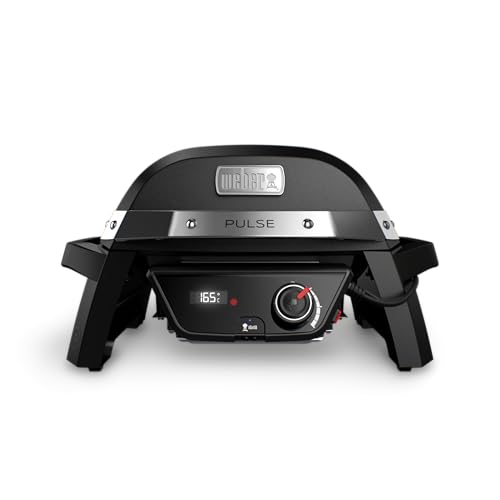
The housing and lid are made of cast aluminium. The lid cladding is aluminium and, according to Weber, is meant to keep the temperature in the grilling chamber even, the lid handle is stainless steel, and the two carrying handles are glass-fibre-reinforced nylon. In the product photo, the grill stands on short legs, with a three-digit display and the control knob at the front. Stand and trolley are separate versions in the model list; neither appears in the photo.
Closed, the grill measures 33 cm in height, 61 cm in width and 54 cm in depth; with the lid open it is 68, 61 and 65 cm. Weber states 13.92 kg. The Amazon catalogue adopts the outer dimensions of the closed grill but lists 42.06 pounds, converted 19.1 kg; we go with Weber’s figure and suspect the catalogue shows the shipping weight.
The grates are made of porcelain-enamelled cast iron. Weber gives heat retention and the grill pattern as reasons. The Amazon text, by contrast, mentions a chrome-plated steel grate; we follow Weber because the product page and the manual both say cast iron. The total grilling area measures 41 × 31 cm. Weber reckons with six burger patties from the Weber hamburger press or up to four steaks.
At the front are the removable temperature controller with an on/off button (with an integrated safety mechanism according to Weber), a digital thermometer with an LED display instead of an analogue thermometer, and coloured status lights for preheating. There is an integrated holder for hanging up the power cord.
The assembly parts list (manual, page 5) includes: iGRILL meat temperature probe with probe sleeve, grill grates, heating element assembly, thumbscrews for the heating element, removable bowl liner, temperature controller, disposable drip tray and removable grease tray. A cover is not included.
In detail: one heating zone, three controller ranges
The control knob is labelled OFF, LOW, MEDIUM and HIGH. The manual (page 11) assigns ranges to the three heating positions: LOW 93 to 149 °C, MEDIUM 176 to 232 °C, HIGH 260 to 316 °C. Weber gives three wordings for the maximum temperature: the product page speaks of evenly above 300 °C, the digital precision temperature control measures the temperature inside the grill according to Weber and adjusts it up to 315 °C, and the manual states 316 °C.
If you convert the ranges, you get round Fahrenheit figures: 200 to 300 °F, 350 to 450 °F and 500 to 600 °F. That also explains the difference between 315 and 316 °C, because 600 °F is 315.6 °C. This derivation is ours. It fits that the display on the controller can be switched between Celsius and Fahrenheit via the app.
Before the very first grilling session, the manual requires a burn-off: lid closed, highest setting, at least 20 minutes. After that you always preheat on the highest setting first, even if the recipe calls for less heat, and only then turn it down. The grill counts as preheated at 260 °C, which takes 15 to 20 minutes depending on the surroundings. While heating up, red status lights flash; once the setting is reached, the controller beeps briefly and the lights stay on continuously.
According to the manual, cold and high altitude lengthen grilling times, and persistent wind lowers the temperature in the grill. The grill should therefore be positioned so that the wind blows against the front.
For direct grilling, the instructions say: preheat on HIGH, brush the grate, set the recipe temperature, close the lid, turn the food only once. For indirect heat, you also preheat to 260 °C, then turn the controller to the middle position and place large pieces such as a whole chicken or a roast horizontally in the centre. This does not create a second zone, because the Pulse 1000 has only one controller.
Weber describes the closed lid like this: the grate is hotter, cooking times are shorter, the smoke aroma is stronger. Low-smoke operation is not mentioned. According to Weber, the cast iron grates also make the grill heat up again quickly after the lid is opened.
iGrill: probe, app, measuring range
Weber describes the iGrill technology as integrated into the grill, and the declaration of conformity lists it as an electric grill for outdoor use with iGRILL-3. The app is called the iGRILL app and, according to the manual, costs nothing. One meat temperature probe is included, and two connections for probes are provided. For two pieces of meat at the same time, you therefore need a second probe.
To pair, you switch on Bluetooth on the mobile device, plug in the probe and switch on the grill. Once the blue light on the front of the controller flashes, you start the app and follow its instructions; Bluetooth only reaches short distances. The manual describes the app as a monitoring tool: watching several probes at the same time, creating your own grilling guides or choosing existing settings, setting timers, monitoring the temperature remotely. The product page, by contrast, says the iGrill technology can be controlled via app; according to the manual, you set the heating output on the control knob.
You insert the probe at least 10 mm deep into the centre of the food, and for poultry into the thickest part of the thigh or breast, away from the bone. The cable runs through the side feed-through on the grill so that the lid can close, and does not lie directly on the hot grate. It cannot withstand flames or temperatures above 380 °C. Below -30 °C and above 300 °C the app shows nothing, and the connection to the probe is lost.
The probes are very sharp, and their coloured markings are not heat-insulated: while grilling, you only touch them with protective gloves. Target values for core temperature by type of meat are in our core temperature chart.
Is 1,800 watts enough for steaks?
The manufacturer’s data cannot answer that. Weber states room for up to four steaks and 260 to 316 °C for HIGH, but neither a grate temperature nor a searing performance. Our assessment: if you mainly want to sear, look first at devices with more power or a switchable turbo function.
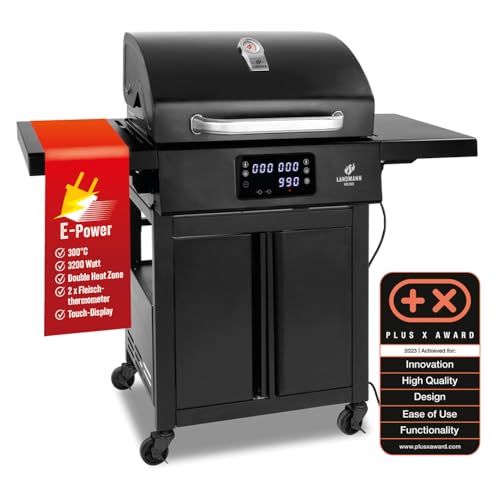
Watts and temperature are two different things. The wattage states the power the heating element draws; the control limits the temperature, and what reaches the grate also depends on how much heat the housing loses, through wind, an open lid or cold food. More power compensates for such losses faster and heats up faster, but it does not raise the upper limit by itself. The Landmann EG-II-590 delivers up to 3,200 W and sets 100 to 300 °C in 50-degree steps, measured at the grill grate. The control of the Pulse 1000, by contrast, measures inside the grill. The two figures are taken at different measuring points and cannot simply be placed side by side.
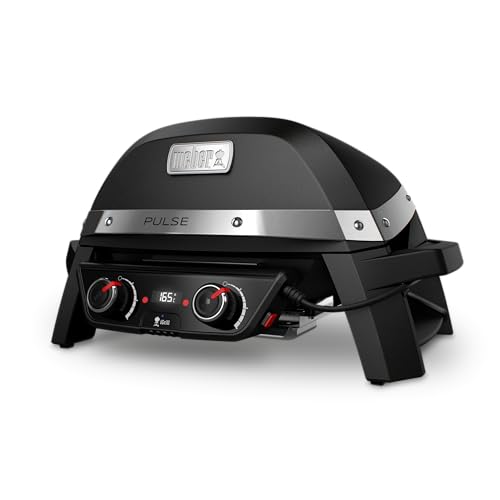
For the alternatives, the design therefore matters more than the wattage. According to the manual, the Pulse 2000 has 2,200 W. The Enders eFLOW PRO 2 TURBO switches on a TURBO ZONE at the push of a button, which Enders intends for searing. In our reading, the probe of the Pulse 1000 suits food that stays in the grill longer, such as a whole chicken or a roast, as the manual describes for indirect heat.
What else comes into question?
| Model | The difference | Price | Our rating | Choose this if |
|---|---|---|---|---|
| Weber Pulse 1000 (this one) | 1,800 W, one heating zone, one iGrill probe, 41 × 31 cm | approx. €854 | 8.9 | you want a probe and app in the device and can manage with one zone |
| Weber Pulse 2000 | 2,200 W, two separately adjustable zones, two probes, 49 × 39 cm | approx. €578 | 9.2 | you want to cook two items at different temperatures at the same time |
| Enders eFLOW PRO 2 TURBO | 3,000 W with TURBO ZONE, 50 × 39 cm, grill trolley | approx. €385 | 8.9 | you want to sear steaks and have room for a trolley |
| Landmann EG-II-590 | 3,200 W, two separately controlled heating elements, 59 × 40.5 cm, trolley | approx. €550 | 9.4 | you want the largest area of these four models and have room for a trolley |
The prices are guide values from the price boxes in our reviews, not daily prices; the rating is our editorial assessment based on manufacturer data, not a measurement result. For the Pulse 1000, the prices at the Weber shop and the Amazon marketplace are far apart (details in the FAQ), so we do not calculate a price gap to the three other models.
When the Pulse 1000 fits and when another grill does
The socket decides first. Outdoors you need an earthed connection behind an RCD (residual-current device), within reach of the power cord or with an extension cord that meets Weber’s requirements (see FAQ). If you lack such a connection, the Pulse 1000 is out for you.
On a balcony, your tenancy agreement and house rules decide whether you may grill; the guide Grilling on a balcony explains the legal situation. Space is the other factor. We add the minimum clearance of 61 cm on each side to the manufacturer’s dimensions: the area that must stay free of anything combustible then measures 183 × 176 cm with the lid closed and 183 × 187 cm with the lid open. On a narrow balcony that gets tight, and in our reading wooden furniture or a fabric parasol nearby count as things the manual does not want there. We would not grill under an awning or canopy, because the manual rules out operation in covered passageways and under combustible structures.
At least a quarter of the grate should stay free (manual, page 12). From Weber’s 41 × 31 cm, that leaves roughly 950 cm² for grilling by our calculation. Our assessment: that works for two to three people; if you regularly grill for more, look at the 59 × 40.5 cm of the Landmann.
If you want to cook two items at different temperatures side by side, you need a device with two zones: at Weber that is the Pulse 2000, and from the table above also the Landmann EG-II-590 with two separately controlled heating elements. Weber Germany does not list the Pulse 2000 on 6 October 2026, while the Swiss Weber site lists both models; so check first whether it is available.
If you want to put the grill away after every use, you carry it by the two handles once it has cooled down.
Running costs come from electricity and disposable drip trays. At full load, 1,800 W over one hour is 1.8 kWh, which is the rated power times one hour; what that costs depends on your tariff. On top of the purchase price comes a cover; which one fits is in the FAQ.
On the product page, Weber states a warranty period of 5 years, excluding ordinary wear and tear. According to the manual (page 4), it starts on the purchase date, covers material and workmanship defects provided assembly and operation followed the manual, applies in Europe, the Middle East and Africa and only to the original purchaser (exception: gift or promotion, where legally permitted). Weber repairs or replaces at its own choice; compensation never exceeds the purchase price, and for replaced parts only the remaining time of the five years applies. As normal wear, Weber lists for example surface rust, dents and scratches; significant defects include certain components rusting or burning through and faults that prevent safe use. Using parts that are not original Weber parts voids the warranty; further exclusions and conditions are on page 4 of the manual. Registering on weber.com is beneficial but not required. Your statutory warranty rights (Gewährleistung) remain unaffected.
If you rent, you should know one clause: the voluntary warranty applies only to products used privately, not to grills used commercially, at municipal level or in multi-family buildings. As examples, the manual names restaurants, hotels, resorts and rental properties. Whether this affects a privately used rented flat is not clear from the wording; ask Weber before buying.
Setup, power and care according to the instructions
The safety instructions are on page 3 of the manual. We reproduce them as close to the wording as possible; they are only complete there.
Weber highlights as DANGER: the grill may only be used outdoors in a well-ventilated area, not in garages, buildings, covered passageways, tents, other enclosed areas or under combustible structures. It is also not suitable for charcoal, briquettes, liquid fuel or lava rocks.
When setting up, the manual says:
- Nothing combustible may be within 61 cm of the grill, measured from all outer edges.
- No body of water such as a swimming pool or pond may be within 3.05 m.
- There must be no flammable gases and liquids (for example petrol and alcohol) in the grilling area, and no other flammable or combustible materials.
- The ground must be level and heat-resistant.
- The grill is only operated if all parts are in place and it has been assembled according to the assembly instructions.
On power:
- The grill belongs only on an earthed socket, plug adapters are forbidden, and the connection runs through a residual-current circuit breaker (RCD) with a rated residual current of 30 mA at most.
- It is designed for 220 to 240 V at 50 or 60 Hz; the voltage must match the device label, and the socket’s wattage must not be exceeded.
- If the socket, cord or plug is damaged, the grill stays off, and likewise if the device has been dropped or is not working properly.
- First you connect the temperature controller to the grill, then you plug the plug into the socket, with the on/off button on OFF. You pull on the plug, not the cord.
- You check the cord regularly, keep it away from heated surfaces and route it so that nobody pulls on it or trips over it.
- Controller, cord, plug, probe and grill do not go into water or other liquids, and you do not spray liquids into the interior.
During operation, you never leave the grill unattended while preheating and grilling, because the entire grilling chamber heats up, and it is not moved while doing so. Accessible parts can be very hot. Children and pets stay away. Weber requires heat-resistant grilling gloves with a contact heat resistance of level 2 or higher according to DIN EN 407 (a standard that applies in Germany and the EU). In case of a grease fire, you close the lid, set the on/off button to OFF and disconnect the grill from the mains; the lid stays closed until the fire is out, and liquids for extinguishing are out of the question. How to avoid it getting that far is covered in the guide Preventing grease fires.
Before moving, cleaning or storing, the grill must cool down. When not in use, the controller should be kept indoors in the supplied box, and the grill is only covered once it has cooled down completely. According to the manual, modifications are not safe and lead to the loss of warranty claims; you do not open sealed parts.
The grease management system directs grease into the disposable drip tray and, according to the manual, reduces the risk of flare-ups. It should be cleaned with every grilling session to prevent grease fires: you check the drip tray in the removable grease tray and replace it if necessary. Before each use, you also look for grease residue in the grease tray, because excessive build-up can trigger a grease fire. You clean thoroughly after every fifth grilling session at the latest, more often with continuous use; for this the grill is switched off, completely cooled down, disconnected from the power and the controller removed.
You brush the grate with a stainless steel grill brush immediately after preheating. Weber recommends checking the brush for loose bristles and getting a new one at the start of each grilling season. You loosen the heating elements via the wing screws, metal brushes are forbidden for this, and you burn off food residue while preheating. According to the manual, the bowl liner is dishwasher-safe; it must not be bent, and the grill is not operated without it. Paint-like flakes on the inside of the lid are deposits of grease and smoke, non-toxic according to the manual, and should be removed with a plastic scraper, otherwise they can fall onto the food.
For the probe, the wording of the instructions applies: wipe the probes with a damp towel or a wet wipe. They are not dishwasher-safe and not waterproof, water can damage them, and the cable and connection area must not get wet. Before first use the probe is cleaned, and coiled up it is stored together with the controller in the storage box. You wipe the controller with a damp microfibre cloth, without abrasive agents; glass cleaner never goes on plastic surfaces.
According to the manual, unsuitable cleaning products are abrasive stainless steel polishes or varnishes, acidic cleaners, white spirit or xylenes, oven cleaners, abrasive cleaners (scouring cleaners) and abrasive cleaning pads. The exterior consists, where applicable, of aluminium, stainless steel and plastic; no bleach and no chlorine cleaners go on stainless steel. Acid rain, swimming pool chemicals and salt water can promote rust; in such surroundings you clean the exterior more often with warm soapy water and dry it. For cleaning, the Weber shop (as of 6 October 2026) lists a cleaning set for Q and Pulse grills for €49.99.
What Weber leaves open
These details are missing from Weber’s product page, the manual and the Amazon catalogue, as far as we have read them:
- Length of the power cord (only the holder for hanging it up is documented)
- Heat-up time to the highest setting above 300 °C
- Power consumption per hour in operation and on standby
- Stepless control or fixed steps on the control knob
- Measuring point of the maximum values 300 °C and 316 °C; for the 315 °C it says only “inside the grill”, without stating whether air or grate is meant
- Protection rating (IP class) and rain suitability of grill and controller
- Statement on house rules or balcony ban, plus minimum dimensions for a canopy
- Assembly time and tools required
- Shelves or side tables
- Dishwasher suitability of the grates
- Supported smartphone models and operating system versions of the app
- Push notification when the target temperature is reached and Bluetooth range in metres
- Height of the cooking space under the lid
- Number of disposable drip trays in the box and per replacement pack
- Year of market launch, discontinuation or successor (copyright notice of the manual 2018, declaration of conformity of 19 April 2022)
- Country of manufacture (only the manufacturer Weber-Stephen Products LLC in Palatine, Illinois, USA, and the importer Weber-Stephen Products (EMEA) GmbH in Berlin are named)
- Seller and current price of the Amazon listing: the Amazon page could not be retrieved, we only have catalogue data from 5 October 2026
Who is it for?
Weber intends the Pulse 1000 exclusively for household use outdoors, not for indoor use and not for commercial use, and it does not serve as a heater. It is therefore wrong for anyone who wants to run an electric grill in a motorhome or on a boat: the manual prohibits operation in a vehicle, in the boot and on the loading area of a vehicle, naming caravans, motorhomes and boats among others. The grill is not suitable for installation in or on caravans or boats, and you do not build it into an integrated or slide-in structure.
It is equally wrong for a household in which children or people with limited physical, sensory or mental abilities are meant to operate the grill themselves. The manual excludes them as users. And if you first want to clarify whether an electric grill fits your space and budget at all, narrow it down in the grill finder.