Which eFLOW we mean: the stainless steel version 97106
Enders builds the eFLOW PRO 2 TURBO in two versions. The one discussed here has a lid, door and control panel made of stainless steel and the item number 97106. The second belongs to the SHADOW series, comes in matt graphite, carries the number 97126 and has its own review on our site: Enders eFLOW PRO 2 TURBO SHADOW.
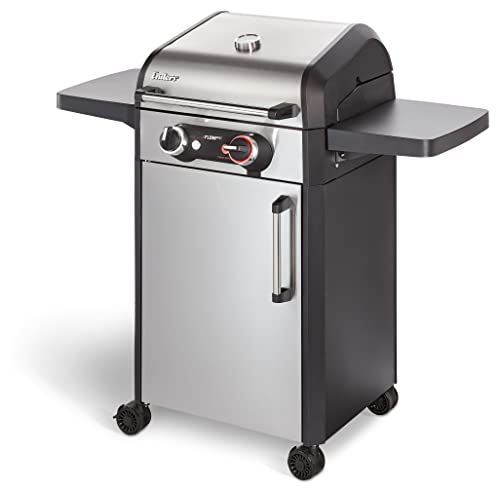
That our price box points to the stainless steel version can be read from the Amazon data record. The title of the linked ASIN ends in “#97106”, the colour is given as silver, and the model field shows the shortened 9710. The product photo fits: silver lid and cabinet door, black frame, dark side shelves.
The manufacturer is Enders Colsman AG in Werdohl, in business since 1883 by its own account; according to Enders, the grills are developed at the company headquarters. On the manufacturer’s electric grill page, eight models were listed on 2 October 2026. The two eFLOW versions cost €469 each there, the same as their RRP, and so the most of all eight. On the same manufacturer page, the eFlavour 2 Turbo follows at €369 and five devices from the e-URBAN and eCrave ranges between €199 and €349.
In our price box, the stainless steel version stands at approx. €385 on Amazon (as of September 2026). In the electric grills category, we give it 8.9 points. We never had a unit here. What follows rests on documents from Enders: the product pages for the eFLOW, eFLOW SHADOW and eFLAVOUR, the electric grill overview, the company page, the 2026 warranty terms and the operating and assembly instructions. Added to that are Amazon’s catalogue data and, for the comparison, the manual of the Landmann EG-II-590. Strictly speaking, both Enders manuals are issued for the SHADOW numbers 9712/97126; Enders does not offer separate ones for 97106 to download, and the documents sit on the SHADOW’s product page. According to the product pages, power, cooking surface, dimensions and weight are the same for both, which is why we draw on them.
Three heating elements, two zones, one cast iron grate
The eFLOW contains three heating elements of 1.5 kW each, of which at most two run at the same time. That gives the total output of 3 kW; the manual states 3,000 W as the maximum wattage, connected to 220 to 230 V and 50 to 60 Hz. In normal operation, one element heats the left zone and one the right. Each zone has its own rotary control with LED lighting, continuous and without a degree scale. The control panel also holds the power button and the button for the TURBO ZONE.
The cooking surface measures 50 × 39 cm, 1,950 cm² according to Enders. Amazon and the running text of the product page round that to just under 2,000 cm².
On it sits the SWITCH GRID, an enamelled cast iron grate with a round element that you can take out. If it stays in, you grill on an ordinary grate. Without the element, an opening is created for the inserts that Enders sells as accessories.
The lid is double-walled, made of stainless steel and has a built-in thermometer. Side parts made of cast aluminium sit on the lid and burner chamber; Enders describes the burner chamber itself as stainless steel and cast aluminium. The control panel and door are also stainless steel, and the door is double-walled. There is also a stainless steel warming rack, which Enders describes as swinging. A removable grease drawer collects dripping fat, and the base is a cabinet with storage space and an additional shelf.
Assembled, the cart is 112.5 cm wide, 57 cm deep and 111.5 cm high according to Enders, and the working height is 89 cm. The two side shelves made of powder-coated steel can be folded down, leaving 76 cm of width. They are not suitable as a surface for food without a plate or board, because Enders does not intend them for direct contact with food. The grill weighs 36.5 kg (Amazon’s catalogue puts the unit pounds after the same number, which would be around 16.6 kg) and, according to the parts list, stands on four wheels with brakes.
What Enders leaves open
In the product pages, the manual and the warranty terms, we looked for the following details without finding them:
- a maximum temperature in degrees, neither for the grate nor for the TURBO ZONE
- a heat-up time to a specific temperature
- the power consumption of a grilling evening in kWh
- how many people the cooking surface is enough for
- the dimensions of the warming rack
- material and diameter of the wheels
- cable type and plug shape beyond the requirement of an earthed socket
- country of production and year of market launch
- GTIN or EAN
The product page also contains a contradiction. Under the highlighted blocks, “Turbo Zone (3 kW)” is directly followed by a second one reading “Turbo Zone (2.2 kW)”, and the TURBO ZONE line in the technical data is empty. Amazon speaks of 3 kW, the manual of the full output of 3,000 W. We take the 2.2 kW block to be a leftover from the page template of the cheaper e-URBAN models.
In detail: where the TURBO ZONE sends the power
The grill draws no more power in Turbo. When you press the button, according to the manual the full output of 3,000 W is concentrated on the right-hand cooking surface, the left heating element switches off automatically, and the LED lighting changes to red.
Our reading of the data: the third 1.5 kW element works only in Turbo and then heats additionally on the right, while one on the left switches off. That way no more than two ever run at the same time, and the right side gets 3 kW instead of 1.5 kW. Two notes in the manual fit this. You cannot regulate the TURBO ZONE heating element, and for the highest temperature you also turn the right-hand control all the way up. A second press of the button ends the Turbo. The LED lights white again, and the left side heats again to the setting its control is on.
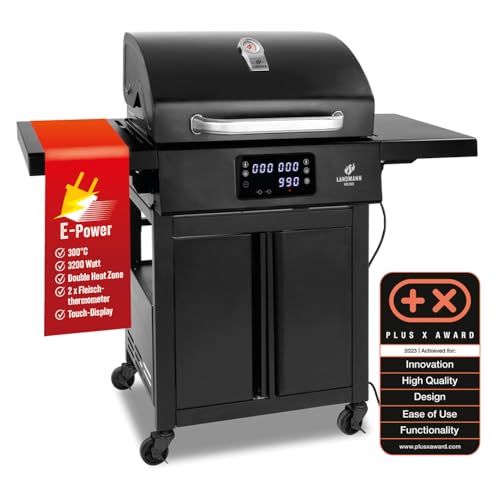
What this means for heat density can be estimated. In normal operation, 3,000 W is spread over 1,950 cm², around 1.5 W per square centimetre. If we assume the boundary between the zones lies in the middle, then in Turbo the same 3,000 W lands on about 975 cm², so around 3 W per square centimetre. According to its manual, the Landmann EG-II-590 delivers at most 3,200 W on 59 × 40.5 cm, around 1.3 W per square centimetre by calculation, and it has no button that concentrates its output on one side. How hot the grate gets is not revealed by these figures, because the lid and the spacing of the heating elements play a part too. Nobody on our side has measured this on either device.
The thermometer in the lid gives orientation. The manual divides its scale into three ranges, referring to the temperature directly at the grate: LOW & SLOW from 0 to 120 °C, GRILLING from 120 to 270 °C and SEARING from 270 °C. Hard searing, for which Enders promotes the TURBO ZONE, belongs in the third range, and that is open-ended at the top. Enders recommends grilling with the lid closed and opening it as rarely as possible.
According to Enders, the two heating zones allow direct and indirect grilling and baking. For indirect cooking, one side heats and the food lies on the other under a closed lid; the principle is explained in our guide direct and indirect heat. Formally this split also arises in Turbo, hot on the right, off on the left. For long cooking times we would still work without Turbo: the Turbo heating element always runs at full power, so the heating side cannot be throttled below its 1.5 kW.
For a thick steak, we derive a sequence from this operating logic. Sear on the right in Turbo, switch the Turbo off, turn the right-hand control back and cook the piece under a closed lid until a probe thermometer shows the desired core temperature.
Is a normal outdoor socket enough for 3,000 watts?
Only if it meets four conditions from the manual: earthing contact, a residual current device (RCD) with a tripping current of 30 mA at most, suitability for 3,000 W power consumption and no other high-power appliance on the same circuit. Extension cables and plug adapters are ruled out.
Enders justifies the exclusion by saying that both can impair the residual current protection and cost power. The grill’s mains cable is 215 cm long, so the socket must be within a good two metres of where you put the grill. Whether your outdoor socket meets the other conditions cannot be seen from the outside; if in doubt, ask a qualified electrician.
Why the circuit should stay free is shown by a rough calculation. 3,000 W at 230 V gives a good 13 A. Household circuits in Germany are usually protected with 16 A, which leaves just under 3 A or around 680 W. If a kettle is on the same circuit, the fuse can trip as soon as both are running.
The remaining rules on the electrics: your supply voltage must match the one on the rating plate. The connection cable should be checked regularly for damage; if it is damaged, the grill stays off, and only qualified personnel replace the plug or cable. It must not be operated on a damaged socket either. Enders also requires you to pull the plug when you are not grilling and to keep electric cables away from all hot surfaces.
The order for switching on and off is also laid down. Before plugging in, you check that both controls and the TURBO ZONE are off, then you plug in, press the power button (white LED) and turn the controls clockwise. To switch off, you turn both controls anticlockwise to the off position, switch off the TURBO ZONE and press the power button. Only after that do you pull the mains plug.
What else comes into question?
| Model | The difference | Price | Our score | Take this one if |
|---|---|---|---|---|
| Enders eFLOW PRO 2 TURBO (this one) | Stainless steel on lid, door and control panel, cast aluminium side parts, TURBO ZONE | approx. €385 | 8.9 | stainless steel and 10 instead of 5 years on the lid and burner chamber are worth around €16 more than the eFLAVOUR to you |
| Enders eFLOW PRO 2 TURBO SHADOW | same technology, lid and burner chamber of enamelled steel instead of stainless steel, panel and door powder-coated, matt graphite | approx. €469 | 8.3 | you prefer matt graphite to stainless steel |
| Enders eFLAVOUR 2 Turbo | same heating elements and surface, lid and burner chamber of powder-coated steel | approx. €310 | 8.5 | the eFLOW is currently much more expensive and powder coating is enough for you |
| Landmann Elektro-Grillwagen EG-II-590 | two grates, together 59 × 40.5 cm, temperature by button from 100 to 300 °C, no Turbo function | approx. €550 | 9.4 | you need more grate area and want to set temperatures as a number |
The prices are guide values from our price boxes and fluctuate. We retrieved the eFLOW’s in September 2026; for the other three we do not know the retrieval date. The score is our editorial assessment of the manufacturer data, with no measurements of our own in it.
When the eFLOW suits you and when another grill does
First the location. For setting up, the manual gives these conditions:
- use outdoors only, not in the house and not commercially
- set up sheltered from wind, on a level, stable surface
- keep away from moisture and splashing water
- at least 0.5 m clearance from flammable and heat-sensitive materials
- no objects or parts of buildings above the grill below a height of 2 m
- at least 3 m clearance from bodies of water such as pools or ponds
- do not push or build it into a structure
- do not route the mains cable across walkways, and guide it so that it cannot touch the hot grill
That makes the eFLOW not an electric grill for the kitchen or the conservatory. For a balcony, the 2 m rule is decisive: the balcony above or a canopy over your spot is, in our reading, a part of a building, and whether the 2 m apply from the ground or from the top edge of the grill is left open by the wording. For a device that is already over a metre tall with the lid closed, that makes a big difference. We would not set up the eFLOW under a balcony above until Enders has answered this question in writing. What tenancy law and house rules allow for grilling there is covered in the guide grilling on a balcony.
Once the location is settled, it comes down to material. The SHADOW version has the same technology but different materials on the lid, burner chamber, control panel and door; which ones is in the questions below. It stands at approx. €469 in our price box (on 21 October 2026 only from marketplace sellers on Amazon, Amazon itself did not offer it), this version at approx. €385; so looks, material and price will decide.
On the Enders eFLAVOUR 2 Turbo, the heating elements including the TURBO ZONE and the cooking surface are the same according to Enders. Its lid and burner chamber are made of powder-coated steel, with no cast aluminium. It weighs 31.5 kg and measures W 108 × D 57 × H 108.5 cm. The 2026 warranty terms set 5 instead of 10 years for its lid unit and burner chamber unit. According to the table, it costs around €16 less than the eFLOW, while the two RRPs are €100 apart. With such a small gap, we would take the eFLOW, because of the longer periods and because of stainless steel instead of powder-coated steel. If the gap approaches the RRP difference, the eFLAVOUR is enough, as long as 5 years on the lid and burner chamber are sufficient for you.
On the Landmann Elektro-Grillwagen EG-II-590, according to its manual you choose per heating element by button between 100 and 300 °C, in steps of 50 degrees, measured at the grate. It costs around €165 more than the eFLOW and has, by calculation, a good fifth more cooking surface.
Inserts, cover, spare parts and warranty
Enders sells inserts for the opening in the SWITCH GRID. On the eFLOW product page on 2 October 2026, the Sear Grate and poultry roaster were €39.95 each, the pizza stone €44.95, the pan €49.95 and the Dutch oven €89.90. In the description, Enders also lists a wok. In addition there is a stainless steel grill skewer for €69.90 and the SWITCH GRID as a replacement grate for €59.90.
A cover is missing from the parts list in the manual. A bundle of the grill and the Premium weather protection cover for eFLOW Pro 2 and eFLAVOUR 2, which is listed at €39.95 on the product page, therefore costs around €425.
The assembly instructions list spare parts with item numbers. On page 12 you find, for example, 130018000 for the SWITCH GRID and 130018020 for the grease drawer, ordered via Enders’ spare parts shop.
On the warranty, two Enders documents contradict each other. The operating manual with the print status 221122 says: “We provide a 2-year warranty on the function of the appliance.” The conditions there are proper handling and proof of purchase. Your own modifications void the warranty, and you report a defect directly to Enders rather than to the retailer.
The 2026 warranty terms, by contrast, place the eFLOW PRO in the group with ten years and stagger it by component: lid unit and burner chamber unit 10 years, SIMPLE CLEAN 5 years, heating elements, enamelled cast iron grate, warming rack, grease drawer and plastic components 3 years each, all other parts 2 years. For lid, burner chamber, heating elements, grate, warming rack and grease drawer, the period applies only to rust-through or burn-through respectively. We go by the newer terms, but at purchase we would have the periods confirmed to us; what you have to do yourself for that is in the questions below.
According to the 2026 terms, the following are excluded:
- normal wear, such as rust formation, colour fading, scratches or dents that do not impair function
- damage from improper use, improper assembly, misuse or neglect of preventive maintenance (see operating manual)
- damage caused by extreme weather conditions, salty air, chlorine sources, acid rain or other environmental influences
- damage from using non-original parts or unauthorised repairs and modifications
Enders limits the benefit to repair or replacement of the defective part, and it never exceeds the original purchase price. A replacement part does not start a new period; the remaining warranty time of the original warranty applies. Your statutory warranty rights (under German law) remain in place alongside it, and the warranty supplements them without restricting them.
Cleaning, grease fires and safety according to the manual
The cleaning system is called SIMPLE CLEAN. According to the manual, a patent is pending for it, and on its company page Enders counts it among its own developments. The burner chamber and grease drawer have smooth surfaces, and their individual parts come out without tools. The wording is: “The removable individual parts are all made of stainless steel and suitable for the dishwasher or alternatively easy to clean by hand.”
This sentence concerns the stainless steel parts and says nothing about the enamelled cast iron grate. For the grate, the manual describes its own route: brush it hot with a stainless steel brush, or take it out cold and clean it with the Enders grill grate cleaner (item no. 4974) or warm soapy water, soaking it beforehand and rinsing clear.
Before cleaning, the grill must be completely cooled down and the mains cable pulled. It is cleaned after every use, above all the insides of the burner chamber, the heating element holders and the grease drawer, and once more before each use so that no fat builds up. The fat from the drawer should be disposed of in an environmentally responsible way. For light soiling, according to Enders the heating elements are almost self-cleaning, and coarse debris is removed when cold with a soft brush. For surfaces, Enders recommends its own grill cleaner (item no. 4975) or a mild cleaning agent, then wipe over damp and dry with a microfibre cloth. Abrasive, chlorine-containing and flammable cleaning agents are off limits, and the appliance must be completely dry before it is next used. Repairs and maintenance on electronic parts belong in the hands of authorised qualified personnel, and sealed components are left untouched.
The manual has its own block on grease fires; how to recognise and smother a grease fire is covered in general in our guide preventing grease fires. Fats and oils can ignite themselves when heated to a high temperature, and accumulated fat can trigger a grease fire. Enders therefore requires you to dab excess fat and marinade off the food before grilling, to keep the inside of the lid and burner chamber, the heating element holders and the grease drawer free of deposits, and not to pull out the drawer during grilling. Burning, hot or smoking fat or oil must never be extinguished with water. When opening and closing the lid, the manual advises a firm grip, otherwise you can trap yourself.
The general safety notes mainly govern running operation. Enders requires that you never leave the eFLOW unattended while grilling and that you operate it neither in heavily frequented areas nor near flammable substances. Flammable materials such as paper, partitions, curtains, cloths or chemicals must not come into contact with it, nor must the cooking surface come into contact with flammable gases and liquids such as petrol or alcohol or other combustible materials. You should use the grill only as the manual describes, otherwise, according to Enders, fire, electric shock or personal injury threaten. You must not modify it, and it is not intended as a heater.
Individual parts of the heater and accessible parts can get very hot and cause burns. Children and vulnerable persons must therefore be supervised especially closely and kept away, also when the lid is opened, because hot air can escape then. For hot components, the manual prescribes protective gloves, and nobody should look directly into the glowing heating elements for a long time. The appliance may be operated only with the rotary control fitted. Avoid immersion in water or other liquids, dropping, bumping or stepping on any parts. As a possible consequence of ignored warnings, Enders names fire or explosion with serious injuries, fatal accidents and property damage. In case of doubt, the manual refers you to your seller.
Who is it suitable for?
For catering or the grill at a club house, the eFLOW is the wrong choice. The list of setup conditions above already rules out commercial use, and the warranty terms expressly exclude grills used commercially or in communal facilities; they apply only to devices used privately.
Anyone who wants embers and charcoal should also look elsewhere: according to the manual, the eFLOW must not be operated with charcoal or similar fuels.
Families will find fixed age limits in the manual. Children under 3 years must be supervised constantly. Between 3 and 8 years, they may only switch the appliance on and off, supervised or after instruction and only if it is in its normal position of use; they may not regulate, clean or maintain it. From 8 years, children may use the grill under supervision or after instruction, but may not take on cleaning and user maintenance without supervision. The same condition, supervision or instruction, applies to people with reduced physical, sensory or mental abilities or without experience.
Pets appear in the manual in the same sentence as children: “Do not leave the appliance on or unattended when children or animals are nearby.” For households with a dog or cat, that means the grill runs only while someone is standing beside it.