The Weber Bar-B-Kettle 47 is a charcoal kettle grill with a 47 cm diameter and the Weber item number 1502055, available in black. We have not had it in our hands and have not grilled anything on it. Despite the words experience report in the title, this text is therefore not a usage report but sets data side by side: Weber’s product page (retrieved on 12 October 2026), the Amazon catalogue (data as of 5 October 2026) and the data sheets of our own reviews.
weber.com/DE does not provide a separate instruction manual for this item. What is said here about safety, lighting, charcoal quantities and cleaning comes from Weber’s general instructions for charcoal grills (dated 2018, German section pages 84 to 93), which expressly describe individual components as model-dependent. These passages carry the note “according to the manual”. Our own calculations and assessments are marked as well.
Which Bar-B-Kettle 47 is behind the Amazon link?
According to the Amazon catalogue it is item 1502055, the same number as at Weber (Bar-B-Kettle charcoal grill Ø 47 cm). Weber’s pages do not link to Amazon, so the match rests solely on Amazon’s data field; the Amazon title adds “with stand and wheels”.
The question arises because weber.com/DE lists two Bar-B-Kettles with 47 cm. The second carries the number 1231004 and costs €110.49 there (as of 12 October 2026). It weighs 10.91 kg and measures 90.9 x 47 x 57.9 cm with the lid closed. Its equipment list has no lid thermometer, but does have a removable aluminium ash catcher, a measuring cup for briquettes, two charcoal holders and four aluminium vents.
Our price box lists the 1502055 at Amazon at approx. €99 as a guide. On its own product page Weber asks €109.99 including VAT, plus shipping (retrieved on 12 October 2026).
Bowl, grate and stand
The bowl and lid are porcelain-enamelled. This is a glass layer that is fired onto the steel at high temperature; according to the manual it does not peel or flake off. Weber describes it as resistant to rust, flaking and scratches as well as heat-retaining, and the reflective surface allows cooking with circulating heat.
The cooking grate is made of coated steel, as stated in Weber’s detail table, and the manual says “made of heavy, coated steel”. Only an English header line on the product page mentions cast iron. It contradicts the German text on the same page and appears identically for the Compact Kettle 47, while the table and the manual both name coated steel. A grate stores heat in proportion to its mass: a solid cast-iron grate stores more than a steel grate of lower mass.
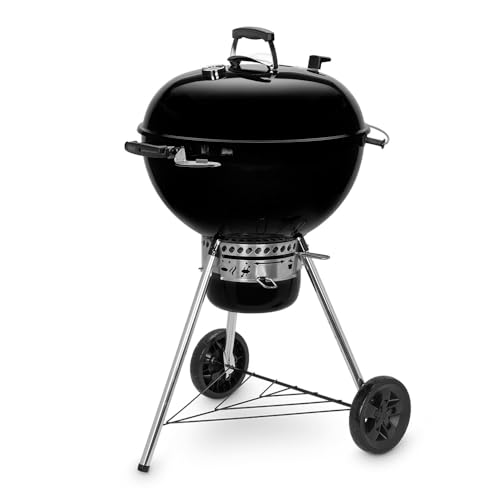
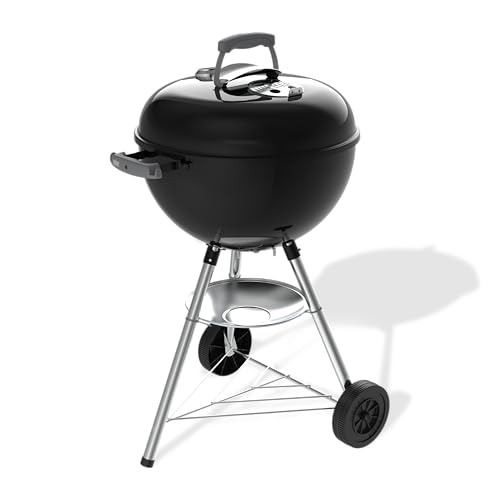
The equipment includes a charcoal grate, a grid base and an ash catcher, which according to Weber protects the patio or floor. The bowl has three vents and the lid one vent; the detail table counts four rust-resistant aluminium vents, presumably the same four parts. The lid thermometer is built in and the only entry under “what is included”; on the product photo it cannot be reliably made out on the lid, and it is backed by Weber’s statement and the Amazon text, which mentions an integrated thermometer. In addition there are a lid hook, two utensil holders on the bowl handle and heat-resistant handles, according to the detail table two glass-fibre-reinforced nylon handles. You hang the lid on the bowl, not on the bowl handle, as the manual requires.
According to Weber, the stand has three rust-resistant aluminium legs and two all-weather wheels. On the product photo, one wheel sits on each of two of the three legs, while the third ends in a foot; to roll the grill you therefore presumably have to tilt it. Under the bowl, the photo shows a flat, round tray hanging, presumably the ash catcher. Weber gives the weight as 9 kg; the Amazon catalogue lists 19.84 pounds, which converts to 9.0 kg as well.
According to Weber, the cooking area is 1,548 cm², both as the primary and as the total grilling area. Weber describes room for 9 burgers and for 4 to 6 people; Amazon’s text gives the same area and the same number of people. Do not recalculate the area from the diameter: Weber’s figure is the one that counts.
In detail: air, charcoal and the two zones
A kettle grill controls its heat through air. The more air reaches the embers, the hotter the fire burns and the more often you have to add fuel. According to the manual, the vents at the bottom of the bowl stay open while grilling, and you close the lid vent about halfway so that the fuel does not burn too quickly. Strong wind raises the temperature of a charcoal grill, and in cold weather or at high altitude the cooking time gets longer.
The lid should stay closed as much as possible for four reasons: it keeps the grate hot, shortens the cooking time, reduces smoke and prevents flare-ups. To open it, you lift it to the side rather than straight up, otherwise a suction effect can draw ash onto the food.
The manual recommends the direct zone, where the coals lie under the food, for small, tender pieces with a cooking time under 20 minutes, for example burger patties, steaks and skewers. Indirectly you cook larger pieces with a cooking time of 20 minutes or more, or delicate food, for example roasts, whole poultry and ribs. For this you push the fully glowing coals with the tongs to one or both sides, the food lies over the unheated area, and a drip pan for the meat juices can go between the layers of coal. Lining the grill with aluminium foil, on the other hand, blocks the air supply.
Our assessment of the area: with a two-zone setup (the guide Direct and indirect heat explains the rules for this), the usable area per zone shrinks, and how many burgers or people then still fit cannot be derived from Weber’s figures. Charcoal baskets and divider plates are not in Weber’s equipment list, so you arrange the coals with the tongs.
Can the grill go on a balcony or wooden patio?
Not on a wooden surface, and Weber gives no separate rule for balconies. The manual requires at least 1.5 m clearance from any combustible material, which includes wood, treated wooden decking, patios and porches, among other things, and prohibits setting it up on glass or combustible surfaces. The fact that Weber describes the ash catcher as protection for the patio or floor changes nothing: the manual does not derive any exception to the clearance from it.
There are further setup rules: the grill stands outdoors in a well-ventilated area, on a secure, level surface free of combustible material, and never under a combustible structure. You do not grill in strong wind. It is not operated in enclosed spaces or in confined or inhabited areas such as houses, tents, caravans, motorhomes or boats; garages and buildings are also expressly named. In enclosed spaces, toxic gases build up and lead to serious or fatal injuries. Whether charcoal is allowed at all where you live is governed by your tenancy agreement and house rules (the guide Grilling on a balcony summarises the legal position), and whether a balcony with a parapet, a roof or a wooden floor keeps the clearances depends on the individual case.
For the space required, Weber gives 91 x 47 x 56 cm (height x width x depth) with the lid closed and 77.5 x 47 x 65.5 cm with it open. Open, the grill is therefore 9.5 cm deeper and 13.5 cm lower (our own calculation). The dimensions in the Amazon catalogue, converted from inches to roughly 38 x 52 x 51.5 cm, do not match the assembled grill.
Lighting, extinguishing, cleaning according to Weber’s manual
The following points are excerpts from the German section of the manual (pages 84 to 92); the hazard and warning notes on page 84 are considerably longer. Read them in full before lighting for the first time.
To light or relight, you use neither methylated spirits nor petrol, nor alcohol or other volatile substances, and only firelighters conforming to EN 1860-3 (a standard that applies in Germany and the EU). The manual does not recommend lighter fluid; anyone who uses it anyway follows the manufacturer’s instructions, first removes any liquid that has run through the bowl ventilation, never applies it to hot or warm coals and never into a burning fire, closes it after use and stores it at a safe distance from the grill. The coals always lie on top of the charcoal grate, not on the bottom of the bowl. You never operate the grill without the ash container (for this model we read that as the ash catcher), never unattended, and it is not moved while in use. Children and pets stay away.
When grilling, adjusting the ventilation, adding coals, using the thermometer and opening or closing the lid, you wear heat-resistant grill gloves with contact heat resistance of level 2 or higher according to DIN EN 407 (a standard that applies in Germany and the EU), plus utensils with long, heat-resistant handles and no clothing with loose sleeves.
To extinguish, you close the air vent on the lid and the bowl ventilation and put the lid on the bowl. You use water neither to extinguish the coals nor to keep flames under control. The grill is only stored once the ash and charcoal have gone out completely.
You wipe the outside with warm soapy water, rinse and dry thoroughly. In harsh environments you do this more often, because acid rain, chemicals and salt water can cause rust on the surface. For the surfaces, you use no sharp objects and no abrasives. You clean the preheated grate with a stainless steel grill brush. You check brushes regularly for loose bristles and replace them if there are any; Weber recommends a new one with stainless steel bristles at the start of each spring.
Warranty, accessories and running costs
Weber staggers the warranty by component. According to the warranty table on the product page, the bowl and lid have 10 years against rust-through or burn-through, a One-Touch cleaning system 5 years, plastic components 5 years (excluding fading and discolouration) and all other parts 2 years. The One-Touch row presumably belongs to other grills in the series.
According to Weber’s warranty page, normal signs of wear such as surface rust, dents and scratches are excluded. The voluntary warranty applies, as far as legally permissible, only to the first buyer and only in a single private household, and only if the grill is assembled and operated according to the manual and maintained as described there. Parts other than genuine Weber parts void it according to the manual. Statutory warranty rights remain in place alongside it; Weber gives two years in the EU as an example.
As add-ons, Weber’s product page lists the Premium cover for €59.99, leather grill gloves for €34.99 and a two-piece Precision grill utensil set for €49.99. The Rapidfire starter set for €29.99 is on the page of the second 47, the 1231004. Neither charcoal nor firelighters appear in Weber’s equipment list, and Weber lists the cover as an add-on. Cover, gloves and Rapidfire together cost €124.97 (our own calculation, without the utensils); with the grill at approx. €99 that comes to around €224, without charcoal and grate brush.
What Weber does not state
This information is missing from Weber’s pages, from the 2018 manual and from the Amazon catalogue:
- Maximum temperature and heat-up time of the 1502055 (the manual only gives a general guideline)
- Measuring range, scale and accuracy of the lid thermometer, and whether it can be retrofitted or replaced
- Steel grade and sheet thickness of the bowl and lid, dimensions of the charcoal grate, legs and ash catcher, and the material of the ash catcher (the charcoal grate is called “made of heavy steel” in the general manual, the page for the 1502055 names no material; for the legs it says only aluminium, without dimensions), thickness and type of the coating on the cooking grate
- Whether the ash catcher is removable and its capacity (for the second 47 it says “removable”)
- Charcoal consumption in grams for exactly this grill
- Country of manufacture: Weber-Stephen Products LLC in Palatine, Illinois, is named as the designer in the 2018 assembly guide (“Designed and engineered by”), and Weber says in general that it continues to manufacture in the USA; no country is stated anywhere for the 1502055
- Year of introduction (Amazon’s catalogue has 21 January 2026 stored as the release date) and whether the item replaces an older model
- Packaging dimensions and shipping weight
- Stability on uneven ground, behaviour in wind and durability of the enamel over several seasons
- Spare part numbers for the 1502055 (Weber has a spare parts search by serial number or model; we have not checked for an entry there)
- Dimensions and fit of the cover: the product page shows it as an add-on without any dimensions
- GBS compatibility and One-Touch cleaning system: for the 1502055 Weber lists neither a Gourmet BBQ System nor accessories for it nor a One-Touch cleaning system; there is no explicit denial
- Full text of the warranty terms: we have not read the PDF for it; we used the table on the product page, the warranty page and the warranty section of the manual
What else comes into question?
| Model | The difference | Price | Our rating | Choose this if |
|---|---|---|---|---|
| Weber Bar-B-Kettle 47 (this one) | Built-in lid thermometer, 4 aluminium vents | approx. €99 | 8.5 | you want a small kettle grill with a thermometer in the lid |
| Weber Compact Kettle 47 | Same area, lid thermometer not listed by Weber, only 1 aluminium vent | approx. €79 | 8.7 | you check the temperature with your own probe thermometer anyway |
| Weber Bar-B-Kettle 57 | 2,342 instead of 1,548 cm² cooking area, 12 instead of 9 kg (Weber page for item 1502062) | approx. €129 | 8.7 | you regularly grill for more than four to six people |
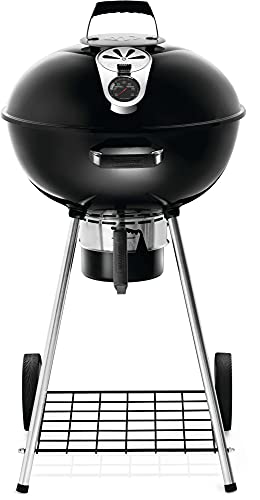
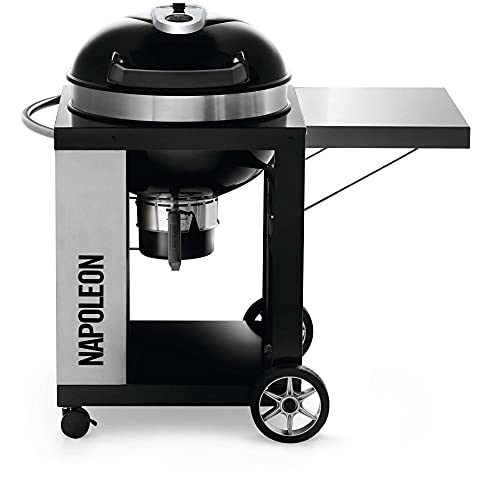
| Napoleon NK22K-LEG-2 | 57 cm diameter, according to Napoleon 2,356 cm², grate inserts that fold on both sides | approx. €373 | 9.5 | you cook for long periods and want grate inserts that fold on both sides |
The comparison of the best kettle grills 2026 places further models. The prices are guide values from the price boxes of our reviews, not manufacturer prices, and the rating is our editorial assessment from manufacturer data, not a measurement result. The difference column follows the Weber pages for the Weber models, and for the Napoleon the archived manufacturer pages and the manual.
Who the grill suits and when another is better
The Bar-B-Kettle 47 suits you if you want charcoal for a small group and have a spot with the required 1.5 m clearance from combustible material. Whether charcoal or gas suits you better is weighed up in the guide Gas or charcoal, and the Grill Finder narrows down the choice. Charcoal needs lead time: between lighting and the first food come the coals burning through and the grate preheating. If you want to eat spontaneously after work, you are better off with gas or electric (our assessment).
If you already have a probe thermometer (when one is worth it is explained in the guide Grill thermometers), the Compact Kettle 47 gets you the same area: approx. €79 in our price box, against approx. €99 for the Bar-B-Kettle.
The 47 has 33.9% less area than the 57 on paper (our own calculation from the figures in the table). If you regularly host larger groups or want to set up two zones, you are better served by the 57 (our assessment). The 47 is less convenient if you want to cook ribs or large roasts for hours at low temperature. For that you have to add coals, and the equipment list has no grate hinges; we conclude that you have to lift the grate for this. On the Napoleon in the table the grate inserts fold on both sides, but it costs approx. €373 instead of approx. €99.