The TP19H is an instant-read thermometer: a handle with an LCD from which you fold out a stainless steel probe. The manufacturer calls it the TempPro TempSwift PLUS TP19H, and the manufacturer’s page lists it as an Instant-Read Meat Thermometer. We have not handled it and have not measured or grilled anything with it. Our information comes from the manufacturer’s page temppro.com, from the manual (an English leaflet with ten booklet pages, version 19H-V20260522; we did not find a German version), from the EU declaration of conformity and from Amazon’s catalogue entries, retrieved on 14 October 2026. Where the sources contradict each other, both statements are given.
The brand name has changed: ThermoPro is now called TempPro. On the manufacturer’s page, the device appears only under the new name, with a note that orders may arrive in packaging with the former brand name. Our price box lists approx. €19; the shop may show a different amount. The Grill thermometers category collects more devices of this kind.
What the TP19H is and who makes it
According to the manufacturer’s page, the TP19H is for grilling, roasting, baking and braising. TempPro gives a chicken in the oven and a steak on the grill as examples: insert the probe, lock the reading, read it away from the heat. As its target group, the page names everyday cooks, parents at dinner time and anyone who wants a reliable thermometer without spending much.
More important than the target group is the design. The TP19H is a handheld thermometer: insert, read, put away. The documents mention neither an app nor Bluetooth nor an alarm, and the manual limits its use accordingly. The manual provides for short handheld measurements, but neither for the oven nor for leaving it in the food permanently; the rules are listed further down under care and safety. If you want to monitor a piece of meat over several hours, you need a different type of device.
TempPro itself sets the device apart on its own page. If you want faster readings, you should go for the TP622, which according to the page reads in 0.1 seconds, against 1 second for the TP19H. If you want a larger, easier-to-read display, you should go for the TP620: the TP19H’s display is said to be compact, while the TP620 has a 2-inch LCD.
As the manufacturer of the model TP-19H, the EU declaration of conformity names Shenzhen Ecare Electronics Co., Ltd. in Shenzhen, China. It was signed on 7 November 2019, relies on the EMC Directive 2014/30/EU and the WEEE Directive 2012/19/EU, and lists four standards: EN 55032:2015, EN 55035:2017, EN 61000-3-2:2014 and EN 61000-3-3:2013. The date belongs to the declaration and says nothing about the market launch. Amazon.de lists China as the country of origin and CE, NSF, RoHS and WEEE as met specifications. An NSF statement does not appear on the manufacturer’s page for the TP19H; it comes solely from Amazon’s catalogue.
How fast and how accurately does the TP19H measure?
Both depend on which figure you take. For response time, the sources give 1, 3 and 4 seconds, and according to the manual, the accuracy of ±0.5 °C applies only between minus 10 and 100 °C.
The product page and Amazon’s listing text say 1 second. On booklet page 1, the manual says the temperature appears within 4 seconds. In the catalogue field for response time, Amazon enters 3 seconds, and the same value appeared in an older product text in the manufacturer’s shop. For each of the three figures, the conditions under which it was measured remain unclear. The manual also advises waiting after insertion until the display has stabilised; how long that takes is not stated. Our assessment: we would plan with the 4 seconds from the manual, because it is the most cautious of the three figures.
A detail on the measuring principle: according to the specification table, the TP19H contains an NTC sensor, a thermistor. Its electrical resistance falls as it gets warmer, and the electronics convert the resistance into a temperature. According to TempPro, the TP19 ELITE and the TP620 have a thermocouple; there, a voltage arises between two joined metals and rises with temperature. In the manufacturer’s table, both devices read in 0.5 seconds, the TP19H with its NTC sensor in 1 second.
The measuring range runs from minus 50 to 300 °C (minus 58 to 572 °F). If the temperature is below or above that, the display shows LLL or HHH. The resolution is 0.1 °C. The specification table on the product page gives ±0.5 °C (±0.9 °F). The manual and the product FAQ tie this figure to the range of 14 to 212 °F, that is, minus 10 to 100 °C. Above 100 °C, there is no accuracy statement.
For meat, the range with an accuracy statement is enough: our core temperature chart lists poultry from 72 °C and pulled pork at 88 to 95 °C. At ±0.5 °C, a reading of 72.0 °C can actually mean 71.5 to 72.5 °C, and a resolution of 0.1 °C does not yet promise an accuracy of 0.1 °C. If you want to measure a grate, a pan or frying oil, you are above the range for which TempPro states any accuracy at all.
Design: probe, display, buttons and battery
According to the specification table, the probe is made of 304 stainless steel and is 4 inches long, which is 103 mm. Amazon describes an 11 cm stainless steel probe; the two statements do not match, which is why we keep them apart. The probe can be folded in. According to the manufacturer’s page, the device measures 6.18 x 1.625 x 0.81 inches, that is, 156.0 x 41.0 x 20.5 mm. As the outer material, Amazon’s catalogue lists plastic. On weight, the figures diverge: Amazon.de gives 77 g for the black TP19H listing, the US shop catalogue 132 g, and that is a shipping weight. The IP65 rating appears in the manual, the product page and the Amazon listing.
The LCD has a backlight and a display area of 44 x 19 mm (1.75 x 0.75 inches). According to the product page, the display rotates automatically by 180° so that left-handed and right-handed users can read it. The manual additionally speaks of a 360° viewing angle (booklet page 3). On the back there is a magnet, plus a hanging hole for a hook.
The manual lists four buttons on booklet page 2, labelled with text instead of symbols: LOCK, LIGHT, °C/°F and CAL. According to the drawing on booklet page 1, LOCK and LIGHT are on the front, the other two on the back. LOCK holds the current temperature for 5 seconds, and a second press releases the lock. LIGHT switches the backlight on and off. If you hold °C/°F for 3 seconds, the unit changes, and the chosen unit is kept the next time you switch on. CAL opens the calibration after you hold it for 5 seconds.
There is no power button: if you pull the probe away from the housing, the device switches on; if you fold it in, it switches off. If the probe stays out and no button is pressed for 90 seconds, it switches off. If it goes to sleep with the probe unfolded, the manual says it wakes up by itself when lifted or moved.
Power comes from an AAA battery with 1.5 V, included according to the manual (booklet page 2). The cover of the battery compartment is screwed shut. The manufacturer’s page and the Amazon listing state up to 3,000 hours of use, without measuring conditions; in continuous operation, that would be 125 days.
Checking with ice water
According to the manual, the thermometer is accurately calibrated at the factory, and calibration is usually not necessary. After long use or if you doubt the reading, the manual describes an ice water procedure on booklet pages 4 to 6.
First the mixture: you freeze ice cubes from distilled or purified water in the fridge, take an insulated bottle (otherwise a beaker or a normal cup) and fill it at least 70 percent with ice. You top it up with cold distilled or purified water, at most 30 percent of the volume. Then stir and let it stand for 10 minutes until ice and water are in equilibrium.
Then the device: switch it on, unscrew the battery compartment, remove the cover, and dip the probe into the ice water without touching the wall of the container. The display falls to a lowest value, which should be about 0 °C (32 °F). If the mixture is not between minus 2 and plus 2 °C (28 to 36 °F), the calibration cannot continue, and you make up the mixture again. If it fits, you hold CAL for 5 seconds until CAL appears for 3 seconds, followed by the current temperature. One press of CAL confirms and ends the mode.
Our explanation: a mixture of ice and water in equilibrium sits at 0 °C at normal air pressure, regardless of the thermometer. Distilled water is probably required because dissolved substances lower the freezing point, which would make the mixture colder than 0 °C.
Care and safety according to the manual
Two parts of the manual matter for everyday use, both given here in full in our translation. First the notes (booklet pages 6 to 7):
- Between different foods or types of meat, it can make sense to cool the probe beforehand by rinsing the tip under cold water.
- Wipe the probe tip clean between measurements, especially when switching between foods or types of meat.
- The thermometer is intended for short handheld measurements and is not to be used in the oven. Do not leave the probe for more than 1 minute in extremely hot foods or liquids above 300 °C (572 °F).
- Always measure in the thickest available part of the meat without touching bones. Thin pieces are hard to measure because they cook through quickly. If the tip touches bone or a thick patch of fat, or is not inserted deep enough, take a second measurement.
- Not intended for people under 12 years of age.
Then the care (booklet page 7):
- Do not touch the stainless steel part during or directly after measuring; it is very hot.
- Do not put it in the dishwasher and do not immerse it in liquids. To clean it, wipe the probe tip with a damp, soapy cloth or sponge and then dry it.
- Do not expose it to extremely high or low temperatures, as this damages the electronics and plastic parts.
- Do not leave the thermometer in the food while cooking.
- Remove the batteries if the device is stored for more than four months.
For a whole chicken, our core temperature chart advises measuring at the breast and the thigh; this fits the rule about the thickest part.
Apart from the lists, there are two more notes. The built-in magnet can affect the function of a pacemaker; according to the manual, wearers should always keep at least 1 foot, that is 0.3 metres, away from the device (booklet page 8). And on disposal: the crossed-out wheelie bin symbol means that the electrical device does not belong in household waste but at a collection point; your local authority can tell you where. Batteries must be removed beforehand and handed in at a collection point or to a retailer; the marking applies to batteries containing lead, cadmium, mercury or lithium.
TP19H, TP19 and TP-19: which model is meant?
With this device, it is worth looking at the model number, because TempPro sells several devices with almost the same name. According to the manufacturer’s page, the TP19H (PLUS) has an NTC sensor, 1 second response time, an LCD of 44 x 19 mm and a 103 mm probe, and it costs $18.99 in the US shop. The TP19 (ELITE) has a thermocouple, 0.5 seconds, a display as an LED, a 110 mm probe and costs $29.99 there. The TP620 also has a thermocouple and 0.5 seconds and costs $39.99.
On Amazon.de, the TP19H and the TP-19 are sold side by side. The TP19H listings carry the model number TP-19H (ASIN B0CRZ5V6SF in orange and B0DSMSS49C in black). The listing with the ASIN B07QMRKLL4 carries the model name and model number TP-19. According to the Amazon catalogue (retrieved 14 October 2026), it has an LED display, a thermocouple, 1 second response time, ±0.5 °C, IP65 and a screwdriver in the box. It matches the TP19 (ELITE) from the manufacturer’s page on the thermocouple and LED display, but differs on response time (Amazon 1 second, manufacturer 0.5). In any case, it is a different model from the TP19H.
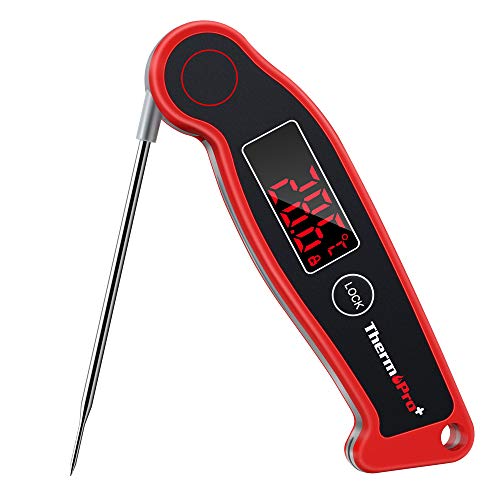
The purchase link and the price box on this page point to exactly the ASIN B07QMRKLL4. On 14 October 2026, Amazon.de listed the TP-19 entry at €18.99 and the TP19H listings at €14.99; our price box (approx. €19) therefore corresponds to the TP-19 entry. The product photo on this page also differs from the manual drawing: it shows a red and black device with the probe unfolded, red digits on a black display, a hole at the end of the handle and the lettering ThermoPro+. On the front, only one labelled button is visible, LOCK; the drawing in the TP19H manual shows two on the front, LOCK and LIGHT. We cannot say for certain which device the photo shows. Check the model number on the Amazon page: TP-19H is the device this page is about.
What is missing from the documents
We did not find the following, either on the manufacturer’s page, in the manual or in the Amazon catalogue:
- Market launch or model year of the TP19H
- Measuring conditions for the response time and for the 3,000 hours of battery life, plus power consumption and standby behaviour
- Accuracy above 100 °C, that is, in the range up to 300 °C that the display shows
- Probe diameter, minimum insertion depth and the total length when unfolded
- Weight, material and surface of the housing and handle from the manufacturer
- Contents of the box from the manufacturer, including whether a screwdriver and instructions are in the box
- The values of the temperature table that the manual lists under the product features
- Whether the display shows tenths of a degree at all temperatures
- Heat resistance of the housing and permitted ambient temperature range
- Why the battery compartment has to be open for calibration
- A German manual and warranty terms for purchases in Germany
- A German manufacturer shop with a euro price, an EU authorised representative or importer, and a German service address beyond the printed phone number
- An explicit statement of origin from the manufacturer
What else is worth considering?
| Model | The difference | Price | Our rating | Choose this if |
|---|---|---|---|---|
| ThermoPro TP19H (this one) | Instant-read thermometer for short handheld measurements, without an app | approx. €19 | 7.8 | you want to check meat briefly and put the device away afterwards |
| Habor 022 grill thermometer | same design, €5 less, manufacturer data not documented | approx. €14 | 7.5 | price matters and you check the Habor’s data yourself before buying |
| ThermoPro TP25 | 4 cable probes for continuous measuring, Bluetooth 5.0 | approx. €37 | 8.4 | you want to monitor several pieces over hours |
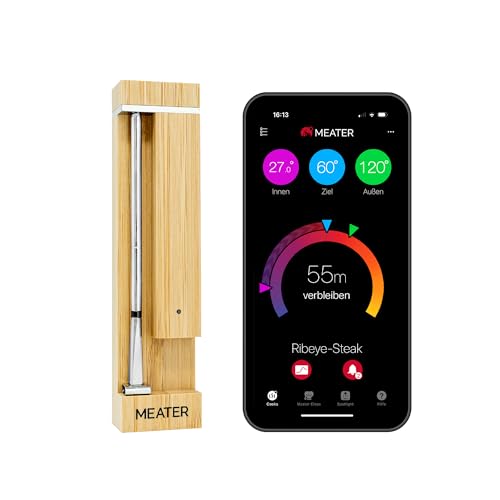
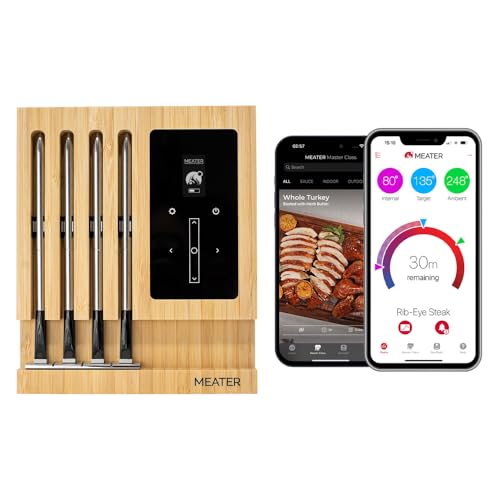
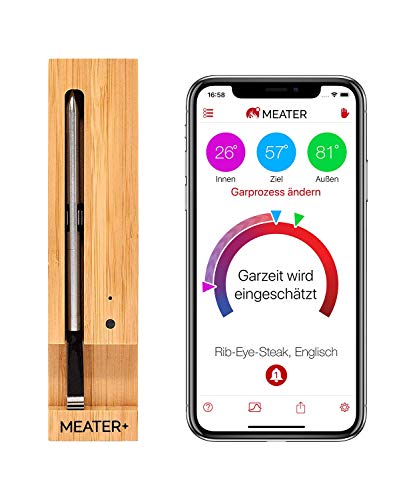
| MEATER 2 Plus | wireless probe that stays in the meat, ambient up to 550 °C according to the manufacturer | approx. €118 | 9.5 | you want to monitor a large piece through the lid without a cable |
The prices are guide values from the price fields of our review pages; the amount in the shop is what counts. The rating is our editorial assessment based on manufacturer data and not a measurement result; we have not handled any of the four devices.
When the TP19H suits you and when it does not
First, the question of whether you want to check meat briefly or accompany it over hours. The TP19H is built for checking. For accompanying, it is unsuitable, because the manual forbids the oven and leaving it in, which is exactly what that use requires. If you want to keep an eye on a roast or a piece from the smoker over hours, look at the ThermoPro TP25 with four cable probes, in our price box approx. €18 more than the TP19H, or at the MEATER 2 Plus, whose probe stays in the meat without a cable. The MEATER, at approx. €99 above the TP19H, costs more than six times as much.
On budget, the Habor 022 in our price box is €5 below the TP19H. We did not find manufacturer data for the Habor, so we cannot say what you get or give up for the €5 less.
For pieces that are done in minutes, response time matters more than for roasting, and here the sources contradict each other. The manual itself calls thin pieces hard to measure. If you mostly grill thin steaks and sausages, in our assessment you would look at the faster TempPro devices. More on choosing is in our guide to grill thermometers.
The TP19H is the wrong choice for anyone who wants an alarm, an app or several probes, and for children under 12 as users, because according to the manual the device is not intended for them. We would pick it if you occasionally check a chicken or a chop for core temperature, put the device in a drawer afterwards and can live with an English manual.