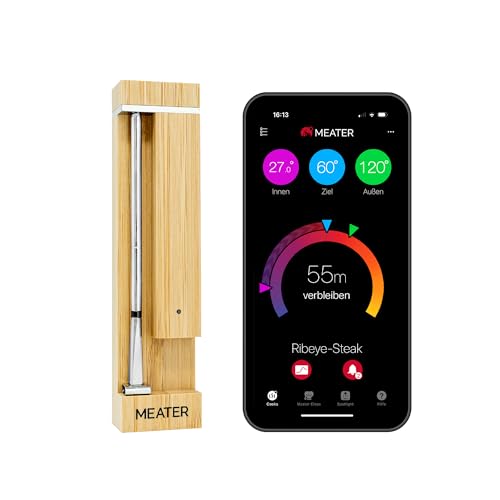
On this page’s product image, the charging station stands upright, a slim bamboo block with a metal band at the top. In the groove on its front lies the silver probe, and next to it a smartphone shows the MEATER app with internal, target and outside temperature and a remaining time. No cables are in sight. That is how the set works, too: the probe sits in the meat and transmits to the charging station, which passes the readings on to your phone over Bluetooth.
The device came onto the market as the MEATER 2 Plus, and MEATER now sells it as the MEATER Pro. Amazon lists the same ASIN under the double name “MEATER Pro / 2 Plus”. The brand belongs to Apption Labs Limited, which calls itself “A Traeger Company” in the safety notes; according to the same notes, the importer for Germany is Apption Labs GmbH in Munich. Our guide price is approx. €118. In our grill thermometers category, ten other devices sit alongside it, three of which the table further down compares directly with it.
Probe and charging station
The probe is made of stainless steel and carries a band of zirconia ceramic. According to MEATER support, the wireless signal passes through this band. That makes sense, because a closed metal shell would shield it. In the support guide the probe is listed at 130 mm length, 5 mm diameter and 14.5 g, and on the product page MEATER advertises it as 30% thinner than previous MEATER probes. In the safety notes it is called MT-PR20.
The charging station (MT-CP20) is made of bamboo, and the contacts where the probe charges are made of stainless steel. The metal band at the top is meant to protect against water and make insertion easier. At the back are magnets for metal surfaces and a rubber nub against slipping. The product page gives 15.7 x 3.7 x 2.3 cm, and the support guide a weight of 10 ounces, about 283 g converted. Power comes from one AAA battery, and on new devices a protective strip in the battery compartment has to be removed before starting. There are no buttons. An LED reports the battery status: if it lights green for three seconds when you take the probe out, all is well; if it stays dark, a replacement is due.
According to the support guide, the box contains the charging station, AAA alkaline battery, probe, three flyers, a safety and operating manual with a QR code and an infographic; devices in MEATER 2 Plus branding also get a calibration certificate. A charging cable is not included, as the station does not need one. In the Amazon catalogue the set carries the model number OSC-MT-MP201. According to the instructions, the product complies with the Radio Equipment Directive 2014/53/EU and with the requirements of the German Food and Feed Code (LFGB) for contact with food.
In detail: why five core sensors
The core temperature is the temperature at the coldest point inside, in a steak the middle of the thickest part. A thermometer with a single sensor only measures where that sensor sits, usually near the tip. If you insert it a few millimetres off, the sensor lies in warmer meat, the reading is too high, and the piece comes off the grill too early.
MEATER places five core sensors in the first few centimetres of the probe, between the tip and the safety notch. On the main screen the app always shows the lowest of the five values, and a tap on the core temperature dot reveals all five. One of the sensors is closest to the coldest spot, and its value is the one that matters.
MEATER answers how accurately the probe measures in two versions. The German product page says 0.3 °C. An English support article gives ±0.1 °C for the Pro probes and equates that with ±0.1 °F, which does not add up mathematically: a tenth of a degree Fahrenheit is about 0.06 °C. The display is in tenths of a degree. Our assessment: even the coarser of the two figures is no bottleneck at the grill. During resting, the core temperature rises by 2 to 3 °C, and for large roasts by up to 5 °C, as our core temperature chart shows. That is many times the measurement deviation.
The sixth sensor measures the surroundings. According to support, it is accurate to ±5 °C, relative to the temperature at its own position, and MEATER stresses there that it is not built to measure or confirm the set cooking chamber temperature of your grill. The app needs it for the cooking time estimate, which an algorithm calculates from the core and ambient values. The ambient value only becomes visible once it is 5 °C above the core value. For the cooking chamber temperature in a smoker, a dedicated chamber probe remains the benchmark in our assessment.
The product page and instructions agree on the limits: 105 °C for the core sensor, 550 °C for the ambient sensor. If a value comes close, the app warns. The MEATER FAQ also describes an optional alarm at an ambient temperature of 275 °C, introduced with the MEATER 2, intended as a warning against flare-ups and grease fires and switchable off for each cook. Up to four alerts can be set per probe, triggered by core temperature, ambient temperature or time. At the low end, operation stops at minus 10 °C according to the support guide.
How far does the signal reach from the grill to the phone?
From the charging station to the smartphone, MEATER states up to 75 metres, as an average value outdoors without obstacles. The first leg is shorter: the probe transmits at most 10 metres, and only to the charging station. It never connects directly to the phone.
For placement this means: the station belongs as close to the grill as is safely possible, as the support article on range puts it. According to support, it can be operated up to 60 °C, and if it gets too hot, the app raises an alarm. What the instructions say about hot surfaces is covered further down under the warnings.
The support guide grades the range by cooking appliance. Rotisserie, gas grill, oven and kamado reach the full value, kettle grill and smoker up to 68 m. Transmission is by Bluetooth 5.2 in Coded PHY mode, which MEATER calls “Long Range”. Whatever stands between station and phone costs range: walls, closed doors and furniture, plus other Bluetooth and Wi-Fi devices nearby. When grilling with the lid closed, one more point applies: according to MEATER, the metal lid of a gas or charcoal grill can act like a Faraday cage.
The station has no Wi-Fi. Among the MEATER models, according to support, only the Block, Pro Duo and Pro XL have it. You get more range in the house with MEATER Link over your Wi-Fi, and on the move you need MEATER Cloud; then you see the readings wherever your phone has internet. Both routes require a second Android or iOS device that stays within Bluetooth range of the station and is connected to Wi-Fi. An old smartphone from the drawer works as a bridge, as long as the app still runs on it.
Before you grill for the first time
If you only open the box on barbecue night, you will not start straight away. The probe has to charge in the station for at least a quarter of an hour, even when brand new. It has no switch; as soon as you take it out, it establishes the connection.
Without a MEATER Cloud account the app cannot be used, and before the first cook you have to watch three introductory videos, each shorter than 30 seconds. The product page requires iOS 15 or Android 8 and newer. The app includes the MEATER Master Class recipe guide.
The probe contains a 2.4 V, 3 mAh rechargeable battery, according to the instructions, and it can only be charged in the station. The product page calculates it like this: 5 minutes of charging is enough for 2 hours of cooking, 15 minutes for up to 12 hours, 30 minutes for 24 hours, and fully charged the probe lasts 24 hours and longer. If a piece is to stay in the smoker for longer than half a day, the quarter of an hour is not enough, and you charge fully beforehand.
What the probe withstands and what the instructions require
The product page lists thirteen cooking methods: pellet grill, kettle grill, gas grill, smoker, kamado, rotisserie, induction, oven, griddle, steamer, deep fryer, air fryer and sous-vide. According to support, the stainless steel housing of the ambient sensor is designed for direct heat: within the limits, MEATER approves the probe for indirect and direct cooking, for frying, for searing and for open fire. For the MEATER Plus, the same article takes a different view: its Alpha probe has a ceramic end intended only for indirect heat.
The German instructions are considerably more cautious on the charcoal grill. Their procedure has twelve steps:
- Always insert the probe into the food past the safety notch.
- Before cooking, check that it is inserted correctly, sits firmly and is not loose.
- Do not cook with MEATER if it cannot be inserted past the notch.
- Always wash your hands after handling raw meat.
- Place the meat on the grill over indirect heat.
- Do not remove the probe before the meat has been taken off the grill.
- Always wear safety goggles when you pull out a probe that has been exposed to higher than permitted temperatures or has touched hot coals or direct flames.
- Carefully take the meat off the grill when the app prompts you to.
- Make sure the ambient temperature has dropped to a safe level before the probe comes out.
- If it is hard to remove, pull and twist at the outer end, but do not bend it against the meat.
- Once it is out, sear the meat over direct heat above the embers.
- Then serve.
Support and instructions draw different limits. Support describes what the probe withstands, the instructions how MEATER would proceed on a charcoal grill. We would stick to the instructions, because then the probe is never pulled out of the meat over open embers. The procedure is the reverse sear that our guide to direct and indirect heat describes.
In the warning about the risk of burns, the instructions state that the probe can explode and cause serious injury or burns if you ignore these points:
- Always insert it past the safety notch to avoid product damage and injury.
- Do not place the charging station on or near a hot surface.
- Do not pull out the probe while it is exposed to heat. Insert and remove it only away from all heat sources.
- If the probe falls into the fire or a direct heat source: close the lid of the grill or cooking appliance and switch the appliance off immediately.
- Let the probe cool down completely before you take it out.
- Do not allow contact with hot charcoal or coals.
- The probe is hot during and after use; handle it only with heat-resistant gloves.
According to a separate support article, only the probes of the Pro series, to which this one belongs, may be fully submerged, for example in the deep fryer or in a sous-vide bath. The liquid can, however, distort the ambient value. For such cases MEATER advises creating a Custom Cook in the app instead of a guided programme, and bringing the charging station as close as possible. When deep frying, according to support the inside of the food usually stays within the permitted range, but you should still keep an eye on the core sensor’s limit.
According to the instructions, the product is intended for use in food only and is to be used only for its intended purpose. In the FAQ, MEATER writes that the probe was developed specifically for meat. According to the same FAQ, damage from use for other purposes can cost you the warranty, and for other foods the manufacturer promises no particular result.
Care and warranty
According to support, residues from cooking are the most common reason when a probe does not charge or finds no connection. The support guide provides for washing it by hand before and after every use, according to the cleaning article with hot soapy water and the rough side of a sponge, then drying it. If something is stuck on, a scouring pad is allowed, or a paste of three parts baking soda to one part water or white vinegar. You clean the flat end as well, and you are done when the stainless steel is completely silver. You wipe the contact area of the charging station with a dry cloth. Once the probe is completely dry, it charges for 15 minutes again.
Under product damage the instructions list eight points. Two of them appear almost word for word in the warnings above: the rule on the safety notch and the ban on placing the charging station on a hot surface. The remaining six are: do not use in the microwave or pressure cooker; do not drop the probe onto hard surfaces; do not use cleaning agents containing alcohol, ammonia, benzene or abrasives, because they can damage the device; do not hold the probe under cold water straight after cooking, but let it cool before washing; do not exceed the limits of both sensors, because higher temperatures can damage the probe; store dry and cool when not in use. Support explains why the pressure cooker is off limits: the pressure can force moisture into the probe, and such use can end the warranty.
The instructions exclude cleaning agents with abrasives, while support recommends a scouring pad and baking soda for stubborn residues. MEATER does not explain how the two fit together. We would start with soapy water and only reach for the baking soda paste if the contacts cannot be cleaned any other way.
Two further warnings in the instructions stand on their own. You keep the charger away from water and liquids, otherwise there is a risk of electric shock, and the probe only goes back into the station completely dry. Keep the tip away from fingers and body, because contact can injure, and keep the probe out of the reach of children.
According to the MEATER warranty page, the warranty in the EU runs for two years and covers defects in parts, materials and workmanship, provided you bought from Apption Labs or an authorised retailer. You may only send it in when asked; without a previously issued RMA number, MEATER does not process a shipment. The same page names five cases in which the warranty expires: the safety instructions for proper use were not followed, you or the cooking appliance accidentally caused damage, the device was used commercially, it was tampered with, or it was taken to a country where MEATER is not certified for sale. According to the instructions, the warranty does not cover shipping costs for warranty parts or warranty products.
Separate from this is the return. MEATER grants the 30-day return against a refund only for purchases in its own online shop. MEATER itself does not take back purchases from retailers or third-party sellers, including those from Amazon. Return and withdrawal then go through the retailer you bought from.
MEATER currently does not sell single probes in its web shop. If you lose one or the warranty has expired, you get a replacement via support, possibly free of charge in a warranty case. According to the instructions, old devices and batteries do not belong in household waste.
What MEATER leaves open
What is missing most is a number that counts when inserting: where the safety notch sits, that is, how deep the probe has to be in the meat at a minimum. With a thin schnitzel that is the first question, and none of our sources answers it in millimetres. Equally open are the price of a replacement probe, the number of charge cycles the battery in the probe can take, and an ingress protection rating under the IP code; MEATER writes only waterproof, with no immersion depth or duration. Which retailers count as authorised is not clear from the warranty documents.
Less important when buying, but equally undocumented: the release year of the MEATER 2 Plus, the place of manufacture, the response time, the interval at which the probe measures and transmits, and the lower measuring range of the core sensors. It also remains open what is in the three flyers and the infographic from the box.
Some statements contradict each other. The probe length is given in the Amazon catalogue as 4.41 inches, around 112 mm, so shorter than the manufacturer states; we go with MEATER. The dimensions of the charging station also differ between the product page and the support guide, the guide giving 158 x 38 mm. On the operating system, the support guide says iOS 14, the product page iOS 15. If your iPhone still runs iOS 14, check in the App Store before buying whether the MEATER app can be installed. And the warranty text in the instructions for this device speaks literally of the MEATER Plus product.
Correction note: an earlier version of this page gave the measurement accuracy as ±0.05 °C. That figure appears in no MEATER source that we found; the two manufacturer values are given above in the section on the core sensors.
Three alternatives from our catalogue
| Model | The difference | Price | Our rating | Choose this one if |
|---|---|---|---|---|
| MEATER 2 Plus (this one) | Ambient sensor up to 550 °C, five core sensors, one probe | approx. €118 | 9.5 | you want to leave the probe in fat, in a water bath or over embers |
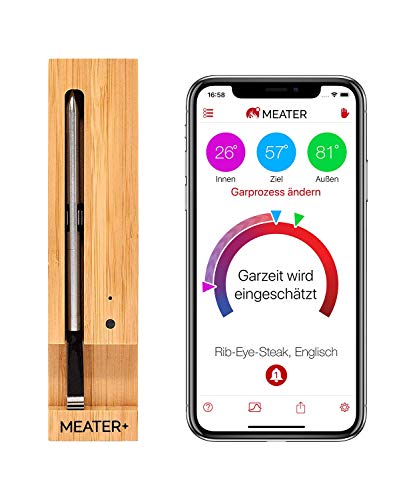
| MEATER Plus | Alpha probe with ceramic end up to 275 °C, according to MEATER only for indirect heat | approx. €75 | 8.9 | you cook almost only indirectly and pull the probe out before searing anyway |
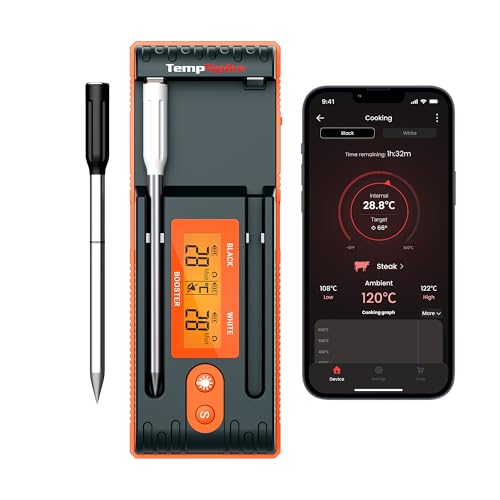
| ThermoPro TempSpike (TP960) | one core sensor with ±1.0 °C, ambient up to 300 °C | approx. €63 | 8.9 | you want to measure wirelessly and one degree of accuracy is enough for you |
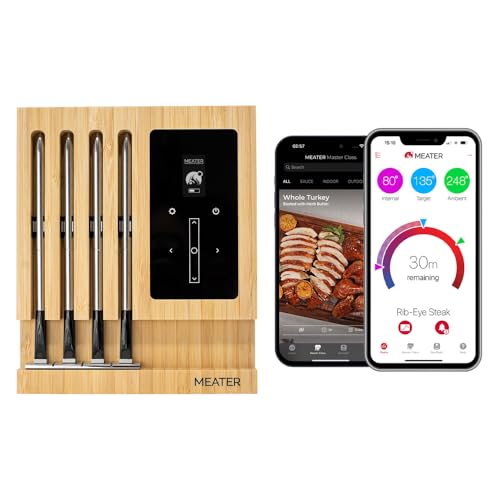
| MEATER Block | four Alpha probes on one station with Wi-Fi and display | approx. €229 | 9.1 | you often cook several pieces at once and want remote access without a second phone |
The prices are guide values from our data sheets; what the price box at the shop shows may differ. The rating is our editorial assessment from the data comparison. Which of the four devices comes closer to the true temperature in the meat is not answered by the table; for that, all four would have to be in the same piece.
When the MEATER 2 Plus suits you and when it does not
First, the question of how many pieces lie on the grate at the same time, because a set has one probe. For two pieces, MEATER sells the Pro Duo with two probes and Wi-Fi, where each probe gets its own doneness. The MEATER Block has four probes on one station and costs €111 more in our table. According to support, however, it contains Alpha probes, so the design of the MEATER Plus from the table. In the German MEATER shop, the Block was not listed on 24 September 2026.
Then the way you grill. The €43 by which the 2 Plus costs more than the MEATER Plus according to our guide prices pays for the approvals from the section on what the probe withstands. Among the four devices in the table, we found them in full only for this one. If you grill almost only indirectly, you pay this premium for uses you do not need.
On budget, the ThermoPro TempSpike is €55 below the 2 Plus according to our guide prices. ThermoPro gives it a core range of minus 10 to 100 °C and the IP67 rating for the probe. ThermoPro puts its Bluetooth range at 500 ft, around 152 m. This is only partly comparable with MEATER’s figure: MEATER means an average outdoors without obstacles, while ThermoPro does not say under which conditions the value arose, and like MEATER points out that walls and grill lids reduce the range.
The 2 Plus is the wrong choice for anyone who wants to measure without a smartphone. The charging station has no display, only the status LED, and MEATER’s support article on standalone mode describes operation without a phone only for the Block and Pro XL.