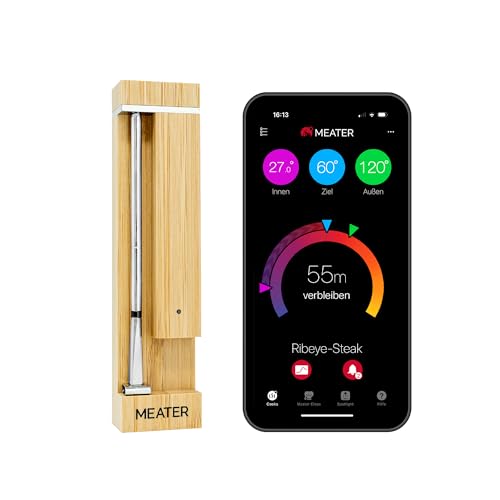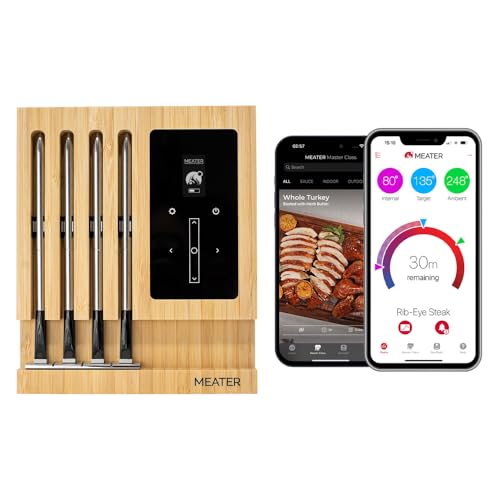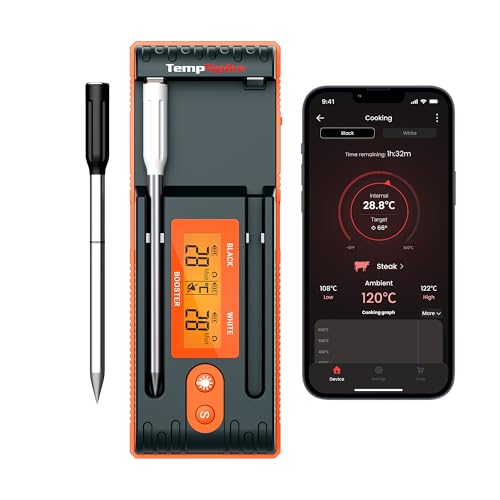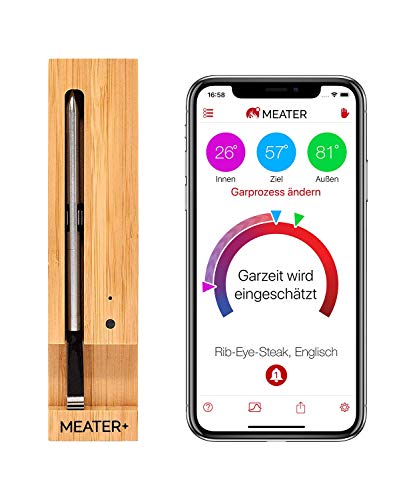
The MEATER Plus measures core temperature with a single probe that has no cable attached. The probe sits in the meat and transmits to a wooden charging station, which passes the signal on to your smartphone via Bluetooth. In the German FAQ the device is called “MEATER Plus of the first generation”. The second generation, which we list as the MEATER 2 Plus, is now sold by MEATER under the name MEATER Pro. The Plus has not been retired for that reason: on 1 October 2026 it was available in the German MEATER online shop in a single version alongside MEATER SE, Pro, Pro Duo and Pro XL.
The brand is owned by Apption Labs Limited, according to the instructions “A Traeger Company”, with a GmbH in Munich as importer for Germany. At Amazon the Plus appears in our price box at approx. €74.90 (as of September 2026), which makes it the cheaper of the two MEATER sets with one probe in our grill thermometers category.
Probe and charging station
According to the support guide, the box contains four parts: charging station, AAA alkaline battery, probe, and a safety and operating manual. A power adapter is not included; the station runs on the battery, a 1.5 V AAA cell.
The probe is 130 mm long and 6 mm thick, and the support guide gives its weight as 10.6 g. Its shaft is made of food-safe stainless steel, the black end of heat-resistant ceramic. This end sticks out of the meat during cooking and houses the ambient sensor. For the probe’s own rechargeable battery the instructions state 2.4 V and 3 mAh; it transmits with Bluetooth LE 4.0 in the range from 2402 to 2480 MHz. In its declaration of conformity it cites Directive 2014/53/EU for the radio link and the LFGB (German food and consumer goods code) for contact with food. There is no on/off switch: when you take the probe out of the station it switches on, and when you put it back it ends the connection.
On the charging station, MEATER’s own sources disagree: the German product page speaks of real wood and 157 x 37 x 28 mm, the English support guide of bamboo and 158 x 38 x 23 mm, and support also gives its 283.5 g for the plastic station of the MEATER SE.
On the front of the station there are a black button and an LED. Pressing the button checks the battery: green means good, red or dark means replace it. If the LED flashes green, the probe is connected; if it flashes red, the station cannot find it. While the probe is charging or sits fully charged in the station, the LED stays off. In the product image on this page it sits tip up in a recess on the front, and according to the FAQ that is exactly how it should lie when you are not using it. According to MEATER it cannot overcharge there.
In detail: one measuring point, about two centimetres behind the tip
The Plus has one core sensor, the Pro models have five. Where this one sits is stated twice in the German MEATER FAQ, slightly differently: about 2 cm from the pointed end in one place, about 2.5 cm in another. In our guide to grill thermometers we state that for classic insertion thermometers the sensor sits in the first few millimetres of the needle. On the MEATER it sits a good deal further back, and that shifts the correct insertion point.
Measurement takes place where the sensor sits. If the reading is to come from the centre of a roast, then by our calculation the tip must reach about two centimetres beyond the centre. MEATER sets two limits for insertion: always past the minimum insertion depth marking, called the safety notch in the instructions, but never as far as the black ceramic part. We explain the second limit by the ambient sensor in the ceramic end, which is meant to capture the air around the meat. For removal, the FAQ advises pulling the probe out straight or turning it carefully, and not moving it back and forth.
For the core sensor, MEATER support gives an accuracy of ±0.5 °C, for the Pro probes ±0.1 °C. According to the same source, the ambient sensor in the ceramic end is accurate to ±5 °C, relative to the temperature at its own position, and MEATER stresses there in capital letters that it is NOT built to measure or confirm the set temperature of your grill or oven. It feeds the app’s cooking time estimate. Its value is only displayed once it is at least 5 °C above the core temperature; until then a dash is shown. According to the FAQ, you can still use the probe as a pure ambient thermometer if an apple or a potato shields the core sensor.
The core sensor is rated up to 100 °C. Even for target temperatures above 90 °C the app shows a warning, because the cooking time estimate becomes less accurate there. Our core temperature chart puts pulled pork at 88 to 95 °C. For a pork shoulder from the smoker that means the target value often lands in the warning range but stays below the sensor’s limit.
Is 275 °C at the probe end enough for your grill?
For indirect cooking yes, as long as the cooking chamber stays below 275 °C, for direct heat no. According to MEATER, the black ceramic end withstands that much, but it is built only for indirect heat.
You should keep an eye on the limit especially on a kamado or a fully fired kettle grill, as both can exceed this value even at a distance from the fire. If one of the two sensors approaches its limit, the app warns you; that is what the instructions say.
The German product page states the sentence verbatim: “We do not recommend open flame grilling with the MEATER Plus.” Anyone planning that is directed there to Pro, Pro Duo and Pro XL. Support justifies the limit with the material. The ceramic housing of the Alpha probes, which besides the Plus include the original MEATER, SE and Block, is built for indirect cooking methods within the limits, and anyone who sears with the probe inserted can damage the ambient sensor. Its advice is reverse searing: first cook indirectly with the probe, then remove the probe and sear hot. How to set up two zones for this is explained in our guide to direct and indirect heat.
The German instructions (as of 03/2025) describe the procedure on a charcoal grill in five steps. Before cooking you check that the probe sits firmly, and if it cannot be inserted that far, you do not cook with the MEATER. You take the meat off the grill when the app prompts you to, and only then pull the probe, once the ambient temperature has reached a safe level. If it sticks, you twist at the end of the ambient sensor and pull. Anyone removing a probe that has been exposed to higher than the maximum permitted temperatures or has come into contact with hot coals or open fire always wears safety goggles. After handling raw meat you wash your hands. One sentence of this procedure is printed garbled in the German version: “Do NOT bend the probe so that it comes into contact with meat.”
Under burn hazard, the same instructions warn that the probe could explode and cause serious injuries or burns if you ignore their notes. The safety notch, safety goggles and the heat prohibitions are listed above in the procedure; in addition:
- Do not pull out the probe while it is exposed to heat. Insert and remove it only away from all heat sources.
- If it falls into the fire or onto a direct heat source: switch off the cooking appliance, close the lid immediately and let the probe cool down completely before you take it out.
- It is hot during and after use; handle it only with heat-resistant gloves.
The Plus copes with liquid less well than the Pro series. According to support it is water-repellent but not waterproof, and Alpha probes should not be submerged at all; MEATER leaves deep frying and sous vide to the Pro models. The German product page nevertheless lists sous vide among the cooking methods, alongside pellet grill, kettle grill, gas grill, smoker, kamado, rotisserie, induction, oven, griddle, steamer and air fryer, and the Amazon title advertises oven, grill, pan and rotisserie. For the water bath we follow support, because it justifies its refusal with the construction.
Wireless range in two stages
From the probe to the charging station the signal manages up to 10 m according to the support guide. The station works as a Bluetooth repeater and passes it on to the smartphone. For this second stage, the data sheet of the same guide says 40 m, elsewhere on the page and on the German product page 50 m; MEATER understands the 50 m as an average outdoors without obstacles.
Graded by cooking appliance, counted from the probe to the smartphone, the guide gives up to 50 m for rotisserie, gas grill, oven and kamado, and up to 43 m for kettle grill and smoker. According to a separate support article, a closed metal lid can act like a Faraday cage, as can the cooking chamber of a smoker or oven and aluminium foil around the meat. In combination ovens, according to the FAQ, even the door can block the connection, even when the microwave is off. Obstacles, the wall thickness of the cooking appliance and the smartphone model cost additional range. The probe can also connect directly to the phone, but over a much shorter distance.
This leads to the placement advice from the product page: during cooking the station always stays near the probe. It is not fireproof, though. Support does not want to see it on or next to hot surfaces, such as the side of a running grill, nor in direct sun; it can be operated up to 60 °C. The magnets on its back, which MEATER promotes for storage, invite you to stick it to the grill wall. On a hot grill, that is exactly what is ruled out.
App, setup and charging
The set has no display; all values appear in the MEATER app. The screenshot in the product image shows what that looks like: three circles for internal, target and external temperature, below them the line “Cooking time is being estimated” and the chosen dish, a medium-rare rib-eye steak. According to the product page the app runs on iOS 14.0 and Android 8.0 and later. The German FAQ differs, naming iOS 12.2, as well as Macs with an Apple silicon chip and Fire OS 8.
Before the first cook, MEATER requires three introduction videos of under 30 seconds each. They can be skipped, but according to support you must have watched all three before the first piece starts. After that you choose the type of meat and the doneness, and a guided mode accompanies you step by step. An estimation algorithm projects cooking time and resting time, and when the target temperature is reached, a notification arrives. You set your own alarms by core temperature, ambient temperature or time, at most four per probe. You can follow the cook on the Apple Watch, from Series 3 with watchOS 7.
According to the product page, the probe’s battery lasts over 24 hours of continuous cooking. On charging time, the figures differ: the support guide puts the first charge at 4 hours and 2 hours after that, while the setup article and the German FAQ require at least 2 hours before first use. We would give a new Plus the four hours before the first piece goes on the grate.
Cleaning, product damage and warranty
After cooking, hot soapy water with the rough side of a sponge is usually enough according to support, and the probe may also go under running water. Afterwards it must dry completely. The instructions justify this with the risk of electric shock: the charger belongs away from water and liquids, and the probe only goes back into the station once completely dry. On the dishwasher, MEATER comments in four places, and inconsistently; the details are in the frequently asked questions for this device.
Under product damage, the instructions list ten points. They also rule out:
- do not use in the microwave or pressure cooker;
- do not drop the probe onto hard surfaces;
- no cleaning agents containing alcohol, ammonia, benzene or abrasives, as they can damage the device;
- do not immerse the probe in water for a longer period;
- do not hold it under cold water immediately after cooking, let it cool before washing;
- do not expose the charger to moisture, keep it covered in bad weather and do not put it in the sink;
- store the probe dry and cool when not in use. The product is intended only for use with food and only for its intended purpose.
Support also rules out the pressure cooker, with a reason: the high pressure can force moisture into the probe and damage the electronics, and such use can put the warranty at risk. Two notes stand on their own in the instructions. The tip should be kept away from fingers and body, because contact can cause injury, and the probe out of reach of children. And because raw or undercooked meat, poultry or seafood can increase the risk of food poisoning, you should always cook to safe temperatures; as a benchmark the instructions name the guidelines of the US authority USDA.
For the full warranty terms the instructions refer to MEATER’s warranty page online, but include a version themselves. According to it, for purchases in the EU the warranty runs two years from the purchase date and covers defects in parts, materials and workmanship under normal use and maintenance; shipping costs for warranty parts are excluded, as are incidental and consequential damages. It can lapse if the product is not assembled or operated according to the instructions for use, on resale or transfer to another owner, with incompatible components or accessories, in commercial or catering use, and in cases of misuse or lack of maintenance. You had better keep the proof of purchase, as Apption Labs may ask for it.
The warranty page in the German MEATER shop ties the warranty to the way of purchase: it is meant to apply to purchases from Apption Labs or an authorised retailer or partner. Which retailers count is not stated there, and so we cannot say whether a purchase through the Amazon or Santos links on this page falls under it. Anyone who wants to rely firmly on the manufacturer’s warranty should, in our assessment, buy in the MEATER online shop or ask support beforehand; the seller’s statutory warranty rights are in principle unaffected by this. The page also lists its own five reasons for which the warranty lapses: safety instructions for proper use not followed, accidental damage caused by you or the cooking appliance, commercial use, tampering, and a device taken to a country where MEATER is not certified. We assign heat damage from cooking above the limits to the first or second point. Returns are only accepted with an RMA number, which customer service issues beforehand.
Separate from this is the 30-day return. The product page grants it for purchases in the MEATER online shop, counted from the purchase date and for goods that are new, unused and in the original packaging. If you buy elsewhere, the seller’s return conditions apply.
What remains open
Some details that matter when buying are missing from all the MEATER documents we opened, that is, product page, German FAQ, support articles, warranty page and instructions:
- how far the safety notch is from the tip and therefore how thick a piece must be at minimum;
- which retailers MEATER lists as authorised for the warranty;
- an IP code protection rating for the probe;
- the battery type in the probe;
- the lower measuring limit of the core sensor; only a lowest operating temperature of minus 10 °C is documented;
- how often the app receives new readings;
- the Bluetooth version of the charging station;
- the prices for replacement probes and replacement stations;
- market launch and country of manufacture.
One gap concerns buying directly. None of the manufacturer shops, that is meater.eu, MEATER’s US shop and traeger.com, links to Amazon, and the model number RT3-MT-MP01 from the Amazon catalogue appears nowhere in the manufacturer documents. The instructions list the charging station as MT-CP01 in the conformity section, as MT-ME01 in their data table, and the probes as MT-PR00 and MT-PR10. That the Amazon listing corresponds to the Plus from the MEATER shop rests on title, brand and manufacturer in the catalogue.
What else in our catalogue comes into question
| Model | The difference | Price | Our rating | Choose this one if |
|---|---|---|---|---|
| MEATER Plus (this one) | one probe with one core sensor, ceramic end up to 275 °C | approx. €74.90 | 8.9 | you want to monitor one piece without a cable and ±0.5 °C at the core matters to you |
| MEATER 2 Plus | Pro probe with five core sensors, ambient up to 550 °C | approx. €118 | 9.5 | the probe should also stay in during searing, in the deep fryer or in a water bath |
| ThermoPro TempSpike (TP960) | probe protected to IP67 according to ThermoPro, core ±1.0 °C | approx. €63 | 8.9 | ±1.0 °C at the core is enough for you and you want to save around €18 |
| Inkbird IBT-4XS | base unit with display and wired probes, two or four depending on the variant | approx. €60 | 8.8 | you measure several pieces at once and accept cables under the lid |
The prices are the guide values from the data sheets of the respective pages, with differing dates; a different amount may be shown in the shop. The rating is our editorial assessment from comparing the manufacturer data, not a measurement result, because none of the four devices was in use with us.
Who the MEATER Plus suits and who it does not
First, it depends on how you grill. If you cook roasts and poultry indirectly and steaks by the reverse method, as described above, the Plus will do. The Pro probe of the MEATER 2 Plus is rated up to 105 °C at the core and up to 550 °C for the ambient sensor, and in our catalogue the MEATER 2 Plus costs around €43 more than the Plus.
Charging is the second difference. According to support the Pro probe needs 15 minutes in the station, one eighth of the Plus’s time, and MEATER gives its range as typically around 75 m. Our assessment: if you keep the probe in the station as MEATER recommends, you will usually have it charged and ready. The longer charging time mainly affects anyone who needs it again right after a long cook.
The ThermoPro TempSpike also measures without a cable. ThermoPro gives an ambient range up to 300 °C for its probe, and it transmits with Bluetooth 5.2. ThermoPro states the ambient range up to 300 °C, 25 degrees more than MEATER for the Plus; if you often cook between 275 and 300 °C in a kamado, you have more headroom there.
If several pieces often lie on the grate at once, a single Plus helps little, because every set has exactly one probe. The Inkbird IBT-4XS, around €15 cheaper than the Plus in our data sheet, is built differently: its probes hang on cables from a base unit, which according to Inkbird has a 1000 mAh battery for about 20 hours and whose plastic housing tolerates at most 55 °C. So it belongs next to the grill, not on it.
The Plus is the wrong choice for anyone who mainly grills sausages and thin steaks directly. It also does not suit anyone who wants to measure without a smartphone, because apart from an LED the station shows nothing.
Correction note: Earlier versions of this page stated a measurement accuracy of ±0.05 °C, an all-metal probe, an AAA battery in the probe and a metal charging case, and also described our own cooking trials with roasts and chicken. None of these statements matches MEATER’s documents, and the editorial team never carried out cooking trials with the Plus.