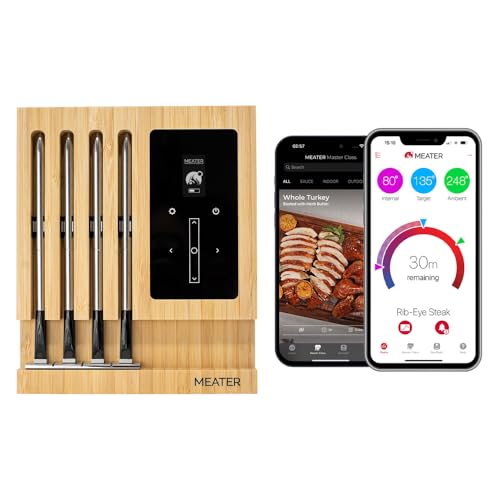
Four wireless probes and a station that charges them, receives their readings and passes them on over Wi-Fi: that is the MEATER Block. In the product image the probes stand upright in four slots of a bamboo block, tips up, black ends down. To the right, on a black panel, sits the display with a handful of control symbols.
Amazon lists ASIN B07TJ95CBM as “MEATER Block” with model number OSC-MT-MB01, manufacturer Apption Labs. According to the safety notes the brand belongs to Apption Labs Limited, which calls itself “A Traeger Company”; Apption Labs GmbH in Munich imports it into Germany. In our price box the Block stands at approx. €229 at Amazon. We cannot assign a date to this value, because when we queried the catalogue on 24.09.2026 Amazon returned no price for the Block. For the other thermometers we compare, see the category grill thermometers.
Correction note: an earlier version of this page gave a measurement accuracy of ±0.05 °C, a heat resistance up to 500 °C “directly at the grill”, an AAA battery in each probe and up to 100 m of range via the hub. For the Block, MEATER gives different values; they are in the sections below.
Four probes, one bamboo station
According to MEATER, the box contains four numbered probes, the Wi-Fi-capable charging station with built-in OLED display and four AA batteries. A Micro-USB cable is not included, and MEATER does not sell one separately. Any Micro-USB cable with 5 V fits.
Each probe is 130 mm long and 6 mm wide, weighs 10.6 g and is made of food-safe stainless steel and heat-resistant ceramic. The rear end is square and black, and it stays outside the meat during cooking. A number is engraved into the flat end, which also appears in the app. If two equally large pork neck pieces are on the grate, this lets you assign each reading to the right piece. According to the manual, each probe contains a 2.4 V, 3 mAh battery, charged only in the station.
The station is made of bamboo and measures 158 mm in height, 132 mm in width and 38 mm in depth. The weight is given in the support guide as 3 lb, which is about 1.36 kg. The station comes with a stand, which the MEATER troubleshooting help mentions for drop damage: if it is missing or dented, that counts there as a sign of an impact. The station is operated via the OLED display and a capacitive touch panel. The display reports the station’s battery level, whether the probes are connected and whether Wi-Fi and MEATER Cloud are up; in the menu you set Celsius or Fahrenheit and find the firmware version.
The station has no built-in battery. Power comes from the four batteries or via Micro-USB. If a cable is plugged in, it powers the station instead of the batteries; it cannot charge them. MEATER nevertheless advises always leaving the batteries inserted. According to the manual, the Block meets the EU Radio Equipment Directive 2014/53/EU and, for contact with food, the requirements of the LFGB (the German Food and Feed Code).
In detail: one core sensor, two wireless links
The core temperature is the temperature at the coldest point of a piece, usually in the middle of its thickest part and away from the bone. A probe with only one core sensor measures exactly where that sensor sits.
That is the case with the Block. Its probes belong to what MEATER calls the Alpha Collection, the same design as the original MEATER and the MEATER Plus, and according to support their core sensor sits about 2 cm behind the tip. In our assessment, an insertion rule follows from this: that point belongs in the middle of the piece, not the tip. If only the tip is in the middle, the sensor sits two centimetres further out in warmer meat, the reading is too high, and the piece comes off the grill too early. According to MEATER, the MEATER 2 Plus has five core sensors, so less depends on a single measuring point.
MEATER puts the accuracy of the core sensor at ±0.5 °C. The probes are calibrated at the factory, and you do not need to recalibrate them. During resting a piece keeps cooking anyway; our core temperature chart allows for 2 to 3 °C, and up to 5 °C for large roasts. Against that range, half a degree hardly matters.
The second sensor sits in the black end and measures the temperature around the piece. From both values an algorithm in the app estimates how much longer the meat should cook and then rest. Besides the guided cooking programmes you set your own alarms, triggered by a temperature, a time or both. The limits are 100 °C for the core sensor and 275 °C for the ambient sensor, and the app warns when a value approaches. Pulled pork, at 88 to 95 °C according to our chart, stays below the core limit, though with little headroom. At the low end, operation stops at minus 10 °C.
Transmission happens in two stages. The probes send to the station over Bluetooth LE 4.0, and the station passes the values on over Wi-Fi to a smartphone or tablet. For the first stage the support guide gives up to 10 m, outdoors as well as at the gas grill and in the kamado. In kettle grills, smokers and pellet grills it is up to 3 m, and from the station to the phone outdoors with line of sight up to 50 m. If the station is on Wi-Fi, the connection reaches as far as your network, and with a logged-in MEATER Cloud account you also see the values on the move over mobile data. With a strong connection, the range in Wi-Fi mode is said to be unlimited. None of the metre figures is guaranteed; MEATER explicitly calls them maximum values.
The probes can also connect directly to the phone over Bluetooth without the station, but then with a much shorter range. The station therefore belongs close to the grill, according to support as close as can safely be done. At a kettle grill that means only the phone goes into the house, getting the values over Wi-Fi, while the station stays outside. Exactly where it may stand is governed by the manual and the support guide; more on this under the warnings.
Is the MEATER Block the same as the MEATER Pro XL?
No. Both have four numbered probes and a station with Wi-Fi and OLED display, but the Pro XL has Pro-series probes whose core sensor is rated according to MEATER up to 105 °C and whose ambient sensor up to 550 °C. Its station has a built-in lithium battery, and a USB-C cable is included.
That the ASIN on this page belongs to the Block can be documented. The model number OSC-MT-MB01 from the Amazon catalogue is the Block’s item number in MEATER’s US shop, listed there on 25.09.2026 with the note “Low stock”. The Pro XL has the item number OSC-MT-MX201 in the same shop.
In the German MEATER shop, by contrast, the Block does not appear at all. On 25.09.2026 it listed MEATER SE, Plus, Pro, Pro Duo and Pro XL, and the Block’s product page returned a 404 error.
The Block and Pro XL also differ in charging and washing. According to the support guide, Pro XL probes charge in 15 minutes and are full after 30 minutes, and they may go in the top rack of the dishwasher. How long the Block probes take to charge and what MEATER says about their cleaning is in the next sections. Both models share the standalone mode, which MEATER describes only for these two.
Before the first cook: charging, account, standalone
You cannot go straight from the box to the grill. First you pull a white tab out of the battery compartment, which interrupts the contact to the springs during transport. Then, according to MEATER, the Block should charge for at least 8 hours before you pair it, with the station switched off; the German manual shows a clock symbol with an 8 for this. That stays the same later: the probes only charge while the station is off. If you unpack at midday, the Block is ready by the evening at the earliest.
During setup the smartphone must be on a stable 2.4 GHz Wi-Fi network. The app has you confirm a safety agreement and then shows info pages on the temperature sensors, the battery tab and charging. Four introduction videos of under 30 seconds each are a step of their own: they can be skipped, but you must have watched all four before the first cook. According to the Amazon description, the app guides you through cooking in German. It fetches firmware updates when the station runs in Wi-Fi mode, and the display shows a progress bar while it does so.
Fully charged, a probe lasts 24 hours of cooking time according to the support guide. Between two uses it may stay in the station; it is not overcharged. There is no charging light, so you cannot tell from the probe or the station whether it is currently charging. It is inserted tip up with the flat end at the contact, as in the product image. The app shows how full the station and probe are under “My Devices”. Without a running cook, the station switches off after 15 minutes; during a cook it stays on until the end.
A pulled pork that sits twelve hours in the smoker is managed by a probe on one charge, while the station transmits continuously over Wi-Fi for that time. For such long cooks MEATER provides the Micro-USB port.
The display has a second purpose, the standalone mode. At the station you choose the type of meat and cut or a custom cook, set the doneness or target temperature and follow progress as a bar. When the target temperature is reached, according to MEATER’s description the station sounds a loud beep and shows “Remove from Heat” for each active probe. A countdown then counts down the resting time, and at the end “Ready!” appears next to the peak temperature.
The app learns nothing of the cook in this mode, and history and graph stay empty. In addition, the range ends at the Bluetooth link between probe and station; Wi-Fi or MEATER Link do not extend it.
What the manual requires at the grill
For the Alpha probes MEATER draws a clear line. According to support, their ceramic end is built for indirect cooking within the limits, and anyone who sears with the probe in place can damage the ambient sensor. MEATER therefore advises reverse searing: cook indirectly with the probe, sear hot without it. How to set up two zones for this is explained in our guide to direct and indirect heat.
For the charcoal grill, the German manual specifies this sequence:
- Insert. Always insert the probe past the safety notch, and check before cooking that it sits firmly and is not loose. If it cannot be inserted past the notch, do not cook with the MEATER. Always wash your hands after handling raw meat.
- Cook indirectly. Place the meat over indirect heat, never directly over the coals. Only pull the probe out once the meat has been taken off the grill. Always wear safety goggles when removing a probe that has been exposed to higher than the permitted temperatures or has touched hot coals or open fire.
- Take it off the grill. Carefully, as soon as the app prompts you.
- Remove the probe. Only once the ambient temperature has reached a safe level. If it is stuck, twist and pull at the end of the ambient sensor. “Do NOT bend the probe so that it touches meat,” it continues.
- Sear. Only once the probe is out, then over direct heat on the other side, that is, over the coals.
- Serve.
Under burn hazard, the manual warns that the probe could explode and cause serious injuries or burns if you ignore its instructions. Safety notch, safety goggles, searing only without the probe and distance from the coals belong to this; they are already in the sequence above, and the rules for the station follow in the next paragraph. It also requires:
- Do not use the probe when cooking at more than 275 °C, over hot coals or over open fire.
- Do not pull the probe out while it is exposed to heat; insert and remove it only away from all heat sources.
- If it falls into the fire or a direct heat source: switch off the cooking appliance, close the lid immediately and let the probe cool down completely before you take it out.
- It is hot during and after use, so handle it only with heat-resistant gloves.
The station should be close to the grill but must not get hot itself. These rules from the support guide and the manual (there under burn hazard, electric shock hazard and product damage) apply to it: not above 60 °C, above which it can be damaged; not on the grill lid and neither on nor next to hot surfaces, because the Block is not fireproof, MEATER’s example being the side of a grill that is in operation; no water, no other liquids and no moisture, so not in the sink either, and cover it in bad weather; do not drop it on hard surfaces; store it dry and cool, protected from direct sun, and do not hang it. A probe only goes back into the station once completely dry. Together with the short wireless range in a kettle grill, this gives, in our assessment, a spot on a table or stool next to the grill, in the shade and out of the waste heat, rather than a shelf on the grill itself.
Cleaning, batteries and warranty
According to MEATER, cooking residue is the most common reason a probe does not charge or does not connect, including a film of grease that is invisible to the naked eye. You therefore clean each probe after every use: hot washing-up water, the rough side of a sponge, then dry it. The Alpha probes may go under running water. If that is not enough, support recommends a scouring pad or a paste of three parts baking soda to one part water or white vinegar, especially for the flat end. The stainless steel is clean when it is completely silver. You wipe the station’s contacts dry, let the probes dry completely, and afterwards they should charge as long as at setup.
Under product damage, the probe comes with rules that are not yet listed above: do not use it in the microwave or pressure cooker; do not drop it on hard surfaces; do not use cleaning agents containing alcohol, ammonia, benzene or abrasives, because they can damage the device; do not submerge it in water for long periods; do not hold it under cold water straight after cooking, but let it cool before washing; store it dry and cool when not in use. The other points of this list, that is, safety notch, station and the two sensor limits, are above. The last point carries the sentence that the product is intended only for food and only for its intended purpose.
Of the eight points on the probe care list in the support guide, six are already above, including that the probe can be very hot after cooking and is not handled with bare hands. Two are new. When pulling out, you should pull gently in the direction of insertion and twist, without pressing left, right, up or down on the ceramic handle, otherwise the probe is damaged. The other is at the very top of the list: the Block probes are “not designed to be dishwasher-safe”.
Here MEATER contradicts itself. A separate support article classes the Alpha probes as water-resistant but not waterproof, expects no durability or safety problems from the dishwasher, and still advises hand washing. In the Amazon description the probes are simply called dishwasher-safe. We would wash by hand, since none of the three sources argues against it. Only the probe is water-resistant anyway, the station not at all. It remains open how scouring pad and baking soda fit with the manual’s ban on abrasives. Our suggestion: use the paste only at the flat end, where residue interferes with charging, and stick to a dry cloth for the station.
According to MEATER, the supplied batteries come from Toshiba and should last about a year from the moment the protective tab is pulled. Another support article expects faster drain on the Block because of Wi-Fi; you will find the contradiction below under the open points. During long storage batteries in the station can leak; the warranty covers damage from the original Toshiba batteries while it runs. According to the manual, empty batteries do not belong in household waste but at a collection point or back to a retailer. Running costs therefore consist mainly of AA batteries.
According to the manual, the warranty runs two years if the Block was bought in the EU, the United Kingdom, Canada, Australia or New Zealand, and one year in the USA and all other countries. It does not cover shipping costs for warranty parts, Apption Labs is not liable for incidental or consequential damage, and for a claim the company may ask for proof of purchase. The warranty is said to lapse if the product is assembled or operated contrary to the instructions, on resale or passing on to another owner, with incompatible components or accessories, in commercial or catering use, and through misuse or lack of maintenance. The manual itself gives priority over all this to the online policies. MEATER’s German warranty page has a different list: the warranty lapses if the safety instructions were ignored, in case of accidental damage by you or the cooking appliance, in commercial use, after tampering, or if the device was taken to a country without certification. Sending in is only possible with an RMA number, a replacement comes only after the return, and the 30-day return applies only to purchases in the MEATER online shop, so not to retailers such as Amazon.
What MEATER leaves open
The gap with the most consequences concerns insertion. Exactly where the safety notch sits, and so how deep a probe must be in the meat at minimum, is not stated in millimetres in any of our sources. With a flat piece, that is exactly what decides whether the Block fits at all.
Also open are the protection rating under the IP code (MEATER writes only “water-resistant”), response time and measurement interval of the probes, size and resolution of the display, the volume of the alarm, the number of charge cycles of the probe battery, the place of manufacture, a battery runtime in Wi-Fi operation in hours, and the content of the “50+ recipes” from the Amazon title. Whether the station handles WPA3 or corporate networks is unclear, as is a German manufacturer price. Whether MEATER has discontinued the Block or merely does not offer it in Germany is not clear from the sources, and the year of market launch also remains undocumented. Only the creation date in the US shop, 29.08.2019, and a release date at Amazon, 01.01.2020, are documented.
Several statements contradict each other. The data sheet in the support guide puts 4 hours for the probes’ first charge and 2 hours afterwards; several support articles and the manual’s graphic require the longer charging time from the setup section. According to the data sheet, the station’s batteries last for 100 charges or about a year, while another article counters that, because of Wi-Fi, they run out much faster than the AAA battery of the single-probe stations, which lasts up to a year. Amazon lists the item, whose dimensions match the station, at 2.56 pounds, around 1.16 kg, so lighter than MEATER’s 3 lb. The German manual speaks of one battery for the charger, the English one of four, matching the contents. And the warranty text of the Block manual literally speaks of the “MEATER Plus product”.
What are the alternatives to the Block?
| Model | The difference | Price | Our score | Pick this if |
|---|---|---|---|---|
| MEATER Block (this one) | four numbered Alpha probes on a station with Wi-Fi and display | approx. €229 | 9.1 | you measure two to four pieces at once and want to read the values at the grill without a phone |
| MEATER 2 Plus | one Pro probe, also approved for direct heat according to MEATER support | approx. €118 | 9.5 | you mostly cook one piece and expect more than 275 °C at the probe |
| Inkbird IBBQ-4BW | four wired probes with 2.5 mm jack, Wi-Fi and Bluetooth | approx. €81 | 8.5 | cables through the lid gap do not bother you and you want four measuring points for little money |
| MEATER Plus | the same Alpha probe, but only one, on a Bluetooth station without Wi-Fi and display | approx. €75 | 8.9 | you cook one piece and stay within Bluetooth range of the grill |
The prices are guide values from our data sheets; what a shop currently charges may differ. The score summarises our data comparison and is not based on any measurement of our own; the table does not answer which probe is closer to the true temperature in the same piece.
When the Block fits and when it does not
First count the pieces. If there is usually only one on the grate, three probes stay in the station with the Block. The MEATER Plus has the same probe type, just one, plus a Bluetooth station with up to 50 m of range, and according to our guide prices it costs €154 less. As soon as pieces that cook at different speeds lie side by side, such as pork shoulder and chicken thighs in the same smoker, the Block plays to what it was built for: four values on one station, separated by number.
Then the heat. If you cook indirectly and sear at the end without the probe, the limit of the Alpha probes does not bother you. If the probe should also stay in over the embers, the Block is the wrong choice. The MEATER 2 Plus is approved for this according to MEATER support, its ambient sensor is rated up to 550 °C, and according to our guide prices it is €111 below the Block, with a single probe.
Third, your network. The station connects only in the 2.4 GHz band; if your router transmits only on 5 GHz, it finds no Wi-Fi, and without a MEATER Cloud account the app does not run at all. If both points check out, the station itself is on the network, and for a look from afar you need no second device at the grill.
On a budget, wired probes are worth a look. According to Inkbird, the Inkbird IBBQ-4BW has four probe channels with 2.5 mm jack plug, Wi-Fi in the same 2.4 GHz band, plus Bluetooth 5.1, and a continuous measuring range of minus 20 to 250 °C. You pay for the price gap to the Block there with one cable per probe that has to pass through the lid gap.
And if a MEATER Plus or an original MEATER is already in the drawer: its probes do not work on the Block, because according to MEATER they lack the necessary firmware, and conversely Block probes only work with the Block station.