The RAY from TFA Dostmann is a pistol-shaped infrared thermometer. You aim at a surface, press the button in the handle and read off how warm that surface is. It does not measure inside a piece of meat. At the grill that means: pizza stone, cast-iron pan or frying fat in a pot, yes; the question of the pink centre, no.
We have not handled the device and have not measured anything with it. Our information comes from the product page on tfa-dostmann.de, from the German instruction manual for cat. no. 31.1136 (version 07/23, one booklet in nine languages) and from Amazon’s catalogue entry. The manufacturer, TFA Dostmann GmbH & Co. KG, is based in Wertheim. On its product page the RAY appears in a single variant, article number 31.1136.20 in turquoise, and its buy button leads to exactly the Amazon offer that our price box links to. There it stood at €22.92 on 20 October 2026. On our site the device sits under Grill accessories, together with the grates, stones and plates on which it is used.
Pistol grip, four buttons, two AAA cells
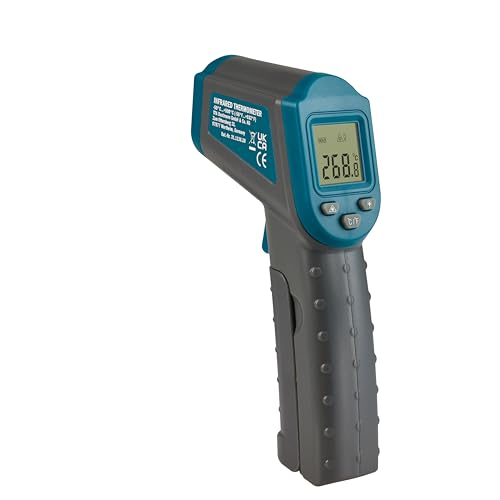
The product photo shows a grey handle with studs and a head with turquoise trim, with the display on its back. The infrared lens and laser are at the front. According to the product page the housing is made of plastic, and the instructions give the housing dimensions as 39 x 110 x 144 mm.
On weight, the sources contradict each other. The instructions say 108 g and add “device only”. The product page and Amazon list 144 g without saying what was included in the weighing. We cannot settle which number would show on your kitchen scale.
The RAY is operated with four buttons. The measuring button sits on the inside of the handle, where the trigger would be on a pistol. One press switches the device on, a short beep sounds and all segments light up briefly. Display backlight and laser are active from the factory. Each has its own button: one with a light bulb symbol for the light, one with a laser warning triangle for the laser. The fourth switches between °C and °F, with °C as the default.
While you hold the measuring button, SCAN appears in the display, with the current value beside it. When you let go, the display changes to HOLD, and the last temperature stays up for a few seconds. After that the RAY switches itself off. The technical data give approx. 8 seconds for this, and according to the Amazon text a press on the measuring button wakes the device up again. That means it needs no on/off switch.
Power comes from two 1.5 V AAA batteries, which you have to buy separately. According to the product page, the box contains only the thermometer and the instruction manual. The battery compartment is in the handle: fold the cover down, insert two new cells with the correct polarity, wait for the beep, close the cover. It is seated correctly when it clicks audibly into place, as the instructions describe it.
In detail: what a fixed emissivity of 0.95 means
TFA describes the principle on the product page in one sentence: the infrared radiation of the surface is converted into an electrical signal, a processor evaluates it, and the display shows the result. Every body gives off heat, and the hotter it is, the more. How much it gives off at a given temperature also depends on its surface, however. This property is called emissivity, a number between 0 and 1.
An infrared thermometer can only calculate the temperature if it knows the emissivity. On the RAY it is fixed at 0.95 according to the technical data. For matt, dark and non-metallic surfaces that is close to reality, for bare metal it is far off. Polished metal radiates little and instead reflects what is around it. The device then shows too little or measures the embers reflected in the metal.
The instructions draw a clear line from this: the device is not suitable for measurements on shiny or polished metal surfaces (stainless steel, aluminium). At the grill that hits exactly the parts that are often bare: a stainless steel grate, a polished stainless steel plancha, a bare aluminium plate. Here the RAY gives no value we would trust.
Things look quite different with a ceramic pizza stone, a seasoned cast-iron grate or a black cast-iron pan. These surfaces are matt and dark, and according to general physics their emissivity is much closer to 0.95. How close depends on the condition of the surface. Nobody has measured this on this device, and TFA makes no promise on it either.
According to the instructions, radiation between 8 and 14 µm is evaluated. In this long-wave range clear air absorbs little infrared, so the distance to the target hardly distorts the value. Smoke and steam above the grill are a different matter, and a separate note from the instructions on that follows further below.
How accurate is the RAY on a hot pizza stone?
At 400 °C the display may deviate by up to 6 °C in either direction according to the instructions. That applies to matt surfaces, for which the fixed emissivity fits. On bare metal this tolerance does not help you.
The 6 degrees follow from the formula in the technical data. Between 0 and +500 °C, ±1.5 °C or ±1.5 percent of the reading applies, whichever is larger. Up to 100 °C the 1.5 degrees are larger, above that the percentages. At 250 °C that is ±3.75 °C, at the upper end at 500 °C ±7.5 °C. Below 0 °C, down to -50 °C, TFA gives a flat ±3 °C.
The product page summarises this as “± 1.5 °C to ± 3 °C depending on the measuring range”. If you only read that sentence, you take 3 degrees to be the worst case. On a hot stone it is double that and more.
The display shows tenths of a degree, and the resolution is 0.1 °C. That does not mean accuracy to a tenth. For repeatability the instructions give 1 percent of the measurement or 1 °C, that is, how far apart two measurements at the same point may be.
Then there is the distance. The spot ratio is 12:1: from 120 cm away the RAY captures a spot 10 cm in diameter, according to the example in the instructions. From 36 cm that is 3 cm by calculation, from 60 cm already 5 cm. The laser marks only the centre of this spot, not its edge. If the spot becomes larger than the target, the device also measures outside the desired measuring field, according to TFA. With a grate made of thin bars, that means that from half a metre away the temperature of the embers underneath mixes in.
TFA therefore recommends aiming at the target as close as possible. At the same time the safety section warns against aiming at hot or dangerous objects too closely (you will find the wording below). You will look in vain for a minimum distance in centimetres in either source, so you have to find the right compromise yourself in front of the open grill.
Also in the instructions: TFA is not liable for incorrect measured values and the consequences that may arise from them.
What TFA intends it for, and where the grill comes in
The product page lists the application examples in full. In the technical field these are air-conditioning and heating systems, thermal bridges, faulty relays and the brake system of a car. In the household you are meant to check the temperature of baby food, drinks, bath water, frying fat, jam or chocolate mass. The RAY is said to be HACCP-compliant and “usable without restriction for temperature measurements as part of self-checks in the food sector”.
The word grill appears neither on the product page nor in the instructions. Only the Amazon text mentions the pizza oven, and it also recommends the device for liquid, pasty and semi-solid materials. That we file the RAY under grill accessories anyway is down to us, not to TFA.
Where it fits at the grill in our assessment: on the pizza stone before the first pizza, on a cast-iron pan or griddle before searing, and in a pot of frying fat, which TFA itself names. For the cooking chamber of a smoker it is only of limited use. An infrared device does not measure air; it shows the temperature of the wall or grate you are aiming at. Which type of thermometer is meant for which job is sorted out in our guide Grill thermometers: spike, wireless or cable-free?.
Safety, care and disposal according to the instructions
The following points reproduce the instructions as completely as they appear there, only put into the second person. Under “For your safety” there are three sentences. Do not use the product in any way other than described in the instructions. Unauthorised repair, modification or alteration is not permitted and can result in dangerous laser radiation. And: the device is not suitable for measuring body temperature.
The laser warning is on page 2: never look directly into the laser beam and never shine it into the eyes of people or animals, as it can cause permanent eye damage. Under “Caution! Risk of injury” this list follows:
- The product has a class 2 laser. If the warning label on the device is not in your national language, attach the notice from page 2 of the instructions to the device.
- Also never point the beam at mirrors or other reflective surfaces. The beam, deflected in an uncontrolled way, could hit people or animals.
- Do not aim at hot or dangerous objects too closely.
- Keep the device and batteries out of the reach of children. Small parts can be swallowed by children under three years of age.
- Batteries contain harmful acids and can be life-threatening if swallowed. A swallowed battery can cause severe internal chemical burns within 2 hours and lead to death. If you suspect this, seek medical help immediately.
- Do not throw batteries into a fire, short-circuit them, take them apart or recharge them. Risk of explosion.
- Replace weak batteries as quickly as possible so they do not leak. Never use old and new batteries or batteries of different types at the same time. If a battery has leaked, avoid contact with skin, eyes and mucous membranes, rinse the affected areas immediately with water and see a doctor.
The “Important notes on product safety” are the part that counts at the grill. Do not expose the device to extreme temperatures, vibrations and shocks, and protect it from large or abrupt temperature changes. Do not put it near hot objects. Do not immerse it in water, otherwise moisture can get in and cause malfunctions, and protect it from moisture. Before use, check the housing for cracks or missing plastic parts and do not use the device if it appears damaged. Steam, dust, smoke and the like can affect the measurement and permanently disturb the optical elements. Translated to a grill evening, that means for us: after measuring, the RAY does not belong on the shelf right next to the hot lid, and above smoking embers you measure better once the smoke has briefly cleared.
For cleaning, TFA writes: the sensor is the most sensitive part, so protect it from contamination. Clean the device with a soft, slightly damp cloth, without abrasives or solvents. If you will not use it for a longer time, remove the batteries. When the battery symbol appears in the display, replace them, and do so with the device switched off.
At the end of its life the RAY does not belong in household waste. Batteries that are not permanently installed are removed beforehand and disposed of separately, and you hand in the device itself at a collection point for waste electrical equipment, following the WEEE marking. According to the instructions, returning it is free of charge.
What the manufacturer does not state, and where Amazon contradicts it
We found no information on these points in either the instructions or the product page:
- Warranty period and warranty terms (the instructions mention only the statutory rights in case of defects)
- Country of origin or production
- Battery life
- Protection class against splashing water or dust (IP rating)
- Spare parts
- Year of market launch
- When the display backlight switches off
- Minimum or maximum distance in centimetres
- Functions for maximum, minimum or average value, an alarm and the exact duration of the HOLD display
In three points the Amazon text departs from the manufacturer’s documents. It speaks of an adjustable emissivity, while the technical data give it as fixed. It claims that the laser sight shows the actual measuring spot, while the instructions say: only its centre. And on speed, a measuring time of 1 second on the product page stands against a response time of under 1 second in the instructions. Where the sources contradict each other, we follow the instructions.
What else comes into question?
In our grill accessories category the RAY is the only thermometer. The three alternatives therefore come from the grill thermometers category and all measure at a different place: in the food rather than on the surface.
| Model | The difference | Price | Our rating | Choose this if |
|---|---|---|---|---|
| TFA Dostmann RAY 31.1136.20 (this one) | non-contact, surface only, no probe | approx. €23 | 8.1 | you want to measure stone, cast iron or fat from the outside |
| ThermoPro TP19H | spike probe, measures inside the food | approx. €19 | 7.8 | you want to check doneness briefly and then put the device away |
| Habor 022 grill thermometer | spike thermometer, lowest price of these four | approx. €14 | 7.5 | your budget is under €15 and you only check now and then |
| MEATER 2 Plus | wireless probe stays in the meat while cooking, values via app | approx. €118 | 9.5 | you want to monitor long cooking times without constantly re-measuring |
The prices are guide values from our price box and may look different in the shop. The rating is our editorial assessment from the data comparison.
When the RAY fits, and when a spike thermometer
The first question is what you want to know. If it is about the surface on which something is cooking, that is, whether the stone is hot enough or the cast-iron pan is ready for searing, then the RAY measures exactly that. If it is about whether chicken or steak is done inside, it misses the problem. Then the ThermoPro TP19H is the better choice, and according to our price boxes it costs approx. €19, the RAY approx. €23.
The second question is the material. If you grill mainly on bare stainless steel, such as a polished plancha, the RAY loses its purpose, see the section on emissivity. For such surfaces we would use a contact thermometer that rests on the plate.
Third, the upper limit of the measuring range. How hot your stone can get depends on the oven, not on the thermometer. If the manufacturer’s figure for your pizza oven is above what the RAY covers, in the end you will only see HI in the display. For frying fat or chocolate mass the limit does not matter.
Fourth, the duration. The RAY measures at a point, for as long as you hold the button, and stores nothing. For a pulled pork evening over many hours, a probe in the meat such as the MEATER 2 Plus is the thing, though it costs approx. €118, the RAY approx. €23.
Our assessment: if you run a pizza oven, griddle or deep fryer and already own a spike thermometer, you add with the RAY for approx. €23 the one measurement that a probe cannot do. If you want to buy only a single thermometer and mainly want to cook meat to the point, you should not choose the RAY as your first device.