A barrel on two wheels
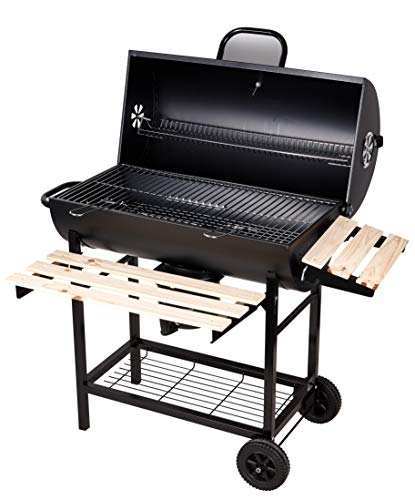
The product photo shows a black cylinder lying lengthwise in a frame of square tubing. The lid is the upper half of this cylinder, it opens backwards and has a bow handle on top. Round rotary sliders for the air sit on the end faces. On the right the frame stands on two wheels, on the left on two feet. A wire-mesh shelf hangs between the legs, and at the side of the body there are two tables made of light-coloured slats, the left one clearly wider than the right.
In the trade this design is usually called a barrel grill. SunJas calls the device a BBQ grill trolley for charcoal grilling, and the Amazon title describes it as a freestanding grill. It is intended for charcoal or charcoal briquettes.
The numbers are already confusing. In the Amazon catalogue the grill carries the model number SK30A, while the part number field says SK29A. Which of them refers to the device in the photo cannot be established without the manufacturer. If you look for a spare part later, note down both.
We list the grill in the category charcoal grills. Our price box shows it at approx. €86 (Amazon page on 20 October 2026: €85.99).
What the catalogue reveals, and what does not add up
The cooking area is stated in exactly one place: in the product title, as 70 x 38.5 cm. It is not repeated in the bullet points below. An overall dimension for the assembled state is missing entirely.
The catalogue field “Size” does give 75 x 45 x 24 cm, and the item dimensions in inches convert to the same numbers. But a standing grill trolley cannot be 24 cm deep if its grate alone is 38.5 cm deep. We therefore read the values as the carton size.
The weight is similar. The catalogue lists 36.6 pounds, converted approx. 16.6 kg, without saying whether with or without packaging. In its promotional text, SunJas on the other hand calls the trolley “light and compact” and lists beach, travel, camping, picnic and festival as places of use alongside garden and patio. A rigid barrel body on a fixed frame cannot be folded. We would not plan on it for the boot of a festival weekend, but for a permanent spot in the garden the design fits.
Smaller inconsistencies come on top. The manufacturer field in the catalogue is empty, under “Colour” the word “Grillwage” appears, and Amazon files the item under Home and Garden, DIY.
In detail: air flow in a horizontal barrel
If you can adjust neither the charcoal nor the grate in height, a charcoal grill is left with two variables: how much air reaches the embers and where the embers lie. SunJas writes of an “air supply control at the top and bottom” and of vent openings and vent sliders with which the oxygen supply “in the grill chambers” can be regulated. Of chambers in the plural nothing is visible in the photo, the body looks continuous.
The principle applies to every grill with a lid. Fresh air flows in at the bottom to the charcoal, hot gas escapes at the top. The further the sliders are open, the more oxygen the embers get and the hotter it becomes. If you throttle at the bottom, you slow the combustion. If you close at the top, you trap smoke and heat under the lid, and if both are fully closed, the charcoal eventually suffocates. That is why control is usually done at the bottom, while the top slider stays rather open.
The barrel shape has a quirk you can use. Under the curved lid there is more space above the middle than at the edges, and the hot air rises and runs along the curve. If you put the embers in only one half and the food in the other, it cooks there indirectly with the lid closed, without flames underneath. At 70 cm length, each zone is left with a strip of around 35 x 38.5 cm. SunJas does not describe such a split, it follows from the design. How this works with charcoal in general is covered in our guide on direct and indirect heat.
According to SunJas, the thermometer sits as a “large thermometer” in the “solid lid”. The lid material, scale and maximum reading are not stated anywhere. In the photo, a short pin points downwards in the middle of the inside of the lid, probably the sensor. It measures the air at the top in the curve, not at grate level, and next to one-sided embers these two values often differ considerably. For a roast or a whole chicken we would therefore additionally use a probe thermometer.
Is the area enough for a larger group?
For a group that grills in turns, yes. If you want to put everything on at once and also cook indirectly, you quickly reach the limit, because one half is then reserved for the embers.
Calculated, the title figure of 70 x 38.5 cm gives an area of 2,695 cm², a good quarter of a square metre. Two numbers for comparison. According to its instruction manual, the Tepro Toronto Click has a grate of approx. 56 x 41.5 cm, so 2,324 cm². The SunJas is thus around 370 cm² or about 16 percent larger. A round grate with a diameter of 57 cm would come to around 2,550 cm², so the two shapes are in the same size class.
The shape matters more than the area here. A long rectangle can be divided cleanly into two zones, and skewers or a row of corn cobs lie across it without sticking out over the edge. In the photo, the grate has two wire handles at the front by which it can be lifted, for example to add charcoal.
Ash, shelves, wheels
Under the body, the photo shows a round, funnel-shaped component in the middle. SunJas describes an “extra-large” ash box that is removable and can be taken out after grilling. No volume is given for it, and we do not infer one from a single picture. Whether the round part is the box itself or an outlet above it is not clearly shown by the photo. If you often grill with briquettes, which leave a lot of ash, it is best to empty the box after every evening.
SunJas describes the two side tables and the lower shelf as “plenty of space for accessories and food”. In the photo, the slats of the tables look like light-coloured wood. If that is correct, they absorb grease and rainwater and turn grey outdoors over time; a wood oil in spring helps, and you are better off not putting hot grill tongs directly on them. On the wire mesh below, a charcoal bag or a box of firelighters stands well, while small items fall through.
For moving, the trolley has, according to SunJas, “two large wheels”, and it calls the frame a “stable metal frame” without naming the type of metal. In the photo the wheels sit on the right under the legs, and a side handle is visible at the left end of the barrel. So the trolley is moved like a wheelbarrow: lift on the left, roll on the wheels. That works well on paving and patio slabs, but on soft grass a trolley of this design rolls harder, especially after rain. As a rule, the grill is only moved when the charcoal is out.
Cleaning and safety without an instruction manual
We did not find instructions, either at Amazon or on a manufacturer page. On care, the promotional text has only one sentence: the materials could be “cleaned easily” and ensured a long service life. Which materials these are and whether water, washing-up liquid or a wire brush may be used on them remains open.
Because nobody says whether the grate is chrome-plated, enamelled or stainless steel, we would start with the gentlest method: burn the grate clean on the embers and let it cool, then brush it off with a brass-bristle brush. Only if that is not enough do soaking and scouring come into play. The methods for stubborn cases are in the guide cleaning a burnt-on grill grate.
There are no safety instructions from the manufacturer. What follows are general rules for any charcoal grill, not requirements from SunJas:
- Glowing charcoal releases carbon monoxide, which you can neither smell nor see. The grill belongs outdoors, never in a garage, garden shed or tent.
- Liquid accelerants such as methylated spirits or petrol have no place at the grill. Solid firelighters or a chimney starter are enough.
- The trolley stands on level, non-flammable ground and at a distance from hedges, awnings and parasols.
- Ash that looks cold can still smoulder inside for hours. It goes first into a metal bucket with a lid and only then into the bin.
What SunJas does not state
For this grill trolley, the following are missing in all the sources we could use: a reachable manufacturer website, an instruction manual or data sheet, the dimensions in the assembled state, the working height, the material of the charcoal pan, lid, grate and side tables, the type of coating, a warming rack, height adjustment of the charcoal, the maximum amount of fuel, the scale and maximum reading of the thermometer, a heat-up time, the load capacity of the shelves, the scope of delivery, assembly time and tools required, a number of people, a standard declaration under DIN EN 1860-1 (the standard that applies in Germany and the EU), warranty and spare parts, matching accessories such as a cover, as well as company seat, importer and origin.
Three alternatives from our catalogue
| Model | The difference | Price | Our rating | Choose this one if |
|---|---|---|---|---|
| SunJas charcoal grill trolley (this one) | Barrel shape, grate 70 x 38.5 cm according to the title, heat adjustable only via the vents | approx. €86 | 7.6 | you want a lot of grate area for little money and can do without a data sheet |
| Strattore Charcoal Grill XL | angular trolley made of powder-coated iron, grate height adjustable by crank according to the Amazon text | approx. €99.90 | 7.7 | you want to control the heat through the distance to the embers |
| Tepro Toronto Click | charcoal pan height adjustable by crank, instructions with dimensions, fuel quantity and standard | approx. €139 | 8.2 | you want to read safety instructions and technical data from the manufacturer |
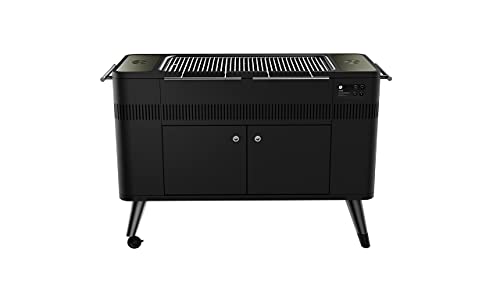
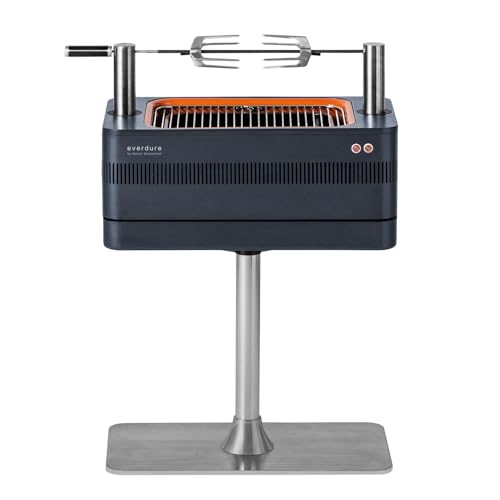
| Everdure HUB II | electric charcoal ignition via a heating coil, rotisserie up to 40 kg | approx. €2,503 | 9.4 | your budget runs to four figures and there is a power socket at the grilling spot |
The prices come from our price boxes and change. The rating is our editorial assessment from the data comparison and is not based on using any of the four devices ourselves.
When this grill, when another
Our assessment: The SunJas is worthwhile if the grill gets a permanent spot on the patio or lawn, you mainly grill directly and want to keep the price low. For approx. €86 you get a large, rectangular grate area, a lid with thermometer and two shelves. Nothing more is documented.
If you also want to control the heat through the distance between grate and embers, the Strattore Charcoal Grill XL would be our first choice. It stands in our price box at approx. €99.90, the SunJas at approx. €86, and according to the Amazon text, an external crank adjusts the height of the grate. However, we know just as little about how large its grate is.
If it matters to you to know before the first lighting what you may and may not do, we would reach for the Tepro Toronto Click at approx. €139. Its instructions give a net weight of approx. 25.4 kg, a maximum of 1.35 kg of charcoal per filling and the standard DIN EN 1860-1, and the charcoal pan can be raised and lowered by crank. Its grate is smaller, as calculated above.
On weight the SunJas is ahead, provided the catalogue value is meant without the carton: around 9 kg less than the Tepro and around 8 kg less than the Strattore, which Amazon lists at approx. 24.79 kg. If you push the grill into a shed after every evening, you will notice that.
For long cooking times of many hours we would not buy the SunJas. That needs information on the charcoal quantity and sliders that close tightly, and there is nothing on either here. If you no longer want to work with a chimney starter at all, you end up with the Everdure HUB II, which according to its instructions ignites the charcoal via a heating coil with a 7-minute timer. It stands at approx. €2,503 in our price box, which is a different league, but the difference in operation is exactly this.
The SunJas is the wrong choice for anyone who needs a contact person in case of a defect. There is no manufacturer that identifies itself in the catalogue, and no instructions you can refer to. If you do not yet know whether a grill trolley, kettle or gas suits you better, you can narrow it down with the grill finder.