Plate instead of rack: where the PG 8595 belongs
Severin sells four electric table grills with a shared instruction manual: PG 8593, PG 8594, PG 8595 and PG 8596. Two of them grill on a stainless steel grill rack, two on an aluminium grill plate. PG 8594 and PG 8596 also stand on their own base frame. The PG 8595 combines plate and tabletop use, so it comes without legs and puts the food on die-cast aluminium instead of bars.
In our electric grill category it is one of the small tabletop appliances. It costs approx. €49 (Amazon page on 20 October 2026: €48.99), and the only shop in our price box is Amazon. Severin describes it as a grill for indoors and outdoors, and the Amazon title mentions balcony and kitchen.
Housing, heating element, water tray: the construction
The manual breaks the appliance down into five parts. At the very top sits the windshield, below it the grilling surface, on the PG 8595 the aluminium grill plate. Then comes the connection box, to which the heating element, power cord, rotary dial and indicator light are attached, below that the water tray and finally the housing. The data sheet adds: housing made of black plastic, grilling surface made of die-cast aluminium with a smooth and a ribbed surface, 39 x 23 cm in size.
It is assembled from the bottom up. First the water tray into the housing, then the heating element with the connection box into the tray, and finally the plate on top. If the connection box sits crooked, the grill cannot be switched on; a safety switch is built in for this. You attach the windshield to the frame, but only if you are grilling outdoors.
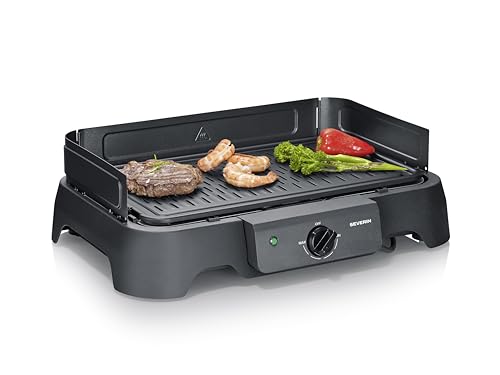
In the product photo the plate is rectangular and framed by the windshield at the back and on both short sides. It stays open at the front. In the middle in front of the plate sits the connection box with the dial, and to the left of it the green indicator light. The ribbing is clearly visible in the image, but how large the smooth portion is cannot be read from it.
For the footprint, the outer dimensions count, which Severin gives as 48.3 cm wide, 36.3 cm deep and 14.4 cm high. The appliance weighs 2600 g, 3540 g with packaging. On a balcony table you therefore need a free area of just under 49 by 37 cm, plus room for plates and tongs.
Electrically the grill is designed for 220 to 240 V~ at 50 to 60 Hz, and the power consumption is 2000 W. The equipment list on the product page confirms an on/off switch, adjustable thermostat, safety microswitch, Safe-Touch, non-slip rubber feet and removable individual parts. It denies a lid, BoostZone, height-adjustable rack, storage compartment and side tables.
In detail: thermostat, aluminium and the water underneath
The rotary dial does not select a heat level, it sets a target value. Between MIN and MAX it covers 40 to 220 °C according to the data sheet. When you turn it up, the indicator light comes on and the heating element heats at full power. When the plate reaches the set value, the thermostat switches off, and when the temperature falls, it switches back on. The manual speaks of cycling; you can see it from the light going on and off during grilling. The 2000 W therefore describe what the element draws while it is running. Averaged over a whole evening the figure is lower, and the more clearly so the lower the dial is set.
Why an aluminium plate? Aluminium conducts heat many times better than stainless steel. A die-cast plate therefore spreads the heat of the heating element across the surface instead of releasing it only where the element runs directly underneath. How evenly this works on the PG 8595 has not been measured by anyone we could cite.
The practical difference from a rack lies elsewhere. On a closed surface nothing falls through: courgette slices, mushrooms, prawns or a salmon fillet sit on top without getting caught between bars. Severin itself names meat, vegetables and grill branding as uses. In our reading, the ribbed half is meant for the stripes on meat and the smooth one for everything that needs flat contact, such as a fried egg or thinly sliced vegetables.
Below the heating element sits the water tray, and it is not an accessory but mandatory. Before every start-up water goes in, and only then the plug into the socket. It is filled up to the Max marking, which is at most 1.5 litres, and in such a way that no water runs directly onto the heating element. Severin justifies this with a warning: fatty food can ignite. According to the manual, the water cools the tray, reduces smoke and makes cleaning easier.
The safety sheet linked on the product page is stricter. The water level must always stay between the Min and Max markings, and before it falls below Min you pull the plug and top it up. Physically this makes sense: at normal air pressure water hardly gets hotter than 100 °C, so fat dripping into it stays well below the point at which it begins to smoke. If the tray is empty, this buffer is missing.
Are 220 °C enough for a steak?
For thin cuts, in our assessment yes, for a dark crust on a three-centimetre-thick rump steak rather not. 220 °C is the end value of the control. Which temperature the plate surface reaches is not stated in any of the Severin documents, and the grill has no lid.
The browning reactions that form a crust take place to a notable degree from roughly 140 °C. A plate regulated to 220 °C is above that, but not by a wide margin. If you put on a steak straight from the fridge, it draws heat from the aluminium, and the thermostat has to reheat with its 2000 W. The thicker and colder the meat, the longer this recovery takes. Without a lid, the top side only cooks if you turn the meat.
Sausages, halloumi, vegetable slices, prawns and thin schnitzels, by contrast, are done in a few minutes and need medium heat rather. For these the thermostat helps, because the plate stays in the range you have set. If you still want to bring a steak to the point, measure with a separate probe thermometer.
Power, cable, plug: what you should clarify before buying
Because the PG 8595 is also intended for outdoors, the manual demands two things from your home wiring: a properly installed earthed socket and a residual current device (RCD) with a tripping current of at most 30 mA. A look at the fuse box will tell you whether your balcony socket is protected like that.
According to Severin, the power cord is 100 cm long. If the table is further away, you need an extension, and the manual ties it to conditions. The cable must be suitable for the power on the rating plate and for outdoor use, and a cable reel must be fully unwound, because it can otherwise heat up impermissibly. Severin expressly expects a loss of power through the extension. You should lay the cord so that nobody trips over it and it does not touch hot parts.
At 2000 W and 230 V, roughly 8.7 A flow by calculation. Household circuits are usually fused at 16 A. If a kettle or fan heater runs on the same circuit, the fuse can trip, and on balconies and terraces several sockets often share one line.
One entry on the product page does not fit the picture. It lists the Europlug Type C (CEE 7/16) as the plug type. According to the standard, this flat plug is intended for currents up to 2.5 A, considerably less than the 8.7 A above, and the manual itself requires an earthed socket. We consider the entry an error on the product page; it can only be checked on the appliance.
Timer switches and app sockets are ruled out. According to the manual, the grill is not intended to be operated with an external timer or a separate remote control system.
An upper limit can be calculated for the running costs. Ten minutes of preheating on the highest setting draw at most around 0.33 kWh at 2000 W, because the element cycles, rather less. Multiplied by your electricity tariff, this gives the cost of heating up; after that consumption depends on the dial setting, wind and food. Gas cylinders, charcoal or firelighters are not needed; the manual even expressly prohibits charcoal and similar fuels for this appliance.
Setting up and cleaning according to the wording of the manual
Severin designates the appliance for household use and similar applications and lists the following: staff kitchen areas in shops, offices and other working environments, farm properties, use by guests in hotels, motels and other similar accommodation, and bed and breakfast establishments. The safety sheet clarifies that the appliance serves exclusively for heating and grilling food; other uses are misuse and dangerous.
For the location, the manual requires a level, heat-resistant surface that is not sensitive to splashes, since splashes are unavoidable with fatty food. The grill does not stand directly against a wall or in a corner, easily flammable objects are moved away from its vicinity, and it is not used at all near combustible materials. Outdoors, the safety sheet sets a further limit: use only when protected from the weather. Under a canopy that fits, in open drizzle it does not. Indoors the windshield stays off.
You may only operate the grill under supervision, and it is never moved while it is running. The warning symbol on the appliance has a concrete background: windshield, grilling surface and heating element can be very hot during operation and also after switching off. Before you move, clean, cover or store the grill, it must have cooled down completely. According to the manual, you pull the mains plug before every filling with water, after every use, in case of a fault during operation and before every cleaning.
Whether you may grill on your balcony at all is governed by your tenancy agreement and house rules. What usually counts there is covered in our guide to grilling on a balcony.
It is cleaned after every use. The manual separates four groups:
- Remove the windshield and grill plate and clean them in washing-up water, soaking if necessary.
- Remove the heating element with the connection box and clean it only with a slightly damp cloth. For reasons of electrical safety it must neither be treated with liquids nor immersed in them.
- Remove the water tray and clean it in washing-up water, soaking briefly if necessary.
- Wipe the other individual parts with a damp cloth and then dry them.
According to the manual, metal sponges and abrasive cleaners are taboo, and the safety sheet also excludes metal parts and other sharp or pointed objects that damage a coating. On the subject of the dishwasher, the sources contradict each other. The product page reports dishwasher-safe individual parts, while the manual says: all parts must not be cleaned in the dishwasher, except the version with the stainless steel grill rack. The PG 8595 has no rack but the aluminium plate, so the exclusion applies to it. We follow the manual, not least because aluminium generally tolerates alkaline dishwasher detergents poorly and turns dark.
What is missing or contradictory in Severin’s documents
Product page, data sheet and manual leave these points open:
- the actual temperature at the plate surface
- how the surface is split between the smooth and the ribbed part
- whether the die-cast aluminium plate is coated
- whether and where fat runs off the plate into the water tray
- the material of water tray, windshield and heating element
- a scope of delivery as a list, in particular whether the windshield is in the box for the PG 8595
- a number of people
- a suitable cover
- individual prices for spare parts
- the power consumption per grilling evening and in standby (Severin refers for this to its own ecodesign page under EU Regulation 2023/826, which applies in the EU)
- the country of production
There are also contradictions. Amazon gives the cable length as 140 cm, Severin on the product page and data sheet as 100 cm; we adopt the manufacturer value. The dimension table of the shared manual lists only one value for all four models, 4.6 kg and a grilling surface of 390 x 225 mm. For the PG 8595, 2600 g and 39 x 23 cm apply according to the product page and data sheet. In the data sheet itself, the fields for outer dimensions and weight are empty.
On the heating-up time, two figures are in the room. The product page states 4 minutes 30 seconds, the manual says the appliance should heat up for approx. 10 minutes before the food is put on. What the shorter value refers to is unclear. We would plan with the manual.
A detail on the side: the safety sheet linked on the product page of the PG 8595 bears the article number PG 8556, a different Severin model. The notes in it agree with the manual but are worded more generally.
Three alternatives to the PG 8595
| Model | The difference | Price | Our rating | Choose this if |
|---|---|---|---|---|
| Severin PG 8595 (this one) | Die-cast aluminium plate smooth and ribbed, tabletop appliance | approx. €49 | 7.7 | you want to put small food on without a rack |
| Severin PG 8593 | same manual, stainless steel rack instead of plate, 35 to 200 °C | approx. €35 | 7.8 | fat should drip off through the rack |
| Severin PG 8596 | Aluminium plate on a stand with storage rack | approx. €62 | 8.1 | there is no free table on the balcony |
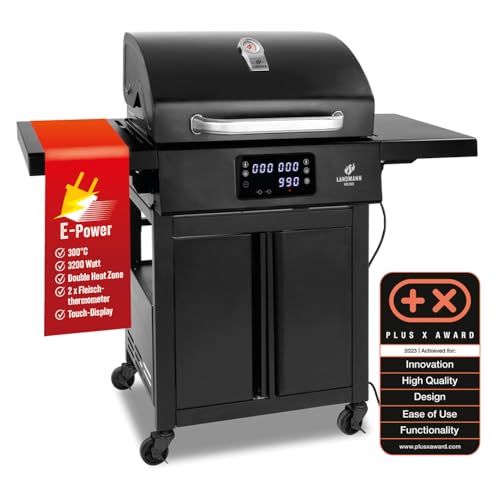
| Landmann EG-II-590 | Grill trolley with chassis instead of a tabletop appliance | approx. €550 | 9.4 | you regularly grill for family or guests |
The prices are guide values from our price boxes and change. The rating is our editorial assessment based on the manufacturer data; we have not measured anything.
Who the PG 8595 suits and who it does not
Start with the surface. 39 by 23 cm make just under 900 cm² by calculation. Severin gives no number of people. We would plan the grill for two people, for three if side dishes come from the kitchen. From four people on, you grill in batches while the first ones are already eating.
The second question is the cooking surface. If you mainly grill sausages and pork belly slices and want the fat to drip off, you will manage with the Severin PG 8593, which costs approx. €35 in our price box (the PG 8595 approx. €49) and is even a tenth of a point ahead in our rating. If you put on a lot of vegetables, fish and small items, you are better served by the plate of the PG 8595.
Then the location. A table grill needs a table that tolerates heat and fat splashes. If you do not have one on the balcony, the Severin PG 8596 with its own stand is the obvious choice; it stands at approx. €62 in our price box. For regular gatherings with family or guests on the terrace, none of the three Severin grills is enough; there the Landmann EG-II-590 plays in a different class as a grill trolley and costs approx. €550.
The PG 8595 is wrong for anyone who wants to cook indirectly, smoke or grill low and slow. Without a lid and without a second heating zone, the basis for that is missing. The same goes for grilling spots without weather protection or without an RCD-protected earthed socket: the manual requires a residual current device with at most 30 mA, and the linked safety sheet permits operation only when protected from the weather. An extension cable is only permitted if it is suitable for outdoor use and fully unwound. If you have not yet decided between appliance types, the Grill Finder gives you a first direction.