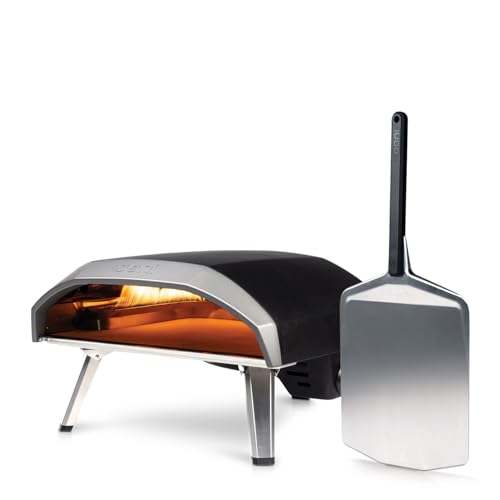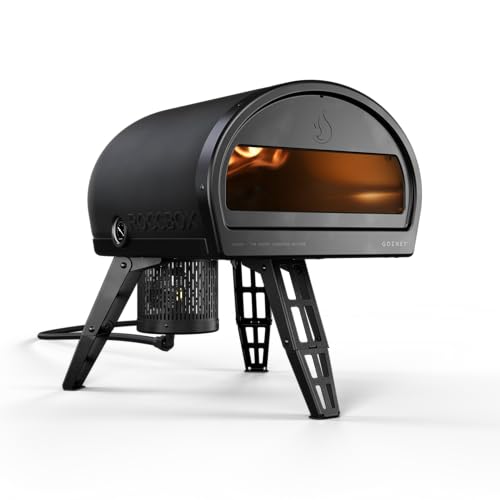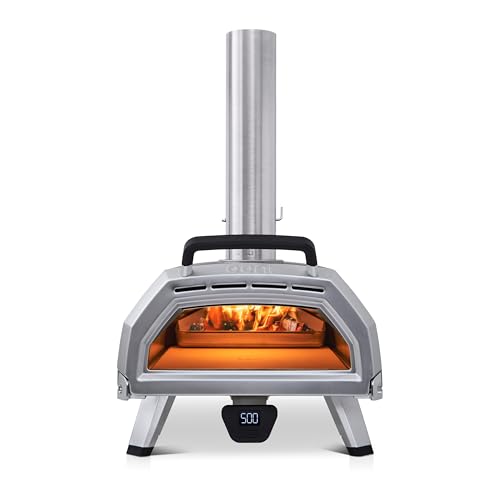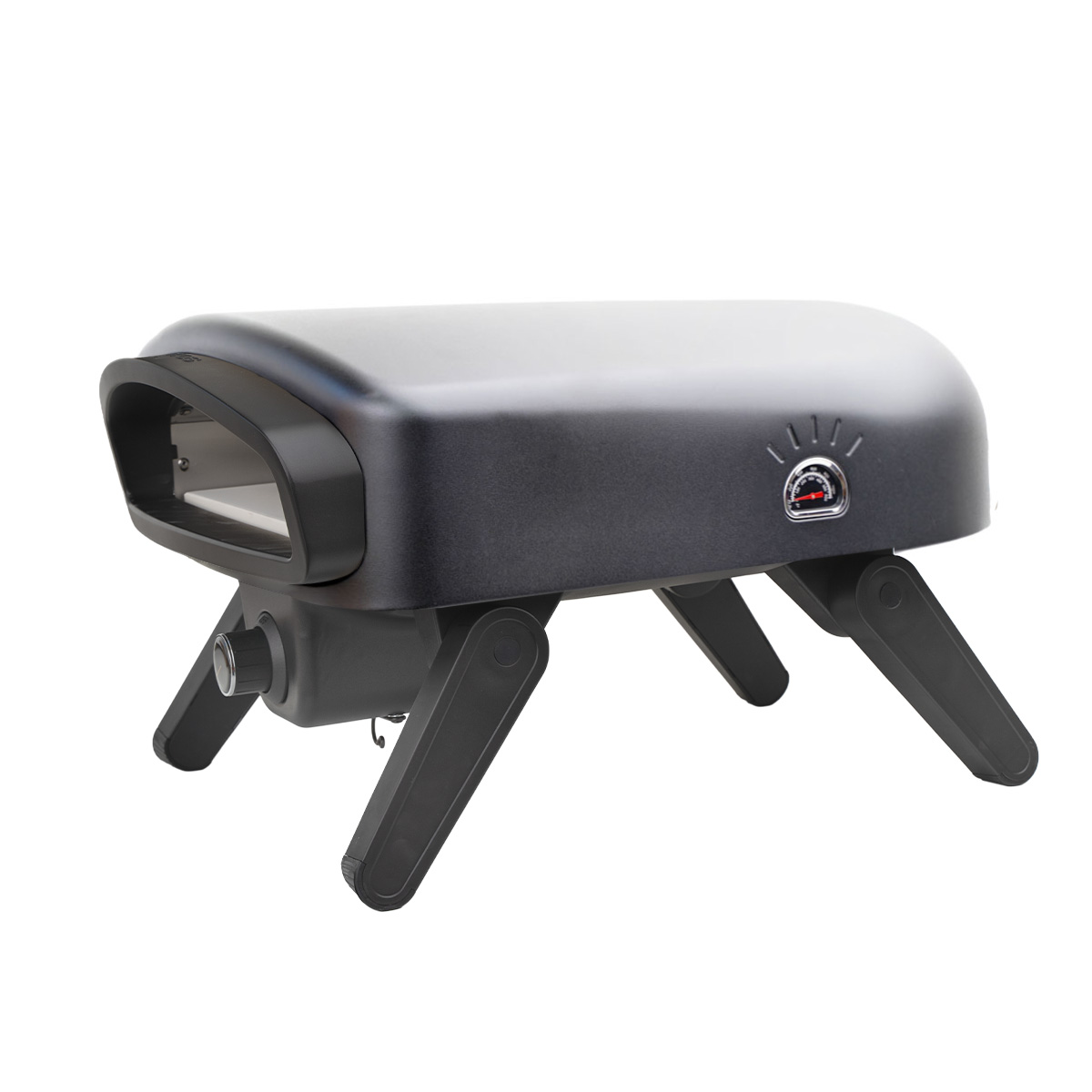
What the O-140 is and what it costs
The O-140 is a gas pizza oven for pizzas up to 14 inches, so 35 cm in diameter. It runs under the house brand of Santos Grills, distributed by Santos Grills GmbH in Cologne; the operating manual names China as the country of manufacture.
On its product page Santos Grills lists balcony, terrace or garden kitchen as places of use. The manual describes the intended use in three sentences: the appliance is “designed exclusively for baking and for preparing bakeable food”, it is intended for private use or household-type use, and it is not a children’s toy.
On 2 November 2026 the Santos Grills shop had exactly two versions. The black one without motor (item number 968892) cost approx. €249 (on 02.11.2026: €249.00) and was ready to ship in 1 to 2 working days. The beige one with motor (968922) had a list price of €299, was marked at €199 and was not available. A black version with motor is not found by the shop search; its former address leads to an error page.
For you this means: anyone ordering now gets the oven without a turntable and turns the pizza themselves. Santos puts it so that it also works without a turntable as long as you stay “on the ball with the pizza turner”. The price given above and in the table further down refers to this black version.
Burner, stone and housing: what the data sheet says
There are two figures for output. The product page gives 4.7 kW, the technical data in the manual a total heat input of 4.65 kW. The first is the rounded version of the second, and we use the more precise value here. The heat is produced by a U-shaped stainless steel rear burner; the page of the motor version gives 304 stainless steel as the material. The manual gives the injector size as 0.94 mm, the gas category is I3B/P(50), and the oven runs on butane, propane or a mixture at 50 mbar connection pressure. It is intended for Austria, Germany, Switzerland and Slovakia. Ignition is by piezo.
Santos advertises up to 500 °C and a Neapolitan pizza in under two minutes. Both are claims from the product page.
With the stone, the two versions differ clearly. The black one has a continuous cordierite stone 15 mm thick. The motor version has two parts: a rotating round stone of 12 mm that sits in the oven, and in front of it a 15 mm thick stone that closes off the area towards the opening. On the side there is a temperature display which, according to the product page, shows the value directly at the stone.
The housing is made of powder-coated steel, matt black or beige depending on the version. Below are four foldable feet. The manual gives the dimensions as 614.4 x 437.0 x 355.5 mm (depth x width x height); the shop rounds to 44 x 36 x 61 cm (width x height x depth). Weight: approx. 13.2 kg without motor according to the manual, 14.5 kg with motor according to the data sheet in the shop.
What Santos leaves open in the product page and manual, in one go: a heat-up time to 500 °C, the material of the inner lining, the size of the stone in centimetres (only pizza diameters and stone thickness are documented), the scale of the temperature display, the number of control settings and the lowest burner output, and for the motor version also battery type, number of batteries and rotation speed. We have not found a separate manual for the motor version. The one available (version 968915_968892_BM_DE 2025 03) carries the item numbers 968892 and 968915, and which version is behind 968915 cannot be traced in the shop.
In detail: what 4.65 kW means in a small pizza oven
A gas pizza oven bakes from two sides at once. The base cooks by contact with the hot stone, the top by radiation from the flame and the heated cooking chamber. In the O-140 the burner sits at the back. The side of the pizza facing the burner therefore gets more heat than the side facing the opening, and that is exactly why it is turned: by hand with the pizza turner or, in the beige version, via the turntable.
The stone is the heat store. Every raw pizza draws heat from it, and the burner has to supply it again before the next one. With the same material, a thicker stone stores more heat per area than a thin one. The 12 mm rotating stone of the motor version therefore has, purely in physical terms, less reserve than the 15 mm of the black one. How much difference that makes in baking has not been measured by anyone for this oven.
Now to output. In our comparison the O-140 has the weakest burner: the Burnhard TONY reaches 5.9 kW according to the Burnhard manual, the Santos O-160 7.5 kW according to the Amazon catalogue, the Ooni Koda 16 8.0 kW according to the Ooni manual. The comparison becomes more meaningful if you relate the output to the largest pizza the respective manufacturer states. This is a rough calculation figure of ours, not a manufacturer specification. For the O-140 there are around 4.8 watts per square centimetre of a 35 cm pizza, for the TONY with its 29 cm pizza around 8.9 watts, for the Koda 16 with 40 cm around 6.4 watts.
Our assessment from this: for its pizza size the O-140 has little burner output. Whether this makes heating up or the time between two pizzas longer cannot be quantified without a manufacturer time, and no such time exists. Anyone who usually bakes one or two pizzas an evening will probably notice this less than someone who wants to pull ten out of the oven in a row.
Are pressure regulator and gas hose included?
No. According to section 3.1 of the manual, the scope of delivery consists of two parts: the oven and the pizza stone. You buy the pressure regulator and hose separately, and both must match the technical specifications in chapter 5.
For the pressure regulator that means: low-pressure regulator to EN61, DVGW/DIN-EN-compliant, outlet pressure 50 mbar, output 1.5 kg/h, bottle connection IG 7/16-28 UNEF, hose connection G 1/4 LH-KN. The hose should be a medium-pressure hose line (PS 10 bar) made of plastic or rubber, also DVGW/DIN-EN-compliant, with connections G 1/4 LH-ÜM and at most 1.5 m long. A regulator with 1.5 kg/h has ample reserve for the consumption of the O-140, more than four times over. According to the manual, you must never connect an unregulated bottle directly.
This too is part of the follow-up costs: you replace pressure regulators and hose lines according to the manufacturer’s information or national regulations, but after 10 years at the latest. On the hose there is a factory type plate with an expiry date, before which it is replaced.
With the Burnhard TONY, gas hose and pressure regulator (50 mbar) are included according to Burnhard. Which bottle is suitable for grill or oven use and what to watch for when buying is covered in our guide to the gas bottle for the grill.
Gas consumption and what else comes up next to the oven
The manual quantifies consumption at 338 g/h for butane (G30) and 332 g/h for propane (G31). These are values at full output. From a 5 kg bottle this gives, on paper, around 15 hours, from 8 kg around 24 hours and from 11 kg around 33 hours of burning time. Because you do not always leave the burner fully turned up, a filling in practice tends to last longer; however, part-load values are not in the table. What a filling costs depends on the retailer and the region. We therefore calculate in hours instead of euros.
Accessories matching the model are available in the Santos shop: a cover for O-120 and O-140 with PU coating for €29.90 and the pizza peel L for O-120 and O-140, also for €29.90. With both you end up at €308.80 in the shop, and pressure regulator, hose and gas bottle are not yet included.
You can request the manual itself from customer service as a PDF.
Setting up and gas: what the manual prescribes
Chapter 2.2 of the manual is a long list of safety notes on gas, children, clothing, vessels and operation. Here are the points that apply to setting up, verbatim. The others do not replace them; you will find them in the same chapter.
- “Use outdoors only! The appliance must never be operated in enclosed spaces.”
- “Always keep a minimum distance of 500 mm on all sides of the appliance to combustible objects and structures.”
- “Do not use the appliance in a hollow, as escaping gas can collect there.”
- “Always set the appliance up on firm and level ground.”
- “The appliance must not be permanently installed or enclosed.”
- “Never place the appliance on a table made of combustible materials.”
In addition, from chapters 3.3 and 4: “The minimum distance between the appliance and the gas bottle is 600 mm.” During baking it must, because of the great heat generation, “be strictly observed”.
On the balcony: the product page names it as a place of use, the manual has no balcony rule of its own and only requires outdoor operation with the stated distances. In general, house rules, tenancy agreements or owners’ association resolutions can restrict gas appliances on the balcony. You clarify that before you order.
Before every use the manual prescribes a complete gas leak test. For this the appliance must be fully assembled and the bottle full. Section 3.4 goes like this: fill soapy water of one part washing-up liquid and one part water into a spray bottle (alternatively leak-detection spray), have a brush or cloth ready for washing off the fittings, turn the gas control to “OFF”, open the bottle valve slowly so that no air pockets form in the hose and pressure regulator, spray all connections from the bottle to the pipe to the burners, close the valve again, tighten leaking fittings and repeat the test until no more bubbles form. Soap bubbles form at leaks. During the test there is no smoking, and tightness is never tested with an open flame. If you cannot get a gas leak under control yourself, you do not use the appliance and contact customer service.
When changing the bottle you wait at least 5 minutes, according to section 6.4, before connecting the new bottle. You tighten the union nut only hand-tight, without tools, otherwise the seal can be destroyed.
Cleaning and care according to the manual
For the stone, Santos relies on heat: according to the product page, high temperatures burn off residues almost completely (pyrolysis effect), and according to the page of the motor version, sweeping out with a hand brush is then enough. With brushes the manual is strict. Section 6.3 says: “Do not use aggressive cleaning agents, brushes with metal or nylon bristles, or sharp or metallic cleaning objects such as knives, metal sponges and the like.” Before every cleaning you let the oven cool down completely, switch off, close the gas valve and remove the bottle. It is cleaned regularly with warm water and a cloth, more thoroughly with washing-up liquid. Cleaning should be done exclusively with SANTOS care and cleaning products; Santos excludes liability for damage or discolouration caused by other agents.
Section 6.1 adds: do not clean in the dishwasher, neither the appliance nor accessory parts. No water hose, no pressure washer. Never pour water onto the hot appliance, never touch hot parts with unprotected hands. Clean after every use, because old grease can cause corrosion through the fatty acids. Dry cleaned parts well, let the interior dry completely before the next operation, and before longer storage let parts and appliance dry open for at least 8 hours. The manual also mentions that the outer shell can fade over time, adding that this does not affect performance.
For the pizza stone, section 6.2 gives seven rules. Do not use over an open flame. Do not use wet, because it can otherwise crack. No extreme temperature fluctuations, no frozen food on the hot stone. It is fragile and can break from impact or a fall. It is very hot during use and stays hot for a long time afterwards. Do not cool it with water while hot. And after cleaning with water, dry it before use, for example 2 hours at 60 °C in the oven.
Once a year, according to the manual, you check the burner nozzles and replace them immediately if they are cracked or damaged.
On storage (section 6.5): you disconnect the bottle from the appliance after every use and never store it in enclosed spaces; for storage you always remove bottle and hose. After use you cover the oven with a suitable cover and keep it dry and protected from the weather, for winter in a dry, closed room without direct sun. If moisture has got into the combustion chamber, you let it dry completely before heating up again.
Three ovens to put alongside
| Model | The difference | Price | Our rating | Choose this one if |
|---|---|---|---|---|
| Santos O-140 (this one) | 15 mm cordierite stone, pizza up to 35 cm, turning by hand | approx. €249 | 8.2 | you want to bake 35 cm pizzas and already have a pressure regulator and hose |
| Burnhard TONY | Gas hose with pressure regulator included, pizza only up to 29 cm | approx. €198.09 | 8.4 | your pizzas stay under 30 cm and you want to connect it without an extra purchase |
| Santos O-160 | Turntable from the factory, stone Ø 37 cm, cover included (according to the Amazon catalogue) | approx. €450 | 8.7 | you do not want to turn it yourself and the oven has a fixed place |
| Ooni Koda 16 | Pizzas up to 40 cm, L-shaped burner | approx. €449 | 9.4 | you regularly bake large pizzas for several people |
The prices are the guide values from our price boxes and change constantly at the retailers. The rating is our editorial classification of the available data; we have not measured anything.
When the O-140 fits and when another oven does
Pizza size decides first. If you bake dough up to 35 cm, the O-140 is enough. If you want the 40 cm of the Ooni Koda 16, that costs you around €200 more than the O-140. If your pizzas stay under 30 cm, the Burnhard TONY is around €51 cheaper, has more burner output and comes with hose and pressure regulator.
Then the question of turning. The O-140 is currently available only without motor. Anyone who on no account wants to turn it themselves waits for the beige motor version or takes the Santos O-160 with turntable, which stands at approx. €450 in our price box (O-140: approx. €249) and weighs approx. 22.3 kg according to the Amazon catalogue.
Then weight and space. At approx. 13.2 kg the O-140 is the lightest of the four ovens; the TONY weighs 14.5 kg according to Burnhard, the Koda 16 18.2 kg according to Ooni. For someone who carries the oven to the cellar after every evening, that is a real argument. But bear in mind the 500 mm clearance to anything combustible: on a narrow balcony with a wooden balustrade or a bamboo privacy screen, space quickly gets tight.
For a group we would not recommend the O-140: for anyone who wants to pull pizza after pizza out of the oven for six or more people. In our comparison it has the least output per square centimetre of pizza and can only be turned by hand. For such gatherings, an oven with a 40 cm surface is the better choice. You will find more models in our overview of pizza ovens, and the Grill Finder narrows the selection by fuel and budget.
From our point of view the O-140 makes the most sense for someone who already runs a gas grill with a 50 mbar regulator. If regulator and hose meet the specifications in chapter 5 of the manual, the missing pressure regulator in the scope of delivery does not matter, and the bottle moves from grill to oven depending on the evening.