What the Fiesta Teppan-Yaki is, and where our information comes from
The Fiesta Teppan-Yaki (item number 22550-56) is an electric table grill from Russell Hobbs, built around a removable plate instead of a grate. The name explains the principle: teppan means iron plate in Japanese, yaki means grilled or fried. The food lies across the whole plate, and there are no bars for anything to fall between.
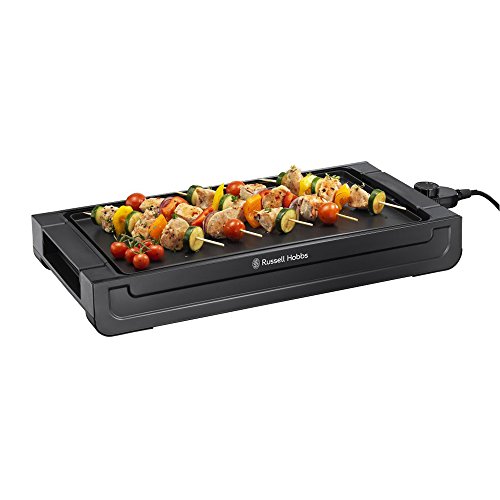
The catalogue photo shows a flat, rectangular appliance in black, with the Russell Hobbs lettering at the front and a flat plate with a narrow rim on top. No grooves can be seen on it.
The manufacturer’s page de.russellhobbs.com is thin: grilling surface, variable temperature, drip tray, plus advertising copy, but hardly any technical data. We therefore rely on the instruction manual (48 pages for 23 languages, the German version is on pp. 5 and 6) and, where it is silent, on the Amazon catalogue. Behind the brand in Germany stands Russell Hobbs Deutschland GmbH in Sulzbach, part of the Spectrum Brands Group. By its own account Russell Hobbs has existed since 1952, the German market followed in 2004, and in 2012 the brand extended its range to ironing and electric cooking. According to our price box the grill costs approx. €70.
Plate, drip tray, control: the construction
The parts list in the manual (p. 5) has eight items: removable grill plate, mains connection, collection tray, safety latch, base, temperature control, indicator light and, in eighth place, the collection tray once more. This is a translation error; in the English version the item is Connector, that is, the appliance connector.
According to the manufacturer’s page the plate measures 45 x 25 cm, is removable and non-stick, and is suitable for meat, fish and vegetables according to Russell Hobbs. Multiplied, that gives 1,125 cm², although without any deduction for the rim or corners. According to Russell Hobbs the heating element is built in.
For assembly the manual prescribes three steps: place the collection tray in the base, insert the plate so that the power supply socket is on the same side as the safety latch, then plug the connector into the socket on the appliance.
According to the drawing on p. 2 and the English parts list, the temperature control, indicator light and appliance connector form one unit on the cable. In the photo the cable can be seen on the right, with a round housing. The control therefore sits on the cable and lies beside the appliance, not in its housing.
In detail: what a plate does differently from a grate
On a metal plate, as is usual for teppanyaki (Russell Hobbs does not state the material of this plate), browning happens wherever the food touches the hot surface. On a grate those are the bars, with air in between, and the stripes in the meat are nothing other than these contact lines. On a plate the whole underside touches the hot surface, so browning is more even but has no pattern.
Two things follow from this. Small pieces such as rice or vegetable strips stay where you put them, whereas on a grate they slip through the gaps. On a closed plate there are no gaps through which fat and juices drip down, as they do with a grate. For the Fiesta, Russell Hobbs writes that excess fat can run off; how much of it stays on the plate and how it reaches the drip tray, the manufacturer does not say. If liquid stays on the plate, meat then cooks partly in that liquid, and moist ingredients steam before they brown: as long as water evaporates at the surface, it stays at around 100 °C. An overcrowded plate also cools down in places.
Power per area gives a rough indication. Our own calculation: with the 2,200 W from the manual that is around 2.0 W per cm² on 1,125 cm², while for the Costway with 1,800 W on 90 x 22 cm (according to the Amazon catalogue) it is around 0.9 W. This says nothing about the actual plate temperature, because plate thickness and material are not part of the calculation. Our inference: more power on less area means a plate tends to recover faster after cold ingredients.
Where does the fat go?
According to Russell Hobbs, excess fat can run off and ends up in a removable drip tray. How the plate guides the fat there, the manufacturer does not describe.
The manufacturer’s page names the fat drainage as the reason cooking is relatively healthy, and promises easy and quick cleaning of the tray. According to the Amazon catalogue the Costway channels the oil into its collection tray via grooves. The manual has you place the tray in the base first, before the plate.
2,200 or 2,400 watts? What is documented on power and the control
The rating line at the end of the manual (p. 48) reads: 22550-56, 220 to 240 V, 50/60 Hz, 2200 watts. The Amazon title says 2400 watts, and the manufacturer’s page has no wattage at all. Which value applies to the appliance that arrives at your home cannot be settled from our sources. We therefore give both figures where it matters, and treat the one from the manual as the more reliable, because it appears in a document from the manufacturer.
For the socket this changes little. At 230 V the calculation gives 9.6 A (2,200 W) or 10.4 A (2,400 W). As a general rule, household sockets are usually on a 16 A circuit breaker, and the grill on its own is below that. If a 2,000 W kettle is added on the same circuit, the limit is exceeded.
On temperature, the manufacturer’s page speaks of a variable setting via an adjustable control. The German manual only says you should set the control to the required temperature. A figure appears in the Finnish (p. 24) and Arabic versions (p. 48): 70 to 230 °C. Whether the control has fixed steps or turns freely is not documented; the word infinitely variable appears in no source. According to the Amazon catalogue the Costway has four temperature settings, and according to Tefal Germany the Tefal has six cooking levels.
On the indicator light, the language versions contradict each other. The German one says: the light goes out when the operating temperature is reached, and switches on and off again repeatedly during reheating. The English and Finnish ones describe it as lit while heating and switching on and off during use as long as the thermostat holds the temperature. So the manual does not settle whether the light comes on or goes off when the temperature is reached. If you want to use the light to mark the starting point, you have no reliable basis.
What the manufacturer does not state, plus warranty and service
The manufacturer (product page and manual) is missing:
- Material of the plate and housing, plate thickness
- Type of non-stick coating, including whether it contains PTFE or PFOA
- Description of the plate surface (smooth, textured or grooved)
- Heat-up time in minutes, the page only says immediately
- Cool-down time before cleaning in minutes
- Temperature range in the German version
- Appliance dimensions and weight (only the Amazon catalogue gives values, without saying whether they refer to the appliance or the packaging)
- Cable length, protection class, overheating protection, non-slip feet
- Power consumption in operation and on standby, energy class
- Minimum distances to walls and combustible materials in centimetres
- Smoke and odour development when frying
- Number of people the area serves, only ideal for the whole family
- Capacity of the drip tray
- Country of origin and year the model launched
- Scope of delivery from the manufacturer, only the Amazon catalogue lists the grill and manual
On warranty: the manual has no section on it. On the registration page Russell Hobbs promises 1 year of additional warranty if you register the appliance within 28 days of purchase. How long the standard warranty runs is not stated there. Claims go through the Russell Hobbs help centre (helpcentre.russellhobbs.com/hc/de) or the hotline 00 800 / 83 07 00 83, Monday to Friday from 9 am to 5 pm.
Setting up, safety and cleaning according to the manual
The grill belongs on a stable, level, heat-resistant surface, not too close to the edge of the worktop. The same goes for the cable. For starting, the manual prescribes a sequence: turn the control all the way anticlockwise once, plug the appliance connector into the mains connection on the appliance, then the mains plug into the socket, and only then set the control to the required temperature.
We reproduce the safety notes of the German version (p. 5) in full, in our own words. The manual should be read, kept and handed on with the appliance if it changes hands; the packaging must be removed completely before switching on. The appliance is suitable for children aged 8 and over and for people with reduced physical, sensory or mental capabilities, if its use has been explained to them or they are supervised and understand the hazards. Children should not play with it. Cleaning and maintenance must not be done by children, unless they are older than 8 and supervised. The appliance and cable stay out of reach of children under 8. The grill must not be controlled by an external timer or a remote control. It runs only with the supplied appliance connector and cable, and vice versa; if either is damaged, separate replacement comes from the manufacturer or its service dealer. Parts of the appliance can become hot during use.
The rest concerns water, fire and use. Do not use it near a bathtub or other vessels containing water. “Bread, oil and other foods can burn”, so do not use it near or beneath curtains or other combustible materials, and watch it during use. Do not wrap food in plastic film, polyethylene bags or metal foil; this damages the grill and can cause a fire hazard. Fry meat, poultry and similar items such as minced meat or hamburgers until the juices run clear, and fish until the flesh is no longer translucent. Unplug the mains cable when not in use. The appliance is only for preparing food, not for other purposes, and must not be used if it is damaged or malfunctioning. According to the manual it is suitable for household use only.
For cleaning, the manual gives four steps: unplug the mains plug and let the appliance cool before you clean or put it away; pull the appliance connector from the mains connection; wipe all surfaces with a clean, damp cloth; wash the collection tray in warm soapy water or in the top rack of the dishwasher.
The manufacturer’s page, by contrast, advertises dishwasher-safe plates and lists dishwasher-safe accessories among the features: yes. The manual does not expressly forbid the dishwasher for the plate, it only names it for the collection tray. Both come from the same manufacturer. We would stick to the manual: when inserting the plate it speaks of the power supply socket, so we assume the plate carries the mains connection, and we would not put that in the dishwasher.
What else is worth considering?
| Model | The difference | Price | Our rating | Choose this one if you |
|---|---|---|---|---|
| Russell Hobbs Fiesta Teppan-Yaki 22550-56 (this one) | Removable plate 45 x 25 cm, control on the cable | approx. €70 | 8.4 | have a tight budget and a small plate is enough |
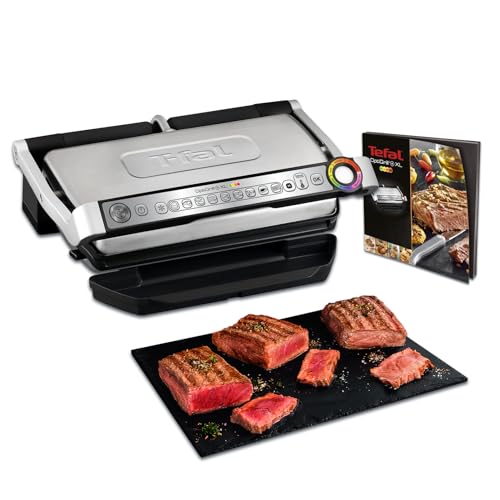
| Tefal Plancha | Switchable Boost zone, continuous plate with 1,300 cm² | approx. €90 | 8.6 | want more area and only cook indoors |
| COSTWAY Teppanyaki Grill 100 cm | Cooking surface 90 x 22 cm, four temperature settings | approx. €83 | 7.9 | regularly cook for larger groups on one long plate |
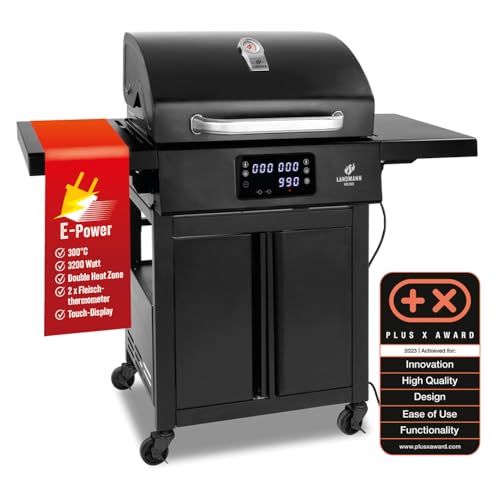
| Landmann Elektro-Grillwagen EG-II-590 | Freestanding grill with grate, two heating zones, up to 300 °C | approx. €550 | 9.4 | want to grill outdoors on a grate and have your own circuit |
Prices are guide values from our price boxes, and the rating is our editorial assessment, not a measurement result. The table is no use as a power comparison: the Russell Hobbs has two wattage figures, and plate, grate and freestanding grill are too different in design for a common number.
According to Tefal, the Tefal Plancha has a continuous plate of 1,300 cm² (50 x 26 cm) and a Boost zone that can be switched on and works with up to 2,200 W. According to the Amazon catalogue, the Landmann has two separately operated heating elements, the temperature can be set in 50-degree steps, and grilling is done on enamelled cast iron grates. In return it needs floor space for a trolley. You will find more table and freestanding grills in electric grills compared.
When this table grill suits, and when it does not
It starts with the cooking style. Our assessment: rice, vegetable strips, prawns and thinly sliced meat sit better on a plate than on a grate. If you want steaks with sear marks, you need a grate, and for that we would pick the Landmann among the siblings in the table.
Then the area. Russell Hobbs only writes ideal for the whole family. According to Tefal, 1,300 cm² is enough for 6 to 8 people, and according to Costway the long plate is for 8 to 10; for larger gatherings we would therefore look there, and plan the Russell Hobbs for the family table.
For power, it depends on the appliance. The Russell Hobbs needs a socket that, in our recommendation, you do not share with other high-power consumers. According to its manual, the Landmann requires a socket rated for 3,200 W and no other high-consumption appliances on the same circuit.
The location decides the rest. The Russell Hobbs manual knows only the household and says nothing about a balcony or terrace; the Landmann’s expressly names operation outdoors. What counts legally on the balcony is covered in the guide grilling on a balcony. If you are unsure which type of grill suits your cooking style, the grill finder helps.
In our assessment the Fiesta Teppan-Yaki is wrong for households where children under 8 sit at the dining table and the grill is meant to stand there: the manual requires the appliance and cable to be kept out of reach of these children, and that is hard to ensure at a shared table. If you want to cook small items on a plate indoors and are looking at the lower end of the price range in our table, it is the right one.