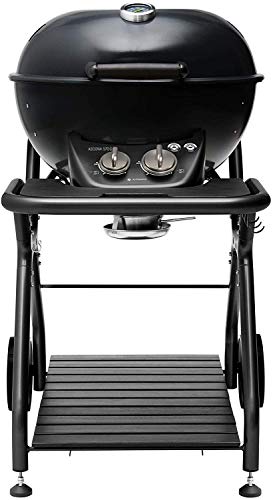
A gas kettle grill with two ring burners
The Ascona 570 G looks like a kettle grill and is one, except that it burns gas instead of charcoal. Outdoorchef, a Swiss company of the Diethelm Keller Group with development in Zurich, sets the round, porcelain-enamelled steel kettle on a mobile X-shaped base frame. Under the grate sit two ring burners, with a funnel in between that separates flame and food. According to the company chronicle, the idea goes back to 1992, and the brand’s first gas kettle grills came out in 1996.
This page covers the All Black version with product number 18.128.57. Our purchase link leads to Amazon, where the device appears as “ASCONA 570 G ALL BLACK” in the model field. Outdoorchef itself does not link an Amazon number, so the match rests on this catalogue entry. According to our price box, the grill costs approx. €955 there (Amazon page on 20.10.2026: €955). On the manufacturer’s site the model is listed at a clearly lower price among the promotional products, but on 21.10.2026 it carried the note “Currently not available”.
In our gas grill category the Ascona is a special case. Most devices there are rectangular grill carts with several burners side by side, and weighing it against them means weighing two cooking principles against each other, not two kilowatt figures.
What sits under the lid
Two burners, separately adjustable. According to the operating manual, the large ring burner delivers 8.50 kW and the small one 1.20 kW, which together make the 9.7 kW that Outdoorchef states as total output. The left control knob belongs to the small burner. It runs on liquefied gas (propane/butane), the German version has nozzles for 50 mbar, and with both burners at full output the grill consumes at most 702 g per hour according to the data sheet.
Ignition is electric at the push of a button, which Outdoorchef calls “One touch ignition”. You do not need a power socket. The Ascona has no side burner, infrared burner or rear burner for a rotisserie.
The grate measures 54 cm in diameter, and Outdoorchef gives the grate area as 2290 cm². Both figures fit together, as a circle with a 27 cm radius has exactly this area. Above it closes a single-walled lid of porcelain-enamelled steel with a thermometer. Its hinge is made of die-cast aluminium and swings it open up to 135 degrees; according to the manufacturer it can be opened with one hand from the front. The burner chamber under the funnel is made of powder-coated steel. There are no flavouriser bars because the funnel takes over their job.
The base frame, also powder-coated steel, stands on two large wheels and carries a holder at the bottom for gas bottles of 5 or 8 kg. In front of the kettle sits a fixed shelf with utensil hooks, made of lacquered wood according to the Amazon description; it cannot be folded. In the product photo it lies across the front of the kettle, and a second shelf made of slats can be seen below it.
Assembled, the grill measures 65 cm wide, 97 cm deep and 107 cm high, and the working height is 86 cm. It weighs 29.3 kg, or 36.3 kg with packaging.
On two components the product page contradicts itself. In the description text the ring burners are called “stainless steel”, while in the table below the main burner is listed as “porcelain-enamelled”. For the grate it is the other way round: porcelain-enamelled steel at the top, stainless steel below. The Amazon bullet points speak of a grate and funnel made of porcelain-enamelled steel, an enamelled large burner and a steel small burner. We cannot settle from here which version is right. It is not a mere formality, because the warranty period depends on this material (more in the FAQ).
In detail: standard and volcano position
On a grill cart, indirect heat is created by switching off individual burners and placing the food over the cold spot. The Ascona solves this differently. The funnel lies as a bowl between burner and grate and can be inserted in two positions.
In the standard position, according to the manual, the heat circulates in the kettle, the food is cooked all around and does not need to be turned. Outdoorchef describes it as the right position for most uses and gives up to 360 °C for this circulating air. The manual lists meat, fish, gratins and vegetables for it, as well as pizza, flammkuchen and bread.
If you turn the funnel to the volcano position, very high, concentrated heat comes from below. This is intended for a wok, aroma pan or cast iron plate, and according to the manual for quickly fried food such as tuna steaks, scallops or wok vegetables. For direct grilling on the grate Outdoorchef states up to 500 °C, without tying the value to either of the two positions.
Two warnings belong right here. You may only change the funnel position during grilling while wearing heat-resistant gloves. And in the volcano position the lid stays open on the highest setting; it is only intended to be closed there on a low or medium setting.
The small burner has a job of its own. According to the manual it is designed for cooking at low temperatures, reaches approx. 100 to 120 °C and can only be regulated slightly, the difference between the highest and lowest setting being not visible. That is the range in which low and slow usually runs, meaning long cooking times for ribs or pork shoulder. The large burner covers the medium to high range and is regulated continuously. On paper, 88 percent of the total output sits in it. How low it gets on its smallest setting is not stated in any source, and so neither is whether a gap remains between 120 °C and its lower end.
Now to the fat. The product page says the funnel system protects “100% against grease fires”. According to the manual, most of the fat evaporates or runs into the collection tray under the kettle. In the same manufacturer’s warranty terms, grease fire is nevertheless listed among the exclusions, alongside ordinary wear on parts such as the funnel, burner, thermometer and ignition, the effect of salt-laden air and other points. We read it like this: by design the risk falls because the fat does not drip onto an open flame. The full tray remains your responsibility, and in the event of a grease fire the warranty does not step in. What to do if it does catch fire is in the guide preventing grease fires, and the two cooking methods themselves are explained in the article on direct and indirect heat.
Are 54 centimetres enough for a whole barbecue round?
In our assessment fine for eight people, for twelve only in several batches. Outdoorchef states 8 to 12 guests. On a round area the upper end gets tight as soon as sausages, vegetables and meat are all meant to go on the grate at the same time.
That comes down to the shape. Steaks and chops leave gaps at the edge of a round grate, which you can fill with sausages or corn on the cob, but not with another piece of meat. Added to that is the principle: if the heat flows around the whole kettle in the standard position, then as we understand it there is no cooler edge zone to push finished food onto to keep it warm. Neither the product page nor the manual mentions a warming rack.
Amazon gives different values, a grate of 57 cm, dimensions of 67 x 97 x 106 cm and 29 kg. We stick to the manufacturer’s figures from the section above. The area speaks for 54 cm: 57 cm would come to around 2550 cm², and a figure like that appears nowhere at Outdoorchef.
Gas bottle, consumption and running costs
According to the manual, only gas bottles with a maximum filling weight of 8 kg may go on the base plate, and the drawing limits them to 500 mm height and 310 mm diameter. An 11 kg bottle therefore does not fit in the frame. The bottle is fixed with the supplied bottle strap or in the holder. The documented scope of delivery also lists a gas hose with pressure regulator, a spanner for the connection and a soap solution for the leak test; a gas bottle does not appear in it.
With the 702 g/h you can estimate the running time, and the calculation is ours: a 5 kg bottle lasts a good seven hours with both burners at full load, an 8 kg bottle a good eleven. Full load is the worst case, and with a smaller flame the filling lasts longer. How much longer cannot be said without consumption figures per setting. What a filling costs depends on the retailer, and which size suits you is covered in the guide gas bottle for the grill.
According to the manual, the hose and regulator comply with EN 16436 (hose) and EN 16129 (regulator). A hose length of 90 cm is recommended, and it must not be longer than 150 cm. Both are to be replaced three years after the purchase date, or immediately if damaged, and that belongs in the calculation just as much as the cover. Outdoorchef sells a matching cover made of polyester with PU coating in its own shop for €89.95 (as of 21.10.2026), and the manual expressly advises an Outdoorchef cover.
What Outdoorchef leaves open
Collected in one place: the manufacturer gives no heat-up time to a particular temperature, only approx. 10 to 15 minutes of preheating with the lid closed on the highest setting in the standard position. Also left open are the definitive material of the burners and grate, the material of the funnel (which only Amazon describes), the outlet pressure of the supplied regulator, whether the batteries for the ignition are included, the country of production, a patent number for the funnel, the model’s year on the market and a complete list of the scope of delivery. On origin, Outdoorchef writes “Swiss Design & Engineering”, with no place of manufacture given.
Against that stands a detailed German operating manual. It applies jointly to several of the brand’s gas kettle grills, including Geneva, Montreux, Ascona and Leon 570 G, and most of the information in this text comes from it.
Safety, cleaning and care according to the manual
According to the manual, the grill may only be used outdoors, with a safety distance of at least 1.5 m from flammable objects. Never under an awning, never indoors such as in garages, buildings, tents and other enclosed areas or under flammable structures, and it is not suitable for installation in or on boats or caravans. The ground must be firm and secure, and wooden floors and other flammable surfaces are off limits during operation. Set it up as sheltered from the wind as possible, do not move it during operation and never leave it unattended. The large round air intake hole at the bottom of the basin and the air slots in the lid must never be blocked. Children must not operate the grill.
Before first use, after every connection or exchange of the gas bottle and at the start of the grilling season, the manual requires a leak test. The procedure: gas control knob to off, open the valve on the bottle, brush all gas-carrying parts (connection at the gas bottle, gas pressure regulator, gas hose, gas inlet, connection at the valve). For this you use the enclosed soapy water solution, your own mixture of 50 percent liquid soap and 50 percent water, or leak detection spray. If bubbles form, there is a leak there: close the gas at the bottle, tighten the connections or replace defective parts, repeat steps 1 and 2. If the leak cannot be fixed, the gas specialist is responsible. During the test there must be no ignition sources nearby, not even a cigarette, and testing is never done with a match or open flame. You must always screw the hose on with the enclosed spanner, never by hand alone.
If you smell gas, the manual provides four steps: cut off the gas supply to the grill, extinguish all open flames, open the lid. If it still smells of gas then, you move away from the grill and contact the fire brigade immediately.
Cleaning is done in four steps. Heat the grill for approx. 10 minutes at full output so that food residues such as meat remnants, fat and sugar from marinades burn off. Then let it cool down completely so that the residues harden. Clean the grate with an Outdoorchef nylon or brass grill brush, no brushes with steel bristles. Finally, take out the grate and clean the funnel with the Outdoorchef funnel brush. The funnel and grease collection tray can be removed completely; you only take off the tray once the fat has cooled down fully.
Only standard, non-aggressive products such as washing-up liquid are used on the outside and on the shelves, never glass cleaner or other spray bottle cleaners, because they can attack the surfaces. Outdoorchef does not recommend special grill cleaners; if you use them anyway, according to the manual you should “test them first on an inconspicuous spot”. Hot grates, grill pans and cast iron pans never belong on the shelf surfaces, as the paintwork could be damaged.
For care through the year: check the gas-carrying parts at least twice a year and after any longer storage, because spiders and other insects can cause blockages. Before longer storage oil all metal parts, treat wooden parts with wood oil once a year, and at least once a year remove dust, dirt and pollen from behind the wheels. The cover only goes onto the fully cooled grill and comes off again after heavy rain so that it can dry. If the grill spends the winter in a room, the gas bottle must absolutely be taken out. It is stored outdoors in a well-ventilated place without access for children, never above 50 °C and never in a basement.
These three alternatives are worth a look
| Model | The difference | Price | Our rating | Choose this if |
|---|---|---|---|---|
| Outdoorchef Ascona 570 G (this one) | Kettle with two ring burners and rotating funnel instead of separate zones | approx. €955 | 8.4 | you mostly cook with the lid closed and rarely have more than eight guests |
| Broil King Crown 490 Shadow | rectangular, four burners side by side plus side burner | approx. €996 | 8.9 | you need hot and cool zones at the same time and want a cooking spot for side dishes |
| Weber Spirit II E-310 | rectangular grill cart with three burners, without funnel and without side burner | approx. €459.99 | 9.2 | you mainly grill directly and put the price difference into a bottle and cover |
| Broil King Regal 590 | five main burners, side cooking plate and rear burner for the rotisserie | approx. €1,649 | 9.4 | you regularly grill for more than twelve people and want to cook on a spit |
The prices are guide values from our price boxes and may have changed since they were retrieved. The rating is our editorial assessment of the available data.
The Crown 490 Shadow stands at approx. €996 in our price box, the Ascona at approx. €955, and the Crown leads in our comparison with 8.9. With such a small gap, the design decides: four burners side by side against a kettle with circulating air. The Spirit II E-310 stands clearly lower at approx. €459.99, but what you get is a classic grill cart without the funnel principle. The Regal 590 stands higher at approx. €1,649 and is the overall winner of our category. What speaks against the Ascona from our point of view is mainly the two burners and a data sheet that contradicts itself on the burners and grate.
When the Ascona suits you and when another grill does
The Ascona suits you if you like cooking with the lid closed: whole chickens, roasts, vegetables, pizza or flammkuchen in the standard position, plus the occasional wok in the volcano position. Then you use exactly what the funnel was built for. That you do not need to turn food in the standard position according to the manual is, in our assessment, a real advantage when cooking several courses in a row.
If you want to sear a steak while sausages next to it only stay warm, a kettle with two burners is the wrong design. Here we would reach for the Broil King Crown 490 Shadow, which costs hardly more. If you mostly grill directly and want to save money, the Spirit II E-310 is the obvious choice, and from the price difference you pay for a bottle, cover and quite a bit more.
When budgeting, include the cover from the manufacturer’s shop and a filled gas bottle, which takes you well above €1,000. With the bottle you are limited to 5 or 8 kg. If you grill for gatherings of more than twelve people, a 54 cm grate will not get you far.
On space: with its two wheels the grill can be moved around the garden, and if you regularly shift it over uneven ground, according to the manual you should check from time to time whether all screws are still tight.
The Ascona is wrong for anyone who wants to grill on a balcony beneath another balcony above. The manual prohibits operation under an awning, in our reading this also applies to a balcony slab above, and together with the distance to flammable material and the ban on wooden floors, little room is left on most balconies. What tenancy law and house rules say about it is in the guide grilling on a balcony.