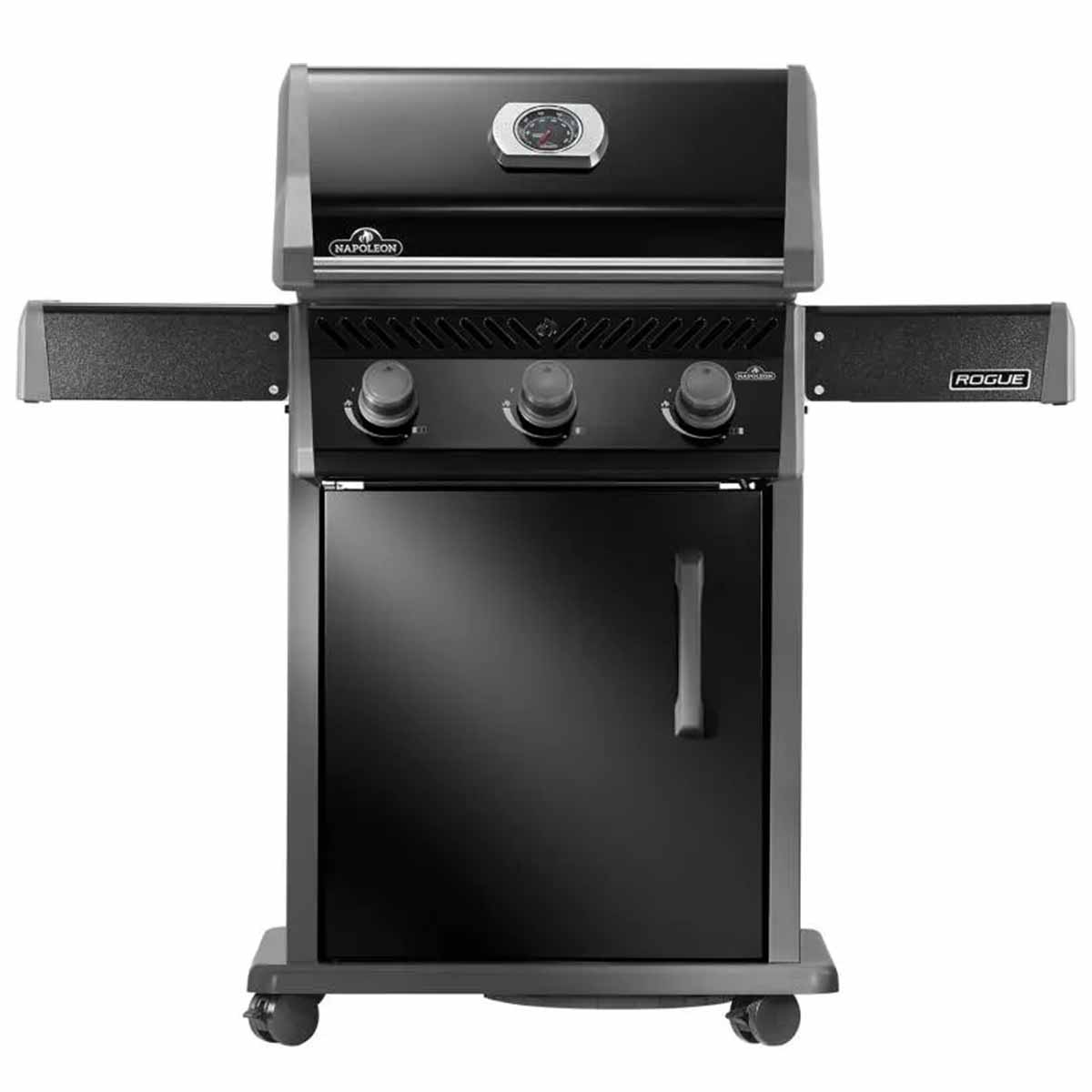
The Rogue 425 is a gas grill with three main burners, which Napoleon lists in Germany under the model number R425PK-2-DE in black. It has a base cabinet for the gas cylinder and two fold-down side shelves. It has no side burner and no rear burner. You only get both on the Rogue 425 RSB, the only other Rogue on Napoleon’s German series page.
In our price box it is listed at Santos Grills at approx. €629 (as of September 2026). Napoleon itself gives an RRP of €799 and sends buyers from the product page to the retailer search.
We have not handled the grill ourselves and have not grilled anything on it. The technical data here come from Napoleon’s German product page and from the user manual N415-10001900CE-DE dated 11.11.2024, which covers the Rogue models R365, R425, R525 and R625 together with the PRO and PRO-S variants. What the manual shows only on a different model, we do not transfer to the R425. An earlier version of this page spoke of stainless steel grates, 11.4 kW and 62 x 46 cm cooking area and described heat-up and cooking times as if we had experienced them ourselves. No Napoleon source supports any of these statements, and the times did not come from any measurement.
Combustion chamber, burners, grates: what the Rogue 425 is made of
The combustion chamber is made of cast aluminium. On the product page Napoleon describes it as “virtually indestructible” and especially rust-resistant. The manual sounds more sober: aluminium does not rust, but high temperatures and weather can cause white oxidation spots to form on the cast parts. On the outside Napoleon combines black porcelain enamel with powder-coated surfaces, which according to the product page are weatherproof and are said not to show fingerprints.
Inside work three main burners made of stainless steel; the maintenance chapter speaks of thick-walled 304 stainless steel. Each burner has its own knob. Above the burners lie two-stage flame guards made of stainless steel, which according to Napoleon are meant to prevent flare-ups, and on them the Iconic WAVE grates made of porcelain-coated cast iron. On top sits a stainless steel warming rack.
According to Napoleon the main cooking area measures 60 x 46 cm, multiplied out 2,760 cm², and according to the manufacturer is enough for 26 burgers. The total cooking area is given on the page as 3,684 cm². The difference of 924 cm² is probably the warming rack, but Napoleon has not assigned it.
Ignition is by JETFIRE: a jet of flame lights each burner individually. The lid is open for this; according to the manual you never light with the lid closed. Before you open the cylinder valve, all burner knobs are set to Off. Then you press a knob and turn it anticlockwise to the highest setting. If the pilot flame and burner do not light within five seconds, you turn the knob clockwise back to OFF and wait 5 minutes before trying again. In an emergency you put a match into the supplied lighting rod.
Before the first grilling session you take out the warming rack and let the main burners run for 30 minutes. That it smells at first is normal according to the manual.
The ACCU-PROBE thermometer sits in the lid, and the cart stands on lockable casters. Assembled, the grill is 134.62 cm wide, 64 cm deep and 120 cm high, 160 cm with the lid open. With the side shelves folded down the width shrinks to 89 cm. Packed it weighs 57.59 kg, and the carton measures 60.50 x 72.01 x 84.51 cm. Assembly follows exactly the assembly instructions N415-10001903CE; if the retailer assembled it, you check the assembly against these instructions.
In detail: 14.25 kW or 12.3 kW, and what the figure says about the grate
For the same grill Napoleon gives two outputs. In the technical data of the product page it is 14.25 kW, in the list of main features further up 12.3 kW. The manual supports the larger figure: its gas table gives a gross heat input of 14.25 kW and a consumption of 1037 g per hour for the main burners of the R425, with nozzle size #59 for category I and #64 for category II. We therefore calculate with 14.25 kW. Where the 12.3 kW come from remains open.
A kW figure describes the gas energy flowing into the burners. How densely the heat arrives under the grate also depends on how much area it has to heat. Dividing 14.25 kW by 2,760 cm² of main cooking area gives 5.2 W per square centimetre; with 12.3 kW it would be 4.5 W.
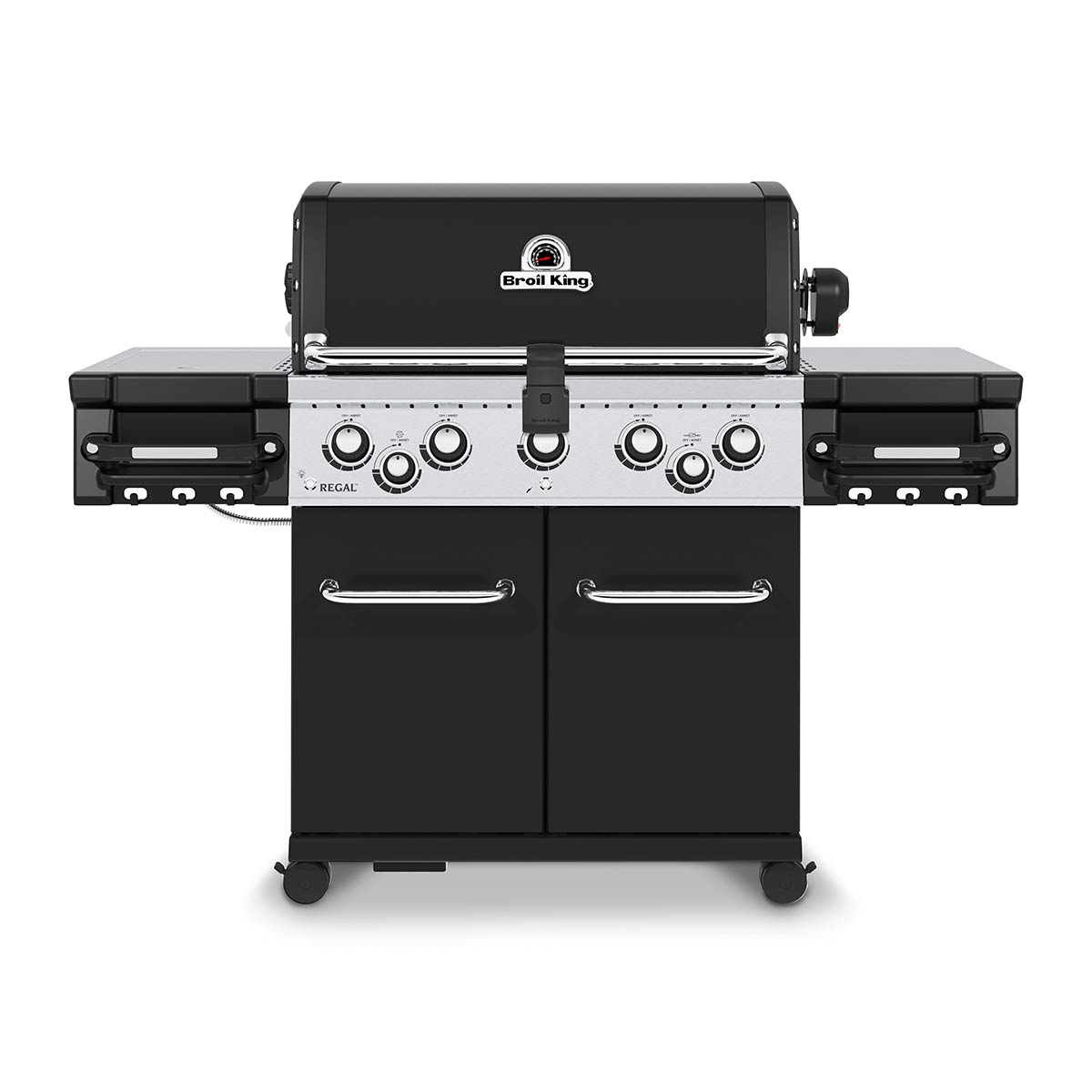
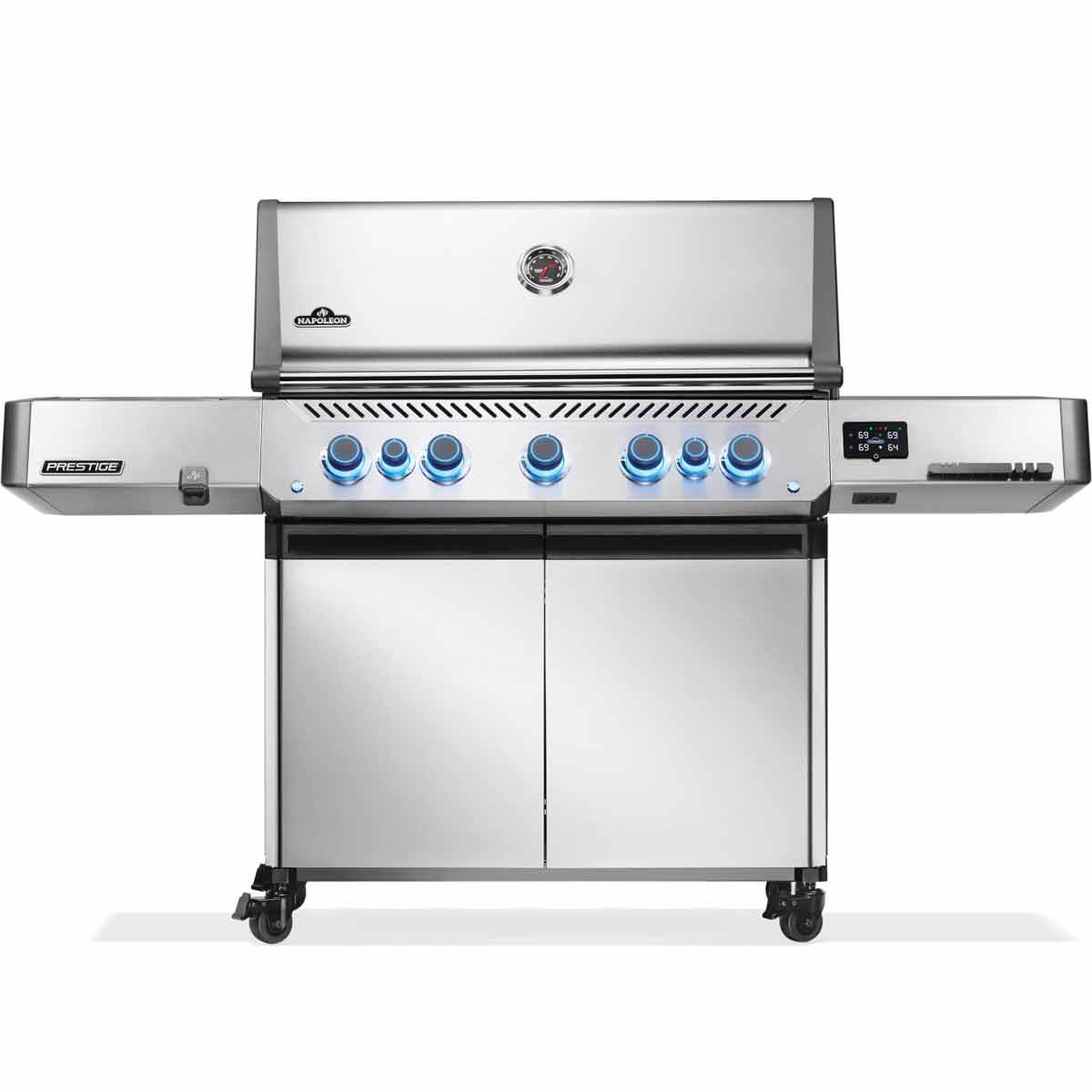
Calculated in the same way from the manufacturer’s figures, the Weber Spirit II E-310 with 7.0 kW on 2,314 cm² comes to 3.0 W and the Broil King Regal 590 with 16 kW on 4,032 cm² to 4.0 W. The Napoleon Freestyle PRO 365 comes to 5.0 to 5.2 W with 12.0 kW of main burner output, depending on which of its two area figures you take. That is not a grate temperature, because the lid, wind and outside temperature play their part. For comparing grills the quotient is still useful, and in it the Rogue 425 is level with the Freestyle PRO 365 in front.
To preheat, according to the manual you let all main burners run for about 10 minutes on the highest setting with the lid closed. Napoleon does not state a temperature that the cooking chamber reaches afterwards. Foods that take longer than 30 minutes, such as roasts, can cook indirectly: the burner opposite the food is switched on, and the food itself lies over a switched-off one. With three burners, two arrangements are thus conceivable, one burner on one side, or the two outer ones on and the food in the middle. If flames flare up, you take the food away from the flames, reduce the heat and leave the lid open.
How much space does the Rogue 425 need on the patio?
Arithmetically an area of a good 185 x 130 cm. With the shelves unfolded the grill measures 134.62 x 64 cm, and the manual requires 660.4 mm clearance to combustible materials at the back and 254 mm to each side. The space where you stand in front of the grill comes on top.
If there is vinyl cladding or a glass pane nearby, Napoleon additionally recommends 610 mm. Above the open lid you need 160 cm of clear height. The 89 cm with the shelves folded down help with storage; in operation we allow for the full width, because the shelves then serve as a work surface.
Where the grill may stand is strictly regulated by the manual. In capital letters it says there: use outdoors in a well-ventilated space. It is intended for an outdoor patio or the garden, and only in an above-ground open-air area with natural ventilation and without stagnant zones. It does not belong in a building, a garage or any other enclosed space, nor in a built-in or slide-in structure, nor in or on caravans and boats. The ventilation openings of the cylinder housing stay free. You do not expose it to strong wind, especially not wind from behind. According to the manual, the minimum ambient temperature for safe operation is minus 17.8 °C.
Balconies do not appear in the manual. Whether your house rules or tenancy agreement allow a gas grill there, you clarify before buying.
Gas, cylinder, leak test: what the manual requires
In Germany the Rogue 425 runs in gas category I3B/P(50), with butane or propane at 50 mbar; according to the manual the same category applies to Austria, Switzerland, the Czech Republic and Slovakia. The product page lists only propane gas as fuel. Use only pressure regulators that deliver exactly this pressure. In one place the manual requires a regulator and hose from Napoleon and, if they are not included, parts to European standard; in another place it allows only the regulator and hose supplied with the grill or replacement parts expressly recommended by Napoleon.
A hose of 0.9 m is recommended, it must never be longer than 1.5 m, and it is replaced before the printed expiry date. It must be neither twisted nor kinked, you do not route it under the drip tray, and it touches neither the drip pan nor other hot surfaces, because otherwise it can melt and cause a fire.
As a cylinder the manual requires propane from 6 kg or butane with 13 kg. It stands in the intended area on the lower shelf as long as it is at most 310 mm wide or in diameter and 590 mm high; larger cylinders stand outside the housing on level ground. It must never be filled more than 80 percent. Before connecting, you check it for dents and rust and have your gas supplier check it. You never use a cylinder with a damaged valve, and any cylinder showing signs of damage or wear goes back unused to the seller. At every exchange or refill you check the seal of the cylinder valve. Keep extreme heat and direct sun away from the cylinder. A spare cylinder does not go under the grill head, and cylinders that are not connected are not stored near this or any other appliance. Which cylinder sizes are common in shops and how to check the fill level is explained in our guide on the gas cylinder for the grill.
You carry out the leak test before every use, once a year, whenever gas components are changed and whenever you smell gas. The procedure according to the manual: do not smoke, remove all ignition sources, all burner knobs to Off, open the gas supply valve, then brush all connections and fittings of the regulator, hose, manifold and valves with a semi-liquid solution of soap and water. If bubbles form, there is a leak there. You tighten the connection; if that does not stop it, you close the gas and have the grill checked by an installer or the retailer. Until the leak is fixed, the grill stays off. Open flames for leak detection are prohibited.
If you smell gas, you turn off the gas supply, extinguish any open fire and open the lid. If the smell persists, you keep away from the appliance and call your gas supplier or the fire brigade immediately.
After grilling you turn the gas off at the source. If the grill is to stand unused for longer, you remove the hose and cylinder and store the cylinder outdoors in a well-ventilated place, never in buildings, garages, sheds or other enclosed spaces.
Seasoning cast iron grates, getting rid of grease: care
Only the cooled-down grill is cleaned, and with protective gloves and safety goggles.
The WAVE grates make most of the work. Before first use you wash them by hand with water and mild washing-up liquid solution, not in the dishwasher, and dry them completely. Then comes seasoning with oil, at 176 to 204 °C, twice for 30 minutes. In capital letters the manual says this procedure MUST be carried out before first use and repeated every 3rd to 4th use. Cast iron grates are brushed with a brass wire brush; according to the manual, the stainless steel brush is intended for stainless steel grates. The enamel is glass-like and can chip on impact, and cold water from rain, a sprinkler or a hose should not hit the hot grill, because the porcelain can chip off.
The grease collects under the grates. You clean the grease tray, drip pan and searing plates regularly to avoid grease deposits and grease fires, the drip pan about every 4 to 5 uses. Aluminium foil and sand have no place in it. You replace the disposable grease tray every 2 to 4 weeks depending on use.
The control panel tolerates only warm soapy water, otherwise you rub off the printing. Oven cleaner does not belong on any part of the grill, nor does a pressure washer, and no part goes into a self-cleaning oven. Anyone living near the coast washes stainless steel and chrome surfaces every 3 to 4 weeks according to the manual.
An insect screen is fitted at the air shutter of the burners at the factory. Cobwebs and nests in the venturi tubes can still cause a yellow flame or a flashback, so you check the tubes regularly. Once a year a qualified service technician should inspect and service the grill thoroughly. The air supply is set at the factory; only a qualified gas installer may readjust it. A step-by-step cleaning for gas grills in general can be found in our guide cleaning a gas grill.
Warranty, accessories and what else costs money after purchase
The product page states a limited warranty of 15 years. The table in the manual graduates it by component: 15 years for cast aluminium parts and stainless steel base as well as for the porcelain-coated lid, 10 years plus 15 for the stainless steel tube burners, 5 years plus 15 for the stainless steel flame guards and the porcelain-coated cast iron grates, 2 years for all other parts. “Plus 15” means: after the period expires, Napoleon supplies replacement parts for a further 15 years at 50 percent of the current sales price. The table applies to purchases from 1 January 2022. Napoleon does not bear labour, transport and installation costs, and after the first year Napoleon may reimburse the wholesale price of the defective part instead of providing a replacement part. The warrantor is Wolf Steel Europe B.V. in Tiel, the Netherlands. Your statutory warranty rights remain unaffected. If you fit replacement parts from other manufacturers, the warranty lapses.
Napoleon lists accessories directly on the product page, each with an RRP: the grill cover 61427 for the Rogue 425 models with top-mounted shelves for €94.95, the rotisserie kit 69912 for all Rogue series for €169 and the enamelled cast iron reversible plate 56426 for €64.95. A rule from the manual applies to the plate: you never cover more than 75 percent of the cooking surface with solid metal.
Grill and cover together come to just under €724, calculated with our price box value and the RRP of the cover. According to no source is a gas cylinder part of the delivery. What mainly recurs are the disposable grease trays: the 3-pack 62020 costs RRP €12.95 according to Napoleon and, at the replacement interval from the manual, lasts 6 to 12 weeks. Napoleon customer service arranges spare parts at +31 345 588655.
What Napoleon leaves open
The following is stated in none of the sources mentioned, or the sources contradict each other:
- the weight of the assembled grill; only the packaging weight is documented
- the output of the individual burners; only their sum is documented, and that in two versions
- the scale range and accuracy of the ACCU-PROBE thermometer and a maximum temperature in the cooking chamber
- which exterior parts are enamelled and which are powder-coated, and thus whether the 15-year line of the warranty table applies to the lid
- the material of the side shelves
- the scope of delivery in detail, above all whether the pressure regulator and hose are in the carton
- how many people the grate is enough for; Napoleon counts in burgers
- the gas consumption separately for propane and butane; the table has one value for both categories
- country of production and market launch of the current version
- whether Santos Grills is among the official Napoleon retailers to which the manual ties the warranty; we have not checked that
Three alternatives from our catalogue
| Model | The difference | Price | Our rating | Choose this one if |
|---|---|---|---|---|
| Napoleon Rogue 425 (this one) | 3 stainless steel burners with 14.25 kW according to the manual, no side or rear burner | approx. €629 | 9.0 | you want a lot of output on 60 x 46 cm and can manage without an additional burner |
| Weber Spirit II E-310 | also 3 burners, but according to Weber 7.0 kW on a smaller main grate | approx. €459.99 | 9.2 | you want to save around €169 and less output per area is enough for you |
| Napoleon Freestyle PRO 365 | 3 main burners with 12.0 kW plus SIZZLE ZONE infrared side burner | approx. €599 | 9.1 | you want a separate searing zone and pay €30 less for it |
| Broil King Regal 590 | 5 main burners with 16 kW, side cooktop with 2.7 kW, rear burner with 4.4 kW | approx. €1,649 | 9.4 | you grill for large groups and can spend around €1,020 more |
The prices come from our price box (as of September 2026); on the day of your order the retailer may price differently. The technical data come from the manufacturer pages and manuals; the rating is our editorial assessment based on the data comparison.
When the Rogue 425 fits, and when another grill
We would take it if you regularly grill for a family or a few guests, have a fixed place in the garden and mainly grill directly over the burners. Then output per area counts, and there it leads.
If a steak with a sharp crust next to the vegetables is at the top of your list, more speaks for the Napoleon Freestyle PRO 365: it has its own infrared zone next to the main grate and costs €30 less in our price box. In return its main grate is smaller.
If budget is the limit, take the Weber Spirit II E-310. It costs around €169 less and, at 9.2, is even narrowly ahead of the Rogue in our overall rating. What you give up is power reserve, see the calculation above.
If you like to cook sauces or side dishes in a pot at the grill, or want to cook on the spit regularly, the Rogue 425 is the wrong choice. It lacks a side cooker and rear burner, and the rotisserie kit comes on top at RRP €169. Then take a look at the Rogue 425 RSB (see the questions below) or, with a much larger budget, at the Broil King Regal 590.
Anyone who dislikes caring for cast iron grates gains little by switching within this table: Weber and the Freestyle PRO 365 also use enamelled cast iron grates according to the manufacturer.
If you only have a balcony where the house rules prohibit open flames, a gas grill is not an option in principle. Which type of grill then comes into question, the Grill Finder helps you narrow down.