Item no. 301030: the grill, not the complete package
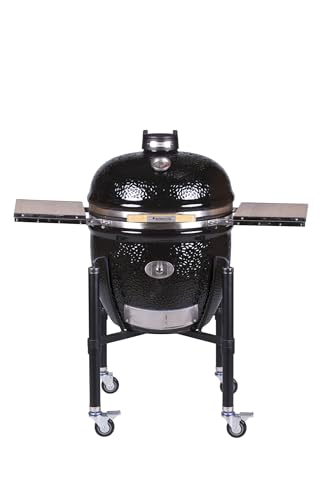
Monolith lists the grill as AVANTGARDE.66 (LeCHEF) under item number 301030; the same number appears at Amazon as the model number under the title “Monolith LeChef Avantgarde”. Behind it is the version without a stand. Stand and side tables are a separate item (item no. 301039, “AVANTGARDE LeCHEF Gestell Set”), and the 2025 Quick Start Guide says the stand for the TWO and Avantgarde series is available separately. The page title speaks of a complete set. At most that applies to the contents of the body; no stand comes with the grill.
According to the manufacturer’s page, the grill comes with: LED handle, smoker rail with pusher, split charcoal basket, 2.0 fire box, grate lifter and ash shovel. In addition there is the Smart Grid System 2.0 made up of a metal frame, two half-round drip trays, two half-round deflector stones, two half-round cooking grates and two SGS lifters.
According to the manufacturer, the Avantgarde series builds on the PRO Series 2.0, whose standard is silicate ceramic plus fittings and seals made of stainless steel and glass fibre. For the Avantgarde, the manufacturer names side tables and handles with LED lights made of carbonised heavy bamboo, as well as a revised stand with a larger shelf area. Monolith already describes bamboo handles and side tables for the PRO Series 2.0. MONOLITH Grill GmbH is based in Osnabrück and was founded in 2008 by Matthias Otto; according to the 2026 catalogue it is made in China, in the Yixing region.
There is no manual of its own for the Avantgarde. We rely on the 2025 Quick Start Guide and on the PRO Series 2.0 manual (2020/2022 edition), on which the Avantgarde series builds. Where we write “the manual”, the latter is meant.
Ceramic, dimensions and weight
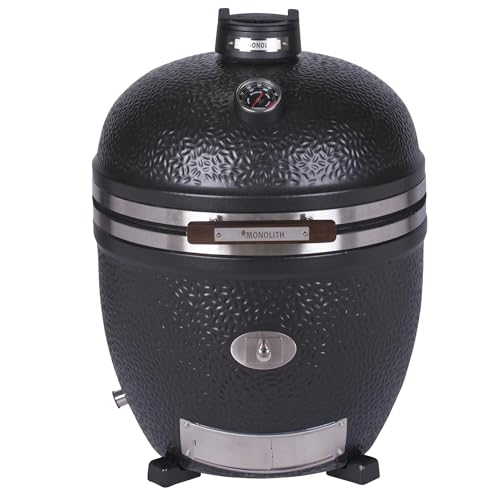
According to the manufacturer, the grill is made of ceramic, stainless steel and cast iron, and the fittings are stainless steel. Monolith calls the ceramic silicate ceramic and cites its heat storage and distribution as an advantage. The manufacturer’s text in the Amazon catalogue describes the glaze as a satin-matt, durable mineral glaze. The seal between body and lid is made of glass fibre and stainless steel and, according to the catalogue, maintenance-free. The lid cannot be removed. Two LED lamps sit in the handle; the Amazon text speaks more vaguely of LED light in the grill.
The product photo shows a dial thermometer in the lid. It is missing from the scope-of-delivery list in the manufacturer’s shop, while the scope-of-delivery page of the 2025 Quick Start Guide does list an “AVANTGARDE THERMOMETER”, as well as the LED handle. As an accessory, the manufacturer offers a thermometer for the .66 (item no. 301057-L, RRP €49.90).
The data sheet draws the body without stand in side view at approx. 85 cm high and approx. 72 cm horizontal, and in top view at approx. 80 and approx. 72 cm. The shop gives the same numbers unlabelled as 85 x 72 x 80 cm, and the Amazon catalogue data assign them: 85 cm height, 72 cm length, 80 cm width. The catalogue lists ONE.66, TWO.66 and AVANTGARDE.66 in a shared row: with the stand the grill is approx. 129 cm high there, and with side tables approx. 135 cm wide.
On weight, the manufacturer’s sources contradict each other. The shop and data sheet give 118 kg without stand, and the shop 144 kg with stand. In the shared column of the three .66 models, the 2026 catalogue arrives at approx. 140 kg for the body and approx. 165 kg with stand. Our assessment: for the ground, transport and setup, you are better off planning with the higher catalogue figure, even though the lower shop figures refer to exactly these item numbers.
For the temperature range there are two values from other sources: the catalogue speaks of 70 to 400 °C, the PRO Series 2.0 manual of a usable range between 80 and 400 °C. You should not heat above 400 °C, because according to the Quick Start Guide the seal between body and lid can be damaged.
What the manufacturer does not state: none of the sources we found gives the wall thickness of the ceramic, the cooking area in cm², a heat-up time to a given temperature, the temperature fluctuation over hours, the assembly time of the stand, a statement on balcony use, a replacement seal explicitly for the Avantgarde, a list of compatible controllers, the contents of the starter set (the catalogue text only says “essential accessories”, the contents are shown in an illustration), or the price and item number of the pizza stone. It also remains open whether the lid thermometer from the photo, the thermometer in the Quick Start Guide and the separately listed thermometer are the same part.
In detail: charcoal divider, Smart Grid System and chip feeder
How a kamado works in general is explained in the kamado grill guide; here we cover the particulars of this model.
Ceramic stores heat, and that shapes how you use it. The manual attributes the fast heat-up to the chimney effect (air flows in at the bottom and escapes hot at the top); the grill is heated up “in no time”. Once the desired temperature is reached, you close the air intake control down to 1 to 2 cm. The same storage capacity makes the way back slow: going from very high to low temperature takes a while, and for cooking at low temperatures the manual advises not letting the temperature climb too high after lighting.
The charcoal basket is split. If you insert the charcoal divider, you fill and light only one half; according to the manual this sets up a direct and an indirect cooking zone at the same time, described there for Classic and LeChef. The Smart Grid parts follow the same split: deflector stone and drip tray come as half-round pairs, plus two half grates and, according to the Quick Start Guide, a ring for height adjustment. Our reading: the design is tailored to the two-way split. With half grates, the manual describes up to five levels, four of them variable; the Avantgarde comes with two half grates, so one level, and for more you need additional grates.
For low temperatures and long cooking times, according to the manual you fill the charcoal directly into the fire box, because the larger quantity burns longer, at most up to the joint between fire box and fire ring. For medium and high temperatures the manual calls the charcoal basket ideal, because the stronger draught makes the charcoal burn hot quickly. You fill it at most to below the opening for the smoker rail and make sure there are no pieces that are too small at the bottom. In the low-temperature range the manual works with a load of 2.5 to 3 kg of charcoal for up to 24 hours. It should be coarse lump charcoal; the manual rules out briquettes because of the binders. More on choosing fuel is in the guide to charcoal and briquettes.
For smoking, you place smoke pellets or smoking wood on the smoker rail, open the flap of the smoker unit, insert the rail, push the material into the embers with the pusher, take the rail out and close the flap. The lid stays closed: according to the manual, the chip feeder system can be filled with wood chips, wood chunks and wood pellets without opening the lid.
On temperature control by fan: the product page says “BBQ Guru Ready”, and Monolith speaks of a connection for digital controls for temperature management. The data sheet labels the connection in the drawing only as “165 for BBQ Guru”. Controller and fan are not part of the delivery; if you plan on fan control, add both to the grill price.
How much meat fits on a Ø 52 cm grate?
It cannot be answered in kilograms or people: the manufacturer gives only the diameter, 52 cm. With the supplied half grates you have one level, and more space only comes with additional ones.
For context: the smaller Avantgarde.55 has a 44 cm grate diameter, Kamado Joe (Big Joe III) and Big Green Egg (XLarge) each state 61 cm, so 9 cm more than the Avantgarde.66.
A quantity per level appears only in the Monolith FAQ from 2019/20, so before the PRO Series and Avantgarde. For the older Le Chef it names 4 to 5 pork shoulders of 2.0 to 2.5 kg each on each of the first two levels and 3 to 4 on the third (optional extra grate).
Price, stand and accessories: what adds up
Our price box lists the grill (item no. 301030, without stand, black) at Santos Grills for approx. €2,990 and at Amazon for approx. €3,200. The Amazon value matches the price in the manufacturer’s shop and the RRP in the 2026 catalogue (each €3,199.90; Amazon retrieved on 5 October 2026, all manufacturer’s shop prices in this text from 6 October 2026). On 6 October 2026 the manufacturer’s shop shows the grill as “Not available”; you can see current availability and delivery time at the respective retailer.
On top of that comes what the grill does not bring. The stand with side tables (item no. 301039) has an RRP of €590.00; it is made of deep-drawn, powder-coated steel with a shelf for accessories, and the side tables are made of carbonised heavy bamboo. The cover (item no. 301037) costs €119.90 in the manufacturer’s shop. Grill, stand and cover add up to €3,909.80 at manufacturer prices (our total).
If you set it up without a stand, you need something for the body to stand on. The scope-of-delivery list in the manufacturer’s shop does not include feet; the manufacturer sells a set of three ceramic feet (item no. 301056-AG) for €37.90 and describes it as matched to the stand-alone version. The starter set (item no. 301030-AVG-START) is listed in the catalogue at an RRP of €3,899.90, so €700 above the grill alone.
For fuel, the manual recommends Monolith’s own charcoal; in the manufacturer’s shop the 8 kg pack costs €25.90. Based on the 2.5 to 3 kg for a long low-temperature cooking phase, we calculate roughly €8 to €10 of charcoal for up to 24 hours. Not all of it is burned: if you close the intake and exhaust completely, the embers are smothered, and according to the manual unburned charcoal can be reused next time.
What else comes into question?
| Model | The difference | Price | Our rating | Pick this if |
|---|---|---|---|---|
| Monolith LeChef Avantgarde (Avantgarde.66) (this one) | Grate Ø 52 cm, LED handle, stand separate | approx. €2,990 | 9.0 | you want the large Monolith grate with LED handle and plan for the stand |
| Monolith Classic (2.0) | Grate Ø 44 cm, stand and side tables included, delisted by the manufacturer | approx. €1,849 | 9.5 | a 44 cm grate is enough for you and you clarify the seller’s status and warranty for the delisted model beforehand |
| Kamado Joe Big Joe III | Grate Ø 61 cm, three-tier grate system | approx. €2,999 | 9.1 | you regularly grill for many guests on several levels |
| Big Green Egg XLarge | Grate Ø 61 cm, manufacturer’s accessory system (EGGspander, convEGGtor XL) | approx. €2,799 | 8.9 | you want a 61 cm grate and prefer accessories from a single source |
The prices are guide values from our reviews and change; for the Avantgarde the Santos price is in the table, for the others the guide value from the respective review. Our rating is an editorial assessment, not a measurement result.
When this grill, when another
Start with the grate. If you almost always grill small quantities, with the Avantgarde.66 you pay for surface that stays empty; in that case, in our assessment, the Classic 2.0 with 44 cm is the better choice, and in our price box it already includes stand and side tables in the price.
Note: according to our Classic review, Monolith has delisted the Classic 2.0 (the successor is the TWO.55). If you buy it at Amazon, clarify the seller’s status and warranty beforehand.
The price boxes alone are misleading in this comparison: approx. €3,200 against approx. €1,849 at Amazon, so a gap of roughly €1,350, puts a grill without a stand next to one with a stand. If you include the stand on both sides, there are roughly €1,940 between the RRP total of €3,789.90 and the Classic.
Within the brand, the TWO.66 (LeCHEF) is the obvious alternative: the same grate diameter of 52 cm, the same dimensions, €2,699.90 in the manufacturer’s shop and thus €500 below the Avantgarde.66, but without the two LED lamps in the handle.
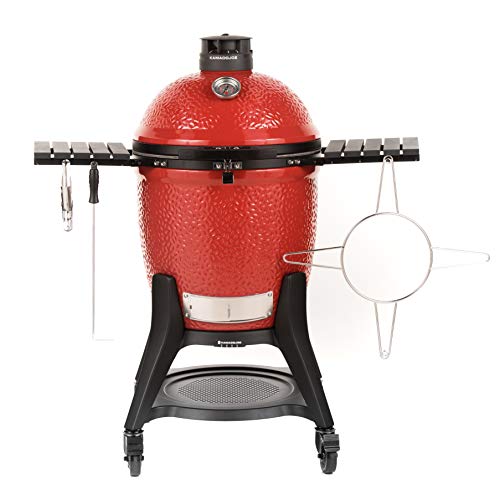
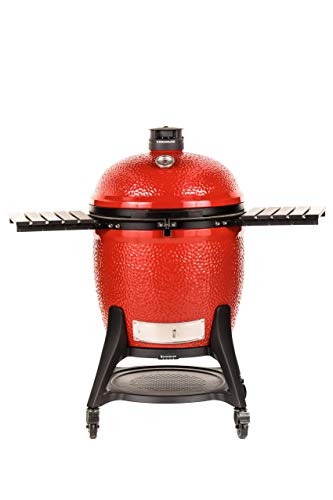
The Big Joe III and the Big Green Egg XLarge offer more grate than 52 cm. Both are in our reviews at approx. €2,999 and approx. €2,840, so in the range of the Avantgarde.66 at Santos Grills (approx. €2,990); what is included in each case is in the reviews. According to Kamado Joe, the Big Joe III brings its 3-Tier Divide & Conquer System, which allows several items to be cooked at different temperatures on three levels.
The charcoal quantity from the manual speaks in favour of long, cool cooking phases. If you need steaks quickly after work, plan for the lighting time with charcoal.
The location also matters. The grill belongs in a fixed, level spot outdoors; putting it away after every use is not an option at this weight. Whether a balcony is possible, you clarify before buying via load capacity and house rules with your landlord or owners’ association. For tenants without a fixed, level outdoor spot, it is in our assessment the wrong choice: for them, weight and house rules count for more than grate size.
You can find more ceramic grills in the kamado category; if you do not yet know which type of grill suits you, you can use the grill finder.
Setting up, lighting, cleaning: what the instructions require
The notes follow the instructions as closely as possible and only give excerpts. According to the Quick Start Guide, the grill must stand on level ground, and the surface must be able to carry its high weight. It must not be operated in enclosed spaces (the manual speaks of suffocation risk) and belongs in a sufficiently ventilated place. Never place it directly near flammable materials or under canopies and patio roofs, because the exhaust is very hot, and flying sparks and hot exhaust can easily ignite flammable materials. Neither set of instructions gives a clearance figure in centimetres. You observe local regulations before putting it into use. In general, any charcoal fire produces carbon monoxide, the obvious reason for the ban on enclosed spaces.
The charcoal is lit from the top, then you close the lid and open intake and exhaust completely. You never use liquid or chemical lighters, and no petrol or methylated spirit either. According to the manual, liquid lighters can soak into the open ceramic and give the food a lasting off-flavour. During the heat-up phase you stay nearby, because according to the manual very high temperatures (over 400 °C) can be reached very quickly, which can damage the seal and grill components.
During use, you first open the lid 4 to 5 cm so that oxygen flows in slowly. If it is opened quickly, the sudden oxygen supply can cause flare-ups, and the effect gets stronger the further the intake opening is closed. Grill gloves belong on your hands, and you stand to the side of the grill. If a flare-up occurs, you close the lid and the intake and exhaust to smother the flames. If, after pyrolysis, the temperature is above 400 °C, you open the lid only a small gap first and wait a moment to prevent a possible “backfire” (jet flame). So the manual allows for over 400 °C being reached, although the Quick Start Guide warns against exactly that.
According to the manual, the outside of a ceramic grill does not get as hot as a steel grill, but there is still a risk of burns during use, and the grill never runs unattended. The exhaust vent is not a peephole. You lift the grate with the supplied grate lifter, with gloves; you do not remove the fire box or charcoal basket with glowing coals in it. You do not put hot components down on flammable or sensitive surfaces. When closing, you do not simply let go of the heavy lid, and neither body parts nor accessories may lie between body and lid. You keep children and pets away. You never extinguish the charcoal with water.
You clean the outside, stand and bamboo side tables only with water and a mild detergent, and the interior never with water or other liquids. For the interior the manual names pyrolysis: open intake and exhaust completely, make sure there is enough charcoal and heat the grill to 400 °C for 10 minutes. According to the Quick Start Guide, you must take the Smart Grid System out beforehand, and you never leave the grill unattended while doing so. Afterwards you brush the cast iron charcoal grate and occasionally rub it with a thin layer of oil to prevent rust. The stainless steel grates may also go in the dishwasher; the manual advises using only suitable detergents and warns that the heat can permanently discolour the grates. After cooling, you shake the loose ash in the charcoal basket into the ash chamber of the fire box and remove it through the ash removal opening with an ash hook or ash shovel.
Burning in is not necessary. The protective lacquer on the cast iron charcoal grate burns off on first use; you wait until the smell has gone before putting food on. Before and after first use you check the screws on body and stand, and you regularly check the hex socket screws of the metal bands around body and lid for tension and tighten them if necessary, because felt gaskets can settle. The instructions speak of felt gaskets; the catalogue describes the Avantgarde’s seal as glass fibre and stainless steel, and the manufacturer’s spare parts section lists a replacement felt gasket for the .66 (LeCHEF).
Warranty: ceramic for life according to the manufacturer, with limits
At Amazon the catalogue field says “Lifetime”; what counts, however, are the manufacturer’s warranty terms (Limited Lifetime Warranty, valid from 01.01.2022), and these are more narrowly worded and graded by component. They apply with proper use and service and regular maintenance in line with the operating instructions. Monolith guarantees that all ceramic parts are free of material, manufacturing and workmanship defects for as long as the private first buyer owns the model, counted from the certified purchase date. Five years apply to all metal parts, one year to grill tools (accessories) and the fold-down side tables, and two years to the buggy and teak table. The rights under the warranty are limited to remedy: Monolith repairs or replaces at its own choice.
Excluded are, among other things, wear parts, in particular seals, consequences of improper storage or cleaning (use of abrasive or corrosive cleaning agents or tools), consequences of using parts or accessories from other manufacturers, and changes to the grill by you or third parties. For commercial use Monolith grants no warranty. The claim is personal, not transferable and lapses if the first buyer gives up ownership. The warranty terms contain further exclusions and reasons for lapse that we do not reproduce in full here; read them in their original wording before buying. In addition, the statutory warranty of at least two years applies in the EU.
Important for how you buy: the warranty applies to products bought within the EU from Monolith or from a dealer authorised by Monolith; defects in products bought elsewhere are excluded. We could not read out the manufacturer’s dealer search, so we cannot say whether Amazon or Santos Grills are among them. Ask Monolith in writing before buying whether the dealer is authorised.