A steel tray for the grate you already have
The MGiessca Universal Plancha Griddle Plate is not an appliance in its own right. It is a flat tray made of sheet steel that you place on the grate of your gas or charcoal grill, and on it you cook everything that would fall between the bars: prawns, finely chopped vegetables, fried eggs, pancake batter. The manufacturer lists steak, vegetables, prawns, pancakes and teppanyaki. As places of use, it names garden, patio, camping and parties.
It costs approx. €60 (Amazon page on 20.10.2026: €59.99). That puts it in the middle of a group of four drop-in planchas that we cover in the grill accessories category and whose prices barely differ. What separates them is sheet thickness, surface area, grease drain and how well the seller documents the product.
On that last point, the MGiessca does badly. We found no website for the brand, the domain mgiessca.com was not reachable during our research, and an instruction manual is nowhere to be found. Everything stated here about the plate comes from the Amazon catalogue: from the title, from the bullet points of the product description and from the product image. You can find it there under model number 3212 if you want to ask the seller.
Dimensions, sheet, weight: what the catalogue says
The manufacturer gives the plate size as W 46 cm x D 32 cm x H 7 cm. The sheet is 2 mm thick, and the weight is approx. 4.9 kg. It describes the surface as scratch and abrasion resistant, and the colour in the catalogue is “Silber Griddle” (silver griddle).
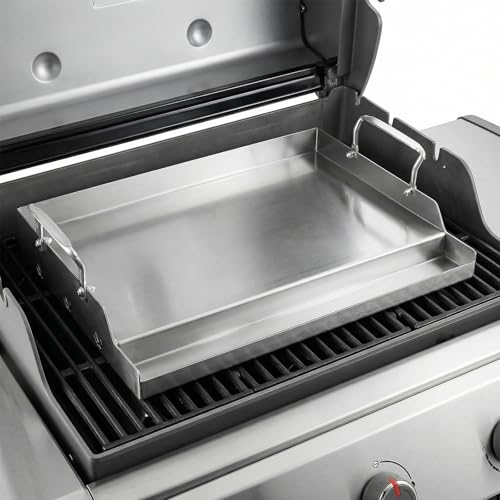
The product image shows what these figures look like: a rectangular tray with a flat base, a vertically raised rim all round, and closed corners. In the photo it stands on the grate of a gas grill with the lid open. What the 7 cm of height measures exactly, that is, the rim alone or up to the top of the handles, is open. Whether the 46 x 32 cm is measured on the outside over the rim or on the inside is not stated. If the outer dimension applies, the usable cooking surface is somewhat smaller; by how much cannot be said without a figure for the rim thickness.
The material is harder to pin down. The title says “Universal Edelstahl” (universal stainless steel), and the first bullet point says “2 mm dickem rostfreiem Edelstahl” (2 mm thick rustproof stainless steel). Two points further on, however, iron is the material of the griddle plate, and the next point says “Dank der stabilen Eisenplatte” (thanks to the sturdy iron plate). Both cannot be true at once. Rustproof stainless steel is a steel alloy with at least 10.5 per cent chromium that forms a protective oxide layer. By “iron”, advertising copy usually means unalloyed steel, and that rusts if it is left wet and without an oil film. The photo shows a bare, silvery surface. That fits stainless steel but does not prove it, because new unalloyed sheet also shines.
According to the title, the handle is removable. The manufacturer describes it as a side handle with which the plate can be lifted, carried and stored. The scope of delivery says “1 Packung” (1 pack); accessories such as a spatula are not listed there.
In detail: why sheet thickness matters on a plancha
A plancha has a thankless job. The heat arrives from below at only a few points, above the burner tubes of a gas grill or above the bed of embers, and the plate is supposed to turn that into an evenly hot surface. Two material properties are responsible for this.
The first is thermal conductivity, that is, how quickly heat travels sideways through the sheet. Austenitic stainless steel conducts poorly, around 15 W/(m·K). Unalloyed steel is at around 50 W/(m·K), a good three times as much. On a stainless steel plate the heat therefore tends to stay where the flame is, while on a steel plate it spreads faster. The second property is mass per area. A 4 mm sheet has twice the mass of a 2 mm sheet of the same material, stores twice as much heat and at the same time has twice the cross-section through which heat flows sideways. If you put a cold piece of meat on, the temperature beneath it drops less on the thicker plate.
For the MGiessca this means: 2 mm is a thin plancha. It heats up faster than a 4 mm plate and cools down faster when you add food. The manufacturer writes that the heat spreads across the whole surface and that there are no more hot spots. Nobody we could cite has measured that on this plate. Our assessment: if the plate really is stainless steel, we would expect clearly hotter zones above the burners than between them; if it is unalloyed steel, the claim fits the physics better. So even the performance question hinges on the material contradiction in the catalogue.
One point speaks for the design. A raised rim stiffens a thin sheet against bending, much as a fold makes a piece of cardboard stiff. Whether that is enough to stop 2 mm sheet warping under strong heat is not stated in any information; a temperature limit is not published. The manufacturer speaks of “verdickter Verarbeitung” (thickened construction) and a surface that stays like new even with frequent use.
Will the plate fit my grill?
On a gas grill with a rectangular grate, probably, if 46 x 32 cm is free there, plus some room for the handles. The manufacturer names Weber, Burnhard and Enders and speaks of most gas grills, but no model name is given. So measure the inside dimensions of your grate yourself.
On a gas grill with several burners, we would place the plate so that part of the grate stays free. Then you fire up under the plancha and grill directly alongside, and the heat under the lid does not build up across the whole surface. What your grill’s manual says about covering the grate takes precedence over our suggestion.
On a round grate it gets tight. The diagonal of a 46 x 32 cm rectangle measures around 56 cm, which is how large the grate would have to be for the plate to sit on it with all four corners. On smaller round grates, the corners overhang. Whether the kettle leaves room at those points is something you can only measure on your own grill.
Then there is a sentence that bothers us. In the same text that advertises the plate for gas and charcoal grills, it says in brackets: “nicht für offene Flammen” (not for open flames). On a gas grill an open flame burns under the grate, although on many models it is under cover plates that sit between burner and grate. Our reading: presumably it means the plate should not be placed directly in a fire, for example on a fire pit. That is no more than one reading. If you want to be sure, have the seller confirm the limit in writing.
One bullet heading reads “Drinnen & Draußen” (indoors and outdoors), and as a further heat source the manufacturer names electric griddle plates. Indoors, only an electric heat source comes into question. Gas and charcoal grills belong outdoors as a matter of principle, because combustion produces carbon monoxide.
Searing, grease and cleaning without instructions
A single instruction for use appears in the product description: first heat the plate, then add oil, and “wenn das Öl raucht, legen Sie das Essen auf die Grillplatte” (when the oil smokes, put the food on the griddle plate). This is meant to stop the food sticking to the plate. This order is generally customary for bare steel and stainless steel pans. On preheated metal, the moisture on the underside of the food evaporates immediately, and the protein at the surface sets before it can bond with the metal. Why meat sticks anyway and when it is better to leave it alone is explained in our guide Food sticking to the grate; the principle applies to the plancha just the same.
For this we would use an oil that tolerates high temperatures, such as refined rapeseed or sunflower oil. That is our recommendation, not a requirement from MGiessca.
On grease: no drain opening is visible in the product image, and the rim runs closed all the way round. Whatever comes out during cooking therefore stays in the tray. That has a good side, because grease does not drip onto the burners and flare up there. With bacon, bratwurst or many burger patties, though, a layer of grease builds up on the sheet after a short time. Push it into a corner with the spatula and soak it up with kitchen paper. Never put out burning grease with water; cover it or use a grease fire extinguisher.
For cleaning, there is no manufacturer information at all. We would treat the plate as if it were made of rust-prone steel, because that does stainless steel no harm: let it cool, loosen residues with a scraper, wash by hand with warm water and washing-up liquid, dry completely at once and oil thinly. In the photo the handles are metal and sit above the plate in the grill, so they get hot. Only touch them with grill gloves while grilling.
What the manufacturer does not state
On these points, we found no manufacturer information either in the catalogue or elsewhere:
- the stainless steel grade, and with it a resolution of the contradiction between stainless steel and iron
- whether the surface is coated
- a maximum temperature or heat resistance
- the heat-up time
- a grease drain, a drain opening or a drip tray
- the meaning of the 7 cm height
- a list of suitable grill models or a minimum size for the grate
- material and fixing of the handle
- notes on cleaning, dishwasher, seasoning and care
- a declaration on food contact under the LFGB (German food and feed code) or EC 1935/2004 (EU rules)
- warranty, spare parts, origin of the goods
The meaning of the second set of dimensions in the catalogue is covered in the FAQ below.
Four planchas around €60: what separates them
| Model | The difference | Price | Our rating | Choose this one if |
|---|---|---|---|---|
| MGiessca Universal Plancha Griddle Plate (this one) | largest surface of the four, 46 x 32 cm, 2 mm sheet, material stated inconsistently | approx. €60 | 7.9 | your grate takes the larger plate and surface area matters more to you than documentation |
| Arebos Plancha Griddle Plate 40 × 30 cm | drain opening, manual with seasoning guide, 2 spatulas and 5 skewers included | approx. €57 | 8.3 | you want instructions and your grate is on the small side |
| Camxon Universal Stainless Steel Plancha Griddle Plate 40.5 × 31 cm | V2A stainless steel with a statement on EC 1935/2004, double oil outlet | approx. €66 | 8.1 | a named steel grade matters more to you than the price |
| Digank Stainless Steel Plancha Griddle Plate 40x30cm | 4 mm sheet, oil drain hole, two removable handles | approx. €58 | 8.1 | you want more heat storage and can give up some surface area |
The prices are guide values from our price boxes and change constantly at Amazon. The rating is our editorial classification of the published data, not a measurement on the plates.
The MGiessca ranks last in our comparison because of the documentation, not the size. Arebos has published a manual with a seasoning and cleaning guide, Camxon names the steel grade on Amazon, and Digank has the thicker sheet. With the MGiessca you do not know for sure which steel it is made of, and there are no instructions.
When the MGiessca fits and when one of the others does
The surface area is the strongest argument. Compared with the 40 x 30 cm of Arebos and Digank, the MGiessca is 6 cm wider and 2 cm deeper; compared with the Camxon, 5.5 cm wider and 1 cm deeper. If you want to cook vegetables and prawns at the same time for four or more people, it gives you the most room, provided your own grate takes the format. On a small two-burner gas grill, hardly any grate may be left free beside a 46 cm wide plate, and then one of the 40 cm plates is the more practical choice.
If you often cook bacon, bratwurst or burgers, we would go for a plate with a drain. All three alternatives have one; with the MGiessca none is documented.
If the material matters to you, for example because the plate sometimes stays outside overnight after grilling, the Camxon is the clear choice. It costs approx. €66 against approx. €60 for the MGiessca, and according to the Amazon description it is made of V2A stainless steel. The Digank costs approx. €58 and has sheet twice as thick, so more heat storage for steaks and smash burgers. The Arebos costs approx. €57 and, according to the manufacturer, comes with two spatulas and five skewers; with the MGiessca you have to buy a spatula separately if you do not have one yet. Which spatulas, tongs and gloves otherwise belong in a basic kit is covered in the guide Grill accessories essentials.
The MGiessca is the wrong choice for anyone who wants to see in black and white which temperatures the plate withstands and how it wants to be cared for. That applies especially to people who want to put it over an open campfire or fire bowl: the note about open flames is most likely to rule exactly that out, and a thin 2 mm plate of unknown grade is, in our view, the riskiest format of the four for such uneven heat.