What the plate is and where our information comes from
The Arebos Plancha is not a grill but an attachment: a rectangular stainless steel plate with a rim that you place on the grate. The heat comes from your existing gas grill, charcoal grill or fire pit; according to the product page it may also go on the hob. The manufacturer lists it as model AR-HE-GP4030 with the EAN 4252023129930.
Behind the brand is AREBOS GmbH in Waldbüttelbrunn (commercial register court Würzburg). By its own account Arebos has existed since 2009, having grown from a one-man business into a medium-sized company, with a focus on DIY, leisure, outdoor and home & living. There, the plate belongs to the product family Grill plate.
Our information comes from the product page on arebos.de, from the German manual (6 pages, the same file is on about.arebos.de) and from the Amazon catalogue. That ASIN B0GXG316XN belongs to this plate is evidenced only by the model number and EAN, which Amazon, the product page and the manual list identically; the manufacturer’s page has no Amazon link. In several places the product page and the manual contradict each other. There we give both values and say which one we would follow.
According to our price box the plate costs approx. €57 at Amazon; in the Amazon catalogue it was listed at €56.90 on 05.10.2026.
Construction: sheet, rim, handles, accessories
The plate measures 40 × 30 cm, and the manual gives the product dimensions as 40 × 30 × 3.8 cm. The 3.8 cm is the rim height, not the sheet thickness. As material, Arebos states stainless steel in silver, food safe and LFGB tested. The thickness of the sheet appears only at Amazon: in the title as 4 mm solid, in the dimensions as a third dimension of 0.4 cm. The product page and the manual give no material thickness, so we list the 4 mm as a catalogue figure.
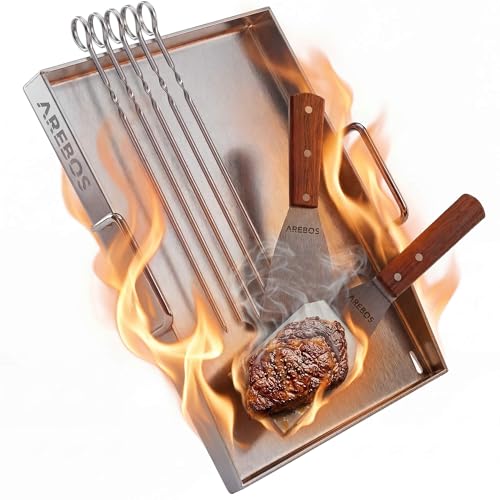
The catalogue photo shows a flat tray: a level base, a raised rim all round, and the AREBOS lettering on one side wall. Two handles sit on the outside of opposite walls; according to the product page they are removable and make placing, moving and storing easier, and in the photo they look like metal brackets. In one corner of the base, close to the rim, an elongated slot can be seen, presumably the drain opening.
According to Arebos, the raised edges serve as a rest for skewers or for keeping finished food warm, and the sealed corners are meant to keep liquids on the plate.
On weight the sources differ: 5.00 kg on the product page, 6.25 kg in the manual, around 5.05 kg in the Amazon catalogue (11.133 pounds).
According to the product page the box contains the plate, two handles, two grill spatulas, five skewers and the instructions for use; the manual lists plate, handles, spatula and skewers in the same way. In the photo the spatulas have dark handles with rivets that look like wood (our observation from the picture).
800 °C on the product page, 350 °C in the manual
Two figures are in play for heat resistance. The product page says the plate is heat resistant up to 800 °C; Amazon repeats this in the title and in the catalogue text and promises cooking results without warping. The manual, on the other hand, says in chapter 3.2 not to exceed 350 °C (660 °F) so that the plate does not deform. Both documents come from Arebos. There is no explanation for the difference, and no proof for the 800 °C either.
Our assessment: we would treat the 350 °C as the operating limit. It appears in the document that comes with the plate, and it is justified with exactly the damage you want to avoid. The 800 °C appears in product texts and leaves open what is still meant at that temperature. It is conceivable that they refer to the material limit (stainless steel melts only well above 1,000 °C) and that the 350 °C is the limit for a sheet that does not warp. That is not documented.
Whether your grill exceeds 350 °C depends on the device. A fire pit has no control, so there all you have is a thermometer. On a gas grill, burner output and the distance between flame and sheet also determine how hot the plate gets. The seasoning step further down stays below the limit with its target temperature.
In detail: heat and fat on a closed plate
On a grate the food touches only the bars, which is why stripes form and anything small, soft or crumbly falls through. On a closed plate it lies flat across the whole surface. Vegetable strips or fish stay in place, and the browning is even, without a pattern. The price for this: fat and juices do not run off by themselves, they collect under the food. Moist ingredients then cook first in their own liquid, and as long as water evaporates at the surface, it stays at around 100 °C and does not brown.
On heat distribution Arebos writes that the strong material construction stores heat and distributes it evenly, without hotspots. That is a manufacturer statement; no measured values or test report are available. Against this stands the fact that stainless steel conducts heat comparatively poorly: common stainless steels are at about 15 to 25 W/(m·K), unalloyed steel at about 50, aluminium at more than 100 (values from materials science, not from Arebos). How well temperature differences across the surface even out depends on conductivity and sheet thickness. With stainless steel, thickness remains the lever, and we know it only from the Amazon catalogue.
Our inference: over a single burner or a heap of embers, the plate is likely to get hotter in places than in the edge zones. That also affects warping, because a sheet bends less because of the absolute temperature than because of differences within the surface: the hotter spot expands more than its surroundings.
According to the product page, the drain opening deliberately carries off excess fat and cooking residues. According to Arebos, this reduces smoke and prevents food from sitting in fat. A drip tray is not included.
Where the fat goes is decided by the grill underneath. On a gas grill it presumably ends up in its fat system, on charcoal it falls onto the embers or into the charcoal tray, and on a fire pit into the fire. That is how we infer it. Fat in the embers flares up and smokes, and for burning fat the manual gives a clear instruction (further down). How to prevent and extinguish grease fires is covered in the guide Grease fires on the grill.
Seasoning and cleaning according to the manual
The product page calls the plate ready to use straight away. The manual, however, requires washing and seasoning before the first grilling (chapter 3.1). For us the manual is decisive, because it comes with the plate.
According to the manual, seasoning forms a thin layer of oil on the stainless steel that acts as a natural non-stick layer; the surface discolouring in the process is normal and intended. The seven steps:
- Wash thoroughly with warm water and washing-up liquid and dry completely.
- Using kitchen paper or a cloth, apply a thin, even layer of vegetable oil with a high smoke point to the whole surface (the manual gives sunflower oil as an example).
- Place the plate on the grill and heat it to approx. 250 °C (480 °F).
- Let it season for about 20 to 30 minutes; the oil darkens and forms a protective layer.
- Switch off the heat and let the plate cool slowly to room temperature.
- Remove excess oil with a clean cloth.
- Optionally repeat everything for a thicker protective layer.
When grilling, the plate should be preheated before the food goes on it, with a small amount of fat; oil should also continue to be used after seasoning. Food is turned with the spatula. Whether the plate is coated from the factory is answered differently by the sources: the feature list on the product page speaks of a non-stick coating, the description text of a natural patina, the manual only of the layer you season yourself. We go with the manual version.
For cleaning and care (chapter 4) the manual gives these notes:
- Clean thoroughly with warm water and washing-up liquid before first use.
- Let it cool completely before cleaning.
- Clean with warm water and washing-up liquid after every use.
- Do not use steel wool, wire brushes, abrasives or cleaning agents.
- Stubborn residues can be removed with conventional oven or grill cleaners.
- Rub the surface regularly with heat-resistant cooking oil.
- Never use olive oil; remove excess oil with a soft cloth.
- Always dry the plate and spatula completely to prevent mould.
- Do not use sharp or pointed tools that could damage the surface.
- Do not use aggressive or corrosive cleaning agents.
The list contradicts itself: cleaning agents are forbidden, yet washing-up liquid is called for three times (when seasoning, before first use and after every use), and oven or grill cleaners are supposed to help with stubborn residue, while aggressive or corrosive agents are taboo. We read the bans as a ban on abrasive agents and stick with washing-up liquid. Oven cleaners are mostly strongly alkaline; before you use one, we would ask customer service (telephone +49 (0) 931 90 80 3000, email info@arebos.de).
The plate is dishwasher safe according to the product page and the Amazon catalogue. The manual describes only hand washing and leaves out the dishwasher. Only hand washing is certain, because only it appears in the manual, and the seasoned layer consists of oil.
Setting up and safety according to the manual
The product page names grill, gas grill, charcoal grill, fire pit and hob as areas of use, and garden, balcony, camping and outdoor kitchen as places. The manual mentions only the grill, and only for seasoning; hob, fire pit and balcony do not appear. Whether charcoal is allowed on the balcony is usually decided by house rules or the tenancy agreement, not by Arebos; details are in the guide Grilling on a balcony. As a general rule for charcoal and open fire: never in enclosed spaces, because of carbon monoxide.
The manual’s safety notes, in our words:
- Always wear heat-resistant protective gloves when handling the hot plate.
- Never touch the plate while it is hot; it gets very hot shortly after being set up.
- Never place the hot plate on flammable surfaces.
- Only place the plate on flat, stable and heat-resistant surfaces.
- Never place the hot plate on a cold surface, because it may crack.
- Do not leave the plate unattended during use.
- Always keep children and pets away.
- Do not modify the product.
- Let the plate cool completely before cleaning.
- Never extinguish burning fat with water, but with a fire blanket or a suitable fire extinguisher.
- Keep packaging material such as plastic bags away from babies and children.
According to the manual, intended use includes four points: the plate is intended exclusively for grilling various foods. It is intended exclusively for private use and is not suitable for commercial purposes. It should be used only as described in the manual, any other use is considered impermissible and can lead to damage to property or personal injury, and in the event of improper use Arebos excludes liability. It is not a children’s toy.
Read strictly, the instruction to use it only as described does not cover the hob, because the manual does not describe it. If you want to fry on a hob, it is therefore better to call the same customer service first.
What the manufacturer does not state
The following are missing from the manufacturer (product page and manual):
- Stainless steel grade or material number (such as V2A or 1.4301)
- Testing body, test report or declaration of conformity for the LFGB claim
- Net grilling area inside the rim, wall thickness of the edges
- Heating time, heat storage, warping behaviour and hotspots as measured values
- Minimum grate dimensions and a compatibility list for specific grills, usability under a closed lid
- Hob: induction, glass ceramic, gas hob, power range, requirements for the flatness of the base
- Material of the plate handles, spatulas and skewers
- Gas grill: flame strength, burner distance, gas type, output in kW
- Setup: minimum distances from flammable materials, balcony, ventilation, use indoors
- Position and size of the drain opening, collecting container
- Spare parts (handles, spatulas and skewers individually)
- Manufacturer warranty
- Country of production and market launch of the plate
- Number of people or portion size for the surface
What else is an option?
| Model | The difference | Price | Our rating | Choose this one if |
|---|---|---|---|---|
| Arebos Plancha Griddle Plate 40 × 30 cm (this one) | Drain opening, 2 removable handles, 5 skewers; heat limit 350 °C according to the manual | approx. €57 | 8.3 | you have a gas grill with adjustable burners and want to get rid of fat through an opening |
| COGRICHBF Plancha 40×30 | Closed surface according to the catalogue text, also suitable as a baking steel for the oven; the catalogue text names no fat drain | approx. €49 | 8.2 | you want a smooth surface without a drain opening and prefer to wipe off the fat yourself |
| Camxon Plancha 40.5 × 31 cm | V2A stainless steel and double oil outlet according to the catalogue text | approx. €66 | 8.1 | you want a named steel grade and are willing to pay €9 more |
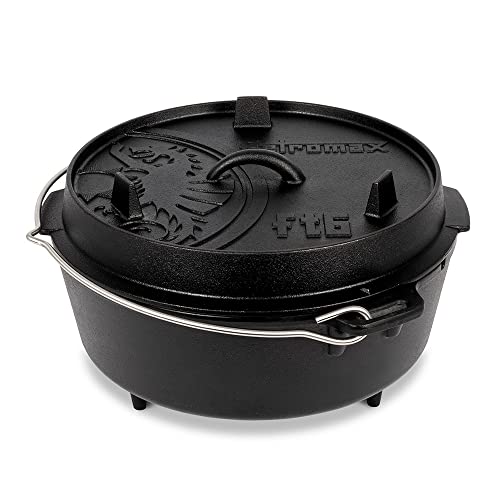
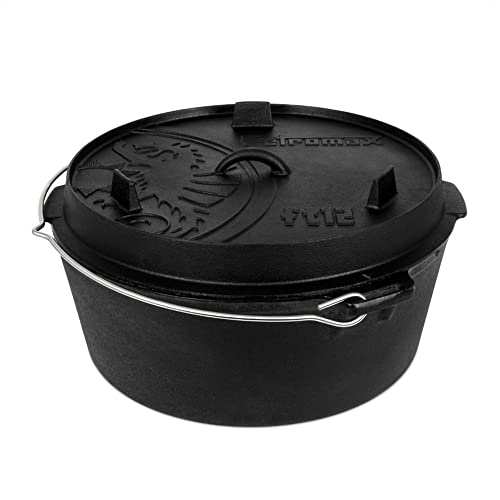
| Petromax Feuertopf ft6 | Cast iron Dutch oven with 5.5 l, not a griddle | approx. €75 | 9.0 | you cook stews and braises instead of frying on a plate |
Prices are guide values from our price boxes, the rating is our editorial assessment and not a measurement result. The table is not suitable as a performance comparison: there is no measurement for any of these plates, and the Petromax is a different type of construction.
On price, the COGRICHBF is €8 below the Arebos, the Camxon €9 above and the Petromax €18 above. The details on the other two plates come from their Amazon catalogue texts and have not been checked by us. All plates, pots and spatulas are in the grill accessories comparison, and you will find the category overview under Grill accessories.
When this plate suits and when it does not
If you want to sear steaks with the burners turned fully up, you easily end up above the 350 °C from the manual. For that, the grate remains the better choice, and the plate takes over what would fall through the grate.
When it comes to fat, the grill matters. On a gas grill the drain opening is likely to be an advantage, because the fat runs off into the grill. On charcoal it falls onto the embers; if you want to avoid that, you are in our assessment better served by a plate without a drain opening and wipe the fat off yourself; the COGRICHBF names no fat drain in its catalogue text, and no opening can be seen in the catalogue photo, but that is not confirmed.
Care takes time: seasoning, cooling, hand washing and regular oiling come with this plate. If you only want to rinse after the meal, you will not be happy with it, regardless of the price.
On the grate, the free area counts, and it is best to measure it yourself. If you grill on a table grill with a small grate, you need a smaller plate; which grill suits your cooking style at all is shown by the Grill finder.
On top of the purchase price come cooking oil and heat-resistant protective gloves, which the manual requires and which are not included.
The plate is wrong for commercial users such as snack bars or catering, because the manual provides only for private use, and for anyone who wants to cook on induction: Arebos makes no statement on this for this plate, and for induction the manufacturer has its own cast iron plate (Grill Pan). Without asking customer service first, we would not buy it for that.
In our assessment it fits best on a gas grill with individually adjustable burners: there the heat under the plate can be limited, which is not possible on a fire pit without a thermometer.