A plate for the grill you already have
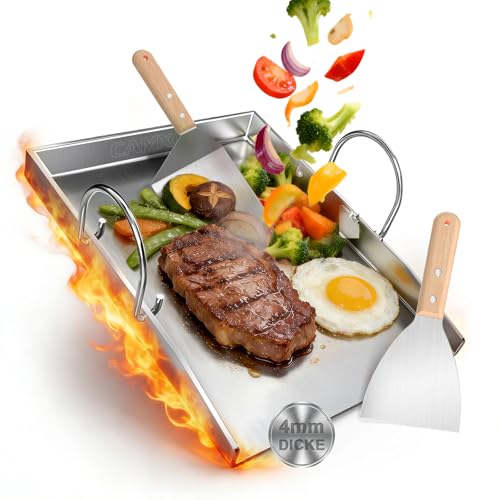
The Camxon plate is not a grill in its own right. It is a stainless steel tray that you place on the grate of an existing gas or charcoal grill so that you can cook things that would otherwise fall between the bars. In its description, Camxon lists smash burgers, fish, fried eggs and vegetables, and elsewhere also pancakes.
On Amazon it is listed under model number sw0487 and costs approx. €66 there (Amazon page on 21 October 2026: €65.99). Amazon itself did not offer it on that day; the price is the lowest new price from a marketplace seller on Amazon. Little can be said about the brand itself. We found no manufacturer website, data sheet or instruction manual in our research, only retailer and bargain sites. Everything stated here about the plate therefore comes from the Amazon catalogue: from the product title, the seller’s bullet points and the technical fields. There the plate is filed as a household item under Home and Garden, and the manufacturer field is empty.
In our grill accessories category, it sits in the middle of the price range for drop-in plates of this size. We put three of them directly beside it further down.
Dimensions, material and a contradiction on thickness
Camxon gives the surface as 40.5 × 31 cm. The item dimensions in the catalogue match: 15.94 by 12.20 inches, converted approx. 40.5 by 31 cm. On top of that comes a height of 1.77 inches, so approx. 4.5 cm, and that is expressly not the material thickness.
The product photo shows where it comes from. The plate is raised at the edges, more a shallow tray than a board, and curved wire brackets stand up at the two short sides. Whether the length figure is measured across these brackets or only across the tray, and whether the stated surface means the cooking area inside the rim, is clear from neither text nor image. We therefore treat the numbers as outer dimensions.
The seller describes the material as stainless steel (V2A). V2A is an old trade name for austenitic chromium-nickel steel; in the kitchen it usually means grade 1.4301 with about 18 per cent chromium and 8 to 10 per cent nickel. Sinks, pots and cutlery are often made of exactly this steel.
On thickness, the listing contradicts itself. The Amazon title says “4MM thickened”, while the description speaks of 5 mm stainless steel. One millimetre sounds like little. With the same surface, however, it means a quarter more material, and mass is what stores heat in a plancha.
Camxon calls the surface scratch-resistant and says it stays shiny even after intensive use. The colour in the catalogue: silver. The plate is also said to stay rigid and warp-free even at extreme temperatures thanks to its solid construction. The seller attaches no temperature figure to this promise.
In detail: why stainless steel heats differently from cast iron
Stainless steel is a compromise for a plancha, and it is worth knowing which one. Austenitic chromium-nickel steel conducts heat poorly, around 15 W/(m·K). Cast iron and unalloyed steel are at about 50, aluminium at over 200. For a plate that sits over burner tubes or a bed of coals, this means the heat travels sideways only slowly. It gets hot directly above the heat source and stays cooler in between.
Camxon describes it differently. The heat is said to spread evenly across the surface, so that meat, vegetables or pancakes cook without burning or cold zones. That is an advertising claim; we found no measurement for it, and the material figures point more to the opposite.
What dampens the differences is the thickness. Four or five millimetres of steel take longer to heat through, but then hold the temperature better when cold food is placed on them, and over time partly even out hot and cooler spots. Our assessment: if you preheat the plate long enough, ideally with the lid closed if it closes, you shrink the zones compared with a cold start. On a gas grill with several burners you can also use it deliberately, one side hot for the patties, the other weaker for onions or eggs.
The advantage of stainless steel lies elsewhere. Under normal conditions it does not rust and therefore needs no protective oil layer against corrosion, as cast iron and black steel do. Acidic food, tomatoes or a marinade with lemon, does not attack it. With cast iron a patina is mandatory; with stainless steel it is a bonus for better non-stick properties.
Does food stick to a stainless steel plancha?
At first yes, more readily than on a coated plate. Camxon does not use a non-stick coating but promises a natural non-stick patina that is meant to prevent sticking. The only care tip in the text is to brush the surface thinly with oil before grilling.
A patina forms when oil polymerises at high temperature, that is, cross-links into a thin, hard film. On cast iron and carbon steel this film anchors itself in the slightly rough surface. On smooth stainless steel it holds less well and rubs off faster. We would therefore not expect a layer that grows over months, but one that you have to renew again and again. Technique does more on stainless steel: preheat the plate fully, then oil it, add the food and leave it until the crust releases by itself. Why turning too early causes sticking is explained in our guide Food sticking to the grate, and that applies equally on a plate.
There is also a tension in the manufacturer’s text. Baked-on oil tints metal brownish. A surface that is meant to stay permanently shiny and a patina that builds up with use rule each other out, at least visually. We read it this way: if you want the shine, you clean thoroughly and largely do without the patina; if you want the patina, you accept a darker coating.
The same tension is in the cleaning statement. Camxon writes: “After cooling down, the plate is dishwasher-safe.” Dishwasher detergents are strongly alkaline and dissolve exactly the grease films that a patina consists of. We would keep the machine for when the plate is crusted over after a greasy barbecue evening, and otherwise clean with hot water and spatula. Whether a tray with a raised rim and two brackets fits in your lower rack at all is better measured beforehand.
Grease drainage: two outlets, but where to?
With fatty food such as bacon or burger patties, drainage is the most important design question of a plancha. According to Camxon, leak-proof corners and a double oil outlet design channel excess grease away efficiently. Where the two openings sit and how large they are cannot be seen on the photo, and the text does not describe it either.
From this follows something to consider before first use. No drip tray is included. What runs through the outlets drips onto whatever lies beneath the plate: on a gas grill onto flame covers and burners, on a charcoal grill into the embers. In principle, hot grease that hits coals or an open flame can ignite. If you fry a lot of bacon, keep an eye on the amount of grease, do not place the outlets over the strongest heat, and keep a lid or a fire blanket within reach for smothering, never water. How a grease fire starts and how you put it out is covered in detail in our guide Preventing grease fires.
The corners are the second part of the promise. They are meant to stop grease from running over the edge, and a raised rim like the one in the photo generally holds liquid better than a flat plate. How high the rim itself is cannot be reliably derived from the overall height, because the brackets protrude beyond it.
Food contact, harmful substances and what is in the box
Camxon writes that the plate is certified to the EU food contact standards (EC 1935/2004) and RoHS-compliant, free of harmful substances such as lead, cadmium or phthalates in accordance with RoHS 2011/65/EU, and 100% food-safe. For a chromium-nickel steel that has been standard in kitchens for decades, that is plausible. It is not yet proven, though: who issued the certificate and where it could be viewed remains open. You are relying on the word of a seller whose address the catalogue does not know.
According to the description, the box contains the plate and two stainless steel spatulas; the unit count in the catalogue is 1. On the product photo, the spatulas have light, wood-coloured handles and wide, straight blades. For smash burgers, two spatulas are enough to press the ball of mince flat and lift the patty off cleanly later; a burger press or a melting dome for the cheese is not included. Whether a thin smash patty or a thick patty suits your evening, and how hot and how long each needs, you will find in our guide Grilling burgers.
What the manufacturer does not state
Without a manufacturer website and instructions, the list of open points is long, so it is collected here. Missing are: the weight of the plate, the exact material number behind V2A, a maximum temperature in degrees Celsius, the rim height, position and size of the two oil outlets, how the brackets are attached (fixed or removable), a minimum size for the grill grate or a list of suitable grill models, a statement on hob, induction or oven, a seasoning guide beyond the oil tip, material and dimensions of the spatulas, safety notes on the hot surface and grease fires, warranty terms, spare parts, the country of origin and the manufacturer or importer with address. A testing body or test report for the two certificate claims is likewise missing.
For you, two of these gaps weigh most heavily. How heavy a hot plate with grease in it is when you lift it off the grate, you have to find out yourself. And whether it fits your grill, you have to measure, because “most gas and charcoal grills” is not a measurement.
Three alternatives to weigh against the Camxon
| Model | The difference | Price | Our rating | Choose this one if |
|---|---|---|---|---|
| Camxon Universelle Plancha Griddle Plate (this one) | two oil outlets, brackets only on the photo, no instructions | approx. €66 | 8.1 | you want two drains and check the fit yourself |
| Digank Plancha Griddle Plate 40 × 30 cm | two removable handles, one oil drain hole | approx. €57.99 | 8.1 | you often lift the plate hot off the grate and one drain is enough |
| Arebos Plancha Griddle Plate 40 × 30 cm | manual with temperature limit and weight, handles and skewers included | approx. €57 | 8.3 | written details on heat and care matter more to you than the dishwasher |
| HAVENHAUS Plancha Smash Burger Set XXL | burger press and two domes in the set | approx. €84.99 | 8.2 | you mainly make smash burgers and do not want to buy the press and dome separately |
The prices are guide values from our price boxes (Camxon: marketplace sellers on Amazon, 21 October 2026) and change frequently for accessories in this price range. The rating is our editorial assessment based on manufacturer data, not a measurement result.
The Digank is at approx. €58, the Arebos at approx. €57, the Camxon at approx. €66. For that you get a second drain on paper, but much less documentation. That the Arebos comes out ahead in our comparison has exactly this reason: it states in writing what remains open with Camxon.
The HAVENHAUS set costs approx. €85 and is thus the most expensive of the four; the extra cost goes into the press and domes.
Who the Camxon suits, and when another plate is better
First the grate. Measure the inner dimensions of your grill grate and compare them with the plate dimensions above. The plate should rest fully on it and leave some air all round to the grill wall, so that the brackets do not hang over the edge. On round grates it gets tight: a rectangle with the stated sides has a diagonal of around 51 cm, so the grate must be at least that wide for all four corners to rest on it. Many small kettle grills have a smaller grate.
Then the lid. If you want to cook with the lid closed, for instance so that the cheese melts on the patty, you need room above the height from the dimensions section plus the food. On kettle grills the lowest point is at the edge, exactly where the brackets sit.
The patina is a matter of patience. If you want a plate that sticks little from day one and want to leave the cleaning to the dishwasher, no stainless steel plate fits well, this one included. If you are willing to oil before each use and work with the heat, stainless steel is the easier-care material for it, because it does not rust when the patina is missing.
With grease, your grill type decides. For bacon and burgers on a gas grill with its own grease pan, two outlets are a plus. On charcoal you have to position the plate so that the draining grease does not fall into the embers.
We would choose the Camxon if you have a gas grill with a large enough grate, often cook fatty food and can live with a plain catalogue description. For smash burgers as the main purpose, the HAVENHAUS set with press is the more direct choice; for carrying hot off the grate, the Digank with removable handles.
The Camxon is the wrong choice for anyone who also wants to use the plate on a hob or on induction, because Camxon names only grills as the place of use. And for anyone who wants to put the plate straight into a full bed of coals and needs a written heat limit for that: that is found only in the Arebos manual.