Five knobs, one Amazon data sheet
The LIFERUN Gas Grill 4+1 is a grill cart with four main burners under the lid and a burner on the right-hand side shelf. On Amazon it costs approx. €270 (Amazon page on 21 October 2026: €269.98); you can find more carts in our gas grill overview. In the Amazon catalogue it carries the model number EQC64BAAJB2X, and the country of origin is China.
You should know what this text is based on beforehand. We did not have the grill in front of us and did not cook anything on it. For most brands we rely on the manufacturer’s site and the manual. For this grill, neither could be found. All product details here therefore come from the Amazon listing: from the bullet points, from the manufacturer’s description below them and from the data table. Where we calculate or judge something ourselves, we say so.
Burners, grates, cart: what the catalogue says
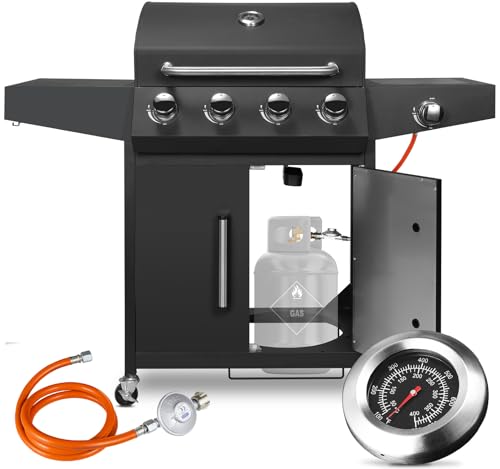
Under the lid there are four stainless steel main burners of 3 kW each, which converts to 10,236 BTU per hour, 12 kW together. The burner on the side shelf adds another 3 kW. That gives the 15 kW or 51,180 BTU with which LIFERUN advertises the grill. Each burner has its own knob and can be adjusted individually. In the product photo, four knobs sit in the front panel and the fifth at the front of the right-hand shelf.
Ignition is by piezo, without a battery. LIFERUN explains the principle itself in the bullet points: when you press the button, two piezoelectric ceramic plates strike each other, and the pressure creates the spark. The data table additionally says “independent ignition design”. Whether that means a separate igniter per burner is not clear from the phrase alone.
The main grate measures 60 x 42 cm and is enamelled; LIFERUN describes it as resistant to high temperatures. Above it sits a warming rack of 59 x 16 cm, which is called “enamelled insulating grill grate” in the delivery list. The body is made of black powder-coated steel with stainless steel parts.
In the lid sits a thermometer that, according to the description, shows the temperature while the lid is closed. Four hooks for grill tools hang on the side, and the side shelves are meant to keep spices and food within reach. The cart rolls on four swivel casters that turn through 360 degrees, two of them with a brake.
Grease runs into an extra-large, square grease tray. It is installed at an angle so that, according to LIFERUN, the grease runs by itself into a smaller oil cup below.
What the text details leave out is shown by the product photo: a closed base cabinet with two doors, in which a gas cylinder is pictured.
In detail: 12 kW on 2,520 square centimetres
The 15 kW sounds like a lot. For the grate, however, only the four main burners count, because the side burner heats a pot and not the food under the lid. That leaves 12 kW for 60 x 42 cm, so 2,520 cm². By our calculation, that comes to around 4.8 watts per square centimetre.
To put it in context, we did the same calculation with manufacturer figures for other carts. According to TAINO, the TAINO Red 4+1 has four main burners of 2.5 kW each on approx. 61 x 42 cm, which is around 3.9 watts. Broil King gives 16 kW of main burner output on 4,032 cm² for the Regal 590, just under 4.0 watts. On paper, each square centimetre on the LIFERUN therefore gets more burner output than on both.
How hot it gets at the food cannot be read from that anyway. The rated output says how much gas the burners can burn at most. Whether that heat reaches the grate or escapes through the lid depends on components we know little about here: the insulation of the lid, the flame covers, gap sizes. And wind costs every gas grill output. No maximum temperature or heat-up time appears in any of the sources, so the higher power density remains a number on the data sheet.
For grilling in zones, four individually adjustable burners are enough. For direct heat, the food sits over the flame. For indirect heat, only the outer burners run, the piece sits in the middle over the switched-off ones, and the lid stays closed. That is how you work on any gas cart with at least three burners; it is general grilling technique and not a LIFERUN specification. How to arrange the zones is covered in our guide to direct and indirect heat.
For indirect cooking, the lid thermometer only helps roughly. It sits at the top of the lid and measures the air there, so not the temperature at grate level. For a roast, we would add a core temperature thermometer.
The side burner: two sizes, one calculation
How big the burner on the right is, LIFERUN answers differently in two places. The bullet points say 44 x 37 cm. In the manufacturer’s description, the component is called a “side oven” and measures 32 x 25 cm. Both cannot be true at once.
The data table gives a clue with its cooking area of 4,264 cm². The main grate and warming rack together make 3,464 cm² (2,520 plus 944). If you add 32 x 25 cm, so 800 cm², you arrive at exactly 4,264. With 44 x 37 cm it would be 5,092 cm². The data table therefore calculates with the smaller size. That is no proof of the actual size; it only shows which of the two figures LIFERUN uses in a third place.
We would plan the burner as space for a pot or pan, not as a second cooking surface. At 3 kW it has as much output as one of the main burners.
How much space does the LIFERUN 4+1 need?
Assembled, it is 135 cm wide, 44 cm deep and 136 cm high, the width including both side shelves. You therefore need a level standing area of at least 1.35 x 0.44 m, plus room at the back so that the lid can open fully.
The grill itself weighs 33.15 kg. It comes in two packages that, according to LIFERUN, do not necessarily arrive on the same day. Package 1 measures 69.5 x 61 x 49 cm and weighs 27.855 kg, package 2 measures 77 x 51.5 x 17 cm at 12.415 kg. Together that is 40.27 kg, a good 7 kg more than the finished grill, which suggests packaging and filler material. We would not carry the heavier box through a stairwell alone.
On smooth ground, a cart with four swivel casters is easy to manoeuvre. On grass or gravel it looks fundamentally different, because swivel casters sink in or get stuck there.
Whether a gas grill of this size is allowed on your balcony is governed by your tenancy agreement and house rules. What is typically in them is summarised in our guide grilling on a balcony.
Gas connection: what is documented, and what you check yourself
The delivery includes a pressure regulator and hose to the specification I3B/P(50). The designation means liquefied gas, so butane, propane or a mixture, at a fixed connection pressure of 50 mbar, as is standard in Germany. LIFERUN restricts the regulator to gas cylinders in Germany, Austria and Switzerland. For the pressure reducer and hose together, the description gives a length of 85 cm.
For every gas grill with a cylinder, a few general rules also apply, which do not come from LIFERUN but from usual practice with liquefied gas. After every cylinder change, you spray the connections between cylinder, regulator and hose with leak detection spray or soapy water before you light it. If bubbles form, you close the cylinder valve immediately and tighten the fitting. An open flame has no place in this check. A grill like this is only operated outdoors, and the data table also expressly lists the LIFERUN for outdoor use.
What LIFERUN does not state
The list is long, and it belongs in one place: a manual or data sheet could not be found online, neither as a PDF at Amazon nor on the brand site, and so manufacturer details are missing on minimum clearances, on operation on balconies, on leak testing and on the replacement interval of hose and regulator; also warranty terms, spare parts, gas consumption in grams per hour, the material of the lid and combustion chamber, whether the lid is double-walled, the material under the grate’s enamel, the working height, the size of the casters, whether the 136 cm height applies with the lid open or closed, the suitable cylinder size for the base cabinet, the pot diameter for the side burner, and the measuring range and accuracy of the thermometer.
One of these points can be clarified after delivery. Gas appliances sold in the EU need a CE marking under the Gas Appliances Regulation (EU) 2016/426 (which applies in the EU), and the rating plate usually states the gas type, connection pressure and rated output. We would look for this plate before connecting for the first time and keep the manual that LIFERUN refers to for assembly.
These three alternatives are worth a look
| Model | The difference | Price | Our rating | Choose this one if |
|---|---|---|---|---|
| LIFERUN Gas Grill 4+1 (this one) | 4 x 3 kW on 60 x 42 cm, 3 kW side burner, documents only via Amazon | approx. €270 | 7.8 | you want four zones and a side burner for little money |
| TAINO Red 4+1 | double-walled lid (aluminium inside), cylinder holder for 5 and 8 kg | approx. €200 | 7.7 | an insulated lid and a manual matter more to you than the higher kW figure |
| TLSUNNY 4+1 Master | base cabinet for a 5 kg cylinder, 14.05 kW, only 2 wheels | approx. €290 | 7.7 | the cylinder should stand securely in the cart and the grill rarely changes place |
| Broil King Regal 590 | 16 kW main burners on 80 x 48.8 cm, 4.4 kW rear burner, cabinet for an 11 kg cylinder | approx. €1,649 | 9.4 | you often grill for many people and want a rear burner, a spare parts list and warranty by component |
Prices are guide values as of October 2026 and change. The rating is our editorial assessment based on the manufacturer data.
When the LIFERUN fits and when another one does
It fits if you are looking for a cart with four separate zones and a side burner for the garden or patio and your budget ends just under €300. On paper, the burner output per area is above that of the TAINO Red 4+1 and Broil King Regal 590; for the TLSUNNY, the manufacturer gives no main grate area.
If you often grill with the lid closed, for example roasts, chicken or ribs, we would reach for the TAINO Red 4+1. According to the price box it costs approx. €200 (the LIFERUN: approx. €270), and TAINO describes its lid as double-walled. With the LIFERUN, how the lid is built is open, and for long indirect cooking in particular, insulation matters more than rated output.
If you want documents in hand before gas flows, the LIFERUN is wrong for you. That applies to you if you have to work out clearances for a small balcony, if your landlord wants to see a manufacturer approval, or if you want to replace a burner after five years. For spare parts, TAINO carries, among other things, a set of four burner tubes in its own shop. With the Broil King Regal 590, at approx. €1,649 (the LIFERUN: approx. €270), there is a public spare parts list and a warranty graded by component. That is a different budget, but for someone who grills every week, it is the obvious alternative.
With the LIFERUN, factor in the cylinder and a cover. We found no information on a matching cover from LIFERUN; so you choose one by the outer dimensions of 135 x 44 x 136 cm. TAINO carries its own cover for the Red 4+1 in its shop.
And if you only grill for two, five burners and 135 cm of width are more equipment than you need. In that case, we would rather look for a smaller cart via the grill finder.