An Electric Oven for Outdoors, 42 Centimetres Square
The FornoVetro is an electric pizza oven from Klarstein, and the product page makes it clear right away where it belongs: it is approved for outdoor use only. Klarstein describes the garden or the patio as the place of use. It runs from a socket, so you do not need a gas bottle or wood, and in our pizza oven overview it is one of the appliances that sit on a table instead of on their own stand.
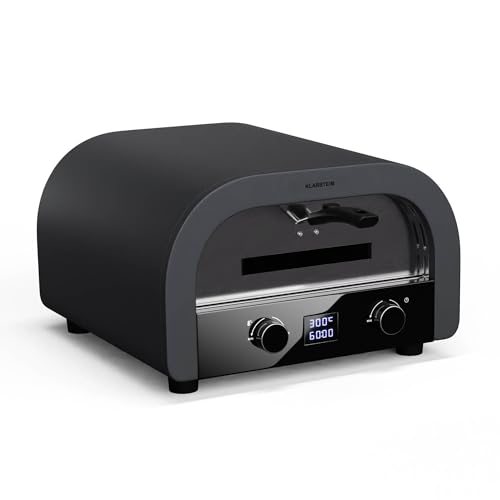
The product image shows a black body with a curved top that merges into a grey arch at the front. The opening sits in this arch, closed by a part with a glass pane and a small bar handle. Below it is a narrow control panel with two dials and a digital display between them, and the oven stands on short feet. Klarstein gives the external dimensions as 42 x 42 x 29 cm (length x width x height) and the weight as 12 kg. The Amazon catalogue arrives at the same values after conversion from inches and pounds.
The FornoVetro costs approx. €272 (Amazon page on 20 October 2026: €271.99).
Construction: Cordierite Stone, Two Heating Zones, One Control Panel
Baking is done on a removable cordierite pizza stone. According to Klarstein, pizzas up to 33 cm in diameter fit. The heat comes from above and below; the product page calls this “dual heating”, and the Amazon text mentions upper and lower heating elements.
The oven is operated via four elements listed in the appliance overview of the manual: power ON/OFF, temperature control, timer and cooling fan. The LED screen shows temperature and timer. You set the temperature in 50 °C steps; after switching on, the default setting of 450 °C appears there. On the mains, the oven needs 220 to 240 V at 50 Hz, and the power consumption is 2200 W.
The product page lists stainless steel as the material, plus a cool-touch surface. The manufacturer’s FAQ lists three protective functions: overheating protection, an automatic switch-off function and a ready-to-bake indicator.
Klarstein is inconsistent in how it names the front. The delivery list speaks of a “lid with glass”, the manual of an “oven closure”, the Amazon text of a glass door. Evidently the same part is always meant: the manual shows the oven closure on page 8 as a curved plate with a bar handle and a narrow viewing slit, and that is exactly how the front looks in the product photo. According to the manual, it provides faster heating and prevents heat loss.
According to the product page, the box contains the oven, the pizza stone, this lid with glass and the operating manual. A pizza peel is not included, even though the manual recommends one for turning.
What Klarstein Does Not State
Some details you would like to have before buying are missing from both the product page and the manual: the interior dimensions of the baking chamber and the height of the opening, the diameter and thickness of the stone (only the pizza size is given), the material of the glass, interior and heating elements, separate control of top and bottom heat (the overview shows a single temperature control), a protection rating as an IP code, minimum distances to walls or combustible materials, the country of production, the year of market launch, spare parts supply for exactly this model, energy consumption per bake and suitable accessories such as a cover.
450 or 500 Degrees: How Hot Does the FornoVetro Get?
The reliable figure is 450 °C. The product page lists this value under the features, and the manual gives it as the default setting and as the top row of its heat-up table. The 500 °C, which also appears in our page title, come from the manufacturer’s FAQ and page title and do not match the manufacturer’s own technical data.
This table is the most useful part of the manual, because it shows how the oven heats up. It takes 4 minutes to reach 100 °C, 10 to reach 200 °C, 16 to reach 300 °C, 22 to reach 400 °C and 25 minutes to reach 450 °C. The intermediate steps are 7 minutes for 150 °C, 13 for 250 °C and 19 for 350 °C. From 100 °C on, that is a steady three minutes for every 50 °C. The table contains no row for 500 °C.
In the FAQ, by contrast, Klarstein promises that the maximum temperature of 500 °C is reached “in about 15 minutes”. According to the company’s own table, after 15 minutes the oven is still just under 300 °C. Both cannot be true at the same time. We go by the manual, because it belongs to the appliance and is documented step by step, and we would therefore switch the oven on about half an hour before the first pizza.
In Detail: Top and Bottom Heat on Cordierite
An electric pizza oven like this bakes with two paths of heat at the same time. The lower heating element warms the stone, and the pizza base cooks through direct contact with the hot ceramic. The upper heating element radiates down onto the toppings and the crust. Cordierite is generally used for pizza stones because the material expands little when heated and tolerates rapid temperature changes better than many other ceramics. What that means for this stone cannot be quantified without information on its thickness: a thin stone gets hot faster and gives off its heat faster, while a thick one stores it for longer.
Where the temperature sensor sits and whether the display measures the air in the baking chamber or the stone is stated neither in the manual nor on the product page. That is not a side issue in practice. In an oven with a stone, the air can reach the target temperature earlier than the ceramic below it. If you want to know exactly, measure the stone surface with an infrared thermometer; one is not included.
Klarstein gives the baking time as 90 to 120 seconds. At the same time, the manual demands: “Turn your pizza regularly while baking (about every minute).” By that arithmetic you turn each pizza once or twice. The Amazon text promises even heat distribution thanks to the combination of heating elements. That the manufacturer nevertheless prescribes turning, we read as a hint that the crust at the back and at the opening does not brown equally fast. That is an interpretation, not a finding.
For turning, the manual recommends a pizza peel. You will find a guide to making pizza work on other appliances under Pizza on the grill.
Power, Cable and Placement
At 2200 W and 230 V the oven draws about 9.6 amperes; that is our calculation from the manufacturer’s figure. Household sockets in Germany are usually fused at 16 amperes. If a patio heater or an electric grill is also on the same circuit on the patio, the fuse can still trip. The manual requires you to check before plugging in that the voltage and frequency of your socket match the values on the rating plate. The power cable is 1.5 m long, so the socket has to be close to the table.
On the weather, the manual is clear: “This appliance can be used outdoors; however, it is only splash-proof and therefore cannot be used in the rain.” A spot under an overhang or an awning is therefore more than a comfort.
Two more sentences from the safety instructions matter when setting up. There are cooling slots on the sides and top of the housing and air inlets on the base. These must not be covered, because otherwise the appliance could overheat and pose a fire risk. A tablecloth under the oven is therefore out. In addition, the oven should not stand near heat sources such as gas or electric ovens or burners. The manual thus rules out placing the FornoVetro directly next to a running gas grill.
Whether a balcony counts as “outdoors” is something Klarstein does not answer. What your house rules and tenancy agreement say about it is a separate question anyway; our guide Grilling on a balcony sorts out the rules.
For electricity, only an upper limit can be calculated: 25 minutes of heating at the full 2.2 kW gives at most around 0.92 kWh. If the thermostat regulates down in between, it is less. Multiply that figure by your electricity price and you get the cost of preheating, without the baking time.
What Else Is Worth Considering?
| Model | The difference | Price | Our rating | Choose this one if |
|---|---|---|---|---|
| Klarstein FornoVetro (this one) | Electric, 2200 W, top and bottom heat, outdoor use only according to the manufacturer | approx. €272 | 8.1 | you have a patio with a socket and bake pizzas up to 33 cm |
| cozze 13 inch electric pizza oven | also 2200 W, stone 34.5 x 34.5 x 1 cm and IPX4 according to the Amazon text | approx. €295 | 8.3 | you want documented stone and protection rating data in an electric oven |
| G3 Ferrari Pronto Pizza 2 Minuti G10186 | 1700 W, 430 °C, 8 programmes | approx. €265 | 8.5 | you want to spend less and 430 °C is enough for you |
| Ooni Koda 16 | Gas at 8.0 kW, up to 500 °C, pizzas up to 40 cm | approx. €449 | 9.4 | you regularly bake large pizzas for several people |
The prices are guide values from our price boxes and change. The rating is our editorial assessment based on the data comparison; we did not measure anything on any of the four ovens.
When the FornoVetro Fits and When Another Oven Does
The first question is where you will put it. If you have only a kitchen and no outdoor space, you cannot take the FornoVetro; the approval for outdoor use leaves no room for that. Whether another electric oven may be used indoors is something you clarify for each appliance individually from the manufacturer’s information.
Then the size. At 33 cm in diameter, that is the limit. According to Ooni, the Ooni Koda 16 takes pizzas up to 40 cm, but costs approx. €449 instead of approx. €272 and needs a gas bottle, which is not included in our price comparison (according to our Ooni review, hose and regulator come with the German 50 mbar version). If you are baking for six people on a Saturday, the large gas oven means fewer rounds.
On budget, things look different from what the badge suggests. The G3 Ferrari costs approx. €175, the FornoVetro approx. €272, and in our comparison the G3 is ahead with 8.5 against the FornoVetro’s 8.1. It has only 1700 W and 430 °C, though. In return, its two heating elements (850 W each, top and bottom) can be switched separately according to the Amazon text, which is not provided for on the FornoVetro with its single temperature control. If you are looking for the cheapest entry, look at it first.
The cozze 13 inch is the direct counterpart: the same power, approx. €295 instead of approx. €272. Its advantage lies in the documentation, because Cozze states the stone and protection rating concretely where Klarstein leaves gaps. On top of that comes a cable that is 1.8 m long according to the Amazon text, 30 cm more than on the FornoVetro.
In our assessment, what speaks for the FornoVetro is the combination of the full 2200 W, top and bottom heat and a heat-up table you can plan with. Add a pizza peel to the total price. And bear in mind putting it away after rain: you can carry 12 kg, but according to the manual only once the oven has cooled down completely.
Cleaning, First Use and Safety According to the Manual
Before first use, the manual lists three steps. You wash the pizza stone thoroughly in warm soapy water, rinse it and dry it; you do not immerse the pizza oven itself in water or other liquids. Then you plug the plug into a suitable wall socket and switch the socket on. Finally, you let the empty oven run for 10 minutes at 450 °C so that any manufacturing residues burn off.
For cleaning afterwards there are six instructions, given here in full:
- Only clean the pizza oven when it has cooled down completely and been unplugged from the socket.
- Wash the pizza stone after every use, once it has cooled down.
- Wash it in hot soapy water with a brush (not a metal one) to remove stubborn dirt, then rinse and dry it.
- Check the lower grill area for food residues and, if necessary, remove them with a damp cloth.
- Work carefully on the heating elements, do not use force and do not apply pressure.
- Clean the outside with a damp cloth, without caustic or abrasive cleaning agents, as they can permanently damage the surfaces.
Before the instruction about the soapy water, the printed manual has a truncated sentence of which only the end survives: otherwise, residues can form that are hard to remove. What this refers to cannot be read from it with certainty. If the stone ever develops a crack, our guide Cracked pizza stone helps with the question of whether it is still usable.
On safety there is a contradiction you should know about. The product page advertises a cool-touch surface. The manual states in capital letters: “Do NOT touch the surfaces of the appliance during operation or after the last use. There is a risk of burns.” We would follow the manual and, as it requires, use oven gloves or pot holders. You should not leave the oven unattended while baking, heating up or cooling down. And it is not to be operated with wet or damp hands. The complete list of safety instructions is on pages 4 and 5 of the manual; read it in full before switching on for the first time.
Who Is It Suited To?
The FornoVetro suits you if you have a covered patio with a socket within cable reach, bake pizzas up to 33 cm and plan for the good half hour of lead time. It does not belong in households where children come to the patio table unsupervised: the manual requires the appliance to be kept out of the reach of children and to be used only by a responsible adult or under their direct supervision. For a family, that means putting the oven away after it has cooled down rather than leaving it outside.
Not sure which type of oven suits your space? The Grill Finder gives you a recommendation after a few questions.