A tabletop grill with two separate heating zones
The KLAMER Elektrogrill Duo-Platten is a tabletop grill for the mains socket: a flat base, two removable grill plates on top, and a wind guard at the sides and back. It is made and sold by Epic Brands GmbH in Berlin, which describes itself on its product page as a small Berlin company. Article number 91568 appears identically in the instruction manual and as the model number on Amazon. The appliance has been listed in the manufacturer’s shop since May 2024.
One risk of confusion up front. Under the same address, KLAMER sells two variants, the tabletop grill (SKU K-EG-SS-2400) and a freestanding grill (SKU K-EG-F-2180-IPX4-BK). This review covers only the tabletop grill. The long description text on the manufacturer’s page, with wheels, folding frame and cable length, belongs to the freestanding grill, so we did not use it for this text.
The KLAMER costs approx. €120 (Amazon page on 20 October 2026: €119.99) and belongs to the electric grills in our catalogue. What sets it apart from simple plate grills is two rotary controls, one per plate. The instructions say: “Each of the two grill plates can be set separately in temperature.”
Base, plates, wind guard: the construction
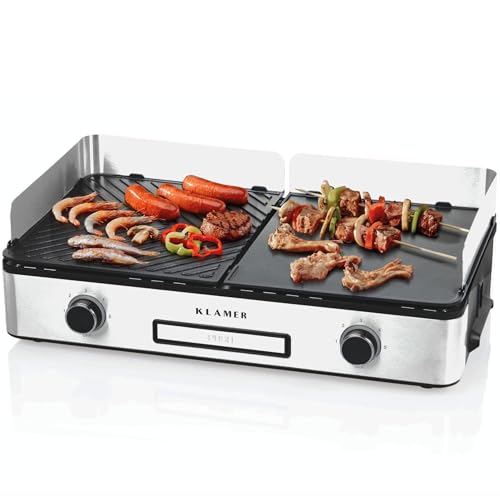
According to the manufacturer, the housing is made of stainless steel, and so is the splash guard. Weight: 4.98 kg, as stated on the manufacturer’s page, and Amazon lists the same value converted. The product photo shows a silver front with one control each on the left and right and a handle in the middle.
The diagram in the instructions names the components: left and right grill plate, wind guard, temperature control, drip tray, base, release button and handle. The release button sits above the handle. To remove a plate, you let the grill cool down completely, take off the wind guard, press this button and lift the plate, then slide it out sideways.
The two plates are firmly assigned, the ribbed one on the left, the smooth one on the right. In the photo you see two rectangular surfaces side by side, ribbed on the left, continuous on the right. The instructions describe the ribbed side as the one for the typical grill pattern and the smooth one as a surface for vegetables, fish and sweet dishes. Important for cleaning later: plates and base have electrical contacts.
Fat runs off via a channel at the front of the grilling surface and collects in a removable drip tray underneath. The grill must not run without this tray. The instructions put it this way: “Never operate the appliance without the intended fat drip tray.” When inserting it, the fat drain should point forwards.
You plug the wind guard into holders at the sides and at the back wall of the base. According to the instructions, it is meant to keep fat splashes away and to protect the grilling surface from cooling down in windy conditions. The grill is open towards the front, the operating side.
For the connection, KLAMER states 220 to 240 V at 50 to 60 Hz. The product page and Amazon give the power as 2,400 W, the instruction manual as 2000 to 2400 W. For the question of whether your socket can handle the appliance, we calculate with the upper value.
In detail: two controls, five levels, one light signal
Two zones on a tabletop grill solve a simple problem. Prawns and bratwursts need different amounts of heat, and on a single plate with one control everything gets the same. Here a high level can run on the left while a low one is set on the right. The instructions also mention a third use: keeping already prepared food warm on one of the two plates.
KLAMER assigns the five levels only in rough ranges. Level 1 to 2 is a low temperature for keeping warm, level 2 to 3 a moderate temperature for gentle cooking, level 4 to 5 a high temperature for quick searing and browning. The ranges overlap at level 2, and between 3 and 4 there is nothing at all. Temperatures in degrees are missing for every level, and there is no maximum value in °C either. So you learn the scale through the food, not through a thermometer.
Whether a plate is hot is shown by a light ring on the respective control. In the OFF position it glows white. On a heating level it turns blue while the plate heats up, and changes back to white as soon as the desired temperature is reached. Our reading: this is the behaviour of a thermostat regulating to a setpoint. The word thermostat does not appear in the instructions, but it follows from the description of the light.
Before the first food, both controls should stand at the highest level for five minutes. Afterwards, depending on the type of food, you choose a lower setting if necessary.
One point that is easy to overlook with the wattage: the 2,400 W are shared between two zones, and how much of it goes to each plate remains open. If both run at full power continuously, that is at most 2.4 kWh per hour. If the thermostat regulates down after heating up, as the light ring suggests, actual consumption is lower. How much lower depends on level, food and wind, and is not quantified anywhere.
How large is the grilling area, and for how many people is it enough?
This cannot be answered from the manufacturer’s information: plate dimensions and number of people are missing at KLAMER. Only the outer envelope of the whole appliance is documented, at 52 cm wide, 30.5 cm deep and 15.5 cm high.
We deliberately do not calculate a grilling area from these outer dimensions. The width and depth include the stainless steel housing with the handle and controls at the front, plus the wind guard at the sides and back wall. How much of that is actually grill plate, the photo only lets you guess, and a promotional photo is not a measurement.
These outer dimensions are still useful for your table. They tell you how much standing space you need to clear, and next to it you need room for plates, tongs and whatever else is going on the grill. Two appliances from our catalogue, by the way, do state their areas concretely; the figures are in the table further below.
What the manufacturer does not state
So that you do not have to search for it at every point individually, here are all the gaps in one place. Still open: the dimensions of the individual grill plates in cm or cm², the temperature per level and the maximum temperature in °C, the heating time to the target temperature (only the preheating recommendation of five minutes is documented), the power per plate, the material of the grill plates and the type of non-stick coating (for example PTFE or ceramic), the material of the base and drip tray, the capacity of the tray, the cable length of the tabletop grill, a protection rating against splashing water, a number of people, the country of manufacture, spare parts such as plates or wind guard for individual purchase, minimum distances to walls or combustible materials, the electricity consumption per hour and an explicit list of what is in the box. On use indoors, the instructions contain neither approval nor prohibition; they only say that the appliance is suitable for outdoor use.
Cleaning, care and safety according to the instructions
Before first use, the instructions list four steps. You remove all packaging parts as well as stickers or labels on the outside of the appliance. You clean the grill plates and drip tray with hot water and washing-up liquid and dry them carefully. You wipe the housing with a damp cloth and a little washing-up liquid. Then you place the appliance on a stable, level surface.
For cleaning after grilling, the instructions give ten points, here in their order. First, you always disconnect the appliance from the power before cleaning or moving it, and let it cool down first. Second, KLAMER recommends removing fat and other residue from the still slightly warm plates with a paper towel. Third, you carefully take the grill plates out of the base, fourth the drip tray. Fifth: grill plates, drip tray and wind guard are dishwasher-safe, but the instructions recommend cleaning them by hand. Sixth, for that you use lukewarm water and a mild washing-up liquid, with a washing-up brush or soft sponge. Seventh, you avoid abrasive cleaners, metal scourers and oven cleaner. Eighth, the base must on no account be immersed in water or treated directly with water; you only wipe it with a slightly damp cloth and a little washing-up liquid and dry it carefully. Ninth, the electrical contacts on the plates and base must be completely dry before you reassemble the appliance. Tenth, once completely dry, you assemble it for storage and keep it in a dry, level place. This last sentence is cut off in the PDF text, so we cannot say what came after.
The cleaning table in the instructions sums it up briefly: plates, tray and wind guard may go in the dishwasher, under running water and onto the damp cloth. For the base, only the damp cloth applies. A separate note adds never to clean the frame under running water. On the manufacturer’s page, the list of benefits simply says “dishwasher-safe”; the instructions are more cautious, and we would stick to them.
The safety notes on pages 2 and 3 of the instructions comprise twenty points, identical on the product page. We do not reproduce them all here and advise reading them completely before switching on for the first time. Four of them touch on the question of where the grill may stand, and we quote those: “Always place the electric grill on a stable, flat and heat-resistant surface where the appliance cannot fall.” “Never leave the electric grill unattended during operation.” “Do not place the appliance on or near a hot gas or electric cooker or in a heated oven.” And: “The appliance is suitable for outdoor use.”
According to the instructions, the warranty covers only material or workmanship defects. Five cases are excluded: normal wear and tear; improper use, for example overloading or unapproved accessories; use of force and damage from external influences; damage from failing to follow the user manual, such as connection to an unsuitable power supply or ignoring the cleaning instructions; and partly or fully dismantled appliances. The fourth point is directly tied to the cleaning above: if you hold the base under the tap and this causes damage, that damage is not covered by the warranty according to the instructions.
What else comes into question?
| Model | The difference | Price | Our rating | Choose this one if |
|---|---|---|---|---|
| KLAMER Elektrogrill Duo-Platten (this one) | two firmly assigned plates, stainless steel housing, no area stated | approx. €120 | 7.9 | you want a stainless steel look and can live with levels instead of temperatures in degrees |
| WMF Lono Master Grill | 2,400 W, two zones, grilling area 50 × 28 cm and cast aluminium plates stated | approx. €117.99 | 9.0 | you want documented area and material information for the same money |
| MEDION Dual-Zonen-Tischgrill MD12027 | 2,400 W, two individually adjustable plates, according to Amazon information up to 240 °C and IPX4 | approx. €100 | 7.9 | you want the two-plate principle more cheaply and need a protection rating for outdoors |
| Solis Deli Grill 7951 | 2,200 W, two plates of 20 × 32 cm each, Xylan coating | approx. €200 | 8.2 | you want to know the plate size and coating exactly before buying |
The prices are guide values from our price boxes and change constantly. The rating is our editorial assessment based on data sheets and instructions; we measured nothing on any of the four appliances.
On the prices from the price boxes: the WMF costs approx. €118, the KLAMER approx. €120, and in our rating the WMF is 1.1 points higher. The MEDION costs approx. €90 with the same rating, the Solis approx. €200.
When the KLAMER suits, and when another grill
It suits you if you want to grill outdoors and have a socket within reach. An electric grill needs no gas bottle and no charcoal, and the instructions explicitly declare it suitable for outdoor use. Whether your house rules or tenancy agreement allow electric grills on the balcony, however, is stated there and not in the data sheet. We have collected what else to consider in the guide Grilling on a balcony.
It suits you less if you want to expose the grill to the weather regularly and expect a stated protection rating for that. For the tabletop grill we found none; the IPX4 designation appears at KLAMER only in the SKU of the freestanding grill. The MEDION from the table lists IPX4 according to Amazon information and costs less.
If documented figures on the grilling area and plate material matter to you, we would advise the WMF Lono Master. However, WMF does not state temperatures in degrees either. It costs practically the same and leads in our comparison precisely because its area and material information can be documented.
Anyone who likes to cook chicken legs or thick cuts under a closed hood is not well served by any plate grill of this design. The KLAMER has no lid, everything lies openly on the plate. For steak, vegetables, prawns and sausages side by side, that is in our view exactly the strength: hot on the left, gentle on the right, and whatever is done goes to level 1 to 2.
A general note on electricity, not a manufacturer statement: household sockets in Germany are usually fused at 16 A, which at 230 V is around 3,680 W. The grill’s 2,400 W fit within that. If a kettle or fan heater is also on the same circuit, the fuse can still trip.
And finally the table. It must be stable, flat and heat-resistant, see the notes above, and have at least as much free space as the appliance brings in outer dimensions. If you have not yet decided between electric, gas and charcoal, it is best to work through the basic question beforehand in the Grill Finder. If you stay with a tabletop grill and need two foods at different heat but can do without documented area information, the KLAMER is right; if you need it, take the WMF.