Which grill is behind this offer
The Amazon offer on this page belongs to the Enders Chicago Next 4 R Turbo, article number 89366. The Amazon catalogue and the Enders product page list it under this number. Enders does not have a two-burner model with 6.5 kW under this name in its range. The series consists of the Chicago Next 3, the 3 R Turbo, the Black 3 R Turbo and the 4 R Turbo, and the largest of the four is the one covered here.
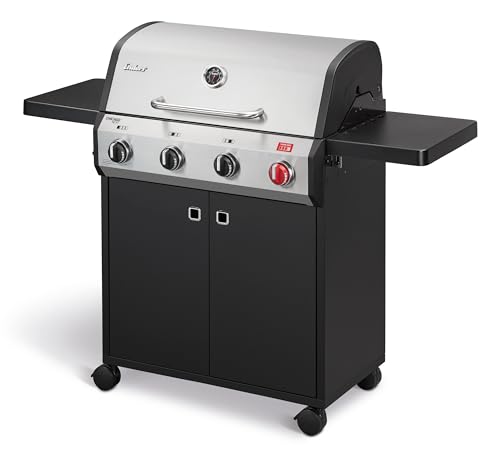
It is a gas grill cart with a base cabinet. Under the hood there are four stainless steel burners, three of them ordinary main burners. The fourth is called TURBO ZONE by Enders and is built for fierce searing. In the product photo you can recognise it by the red control knob on the far right; the other three knobs are silver.
Our reference price is approx. €300 (Amazon page on 21 October 2026: €299.95); Enders gives a recommended retail price of €349. How that compares with other carts from our gas grill overview is shown in the table further down.
Where the information comes from: we did not have the grill in front of us and did not cook anything on it. Everything that follows comes from the Enders product page, the user manual of the Chicago Next series and the Amazon catalogue. The manual covers all four models in the series (articles 89342, 89396, 89346 and 89366); the assembly instructions are a separate booklet and were not available to us. Where we calculate or judge something ourselves, we say so.
Burners, grate, hood and cart
Three main burners of 3 kW each and the 4 kW TURBO ZONE add up to 13 kW. Each of the four has continuous control and its own control knob with a piezo ignition inside. It needs no battery, and because each knob produces its own spark, you light the burners one by one. The technical data in the manual also gives the nozzles: 0.74 mm in diameter on the main burners, 0.83 mm on the TURBO ZONE. Above the burners there are flame covers which, according to Enders, protect the burners and distribute the heat.
You grill on 71 x 42 cm, that is 2,982 cm². The grate is enamelled cast iron, in several parts and removable for cleaning. Enders calls the system SWITCH GRID. Above it sits a stainless steel warming rack.
The cooking hood is double-walled and made of stainless steel and powder-coated steel, and in the photo the thermometer sits in the centre of the front. The combustion chamber below is made of enamelled steel. What drips from the grate lands in a removable grease drawer with a collecting container.
The side walls of the cart are closed. On the left and right hangs a powder-coated steel shelf each, which can be folded down for storage. The shelves are not meant for cutting or preparing food: the manual expressly says they are not intended for direct contact with food. Assembled, the grill measures 134.5 cm in width, 51 cm in depth and 108 cm in height, and 119 cm in width with the shelves folded down. The working height is 85 cm and the weight 39 kg, and Amazon lists the same outer dimensions as Enders. The photo shows a base cabinet with two doors on castors.
In detail: how the TURBO ZONE works
The 800 °C that Enders advertises apply only to the TURBO ZONE. According to the manual, the heat there comes from the interplay of specially developed burners and covers, which together produce intensely glowing infrared radiation; the product page calls the component infrared mesh.
Why that suits searing can be derived from the design. A glowing mesh above the flame gives off a large part of its heat as radiation, and that hits the surface of the food directly. With a normal burner under a flame cover, more of the heat travels via hot air and the heated grate. That is why the surface browns before much heat reaches the inside. This is the physics of the design, not our observation on this appliance, and nobody has measured for us how hot it actually gets at the grate above the zone.
The zone does not sit idle when no steak is on. On a low setting it works as a perfectly normal grilling zone, according to the manual.
A sentence from the manual helps when reading the temperature: the lid thermometer measures at the top of the cooking hood, not at the grate, and it is considerably hotter at the grate. So the display reads lower than what the food gets. Enders does not say by how much.
For indirect grilling, according to the manual, you light only the side main burners and close the hood; the food lies between or next to the flames. With four individually controllable burners, you can keep part of the grate hot and let a roast cook slowly on the other part. How to set up such zones is explained in our guide to direct and indirect heat.
Before every grilling session you preheat for 15 minutes at full power, all main burners on, hood closed. The very first time, all burners run for 20 minutes on the highest setting, with no food.
Does a 134.5 cm wide grill cart fit on your balcony?
Only on a large one that is open above. In the manual, Enders does expressly name a patio or balcony as a grilling place, but it requires at least 1 m clearance to combustible and heat-sensitive materials and 2 m of height above the grill with no objects or parts of the building.
Let us work this out for a balcony with a privacy screen of wood or plastic on the left and right. With the shelves folded out, 100 cm of clearance on each side is added to the 134.5 cm, which makes 334.5 cm of free width. With the shelves folded down it would be 319 cm, but then you have no shelf space. If there is another balcony above yours, the height becomes the real hurdle. Whether the 2 m count from the floor or from the top edge of the grill is left open by the sentence in the manual; if in doubt we would count from the top edge, and under a balcony above we would not plan on the Chicago Next.
The manual contains a long block of safety instructions for operation, which you should read in full before lighting it for the first time. For choosing the location, this DANGER notice matters most, quoted here in substance verbatim: do not use the grill in garages, buildings, covered passageways, tents, other enclosed areas or under combustible structures. Enders also requires a nearly level and stable surface, a spot sheltered from wind and, if present, the castor brakes applied. While it is running, the grill is not moved.
In principle, your tenancy agreement and house rules also have a say. What is typically regulated there, we have collected in the guide grilling on a balcony.
Gas, pressure regulator and leak test
The grill runs on liquefied gas, propane G31 or butane G30, at 50 mbar. Pressure regulator and hose are in the box. The regulator keeps the pressure constant and has a built-in hose rupture safety device (EFV): if the hose breaks or comes loose, it stops the gas escaping by itself. The regulator is always mounted horizontally, because otherwise the safety device can trigger.
For this grill, only gas hoses to EN 16436-2:2019 and pressure regulators to EN 16129:2013 are permitted (EU standards). The hose is at most 1.50 m long, must be neither kinked nor twisted, abrasion points are to be avoided, and it lies free of kinks and trip hazards. You screw the regulator onto the bottle by hand, without tools. At the grill, the union nut goes onto the gas connection and is counter-held with a second spanner, width across flats 17 mm. Watch out when attaching: the hoses have a left-hand thread, so you turn anticlockwise. According to Enders, hose and regulator are replaced after ten years in most European countries; which rule applies to you, you check against the national regulations.
After every bottle change you check for leaks at three connections: regulator and bottle, hose and regulator, hose and gas connection at the grill. The procedure from the manual:
- All control knobs are set to OFF and the grill has cooled down.
- Spray all connections with leak detection spray or brush them with soapy water, one part soap to three parts water.
- Open the valve of the gas bottle.
- If bubbles form, close the gas supply at the bottle immediately. The grill must not be operated under any circumstances. Tighten the union nuts and repeat the test.
- If there are still bubbles afterwards, replace the affected regulator or hose.
- With no bubbles: close the bottle valve and rinse the tested points with water.
Open fire has no place near the test.
The manual sums up intended use in four points. Operate only with butane or propane liquefied gas; natural gas is not permitted. Use only for preparing food, for grilling and cooking. Do not use as a fire pit. Do not mount or operate in or on caravans or boats. Separately, it states that charcoal, briquettes and lava stones do not belong in this grill, that it must not be modified, and that only authorised specialist personnel may repair gas-carrying and sealed parts.
If grease catches fire, Enders prescribes: switch off all burners immediately, keep the lid closed and close the gas bottle until the fire has gone out. You never extinguish burning, hot or smoking grease with water. For everyday use: the bottle valve is open only while the grill is running. When switching off, you close the bottle first and then turn all knobs to off. Someone always stays with the grill while preheating and grilling, and your hands belong in grill gloves with contact heat resistance level 2 or higher according to DIN EN 407 (the standard that applies in Germany). What to consider when buying and exchanging the bottle is in our guide to the gas bottle for the grill.
Cleaning according to the manual
After every grilling session, Enders provides a quick clean in four steps. First you burn off the grate by letting the grill run for about five more minutes on the highest setting. Then you brush the grate while it is hot. Once it has cooled, you rub it with a little rapeseed oil or another oil that tolerates high heat, which according to Enders protects against corrosion. Finally you empty and clean the grease drawer and grease tray so that no grease fire can start. According to the manual, burning off is not pyrolysis and affects only the surface of the grate.
The thorough clean is due at least twice a year, and quarterly for frequent grillers. Beforehand the grill is off and cold, and because individual parts can have sharp edges, Enders advises safety gloves. You free the burner covers of coarse deposits with a sponge or washing-up brush and then put them in the dishwasher. The burners come out for cleaning but must not be swapped with each other; the TURBO ZONE burner must go back in its place. If insects have nested in the burner tube, you clear it with a needle or a pipe cleaner.
Off limits are a strong jet of water from a garden hose or pressure washer and these agents, listed in full as in the manual: abrasive stainless steel polishes, acidic or flammable cleaners, oven cleaner, and abrasive or chlorine-containing cleaners. No oil goes on the valves, because gas and oil form an explosive mixture. The opening in the rear wall stays open, because it prevents escaping gas from collecting inside.
If the stainless steel discolours after high temperatures, according to Enders this is typical of the material and not a defect. Before the next use you let everything dry. You check the grill brush regularly for loose bristles and wear. How a basic clean works step by step is shown in our guide cleaning a gas grill.
Accessories, gas consumption and spare parts
On its product page, Enders lists for this grill the Premium weather protection cover Chicago Next 3 + 4 for €44.95, a SWITCH GRID for Chicago Next 4 for €79.90, a Sear Grate for €39.95, a pizza stone for €44.95 and a cast iron reversible plate 1/2 for Chicago Next 4 for €69.90. As possible inserts, the page also names a pan, poultry roaster, Dutch oven and wok; their prices were not available to us.
One point is unclear here. SWITCH GRID is listed under the grill’s features, and at the same time Enders sells a SWITCH GRID for the Chicago Next 4 as an accessory. Whether the grate supplied already takes the inserts or whether you need the accessory for that, we would clarify with the retailer before ordering.
On consumption, the manual is precise: 218 g per hour for each main burner, 291 g for the TURBO ZONE, 945 g when all four run at full power. We calculated the following. An 11 kg bottle lasts around 11.6 hours with all burners at full load. Preheating for 15 minutes with the three main burners takes a good 160 g, and the one-off burn-in for 20 minutes with all four around 315 g. If you do not leave everything at full, you use less; exactly how much depends on your control settings. We cannot convert this into euros here, because none of our sources contains a gas price.
You find spare parts via a QR code in the manual, and the complete list is in the assembly instructions. Enders prescribes original spare parts. When it has reached the end of its life, the grill does not belong in household waste.
After the product page, manual and Amazon catalogue, these points remain unresolved: a heat-up time in minutes, the maximum temperature at the main grate outside the TURBO ZONE, the dimensions of the warming rack, number and material of the castors including brakes, the material of the base cabinet and doors, the grade of stainless steel, country of manufacture and market launch, packed size and assembly time, and spare part prices. The manual mentions a viewing window in the hood only for the series in general; on the photo of the 4 R Turbo there is none to be seen.
Three alternatives from our catalogue
| Model | The difference | Price | Our rating | Choose this one if |
|---|---|---|---|---|
| Enders Chicago Next 4 R Turbo (this one) | four burners, one of them a 4 kW searing zone, no side burner | approx. €300 | 8.0 | you want a lot of grilling area and a searing zone for little money |
| LIFERUN Gas Grill 4+1 | 3 kW side burner instead of an infrared zone | approx. €270 | 7.8 | you cook side dishes in a pot outdoors and can do without maximum heat |
| Enders Monroe Pro 3 SIK Turbo | TURBO ZONE plus integrated side burner | approx. €529 | 8.9 | you want to stay with Enders and need both |
| Weber Spirit II E-310 | three burners with 7.0 kW, no high-temperature zone | approx. €460 | 9.2 | our highest rating in this field matters more to you than a searing zone |
The prices are reference values from our price boxes and can change at any time. We formed the ratings from data sheets and instructions; no measurement result is behind any of the four numbers.
When the Chicago Next 4 R Turbo fits and when another does
Start with the location, because it decides more than anything else. If a roof, an awning or your neighbours’ balcony above your grilling spot is so low that the 2 m from the balcony section do not stay free, the Chicago Next is ruled out under Enders’ requirements. For the alternatives in the table we have not evaluated the clearance rules; there the only help is a look at the respective instructions.
Next comes the side burner. The Chicago Next has none. If you like cooking sauce or potatoes outdoors in a pot, the LIFERUN Gas Grill 4+1 is the alternative, at approx. €270 against approx. €300 for the Chicago Next, though without an infrared zone and just behind in our rating. If you want a side burner and TURBO ZONE together, you pay approx. €529 for the Enders Monroe Pro 3 SIK Turbo instead of approx. €300.
The third question is how much the searing zone is worth to you. The Weber Spirit II E-310 costs approx. €460 in our price box, the Chicago Next approx. €300; it has three burners and no high-temperature zone, but is ahead in our rating. Of the appliances in this table, only the Chicago Next has a searing zone at a price around €300.
For two people the Chicago Next is simply oversized. You heat a grate meant for a group to fry two steaks, and you push 39 kg across the patio. Enders does not name a number of people, but in our assessment the area is only worth it once six or more people regularly sit at the table.
So it is the wrong choice for anyone who grills on a small or covered balcony, and for anyone who wants a side burner. If you are still right at the start on size and fuel, you can go through the grill finder. If you have ordered it, plan the 20 minutes of burn-in before the first food goes on.