What the Arizona is and where our information comes from
The Arizona is a grill cart with three grills built together: a gas grill, a charcoal grill and a side smoker box. Amazon sells it as the combi grill “ARIZONA” by El Fuego, model AY 534. In the operating instructions it is called model Arizona, item number AY0534, and the importer given there is ARTE Living GmbH of Hilpoltstein.
We did not have the grill in front of us and cooked nothing on it. We have two sources: the Amazon catalogue and the importer’s user manual, which is available as a PDF from the DIY chain toom. We found no manufacturer website under either El Fuego or ARTE Living. Where retailers give different values from the manual, such as a lower total output, we have stuck with the manual.
On Amazon the Arizona costs approx. €679 (Amazon page on 21 October 2026: €679.00). We do not list a second combi unit of this design in the gas grill category, so further down we compare it with pure gas grills. The guide Gas or charcoal explains more fundamentally than a single review can whether gas, charcoal or both suit you.
Three body sections, four burners: the construction
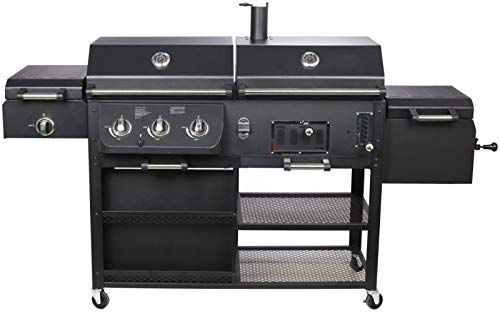
The product image shows three parts side by side. In the middle sits the wide main body with two lids, on the left a small box with its own control knob, and on the right another box with a handle on the flap. The parts list in the manual calls them grill body with lid, side burner body and smoker body. Amazon counts three cooking chambers from these.
The gas side lies under the left lid, and its three control knobs can be seen in the photo in the control panel below. According to the technical data, the Arizona has three main burners of 2.93 kW each and one infrared burner of 3.5 kW, 12.30 kW nominal output in total. The injectors measure 0.74 mm on the main burners and 0.80 mm on the infrared burner, and it runs at 50 mbar. For the infrared burner the parts list gives its own regulator and a wind guard. The manual does not say in so many words where exactly it sits. Judging by the picture and the part names, we assume it works in the left side box with the single knob.
For charcoal, gas and infrared together, five cooking grates are listed, plus a separate grate for the smoker and a warming rack. Amazon describes chrome-plated warming racks in the plural, while the manual counts one. Three flame guards match the three main burners in number.
Grease drains away by separate routes. The charcoal grill has its own grease collector, and the gas grill has a grease collector with a grease cup. According to the exploded drawing, the two thermometers sit on the two lids of the main body, one above the gas side and one above the charcoal. On the right lid is the chimney, which Amazon describes as adjustable.
The charcoal lies in a charcoal tray whose height can be adjusted using a handle, in six settings according to Amazon. The smoker box has its own fuel grate and a vent with a locking clip and handle. At the bottom, the frame carries a storage grid in the middle and one below it, it rolls on four wheels, and a bottle opener is part of the delivery. Amazon gives the material as “steel construction”, with no steel grade or coating, and the colour as black. The dimensions there are 203 x 127 x 60 cm, the weight 182.98 pounds, so around 83 kg. The catalogue leaves open which figure is width, height or depth; judging by the photo, we take the 203 cm to be the width across both side boxes.
What none of our sources state: cooking area and grate dimensions, the material of the grates, material and sheet thickness of the body, lids and burners, maximum temperatures and heat-up times of the individual zones, the ignition type, the permitted amount of charcoal, lockable wheels, whether a gas hose and pressure regulator are included, warranty, spare parts supply and country of production. Deriving a cooking area from the external dimensions would be wrong, because they include side boxes, handles and shelves.
In detail: how the gas side, charcoal and smoker box work
The gas side is the part for everyday use. Three individually adjustable burners allow the usual zone principle: one burner runs high on the outside, one next to it stays off, and the food cooks there indirectly under the closed lid.
An infrared burner works differently from an ordinary tube burner. With this design, the gas flame heats a surface of ceramic or metal mesh until it glows, and this surface passes a large part of its heat as radiation directly to the surface of the food. That is why such burners are used for searing. The manual does not describe which material El Fuego uses for it.
With charcoal, the height of the tray controls the heat at the grate. The closer the embers are to the food, the more strongly the radiation hits it, and further down it becomes gentler. We consider six settings a useful range for this, provided Amazon’s figure is correct; the manual itself prints no number of settings.
The right-hand box is reminiscent of an offset smoker. In this principle the fire burns in a side chamber, and heat and smoke travel through the larger cooking chamber next to it to a chimney at the other end. The food never sits over the embers. The manual has no chapter of its own on smoking. But the components fit this design: fuel grate and vent in the right box, the chimney at the far end of the charcoal lid. How to coordinate smoking wood, temperature and time is covered in our guide Smoking on the grill.
One point we consider important: there is no thermometer on the smoker box. Both displays measure the air under the lids of the main body, and a lid thermometer reads a fundamentally different value from the one at the grate or in the meat. For longer smoking sessions we would therefore plan on a wireless thermometer with a cooking chamber probe. Whether the gas and charcoal sides may run at the same time is not covered in a section of its own in the instructions.
Lighting charcoal, and a contradiction in the manual
For charcoal, the chapter “Lighting charcoal” gives four steps. First you open the lid and vents and take out the cooking grates. Then you pile the permitted amount of charcoal onto the charcoal tray. In the third step you set the tray to the lowest level and light the charcoal in the way you prefer; a chimney starter is recommended, and the instructions of the respective lighter manufacturer on use and safety apply in full. When all the coals are covered with a light layer of ash, after approx. 20 to 25 minutes, the embers are ready and are spread evenly with a suitable tool.
Two pages earlier, under the operating instructions, there is a sentence that does not fit: “Do not use charcoal, briquettes, lava stones, pizza stones or the like in the grill.” For a pure gas grill that would be a common warning. The manual is evidently written for several models; phrases such as “depending on the model” and “if the function is present” show this. We therefore read the sentence as a rule for the gas side, but it is not clarified in writing anywhere. If you want to use a pizza stone on the charcoal side, you should ask the importer first.
Where can the Arizona stand, and does it fit on a balcony?
Only outdoors and with no roof above it. The manual explicitly rules out coverings and requires that there are no structures within a radius of approx. 3 metres. On a typical balcony, we think this can hardly be met.
The instructions summarise the most important points for use in an overview, given here in full:
- The grill may only be used outdoors (not under coverings or the like) for private use.
- Using a grill is permitted at the intended place of use (observe tenancy restrictions etc.).
- Installing it on caravans, boats or other vehicles is not permitted.
- The grill must never be left unattended.
- No flammable materials may be nearby during operation.
- All packaging material, including on internal components, has been removed.
- The burners are connected correctly and safely.
- All regulators and valves turn freely without problems.
- The grill and gas lines have been checked for leaks regularly.
For the location itself, six conditions are added. Children and pets must not come into contact with the grill. It should not be exposed to extreme weather, with strong winds and snow named. There must be no risk of tripping or falling in the immediate surroundings. The ground must be non-flammable, level, firm, stable and non-slip. No structures stand within a radius of approx. 3 metres. And you must be able to monitor the grill closely at all times during operation.
A wall, a carport or a pergola within reach are therefore ruled out. What tenancy law and house rules typically say about grilling on a balcony, we have collected in the guide Grilling on a balcony.
Gas connection, leak test and operation according to the instructions
The technical data give the gas type as “G30 (propane), G31 (butane) and mixtures (LPG)”. Under the usual European gas designation it is the other way round: G30 stands for butane and G31 for propane. In both cases liquefied gas from a cylinder is meant.
Before connecting, the manual requires a series of checks. The regulator must be fitted at a point where the temperature does not exceed 60 °C. The cylinder valve is closed, the correct external thread is present, the hose is routed without contact with other parts, and all burner controls are set to Off. You check the valve connection and regulator for damage and dirt and clean them if necessary, and the hose for damage or blockages, replacing it if need be. Then you screw the union nut of the pressure regulator onto the valve by hand clockwise, because hard tools can easily damage it. Finally you open the cylinder valve and apply soap solution to the connections before lighting.
The cylinder is always disconnected when you are no longer using the grill: all regulators to Off, close the cylinder valve completely, loosen the union nut by hand anticlockwise, put the protective cap back on the valve.
The leak test is mandatory before first use, then at regular intervals and whenever you notice a smell of gas. The importer justifies this by saying that connections can leak, for example through transport damage, despite being checked before delivery. The test is carried out outdoors, away from ignition sources such as electrical appliances, open flames and flying sparks, without smoking, with flames extinguished and burners switched off. You mix a light soap solution of soap and lukewarm water and make all connections properly. Then:
- Open the cylinder valve completely. If it whistles, close it again immediately, because then there is most likely damage to the connections; in this case call the fire brigade and, if necessary, a gas systems technician.
- Brush some soap solution onto every point of the gas line system from the cylinder to the burners.
- If bubbles form, the point is leaking. Close the cylinder valve and check whether it can be fixed, for example because a connection only needs tightening. Then check the point again.
The manual describes lighting in general terms for several models. You open the lid, set all burner controls to Off, open the cylinder valve and turn one control to maximum output; depending on the model, a specific burner marked on the control panel must be lit first. Then you hold the ignition button down for approx. 2 seconds, which does not apply to models with automatic ignition. If nothing lights, you switch off and try again after about 5 minutes; if it fails repeatedly, the fault table helps. One of its rows concerns exactly this multi-burner design: if the flame does not spread to the other burners, the manifold is usually blocked by food residue or grease and must be cleaned and brushed out.
For ongoing operation, the operating instructions list these points. You keep children and pets away. A suitable extinguisher should be ready. After a long period of non-use, you inspect the grill thoroughly before use. During operation all parts may become very hot and must not be touched. If a burner goes out, you close the gas supply, open the lid and let the grill cool down before looking for the fault; only when it has been found and fixed does the grill go back into operation. Charcoal, briquettes, lava stones and pizza stones are excluded, with the contradiction described above. You do not store fuels or fuel containers in the lower cabinet. Suitable protective equipment is recommended, and you are to seek advice on it from a specialist retailer. If food residue or dripping grease catches fire beyond the usual extent, you immediately close the gas supply and close the lid to smother the flames. Note the difference: with a burner that has gone out the lid comes off, with a grease fire it goes on.
Four further rules concern the surroundings. Do not store or use fuels or other flammable substances nearby. Do not place unused gas cylinders nearby. Neither cylinder nor hose may touch hot parts. And the gas cylinder does not belong inside the unit, not even switched off or for storage. Any deviation from the instructions and any modification of the unit counts as use outside the intended purpose; in that case, according to the manual, all liability of the manufacturer and seller lapses.
On consumption, the manual gives a maximum of 900 g/h, split into 214.4 g/h each for the three main burners and 256.1 g/h for the infrared burner. Our own calculation: a 9 kg cylinder, the largest permitted, is empty after around 10 hours at full load on all four burners. With the controls half open it lasts longer, and how much longer depends solely on your setting. What to bear in mind when changing a cylinder is explained in the guide on the gas bottle for the grill.
Cleaning and care according to the instructions
You clean the burners in four steps: close the gas supply, remove the gas manifold, inspect the inside of the burners with a torch, and finally clear the openings at the burner ends and the valve nozzles with a wire. The outside of the burners may be cleaned with a steel brush.
According to the manual, spiders and insects like to nest in the area of the burner tube. This disturbs or blocks the gas flow, gas can then escape mainly from the burner air openings and cause a fire behind the control panel, and in the worst case the burners can no longer be controlled. At every burner check you therefore also look for infestation.
The grease drawer is emptied regularly, cleaned with mild detergent and warm water and rubbed dry with a soft cloth. If you like, you sprinkle some sand into it to soak up grease; you then dispose of it properly. On the Arizona this affects two collectors, the one on the gas side with its cup and the one on the charcoal side. If flare-ups rise, the fault table names dripping grease, too high a temperature and burning grease in the drip tray as causes, with the remedy of trimming off excess fat, lowering the temperature and emptying the tray.
Harsh cleaners, rust inhibitors and the like have no place on any component, because they attack the surfaces and can wear away markings such as warning notices. The manual also advises keeping the area around the grill clean, because that reduces the cleaning effort on the grill itself.
The care chapter says not a word about the charcoal tray, ash disposal or the smoker box. As a general rule, ash goes in the bin only once it has cooled completely, and that can take hours. More on the gas side is in the guide Cleaning a gas grill.
What else comes into question?
| Model | The difference | Price | Our rating | Choose this one if |
|---|---|---|---|---|
| El Fuego Combi Grill ARIZONA (this one) | Gas, charcoal and smoker box on one cart | approx. €679 | 8.1 | you really use all three types and have space without a roof |
| El Fuego Kingston 4+1 burner | pure gas grill from the same brand with infrared side burner | approx. €456.74 | 8.4 | gas is enough for you and you want to keep the infrared zone |
| Weber Spirit II E-310 | classic gas grill with 3 burners and 7.0 kW | approx. €459.99 | 9.2 | you grill almost only with gas and want fewer parts to look after |
| Broil King Regal 590 | large gas grill, 16 kW main burners plus 4.4 kW rear burner | approx. €1,649 (Santos Grills) | 9.4 | your budget is well over €1,000 and charcoal does not matter |
The Kingston and the Spirit II E-310 appear in our price boxes at approx. €457 and approx. €460, against approx. €679 for the Arizona. The Regal 590 sits above at approx. €1,649. The prices are guide values and change constantly. The rating is our editorial assessment based on manufacturer data; we measured nothing.
When the Arizona suits you and when another grill does
The most uncomfortable question first: do you actually light the charcoal regularly? If you grill almost only with gas, with the Arizona you pay for two body sections that mostly stay cold, and you still clean more. In that case we would go for the Kingston or the Weber.
The location often decides before that. With the siting rules above, balconies, covered terraces and the spot right by the house wall are out. A free garden spot with firm, non-flammable ground works, and since the grill stands on four wheels, it may be kept in another open-air spot out of season, just never in an enclosed space.
For quick after-work grilling, the gas side is enough. The charcoal needs lead time until the embers are ready, and the smoker box is for afternoons when you cannot leave the grill anyway.
Add to the purchase price a gas cylinder, depending on what is delivered a pressure regulator and hose, charcoal, a chimney starter, a thermometer of your own for the smoker box and a cover that you have to find to fit yourself. If you want everything from one manufacturer with an accessories range, a spare parts shop and a written warranty, then in our assessment you are better served by a large gas grill brand.
The wrong choice is the Arizona for tenants without a garden. Unsure which design suits your habits? The Grill finder asks you in a few steps. If instead you have an open garden spot and want gas, charcoal and smoking on one cart, we would take the Arizona and clarify with the importer before ordering whether a regulator and hose are included.