One cast plate over two burners: what the G-500 Plancha is
The G-500 Plancha is a tabletop gas unit without a grate. You cook on a continuous plate with two burners running underneath. On Amazon it is listed under model number 90521 and costs approx. €359 at Amazon (Amazon page on 21.10.2026: €359.00).
The brand is backed by Millarco International A/S from Lystrup in Denmark, as the manual states. Cozze itself has existed since March 2021 and, by its own account, is designed in Denmark.
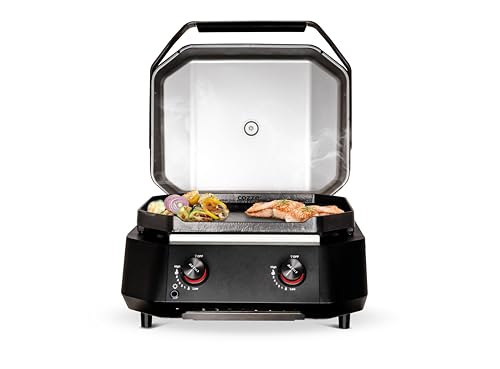
In Cozze’s plancha range, the G-500 sits in the middle. Below it is the G-400 with 48 x 35 cm and 4.4 kW, above it the G-700 with 66.5 x 35 cm and 6.6 kW as well as the G-800 with 80 x 50 cm and 7.5 kW. The product photo shows a compact black body on short feet, an open lid with bevelled corners and a bow handle, two control knobs with red rings at the front and a small round button at the bottom left. In our overview of gas grills, it belongs with the small plate units, not with the mobile grills with a base cabinet.
Cast iron, not aluminium: the construction according to the data sheet
One misunderstanding first, because the old version of this page had adopted it too. The Amazon text speaks of an aluminium plate. According to Cozze, the cooking plate is cast iron and has a non-stick surface. Aluminium only concerns the inside of the lid, which is coated with heat-resistant aluminium. In the photo, that is the bright, reflective surface under the open lid. For care, this makes a real difference, more on that below.
According to the manufacturer, the plate measures 53.5 x 41.8 cm, which is around 2,236 cm². Underneath are two U-shaped stainless steel burners, described in the Amazon text as SS409. Together they deliver 5.0 kW. Cozze gives a maximum temperature of 460 °C without saying where it is measured.
The housing is made of powder-coated, galvanised steel, and the grease tray is galvanised as well. On the side sits a removable spatula holder made of stainless steel. A thermometer is built in; in the photo you can see it as a round display in the middle of the lid.
There are two sets of dimensions. Cozze gives 59.7 x 58.9 x 37.8 cm, Amazon 65 x 61 x 44 cm. We go with the manufacturer. Because the 53.5 x 41.8 cm plate has to fit into the housing, the 37.8 cm can only be the height.
For assembly, the manual shows an angled key and an open-end spanner, plus four M6 x 30 screws and two M4 x 10. The declaration of conformity names the EU Gas Appliances Regulation 2016/426, EN 498:2012 and ISO 4531:2018; the type examination was issued by DBI Certification A/S on 20.06.2023. For the plate, Cozze cites an LFGB approval (German food and consumer goods law) under EC 1935/2004.
What Cozze does not state
The following details are missing from all manufacturer sources we opened (product page, pages of the sister models, German manual 90521):
- Weight of the unit
- Thickness of the cast plate and type of non-stick coating
- Output per burner, only the total is documented
- Heat-up time
- Measuring range of the lid thermometer
- Capacity of the grease tray
- Material of the lid itself, only the inner coating is documented
- Country of manufacture
- Warranty period and spare parts supply
- Scope of delivery according to the manufacturer; regulator and hose appear only in the Amazon text
In detail: two zones on one plate
On a grate, each burner almost alone determines how hot it gets directly above it. A solid plate also conducts heat sideways, and cast iron stores it for a long time as well. The zones therefore blend into each other. For a plancha, that is desirable: on the left something sears at full power, on the right vegetables cook on a low flame, and in the middle there is a strip where you push finished food.
According to the manual, each of the two burners has its own control knob, and every position between high and low is permitted. How clearly a hot and a cool side can be separated across 53.5 cm of width depends on the plate thickness. That is not stated, so it stays with the direction: the thicker the cast iron, the more it evens out differences and the longer it takes to react to a new setting.
A calculation helps put the output in context. Dividing the 5.0 kW by the plate area, the G-500 comes to about 2.2 W per cm². The G-800, with 7.5 kW on 4,000 cm², is at just under 1.9 W, the G-400, with 4.4 kW on 1,680 cm², at a good 2.6 W. So the smaller sibling has more output per area, the larger one less. This is a figure on paper and says nothing about the actual surface temperature, which among other things also depends on wind and outside temperature.
On the lid, the manual says that food can be prepared with or without the lid closed; with the lid closed, you should pay particular attention to possible high heat build-up. Incidentally, it speaks of the “grill grate” there, although the unit has none. The manual is evidently written for several Cozze units.
A thermometer in the lid measures the air under the lid, not the surface of the plate. With open cooking, the normal case on a plancha, it therefore shows little of use. You measure the plate temperature with an infrared thermometer from above.
How do you light the G-500, and what does the LED light show?
Electrically, via the starter. You press it, and the LED light glows white. Then you press the left burner’s knob down and turn it anticlockwise to 90°, the full-power position. The light changes to red.
There is a fixed sequence beforehand. Open the lid, because according to the manual you must never light it with the lid closed. Connect the gas bottle following the regulator’s instructions, set all knobs to “OFF”, then check the hose and connections for leaks with soapy water. Only when nothing leaks do you light the left burner; the right one follows in the same way.
If the burner stays off after two attempts, you set the knob to “OFF”, close the bottle valve and wait 5 minutes. In that time, escaped gas can disperse before a spark appears again. Common causes and what you may check yourself are collected in our guide gas grill won’t light.
To switch off, first close the bottle valve or turn the regulator to “OFF”. As soon as the flames are out, the control knobs also go to “OFF”.
Gas, regulator and hose on the 90521 version
The G-500 Plancha comes in two versions, 90520 and 90521, each with its own manual. The 90521 is the version for Germany, Austria, Switzerland and Slovakia: gas category I3 B/P (50), 50 mbar, injector 0.68 mm, operated with butane, propane or mixtures of them. Unlike with some other Amazon listings, the assignment is clear here, because the catalogue gives exactly the 90521 as the model.
The manual itself has an inconsistency. Its data sheet gives 50 mbar, while elsewhere it lists several pressures from 28 to 50 mbar and mentions a regulator for a butane-propane mixture at 30 mbar. What counts is what is on the rating plate, and the manual expressly requires you to operate the unit only at the pressure it is designed for.
According to Amazon, a pressure regulator and a 1.01 m hose are included. If you replace either, the manual’s requirements apply: regulator certified to BS EN 16129:2013, hose to EN 16436, no longer than 1.5 m, fixed to the regulator and the unit with hose clamps. It must not be crushed, kinked or twisted and must not touch the unit.
Bottles of 4.5 to 15 kg butane or 3.9 to 13 kg propane are permitted, so also the common 5 kg and 11 kg propane bottles. How long they last is covered in the questions above. What to look for when buying a bottle is explained in our guide to the gas bottle for the grill.
What else is worth considering?
| Model | The difference | Price | Our rating | Choose this one if |
|---|---|---|---|---|
| Cozze G-500 Plancha (this one) | Cast plate 53.5 x 41.8 cm, 5.0 kW, tabletop unit with lid | approx. €359 | 8.1 | you want a plate with a lid in a small spot |
| Cozze G-800 Plancha | Plate 80 x 50 cm, three burners, 7.5 kW | approx. €525 | 8.4 | you regularly cook for larger groups and have room for an 86 cm wide unit |
| Enders AMARO 3 | Stainless steel surface 3,140 cm², three burners, 9.6 kW | approx. €329 | 8.3 | more surface for less money matters more to you than the cast plate |
| Weber Slate GP 56 cm | Porcelain-enamelled plate, tabletop unit from Weber | approx. €460 | 8.4 | at a similar size you would rather have an enamelled plate from Weber |
The prices are the guide values from our price boxes and change constantly in the shops. The rating is our editorial assessment based on the manufacturer’s data, not a measured value.
When the G-500 Plancha fits and when it does not
Start with the spot. When setting up, the manual requires 1 metre of clearance around the unit. With the footprint of 59.7 x 58.9 cm, you therefore need an area of around 2.6 x 2.6 m in which nothing flammable stands. You also need a sturdy table, because the G-500 has no wheels or frame. The unit and the gas bottle must stand on a level surface.
Then the surface. The G-800 has around 79 per cent more plate, the Enders AMARO 3 around 40 per cent more. The G-400, by contrast, has a quarter less than the G-500. No manufacturer says how many people a plate is enough for, and we would not invent a figure. A useful yardstick is your pan: if you currently cook for the family in three batches, work out how many of them fit side by side on 2,236 cm².
On budget, the alternatives lie on both sides. The Enders AMARO 3 is at approx. €329 against approx. €359 for the G-500, but has a stainless steel surface instead of cast iron. The Weber Slate GP 56 cm is at approx. €460. The Cozze G-800 Plancha is at approx. €525 in the price box and is the unit for large groups. If you only cook for two now and then, take a look at the Cozze G-400 Plancha: it costs approx. €177, and Cozze gives 320 °C as its maximum temperature. With any plancha, add the gas bottle, and with the G-500 possibly the separate cart.
Finally, the basic question: plate or grate. On the cast plate lands everything that would fall through a grate, so fried eggs, onion strips, chopped vegetables, prawns, pancake batter. Grill marks and fat that drips into the flame and vaporises there, however, do not happen. If you mainly want steaks and sausages from the grate, you are better served by a classic gas grill. Our grill finder asks about these points one after another.
Cleaning, care and set-up according to the manual
Cleaning and maintenance are carried out only when the product has cooled down and the gas supply at the bottle is closed. Cozze recommends this at least once a month, plus an annual service by a competent, registered person. If you let the unit keep running for 15 minutes after grilling, food residues are burned off, according to the manual.
For the plate, the manual names a mild soapy water solution and states: “Never use a hard steel brush for cleaning.” You free the underside of the plate of residues with a brush, scraper or cleaning pad and then wash it with soapy water. For the other parts, the following applies:
- Exterior surfaces: mild detergent or baking powder dissolved in hot water, for stubborn dirt a non-abrasive scouring powder.
- Lid interior: if the surface looks like peeling paint, baked-on grease has turned to carbon. Clean thoroughly with a strong hot soapy water solution, rinse with water, let dry completely. “NEVER USE OVEN CLEANER”.
- Plastic parts: no abrasives, no degreasers, no concentrated product cleaner.
- Grease tray: do not open it during use, check it in good time and remove the oil when it is 1/3 full.
- Burners: clean with a soft brush or compressed air, wipe with a cloth, check for cracks and holes and replace if damaged. You clean clogged ports with a pipe cleaner or a stiff wire.
Before storing, you wipe the unit free of grease with a damp cloth and mild detergent and put it in a clean, dry place, in the original packaging for longer breaks. You may only keep the plancha indoors if the gas bottle is disconnected and removed. The bottle itself belongs outside, upright, in a well-ventilated place out of direct sun, out of children’s reach and never anywhere that can get above 50 °C. More on this in the guide cleaning a gas grill.
On set-up, Cozze writes: outdoors only, never in enclosed spaces, away from flammable materials during use; in brackets, the manual names mineral oil based products, thinners or other substances classed as a fire hazard. When changing the bottle, there must be no ignition sources nearby. The user must not tamper with components sealed at the factory, and the manual calls modifications of any kind to the unit dangerous.
Who is it for?
For people with a fixed spot on the terrace or in the garden, who have a sturdy table and want to cook several side dishes next to each other on the plate rather than fetch steaks from a grate. If you already own another Cozze unit of the 500 series, you can share the cart.
The G-500 is the wrong choice for anyone who often moves their grill around or takes it along. According to the Amazon catalogue, the unit weighs approx. 26 kg, without wheels. On page 2 of the manual, the user notes read in full: use outdoors only, read the manual before use, parts of the grill can get very hot and small children must be kept away, do not move the unit during use, keep the manual for later reference.