Which Bistro this page covers
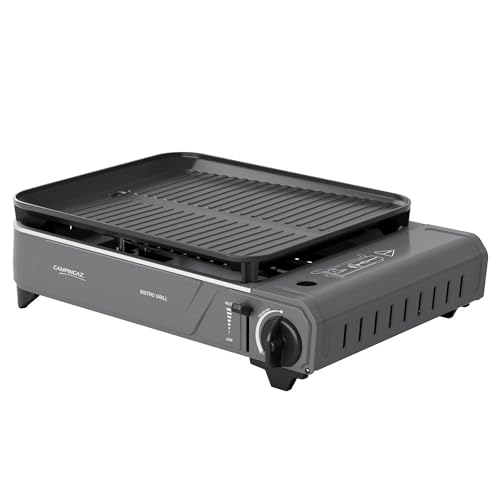
This page discusses the Campingaz Bistro Grill with the item number 2197182. The same number appears in the Amazon catalogue as the model number, where the appliance is called “Gasgrill Bistro Stahl 2000 W”. Campingaz itself calls it “Bistro Grill Gaskocher & Campinggrill” and describes a compact tabletop grill. What is meant is a flat housing with one burner, on which a grill plate sits, fed from a gas cartridge of type CP250.
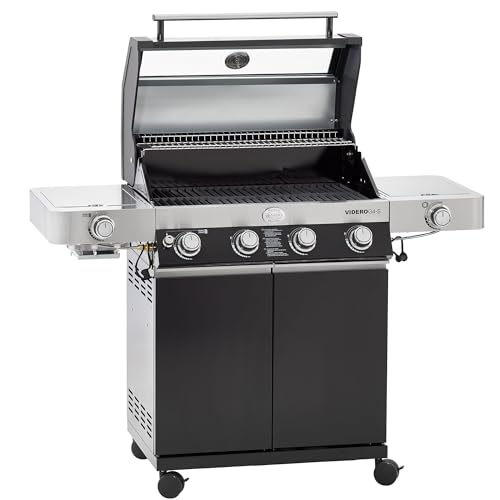
It has little to do with a gas trolley grill. Amazon does list the item at 60.67 x 52.08 x 53.08 cm, but these values do not fit the appliance in the product photo. Campingaz states 43 x 28 x 11 cm and 3.8 kg, while Amazon’s weight converts to approx. 2.9 kg. We go with the manufacturer’s figures.
You can also pick the wrong one within Campingaz’s own range. Under the name Camp’Bistro, Campingaz sells five appliances, including a Camp’Bistro 3 with a grill plate, at €52.99 in the Campingaz shop. That is a different model. In this line, only the Bistro Grill has 2,000 W and a grill plate of 940 cm².
In our price box it is listed at approx. €97 (Amazon page on 21 October 2026: €97.09). With us it is filed under gas grills, although technically it is closer to a camping stove. Campingaz itself lists it in its shop under gas stoves.
We did not have the Bistro Grill in front of us and have not cooked anything on it. Our sources are the product page on campingaz.de, a safety document linked there under EN 17476 (a European standard), and the Amazon catalogue. We did not find a full operating manual with steps for lighting or cleaning anywhere. The safety document, in turn, is written in general wording for camping stoves and therefore speaks of “the stove”. Where we quote from it, we say so.
Housing, burner, plate: the construction
A single 2,000 W burner works under the plate. It is lit by piezo, and according to Campingaz you do not need a lighter. In the product photo the control knob sits at the front right of the housing, and the cartridge compartment is at the top right under a cover.
The housing is made of painted steel, the firebox of galvanised steel. The grill plate is die-cast aluminium with a non-stick coating. Its surface is ribbed so that the food gets the typical stripes, or at least that is how Campingaz describes it. In the photo the plate is rectangular, has a raised edge and covers almost the whole top. Excess fat runs into a removable grease tray.
You do not have to assemble anything. The grill comes fully pre-assembled, and a carry case made of recycled plastic is included.
In case it gets too hot, Campingaz has built in a dual safety system that automatically cuts off the gas flow on overheating. Unfortunately, the product page does not explain what the two stages of this system are in detail.
What Campingaz leaves open on the Bistro Grill, collected in one paragraph: the maximum temperature of the plate, its edge dimensions in centimetres, the number of control settings and how small the flame can get, the burner material, the dimensions of the case, the country of manufacture, minimum distances to combustible materials in centimetres, whether the plate and grease tray may go in the dishwasher, a number of people, and the gas mixture and fill quantity of the CP250 cartridge. A lid appears in no source, and the photo does not show one either.
In detail: grill plate instead of grate
On a classic grate the food lies over the flame or over heat shields, the heat arrives as radiation and hot air from below, and dripping fat lands underneath. On the Bistro, by contrast, the meat lies on a hot metal plate. The heat transfers mainly where the food rests, that is, on the ribs. Hence the stripes. The fat collects in the grooves in between and runs off to the tray.
Two things speak for this design. Small vegetables, halloumi or thinly sliced meat do not fall through, and without an open flame under the food there are no flare-ups from dripping fat. In general, aluminium conducts heat considerably better than steel or cast iron, so a plate made of it warms up quickly. How evenly the heat spreads across the 940 cm², that is, where the centre above the burner is hotter than the edges, has not been published for this appliance by anyone we could cite. Campingaz states a preheating time of 6 minutes.
We worked out one figure ourselves: 2,000 W over 940 cm² is around 2.1 W per square centimetre. On the Campingaz Tour & Grill CV Plus we arrive at around 2.0 W with 2.4 kW over 1,200 cm². So both spread their burner output in a similar way. A rated output is not a temperature at the plate, however; wind and outside temperature play their part.
What is missing is a second heat zone. One burner and no lid means you cannot cook anything indirectly. In our assessment the Bistro is built for sausages, vegetables, skewers, fish and thinner cuts. A thick roast that would need to cook slowly with the hood closed belongs on a different appliance.
A non-stick coating does not tolerate sharp-edged metal spatulas or a wire brush. We did not find a specific Campingaz instruction on utensils in the documents; we would use wood or heat-resistant plastic.
How long does a CP250 cartridge last?
Campingaz states an operating time of 1 hr 30 min and a consumption of 146 g/h. That the operating time refers to one cartridge is the obvious reading, but it is not stated that way on the product page.
By calculation, 1.5 hours times 146 g/h gives 219 g of gas. Whether that corresponds to a full CP250 depends on the fill quantity, which we listed above among the open points. For a grilling evening with several rounds on full power we would still pack a second cartridge. We did not have a cartridge price available, so we do not calculate a price per hour.
On the cartridge, the safety document is clear: the grill may be operated exclusively with Campingaz CP250 or CP250 SP, and other gas containers can be dangerous. Adapters for other cartridges or a gas bottle are therefore ruled out. The product page gives the operating pressure as 50 mbar.
The instructions are to be read before connecting, as it states there, and before inserting the cartridge you check the seal. If it is missing or damaged, the grill stays off and goes back to the retailer. The cartridge must sit correctly in the guide with the notch facing up. If it sits wrongly, either the gas supply is cut off or gas escapes audibly and can be smelled. Changing is always done in a well-ventilated place, ideally outdoors, never near open flames, heat sources or sparks, and away from other people and combustible material.
Balcony, picnic, awning: where the Bistro may stand
On the product page it sounds generous. It says the grill is ideal for balcony and patio, camping and outdoor kitchen, festivals and picnics, emergency preparedness and power cuts. The safety document is stricter: the stove should be used only outdoors and at a distance from flammable materials.
According to the same document, caravans, vehicles, tents, shelters, huts and small enclosed areas are excluded. The reason is given right next to it. Gas combustion consumes oxygen, the residues can contain carbon monoxide, and carbon monoxide is odourless and colourless. It can cause nausea and flu-like symptoms and, in an enclosed space without ventilation, lead to death. The awning of a motorhome is therefore just as off limits as the kitchen.
For the emergency preparedness point, this means: if the power goes out in winter, the Bistro still stays outside. The product page itself also says it is not suitable for enclosed spaces.
On setting up, the document names three points. The surface is stable and level, and you do not move the appliance during operation. The ventilation openings on the back and the cover of the cartridge compartment stay clear. And the grill never runs while someone is asleep, and never unattended.
The safety document has no sentence of its own on balconies; the mention comes solely from the product description. In principle, the tenancy agreement and house rules decide there whether gas is allowed. We have gathered what is typically regulated in the guide Grilling on a balcony.
Gas smell and residual gas
If you smell gas before you have even opened the control knob, according to the safety document you take the appliance outdoors immediately. There, in a well-ventilated place away from ignition sources, you look for the leak and fix it. You never search with a flame, but with a gas leak detection liquid, and only outdoors. An appliance that is leaking, working poorly or damaged is not operated further; it goes back to the retailer.
One detail that stands out when reading concerns the residual gas. After operation, gas residues can remain in the appliance. If the cartridge lever is on UNLOCK, you are to turn the control knob to burn off the residual gas. The German version says only “turn to the position”, without naming which one. In the English version of the same document it says “ON position”.
Cleaning and spare parts
The grill plate and grease tray can be removed, and that is all the product page says about cleaning. The safety document contains no further care steps, and the dishwasher question is among the open points above. You will find general advice on how to proceed in our guide Cleaning a gas grill; for a coated aluminium plate, what applies from it is whatever manages without scouring agents and a wire brush.
The spare parts question is well solved. In the Campingaz manufacturer shop, the “Grillplatte Camp Bistro Grill & Elite” (item no. 2203975) costs €54.99, the grease tray (2203976) €7.99 and a grease drawer (2203977) €16.99. All three carry the name “Camp Bistro Grill & Elite”. That they fit exactly this Bistro Grill is our inference from the name; we have not seen an explicit compatibility list with the item number 2197182. It is also striking that the product page speaks only of a grease tray, while the spare parts shop additionally lists a grease drawer. Before ordering we would ask the manufacturer.
A new plate therefore costs €54.99, while the whole grill in our price box costs approx. €97. Anyone who scratches the coating with the wrong tool pays dearly for it.
Three alternatives from our catalogue
| Model | The difference | Price | Our rating | Choose this one if |
|---|---|---|---|---|
| Campingaz Bistro Grill 2000 W (this one) | Tabletop grill, ribbed cast aluminium plate of 940 cm², CP250 cartridge only | approx. €97 | 7.7 | you want an appliance in a case for picnics and festivals |
| Evergrill Butangas 2300 Watt | 2.3 kW, grilling area 34 x 25.5 cm, butane cartridge not tied to one brand | approx. €60 | 7.6 | you want to spend as little as possible and buy cartridges freely |
| Campingaz Party Grill 400 R | 2,000 W on a gas bottle instead of a cartridge, regulator separate | approx. €90 | 8.2 | you already have a gas bottle or grill often |
| Campingaz Tour & Grill CV Plus | 1,200 cm², 2.4 kW, lid, detachable legs, CV cartridge | approx. €182 | 8.1 | you need more area and a lid |
The prices are guide values from our price boxes and change. The rating is our editorial assessment based on the manufacturer’s data.
The Evergrill is listed at approx. €60 in our price box, the Bistro at approx. €97. According to the information in our research, the grilling area of the Evergrill measures 34 x 25.5 cm, which is around 867 cm² and therefore somewhat less area than on the Bistro. The Campingaz Party Grill 400 R costs approx. €90 in our price box, but needs a gas bottle with a separate pressure regulator, which not everyone has in the cellar. The Campingaz Tour & Grill CV Plus is listed at approx. €182 in the price box and brings a lid in return.
When the Bistro fits and who it is not for
It fits if you are looking for an appliance that goes in the boot, starts without assembly and stands on any stable table outdoors. The flat housing in the case makes it a grill for the picnic blanket, the festival field and the pitch next to the car. Anyone who already uses a Campingaz stove with CP250 there does not need a second cartridge type.
On the number of people we would be cautious. Campingaz does not say how many people 940 cm² will feed, and we do not set a figure of our own against that. If you regularly need more area, the Tour & Grill CV Plus has a good quarter more with 1,200 cm².
The Bistro is the wrong choice for three groups. First, for anyone who wants to grill in an awning or under a shelter in the rain, because that is exactly what Campingaz rules out. Second, for frequent grillers who need several hours on full power every week; at 146 g/h cartridges add up, and in our assessment you are better off in the long run with the Party Grill 400 R on a gas bottle. Third, for anyone who wants to cook roasts or whole chickens indirectly. That does not work without a lid.
If you are still unsure about the type of appliance, our camping grill buying guide helps with the question of whether cartridge, bottle or charcoal suits your trips better.