Two burners in a case, but no grill grate
Amazon lists the CADAC 2-Cook 3 Classic Stove as a tabletop grill. Cadac itself describes it as a light, 2-burner camping stove, and that is more accurate: the box contains two pot supports and windshield panels, and a grill plate is not included. We still file it under gas grills because, like a tabletop gas grill, it connects to a gas bottle with a regulator.
The version behind our Amazon link (ASIN B0CVQPQXKQ) carries the model number 203M1-10-DE and the EAN 6001773118637. Both match the German manufacturer page, where this is the 50 mbar version. The price is approx. €79 (Amazon page on 21 October 2026: €79.00), the same in the Cadac shop.
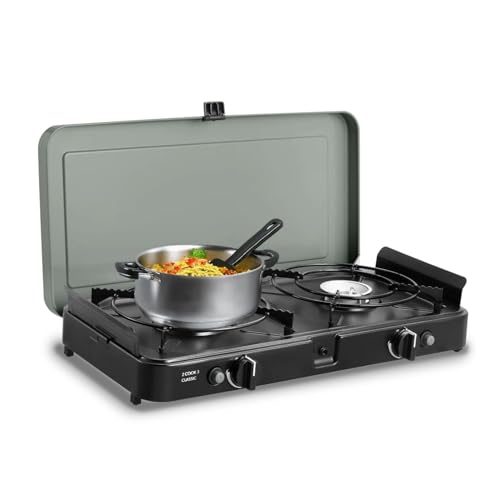
The product photo shows how the appliance is built: a flat black base with two round burners side by side, a pot support above each, and two control knobs at the front. The grey-green lid is hinged at the back and, when opened, stands vertically behind the cooking positions. According to Cadac, it serves as a windshield in this position. For transport you fold it shut, close the clip and put the stove in the supplied carry bag.
Dimensions, ignition and the safeguard on the gas knob
Cadac gives the 50 mbar version as 55 cm wide, 33 cm deep and 9 cm high. The Amazon data converts to the same values. According to the German manufacturer page the weight is 3.9 kg, and the housing is made of metal.
Ignition is by piezo. The instructions describe the sequence like this: press the control knob, turn it 90 degrees anticlockwise, then press the piezo button. This pressing before turning is also the child lock that Cadac explains on the EU page. Without pressure on the knob, the gas supply does not open. Non-slip rubber feet sit under the housing.
For the gas side, the instructions state appliance category I3B/P (50) for Germany, Austria, Switzerland and Slovakia. Butane (G30), propane (G31) or a mixture of both are permitted. For 50 mbar, the fitted nozzle is number 0.64, spare part HM6-064. According to the manufacturer, the appliance complies with the standard BS EN 484:2019. You do not have to assemble anything, the cooking surfaces are simply placed on; before first use you remove all protective packaging and plastic parts.
What Cadac leaves open is collected here so it does not appear in every paragraph: the manufacturer does not state a cooking surface area in square centimetres, nor the material of the burners, pot supports, windshield panels and lid, a maximum temperature, the control range or the lowest output per burner, the country of production, the market year (the instructions are dated 2023), the material and dimensions of the bag, prices of individual spare parts, the cartridges for the Power Pak including running time, and an explicit statement on balcony use.
In detail: 2.2 kW per burner, and how much of it reaches the pot
According to the instructions, each of the two burners has 2.2 kW, together 4.4 kW. Consumption is 160 g of butane per hour and burner, so 320 g per hour with both burners. The two figures fit together: 160 g of butane contains, by calorific value, around 2.2 kWh. The kW figure therefore describes how much energy per hour goes into the flame as gas. How much of that ends up in the pot is another question.
Cadac has a concrete figure for this: one litre of water boils in about 6 minutes, depending on conditions and pot size. Let us work that out roughly. Bringing one litre of water from 20 to 100 °C takes around 335 kJ. A 2.2 kW burner converts about 792 kJ in 6 minutes. That means a good 40 per cent arrives in the water, and the rest heats the air, the pot wall and the frame or escapes sideways. We do not know what starting temperature Cadac calculated with, but the order of magnitude is plausible for an open stove. It also explains why the instructions say tersely: “Use windshield in windy conditions.” Every gust that pushes the flame away from the pot base shifts this ratio downwards.
Pot size is limited, in both directions. At least 180 mm in diameter, at most 250 mm. The instructions expressly prohibit larger pots or cooking surfaces, giving the reason that the cooking surfaces are designed so that combustion gases can escape. As a general rule for gas burners: if an oversized pot covers the vent, the gas burns less well and more carbon monoxide is produced. At the other end, Cadac advises against plastic handles on small pots because they can get very hot.
Which gas bottle and regulator fit?
You need a 50 mbar low-pressure regulator and an approved hose to DIN 4815 part 2 (the standard that applies in Germany); neither is included. You also need a refillable gas bottle, at most 500 mm high (without regulator) and 400 mm wide, or alternatively the CADAC Power Pak.
According to the instructions, the hose should be between 0.8 m and 1.2 m long. It is screwed with matching threaded connections onto the “left-hand 1/4 inch BSP thread” of the appliance valve, and the regulator sits at the other end. For I3B/P(50), the instructions name as regulator either a 50 mbar regulator for butane, for propane or for the mixture. For the bottle size, it helps to look at the English original of the manual: it says the bottle must not exceed 500 mm in height and 400 mm in width. The German translation sounds as if it had to be exactly that size.
For the Power Pak, Cadac warns in capital letters that it can be dangerous to fit other types of gas bottles or gas cartridges.
What a bottle fill yields can be estimated from consumption. At 320 g per hour, a 5 kg bottle theoretically lasts around 15.6 hours with two burners turned fully up; if you mostly use only one burner on a medium setting, you get correspondingly further. Which bottle sizes exist and how changing one works is covered in our guide gas bottle for the grill.
When buying, pay attention to the pressure rating. Cadac also sells the stove as a 30 mbar version; the version linked on Amazon is the 50 mbar version.
What else is worth considering?
| Model | The difference | Price | Our rating | Choose this one if |
|---|---|---|---|---|
| CADAC 2-Cook 3 Classic Stove (this one) | 2 burners with 2.2 kW each, 3.9 kg, regulator and hose extra | approx. €79 | 7.9 | you want to run two pots at once from one gas bottle |
| Campingaz Bistro Stahl 2000 W | 1 burner with 2,000 W under a ribbed grill plate (940 cm²), runs on a CP250 cartridge | approx. €97 | 7.7 | you want to grill rather than cook and do not want to carry a bottle |
| CADAC 2-Cook Deluxe | Model 310/444, listed on Amazon since March 2021, made of steel, aluminium and plastic according to the Amazon title | approx. €129 | 7.8 | you are looking for exactly this model and will clarify what is included with the retailer beforehand |
| BBQ-Toro gas grill table with windshield | 2 cast burners with a combined 12 kW on their own stand, 19.5 kg | approx. €85 | 7.9 | you want to heat pots over 250 mm and do not have to carry the appliance |
The prices are the guide values from our price boxes and may have shifted since the date shown. The rating is our editorial assessment from the data comparison and not a measurement result.
The Campingaz Bistro costs approx. €97 in our price box, the Classic approx. €79. It is a different appliance: one burner, but a fixed grill plate.
The 2-Cook Deluxe is at approx. €129 in our price box, the Classic at approx. €79. We cannot derive a technical advantage from documented data.
The BBQ-Toro grill table is at approx. €85 in our price box, the Classic at approx. €79.
When the Classic fits and when another does
The first question is whether you want to cook or grill. Two separately adjustable burners for pot and pan are exactly what the Classic does. If food with grill stripes is the priority, the Campingaz Bistro already has the plate built in, whereas with the Cadac you have to buy the plates separately.
Then group size. The Classic does not permit more than 250 mm pot diameter. For large group pots that gets tight. According to the manufacturer, the BBQ-Toro has burners 27 cm in diameter and considerably more output, but stands on its own frame and is not something you carry from the car park to the pitch.
Third, the budget. The approx. €79 is not the final price: regulator and hose are needed in every case, and the bottle if you do not have one yet. If you already own 50 mbar equipment from an old grill, you have an advantage here. If you are starting from zero and only want to make the occasional coffee and scrambled eggs, you should consider the cartridge operation of the Bistro.
And the location: according to the instructions, the Classic is an outdoor appliance, with fixed distances from anything that can burn (details in the next section). Our assessment: for two to four people at a campsite who arrive by car and cook at the table, the Classic is the most coherent choice among the four appliances in our comparison. If you are unsure which type of appliance suits your use, the grill finder can help.
Setting up and operating according to the instructions
The “Manual 2 Cook 3” instructions (dated 2023) apply to the product codes 203P1 and 203M1. The following points are an excerpt from their safety section, not a complete reproduction. Read them in full before first use.
According to Cadac, the appliance is intended for outdoor use only and must not be operated in an unventilated area. For combustible materials, minimum distances apply of 1.2 m above the appliance and 0.6 m at the back and sides. Always operate it on a firm, level surface, and the assembled appliance must stand firmly without wobbling. While it is burning you do not move it, because that can cause flaring, and you never leave it unattended. Accessible parts can become very hot, especially the burner; keep small children away, and the instructions recommend oven gloves.
On gas: do not twist or pinch the hose, and route it away from the appliance so that heat does not damage it. The bottle stands upright at all times, away from heat and flames and never on a hot surface. You check the hose and regulator seal for wear or damage before every use and before connecting to the gas container. If the hose is damaged, brittle or cracked, it is replaced. The appliance does not belong on a mains gas supply.
When lighting, Cadac advises removing the cooking surfaces so you can see when the burner is lit. If the flame flashes back and ignites at the nozzle, you immediately close first the regulator valve on the gas container, then the appliance valve. Then you remove the regulator and check the seal, replacing it if in doubt. If the flame keeps flashing back, the appliance goes to the authorised retailer. The order is also fixed for normal shutdown: first the control valve on the bottle, and once the flame has gone out, the valve on the appliance.
Cleaning, storage and nozzles
Cadac recommends cleaning the stove after every use, and only once it has cooled down. For the outer surfaces you use a damp cloth wrung out in soapy water, and you wipe the appliance body with a damp cloth and, if needed, a little washing-up liquid. “DO NOT IMMERSE IN WATER”, say the instructions in capital letters, because otherwise water runs into the burner tubes. It continues: when cooking use only plastic or wooden utensils, always let the grill and flat plate cool before they go into water, do not get water on the burner or pilot area, and wipe the appliance completely dry before use. Abrasives are forbidden, as are high-pressure steam cleaners and water jets. After cleaning you rub the cooking surface lightly with oil. For stubborn stains Cadac names its own oven cleaner.
Before storing, you let the appliance cool and clean it. The gas supply is switched off, disconnected and removed; the instructions call storing an appliance with the gas supply connected unsafe. You store the appliance and gas well ventilated and away from combustible materials, gas bottles preferably outdoors and expressly not in the cellar.
According to Cadac, the stove needs no scheduled maintenance, and only an authorised person may service it. Cadac recommends cleaning or replacing the nozzles every six months so that operation stays efficient in the long term.
Warranty, spare parts and accessories
According to the instructions, the warranty is given by CADAC Europe BV, to the original purchaser for a term of 2 years from the date of purchase. Different periods apply per component: valves 2 years, enamel parts 2 years, die-cast parts 1 year, burners 1 year, plastic parts without warranty. Keep the proof of purchase, as Cadac can ask for proof of the purchase date. The warranty only applies if you assemble and operate the appliance according to the printed instructions, it only applies to products sold at retail and is limited to repair or replacement of defective parts. The Cadac shop also shows a banner with “2+1 years warranty on our grills*”, the conditions of which we could not find on the page.
The instructions contain a spare parts list with numbers from 203P-SP001 to 203P-SP023 and the nozzles HM6-073, HM6-069 and HM6-064, of which the last applies for 50 mbar. Cadac expressly advises using original spare parts.
As accessories, Cadac’s EU shop lists, among others, a Cleaning Set 2 Cook for €34.95, a Coffee Pot Stand for €9.95, the Paella Pan 30 for €49.95 and a Soft Soak 2 Cook for €22.95 (retrieved in October 2026). Whether the 30 in the paella pan’s name stands for 30 cm is not clear from the shop. If it did, it would exceed the 250 mm that the instructions set as the maximum for pots. In that case, ask Cadac customer service before ordering it as well.