A gas grill that folds up like a suitcase
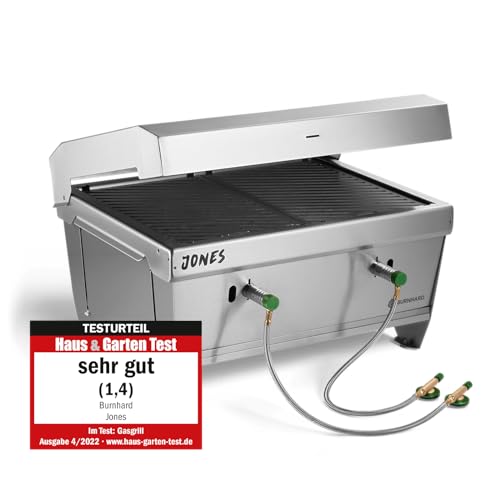
The Jones is the larger of the two folding grills in Burnhard’s JONES series. Two burners, two cartridges, a stainless steel body that folds flat and then goes into a bag with backpack straps. Burnhard lists it under item number 945835; the same number appears on Amazon as the model number, which is how we matched the two listings.
In our gas grill category it sits at the very mobile end. It has no base cabinet, no wheels and no side tables; you put it on a table or on the ground. It is built for people who drive to the campsite, walk a few metres to the lake, or want to put the grill back in the cupboard after the meal.
On Amazon the Jones costs approx. €187 (Amazon page on 20 October 2026: €186.75) and is currently cheaper there than in the Burnhard shop, which asks approx. €249 (as of October 2026). According to the manufacturer, the design won the German Design Award.
Body, burners, grates: what the data sheet says
According to Burnhard, the body is made of V2A stainless steel. The instructions (edition 08-2024) are more specific about the components: two stainless steel burners, two stainless steel cooking grates, a stainless steel lid. Each burner delivers 3.2 kW, together 6.4 kW, and according to the instructions both can be turned to any position between the highest and lowest setting. The gas nozzle is 0.3 mm, and the gas category is direct pressure.
Burnhard gives the cooking area as 38 × 28 cm. In the product photo the two grates lie side by side over the burners, with a drip tray underneath.
For dimensions, the manufacturer gives two states. Unfolded, the Jones measures 27 × 43.5 × 32.5 cm, folded 8.5 × 43.5 × 32.5 cm; the highlight text on the product page gives a rounded 43 × 32 × 8.5 cm. According to the instructions the weight is approx. 7.3 kg with the lid. On Amazon the grill is also listed at around 7.3 kg in the catalogue field, but next to it in the description text at 5.7 kg and a folded thickness of 5 cm. We do not find either figure from the manufacturer; we go with 7.3 kg and 8.5 cm.
One contradiction on the product page itself stands out: under the performance data it additionally says “Total 12.8 kW”. That is exactly double 6.4 kW. The instructions and all other details give 6.4 kW, and that is the figure we use.
The instructions list the following as included: a grill frame, the drip tray, two burner tubes, two gas hoses with valve and nozzle, two flame tamers, two cooking grates, the multitool, the storage bag and the lid. A small bag for the burner and gas hoses comes as an accessory. According to Burnhard, the multitool has four functions, including lifting the lid, cleaning and lifting the grate, and opening bottles. The large bag also doubles as a heat-resistant grilling mat outdoors.
In detail: two burners on 38 centimetres
Two separate burners on 38 × 28 cm are the real reason to buy the Jones rather than a single-burner model like the JONES Jr. Burnhard writes that both burners can be lit independently of each other, and promotes indirect grilling.
The principle is the same as on the big gas grill: one side runs, the other stays off. Whatever lies directly over the flame gets radiant and contact heat from below. On the cool side the food cooks mainly in the hot air under the closed lid, more slowly and without fat dripping straight into the flame. For sausages that are already browned, or for thicker vegetables, this is the usual technique. How well it works on 38 cm of width depends on the distance between the hot and the cool zone, and that is short here. We would use the indirect side more for finishing and keeping warm than for a whole chicken.
Converting the output to the area gives 6,400 watts on 1,064 cm², or about 6 watts per square centimetre. This figure says nothing about the actual grate temperature, but it helps with putting things in context: a small grill with little area does not need much output to get hot. Burnhard states that the Jones is hot in under 5 minutes and reaches up to 500 °C with the lid closed. Nobody on our side has measured this; both values are manufacturer claims.
According to the product page, a flame bridge in the burner makes it light on both sides even though you only have to light it at one point. A core temperature or lid temperature cannot be read off the device; a lid thermometer does not appear in any of the documents.
How long do two cartridges last?
At full output of both burners, arithmetically a good two hours, if each cartridge contains 550 g of gas. The calculation behind this and its uncertainty are given below.
The Jones needs two EN417 screw-on cartridges, one per burner, and neither is included. The instructions allow cartridges up to a maximum of 550 g gas fill. For the connection rating it gives 466 g/h for butane and 457 g/h for propane, headed “Burner connection rating”.
The instructions do not resolve whether this applies to one burner or to both. The substance values point to both together: butane has a calorific value of around 13.75 kWh per kilogram, and 6.4 kW divided by this value gives almost exactly 466 g/h. For propane (around 14 kWh/kg) the calculation works out equally to 457 g/h. We therefore assume about 233 g/h per burner. A full 550 g cartridge would then last around 140 minutes at full load. If you read the figure instead as a value per burner, it would be only a little over 70 minutes.
Burnhard itself counts in grilling sessions: the smaller JONES Jr. manages around 10 sessions of 20 minutes at full blast on one cartridge, and the Jones reaches the same performance with two full cartridges. That would be 200 minutes. The cartridge size meant is not stated, and our calculation comes in below that. For a weekend with two or three grilling evenings, we would pack a second pair of cartridges rather than rely on the session figure.
While grilling, the cartridges stand to the left and right of the grill with enough clearance, as the instructions describe it. So you need more space on the table than the 43.5 cm of body width.
Accessories and running costs
On the product page Burnhard sells a few parts explicitly meant for the Jones. A folding stand for the JONES 2-burner with side panels left and right costs approx. €39.90, a 2-piece cookware set of 1.2 l approx. €34.90. The shop lists the Plancha Set Fred as an accessory for the Jones at approx. €165.00.
Running costs come mainly from gas. Because two cartridges are always connected at once, you buy them in pairs, and below 10 °C you need winter gas (more on this in the questions below). We did not find a cover for the Jones in the Burnhard shop; it is protected in its bag.
Cleaning, care and safety according to the instructions
After each grilling session the Jones should burn off: lid closed, all burners on HI, 15 to 30 minutes, until no more smoke rises. After that, according to the instructions, the drip tray, cooking grates and flame tamers may go in the dishwasher, and so may the lid. You brush the burner tube with a copper brush. For deep cleaning the grill can be taken completely apart, and “apart from the burner tube and gas hose” all individual parts are dishwasher-safe. The product page says the same more briefly: burners out, grill in the dishwasher. For use on the move it names washing-up liquid, water and, if needed, steel wool. All parts must be dry before packing away.
The existing content on this page previously said the burners were dishwasher-safe. That is not correct: Burnhard removes precisely those before the dishwasher.
The manufacturer describes the stainless steel discolouring from heat as normal. If a burner burns yellow or orange and smells of gas, the fault table gives foreign bodies or dirt in the burner tube as the cause and requires the burner to be cleaned. According to the instructions, you clear a blocked nozzle with a nozzle needle.
On siting, Burnhard writes: “The gas grill may only be used outdoors.” Never in a building, a garage or an enclosed area. The grill should stand sheltered from the wind on a level, stable and fireproof surface, with at least 50 cm of clearance behind and 50 cm to the side, and never directly against glass fronts, walls or plants. You must never line the cooking chamber with aluminium foil, and the ventilation openings of the body must not be covered under any circumstances. The grill is not moved during operation.
On the gas: a leak test with leak-detection spray or soapy water (1 part soap to 3 parts water) before every use and after every cartridge change, never with an open flame. If bubbles rise, tighten the connection and repeat, otherwise close the valve and call customer service. You replace the pressure regulator and hose after 10 years at the latest, and a new hose may be no longer than 1.5 m. You do not store spare cartridges under or next to the grill, and according to the instructions you keep cartridges below 50 °C in a well-ventilated, shaded place. This also applies to empty cartridges, because they contain residual gas.
What Burnhard does not state
Several points remain open in the product page and instructions. The weight without the lid is missing, as is the stainless steel grade beyond V2A and the material of the drip tray and flame tamers. The outlet pressure of the regulator in mbar is not in the documents, only the direct pressure category. Also left open are the distance between grate and burner, how the cooking area is divided between the two burners, the weight of the bag and the load capacity of the backpack function. On the country of manufacture and the year of market launch we found nothing reliable; the declaration of conformity in the instructions is dated 19 December 2023. We could not evaluate the Quick Starter Guide because the PDF has no text layer.
These three alternatives are worth a look
| Model | The difference | Price | Our rating | Choose this one if |
|---|---|---|---|---|
| BURNHARD Jones folding grill (this one) | 2 burners with 6.4 kW, 2 cartridges, foldable | approx. €187 | 8.3 | you grill on the move for more than two people and want two zones |
| BURNHARD JONES Jr. folding grill | 1 burner, 1 cartridge | approx. €127 | 8.2 | you mostly grill alone or as a pair |
| Weber Q 1200N | 1 burner, solidly built tabletop grill, not foldable | approx. €249 | 8.3 | the grill can sit in the boot and does not need to go in a bag |
| Broil King Regal 590 | Grill cart with 5 burners, 16 kW main burner output, side burner | approx. €1,649 | 9.4 | you have a fixed spot in the garden and do not need to be mobile at all |
The prices are guide values from our price boxes and change. The rating is our editorial assessment of the manufacturer data.
When the Jones suits you and when it does not
The cooking area decides first. On 38 × 28 cm, in our assessment, a few sausages and two steaks fit at the same time; for six people you grill in several rounds. If you are usually out as a pair, you hardly need the second burner and with the JONES Jr. you save weight and one cartridge per outing.
Then transport. You can carry 7.3 kg in a backpack bag from the car park to the beach, but not on a day hike. If the grill only ever sits in the boot anyway, folding matters less, and a solidly built tabletop grill like the Weber Q 1200N for approx. €269 is also an option.
For the balcony, in our assessment the Jones is not a safe choice. Burnhard mentions balconies neither as a permitted nor as a prohibited place, but requires free-standing siting with 50 cm of clearance behind and to the side. On many balconies this is hard to manage, and what house rules and tenancy agreements say about gas is covered in our guide Grilling on a balcony.
The Jones is the wrong choice for anyone who regularly grills for a family with guests in their own garden. The area is too small there, and a grill cart has room that a folding grill never will. If you are torn between camping designs, the Camping grill buying guide covers the differences from charcoal and electric, and the grill finder asks about your circumstances step by step.